Board Game Printing · Formats & construction
Game Token & Tile Printing
Game tokens and tiles are printed components cut from a defined board construction.
- Loose die-cut tiles or attached punchboard; component IDs and counts
- Mounted paperboard
- Player-punched components
Start with the intended use, finished size and quantity. The material and construction can follow.
The product in use
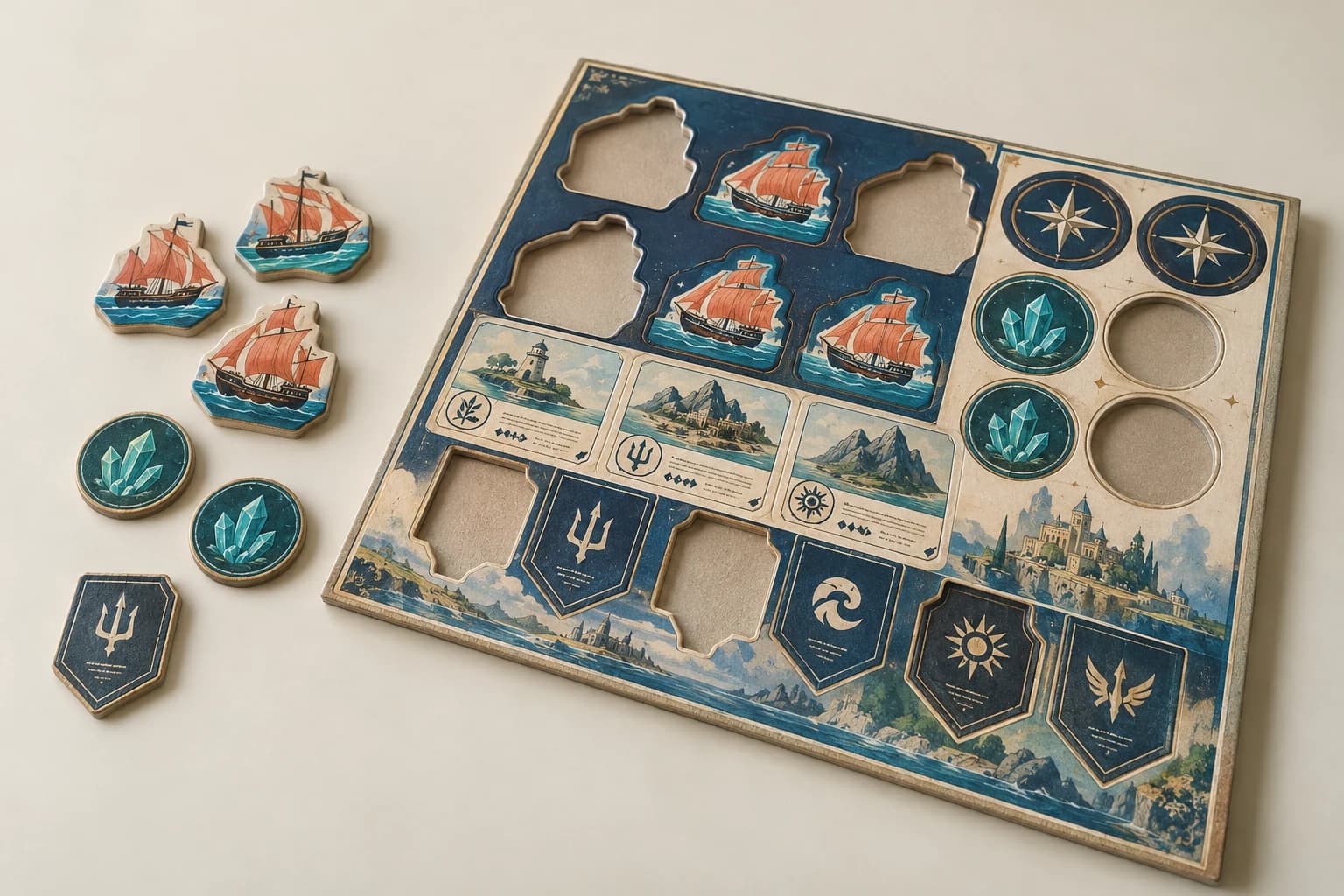
Identified paperboard pieces with controlled release and edges
Paperboard game tokens are supplied as loose pieces or as components held in a punchboard. Printed faces, cutting positions and release points work together to make a complete playable set. Material thickness and edge condition affect picking up, stacking and removal.
What makes up the finished product?
- Printed faces
- Each piece has an identified front and, where specified, a matching reverse.
- Paperboard body
- Thickness, stiffness and edge condition affect picking up and stacking the piece.
- Cut and release points
- Loose pieces and punchboards need different release and packing arrangements; tokens have no folding hinge.
Specifications and materials
Game Token & Tile Printing specifications
Use these reference options to build the project brief. Dimensions are design examples; material availability, tooling and production timing depend on the confirmed specification.
| Parameter | Reference or option | Why it matters |
|---|---|---|
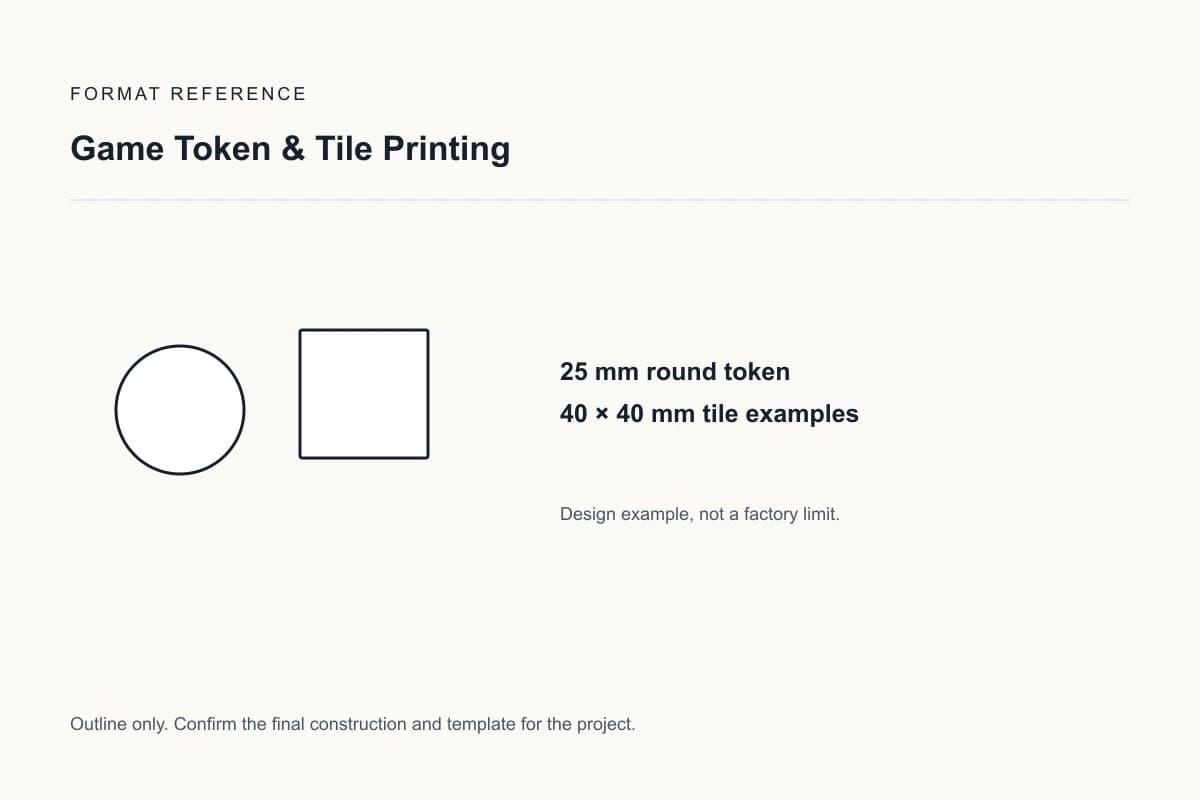
| Finished dimensions | 25 mm round token; 40 × 40 mm tile examples | These design examples require their own corner geometry, punch layout and intended handling check. Design reference, not a factory limit. |
| Component supply | Loose die-cut tiles or attached punchboard; component IDs and counts | Punchboard release and loose-piece packing require different edge and counting checks. |
| Component manifest | Piece IDs, quantities, front and reverse files and packed set count | Count the components of a complete game version before quoting or assembling sets. |
| Board construction | Selected mounted board, measured caliper and cut or hinge pattern | Review release, flatness and repeated handling on an assembled sample. |
| Material construction | Mounted paperboard or Printed solid card | Compare the actual grade and construction. Inspect the folded and open sample with its box and game components. |
| Format and order unit | complete component sets or identified pieces per game version | List components and versions separately so quantities refer to the same finished unit. |
| Finishing choice | Loose die-cut pieces and user-punched sheets have different pack counts and release requirements. | Approve the proposed material and process combination on an appropriate sample. |
Compare the material and its effect.
Choose the surface and construction for the way the finished product will be used. The options below are selection references, not a guaranteed inventory list.
Mounted paperboard
Printed sheets mounted to a specified board
The board supports the play surface; the printed facing controls image detail. Thickness, hinges and fold direction must work together.
Sample check: Inspect the folded and open sample with its box and game components.
Printed solid card
Separate lighter card construction
A lighter card can suit small loose pieces or a compact display, but has a different stiffness and edge behavior.
Sample check: Test actual-size pieces rather than assuming board thickness from GSM.
Selected sample focus — Mounted paperboard: Inspect the folded and open sample with its box and game components.
Format & usable space
Token Size, Punchboard Layout & Component Counts
25 mm round token; 40 × 40 mm tile examples
These design examples require their own corner geometry, punch layout and intended handling check.
This is a design reference, not a required size or a manufacturing limit.
Component supply
Loose die-cut tiles or attached punchboard; component IDs and counts
Punchboard release and loose-piece packing require different edge and counting checks.
View the original format reference
Surface finish options
Board or token printed surfaces
Compare low-glare film or compatible coating for the play surface. Test folding hinges, token edges, adhesion and repeated handling on the assembled sample; the finish alone does not establish scratch resistance.
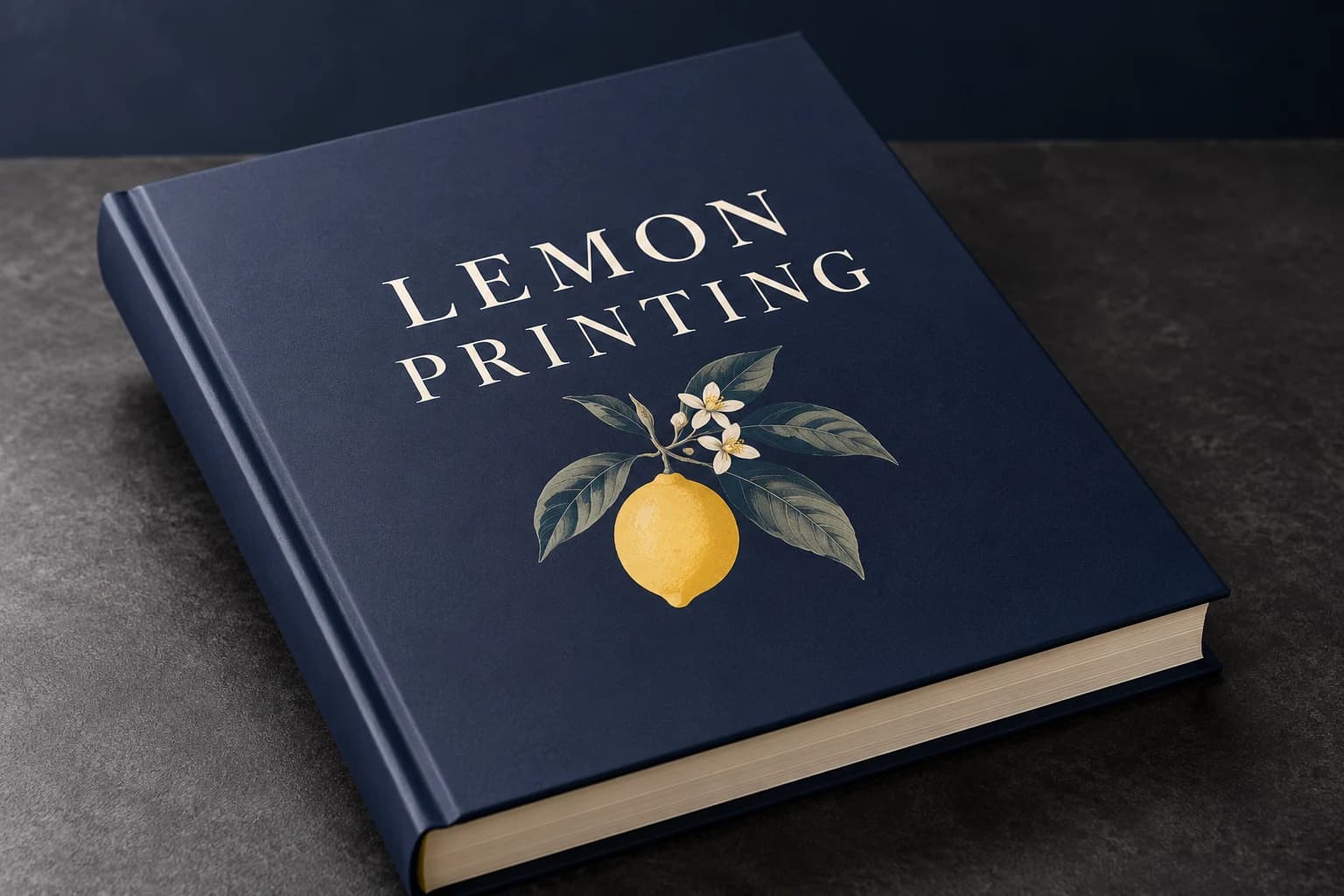
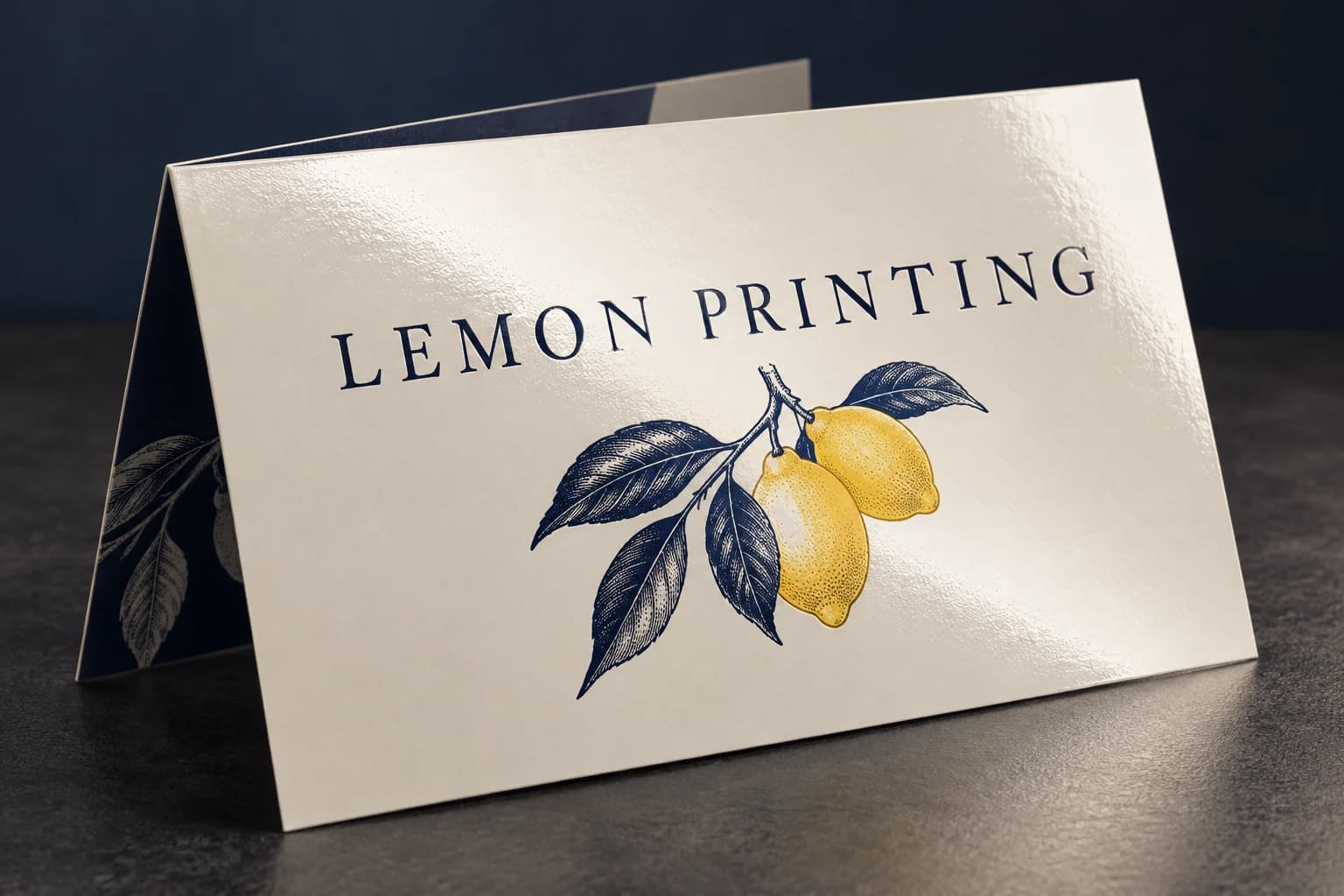
Illustrative finish samples, not photographs of this product. Final suitability follows the confirmed stock, construction and approved sample.
Compare all surface finishes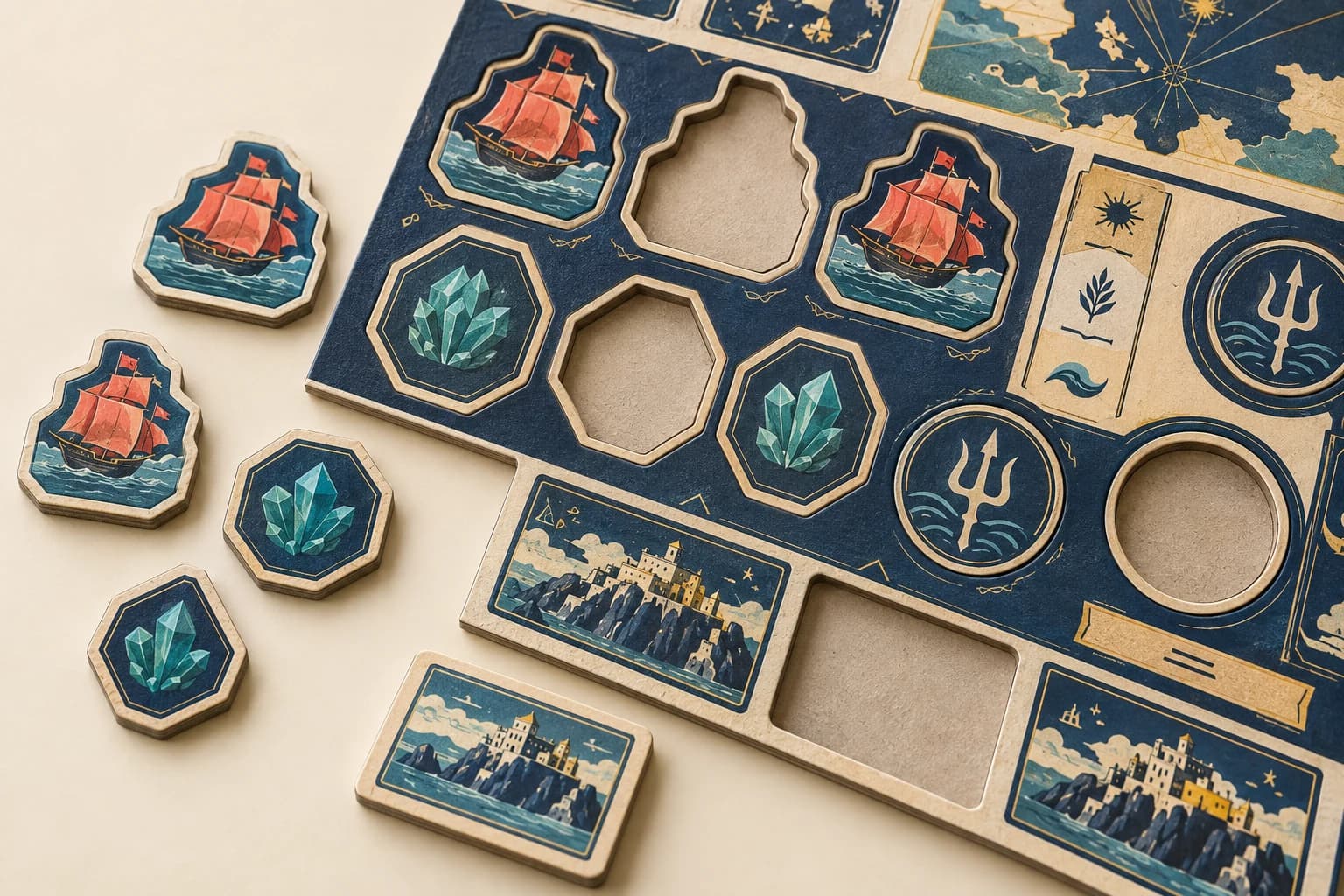
Details that change the finished product
Inspect the components as players receive them
Choose loose pieces or player-punched sheets
Prepare a piece manifest and separate cut paths. For punchboards, specify which components remain attached for the player to release.
Component supply
Punchboard release and loose-piece packing require different edge and counting checks. An assembled component set checks piece counts, front-to-back alignment, hinges or punch release.
Surface and finishing compatibility
Loose die-cut pieces and user-punched sheets have different pack counts and release requirements. The board supports the play surface; the printed facing controls image detail. Thickness, hinges and fold direction must work together. Inspect the folded and open sample with its box and game components.
Player-Punched Pieces & Loose Game Tiles
Player-punched components
Test release and edge condition using the actual punchboard assembly.
Loose tiles
Count and protect the finished pieces, including front/reverse orientation where it matters.
Solve the risk before production
Check Punch Release, Layer Bonding & Reverse Alignment
The critical finished-product check
Pieces can delaminate during removal or show an off-center reverse. Test release, front-to-back alignment and edge condition on the assembled board.
Missing pieces escape inspection
Why it happens: A punchboard is checked as artwork without a complete component count.
Fix and check: Map every ID and count, then punch and inspect one complete playable set.
When to choose another format
Tokens, Game Cards & Hinged Playing Boards
| Alternative | Use and trade-off |
|---|---|
| Game Card Printing | Cards carry information with a different handling surface and collation method. |
| Game Board Printing | A hinged play surface has fold and continuity requirements rather than loose-piece release. |
Sample and approval
Test Punch Release & One Complete Component Set
Free samples are available, with preparation completed within 15 days. Confirm the sample scope; courier arrangements and transit time are separate.
Structural sample
Checks dimensions, fit and assembly using unprinted or representative materials. It does not establish final color.
Printed proof
Checks text, image reproduction and artwork on the agreed proof medium. It may not reproduce final assembly or every finish.
Complete finished sample
An assembled component set checks piece counts, front-to-back alignment, hinges or punch release.
From brief to delivery
Order Details for Game Token & Tile Printing
Build and approve the order in five steps
Send the project brief
Send piece IDs and quantities, shapes, board thickness reference and loose or punchboard supply. Include finished dimensions, quantity by version, destination and required arrival date. If a configuration is undecided, describe the intended use.
Compare the quoted configuration
Compare the same quantity basis: complete component sets or identified pieces per game version. Check that the quote identifies materials, finishing, included components, sample scope, packing and freight.
Approve the appropriate sample
An assembled component set checks piece counts, front-to-back alignment, hinges or punch release. A print proof checks artwork and color; a complete finished sample also checks assembly. Record what the selected sample does and does not reproduce.
Confirm files and release production
Approve the final artwork revision and the component supply specification. Record the agreed quantity, payment conditions, packing and production schedule in the order.
Confirm packing and dispatch
Specify loose pieces or punch sheets, complete component sets and the box arrangement. Confirm production completion and transit as separate dates, using the delivery destination and required arrival date.
- Supply a component ID map with the cut or hinge drawing. Separate front, reverse and assembly layers and identify any repeated pieces.
- Extend edge-to-edge trim artwork by 3 mm unless the approved template specifies a different bleed. Use approximately 300 effective ppi for continuous-tone images at their placed size; keep fine linework as vectors where possible.
Project questions
Planning Game Token & Tile Printing
Should loose pieces and punch sheets share one packing count?
No. Identify the supply format for each component group and count complete sets accordingly. A sheet count does not prove the correct loose-piece assortment, and a total token count does not define the sheet layout.
How should I specify quantities and versions?
Count complete component sets or identified pieces per game version. State piece IDs and quantities, shapes, board thickness reference and loose or punchboard supply; components, language versions and different structures must be listed separately.
What determines the minimum quantity and delivery schedule?
The selected stock, construction, finishing, version count and sample scope determine production planning. Request quantity breaks for the same configuration and an arrival-date plan that separates sampling, manufacturing and transit. No minimum or lead time is implied by the design examples above.
Specify the finished product.
Send piece IDs and quantities, shapes, board thickness reference and loose or punchboard supply. Include finished dimensions, quantity by version, destination and required arrival date.