Paper and board
Select paper for what it must do.
Compare six material families for image reproduction, handwriting, bags and cartons. Surface, caliper, grain and structure matter as much as sheet weight.
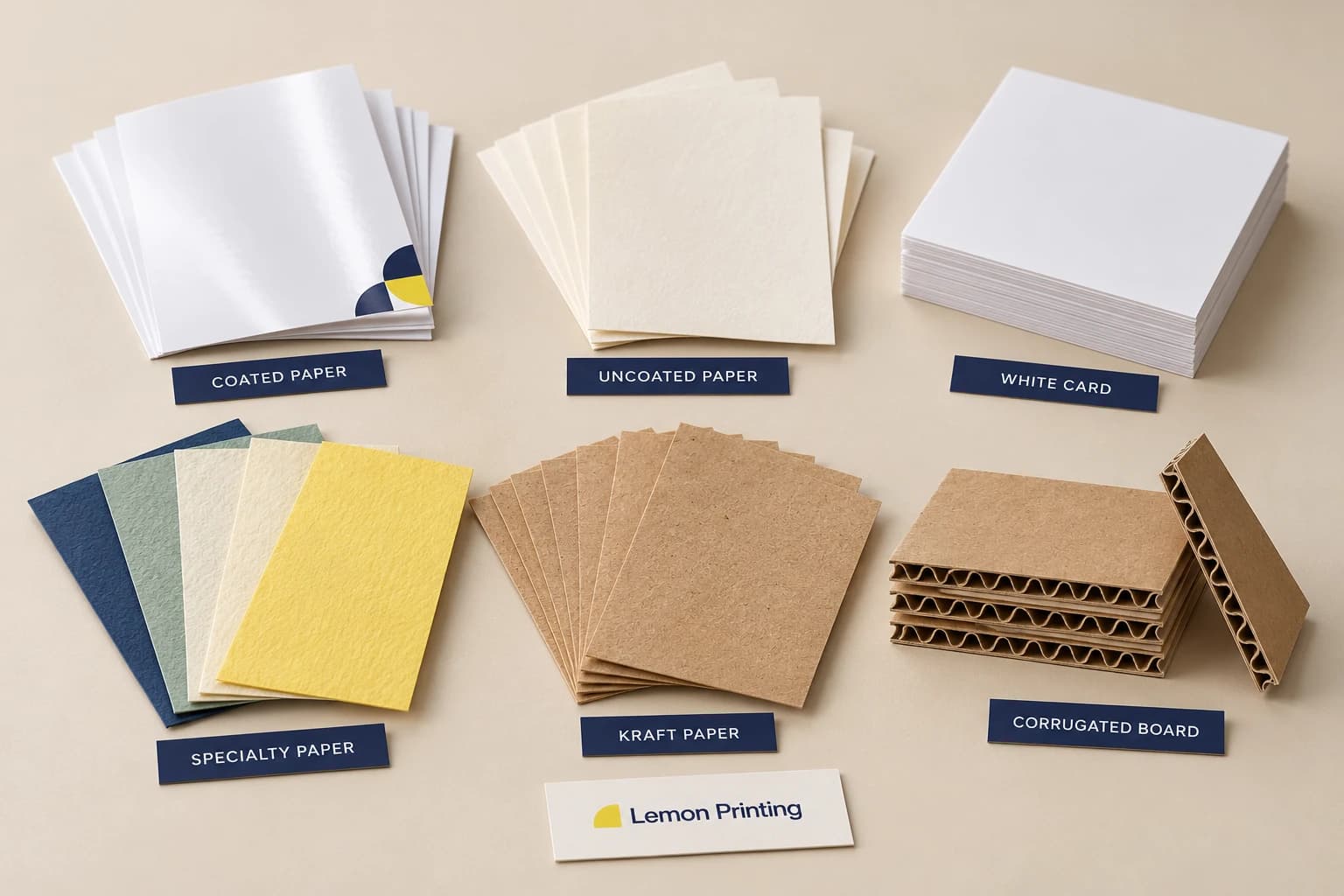
Six material families, selected by use.
Compare coated art paper, woodfree uncoated paper, white card, specialty paper, kraft paper and corrugated board. Gloss and matte coated papers belong to the same coated family; their surface appearance is not the same as a film laminated after printing.
Uncoated paper suits reading and writing applications when the selected grade passes the intended pen test. White card supports covers, cards and folding cartons; specialty paper introduces a selected texture, shade or translucency.
Kraft paper is a separate choice for bags and wraps. Corrugated board combines flat liners with a fluted medium for packaging structures such as shipping cartons. Compare the actual grade and construction, not only a color, weight or material name.
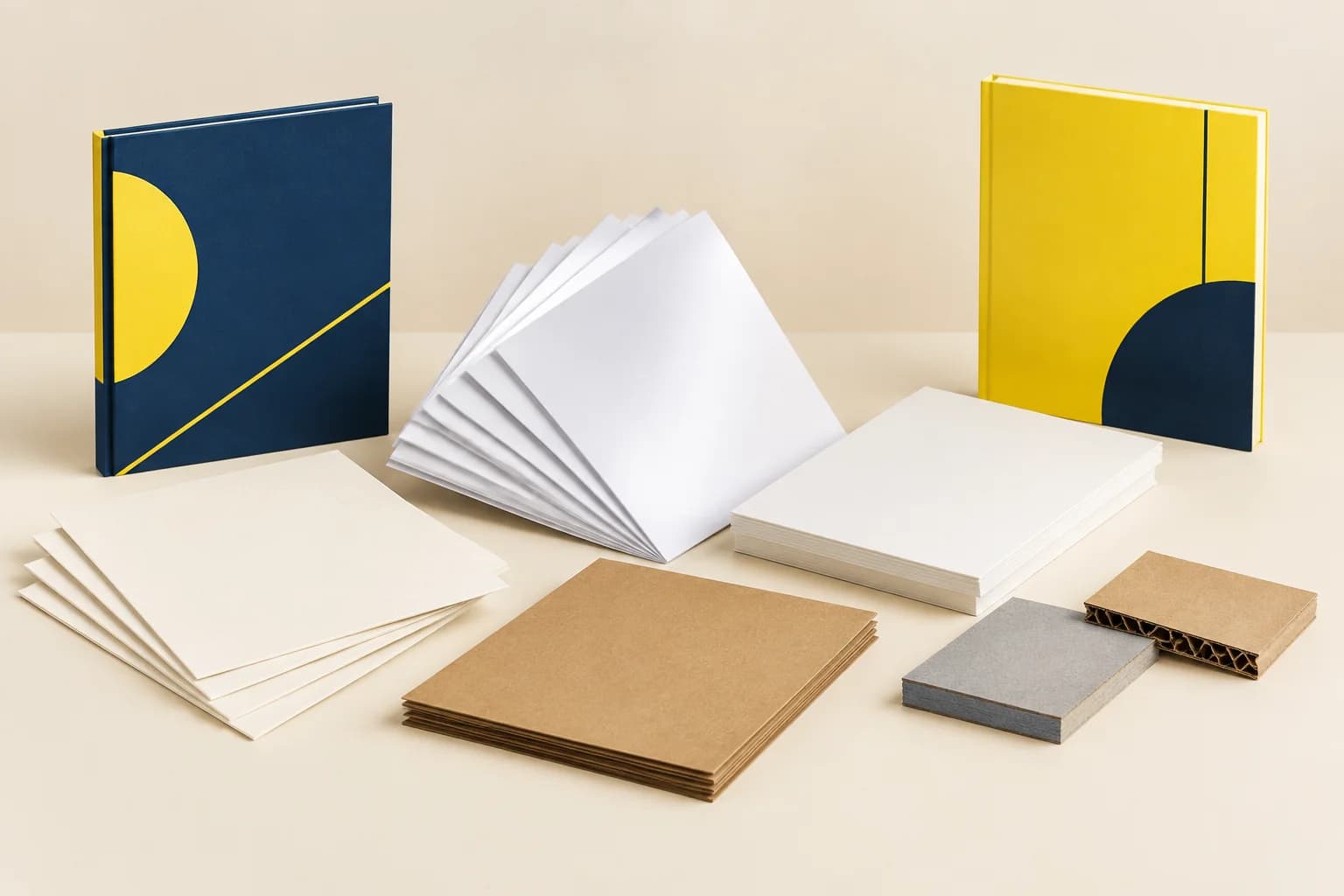
Read the measurements separately.
| Measurement | Unit / example | Decision it supports |
|---|---|---|
| Grammage | g/m² (GSM) | Mass per area, useful for comparing sheet weight; not a direct thickness measurement. |
| Caliper | µm or mm; 100 µm = 0.10 mm | Book-block thickness, fold geometry and the fit of stacked components. |
| US point thickness | 1 pt = 0.001 inch = 0.0254 mm | A thickness unit; do not confuse it with a typographic point or US basis weight. |
| Opacity | Supplier percentage for a named grade | Reverse-side show-through, especially on thin text stock with dark coverage. |
| Grain direction | Along or across the intended fold / spine | Fold behavior, page handling and dimensional movement. |
| Stiffness | Grade-specific test value and direction | Handling and structural resistance; two sheets with the same GSM can differ. |
Compare all six families against the job.
| Material family | Possible use / reference | What still needs checking |
|---|---|---|
| Coated art paper | Image-led interiors; published Sappi Magno Satin examples include 115 / 150 / 170 g/m² | Gloss or matte surface, pagination, opacity and the final book-block thickness. |
| Woodfree uncoated paper | Text interiors and writing pages | Ballpoint or intended pen test; feathering, bleed-through and show-through. |
| White card | Cards, covers and folding cartons; published Fedrigoni Symbol Card 2SC examples include 300 / 350 g/m² | Exact coating faces, stiffness, crease behavior and finish compatibility. It is not corrugated board. |
| Specialty paper | Cover wraps, textured inserts or translucent overlays | Base shade, adhesion and print contrast; availability must be identified by grade. |
| Kraft paper | Retail bags, wrapping and selected packaging components | Fiber composition, print contrast, tear behavior and the complete bag or wrap construction. Brown color alone does not establish recycled content or certification. |
| Corrugated board | Shipping cartons, protective inserts and selected retail packs | Flute profile, wall construction, liners, board caliper and the packed-box performance requirement; GSM alone cannot specify a shipping box. |
Supplier examples describe published grades, not guaranteed Lemon stock or a universal product specification.
Specify corrugated board as a construction.
Single-wall board has one fluted medium between two flat liners. Double-wall board has two fluted mediums and three liners. Flute profile and finished board caliper affect the structure, usable box dimensions and graphics surface; a flute letter is not a complete strength specification.
State the packed contents, internal dimensions, weight and stacking or delivery conditions. Edge crush testing (ECT) measures the board's resistance to compression on edge. It is not a direct box load rating: the assembled package and its distribution conditions still need evaluation.
- Name the wall construction, flute profile, liner grades and required board tests in the brief.
- Compare direct flexographic or digital printing with a separately printed sheet laminated to the board. Confirm the route against the artwork and structure; these are industry options, not a statement of equipment ownership.
- Check the actual contents, inserts, closure and packed-box performance with a representative sample. A folding carton or rigid presentation box is not automatically a shipping carton.
Convert GSM with the paper category.
US pounds refer to the weight of 500 sheets at a category-specific basis size. Select Text, Cover or Bond before comparing numbers.
Based on 500 sheets at 25 × 38 inches.
Reference conversion for a 500-sheet US basis ream: GSM × basis width × basis height × 0.0254² × 500 ÷ 453.59237. 150 GSM is approximately 101 lb text or 55 lb cover. Weight does not predict caliper, stiffness or opacity.
Match thin and textured papers to the content.
Thin Bible-style stock reduces the size of a long text block, but dark areas and small type make opacity and handling important. A vellum-like translucent overlay deliberately shows what sits beneath it; that is a different goal from an opaque reading sheet. These material families are selection references, not a promise of a particular grade.
For brown, colored or textured stock, inspect the actual printed appearance. The sheet can change contrast and fine foil coverage. Request material documentation when your brief requires a certified or recycled claim; a generic material description is not that documentation.
Common questions
Does higher GSM always mean a thicker sheet?
No. GSM measures mass per area. Fiber composition, bulk, coating and moisture affect thickness and handling. Use the actual grade caliper when the spine or folded fit matters.
Why is 80 lb Text different from 80 lb Cover?
The basis sheet sizes differ. Text uses 25 × 38 inches and Cover uses 20 × 26 inches. The same pounds therefore describe different grammages; include the paper category in every comparison.
Are gloss and matte coated paper two separate material families?
They are two surface variants within the coated-paper family used in this guide. A gloss or matte coating is part of the selected paper grade; a film added by lamination after printing is a separate finishing choice.
Can I specify a corrugated shipping carton by GSM alone?
No. Specify the liners and medium, flute profile, wall construction, dimensions and required board performance. ECT and burst testing assess different board properties; neither alone proves the performance of the complete packed box.
Does brown kraft paper mean recycled or FSC-certified paper?
No. Kraft grades may contain virgin, recycled or blended fibers. Brown appearance does not establish recycled content or an FSC claim. Request the named grade and the supporting documentation for any claim required by your project.
Sources and scope of this guide
Reviewed October 10, 2026. Industry examples explain selection; the quotation defines the actual Lemon product and service. Supplier data does not certify Lemon or establish our inventory.
- Case Paper: equivalent-weight tables
Paper supplier reference for named US paper categories and metric equivalence.
- Sappi: Magno Satin
Published coated-paper examples; actual grade availability belongs to the quotation.
- Fedrigoni: Symbol Card 2SC
Coated-card grade examples; weight alone does not establish opacity or strength.
- Holmen: Graphics Handbook
Substrate and conversion principles; no claim of equipment ownership or a universal tolerance.
- Fibre Box Association: corrugated construction
Liner, medium and wall constructions; not a guaranteed box load rating or evidence of Lemon stock availability.
- FSC: chain of custody
Explains chain-of-custody and material claims; this reference does not verify a particular order claim.
Build a specification we can quote.
Tell us the product, finished size, quantity and destination. Include the feature you need the sample to check.