Table of Contents
- Key Takeaways for Gift Certificate Buyers
- What Is Custom Gift Certificate Printing?
- Gift Certificate Material and Format Comparison
- How to Plan Writable and Scannable Areas
- Numbering and Security Options for Printed Vouchers
- Premium Finishes That Do Not Disrupt Use
- Gift Certificate Proofing and Production Steps
- Common Voucher Printing Mistakes
- Gift Voucher Printing Options from Lemon Printing
- Packaging Certificates for Retail or Corporate Distribution
- Quote Information Checklist
- Frequently Asked Questions
- Final Specification Check Before Production
- Get a Clear Quote for Your Gift Certificate Project
A practical sourcing guide to gift certificate materials, writable and scannable areas, numbering, security features, premium finishes, redemption setup and quote preparation.
Key Takeaways for Gift Certificate Buyers
A successful gift certificate must look appropriate for the brand, accept any required handwriting and connect reliably to the buyer’s redemption process. Security comes from controlled data and validation procedures—not decoration alone.
- Choose uncoated or selectively uncoated paper for signatures, dates, stamps and handwritten values.
- Keep foil, embossing, UV coating and textured backgrounds away from QR codes and barcodes.
- Use a unique serial number or code if each certificate must be tracked individually.
- Test every scan path at final printed size before approving production.
- Define who activates, redeems, cancels and audits each code before artwork approval.
- Give the printer clear rules for numbering sequence, duplicates, damaged-sheet replacement and packing order.
Final MOQ, production time, pricing and shipping depend on the certificate specifications, quantity, finishing, packing method and destination.
What Is Custom Gift Certificate Printing?
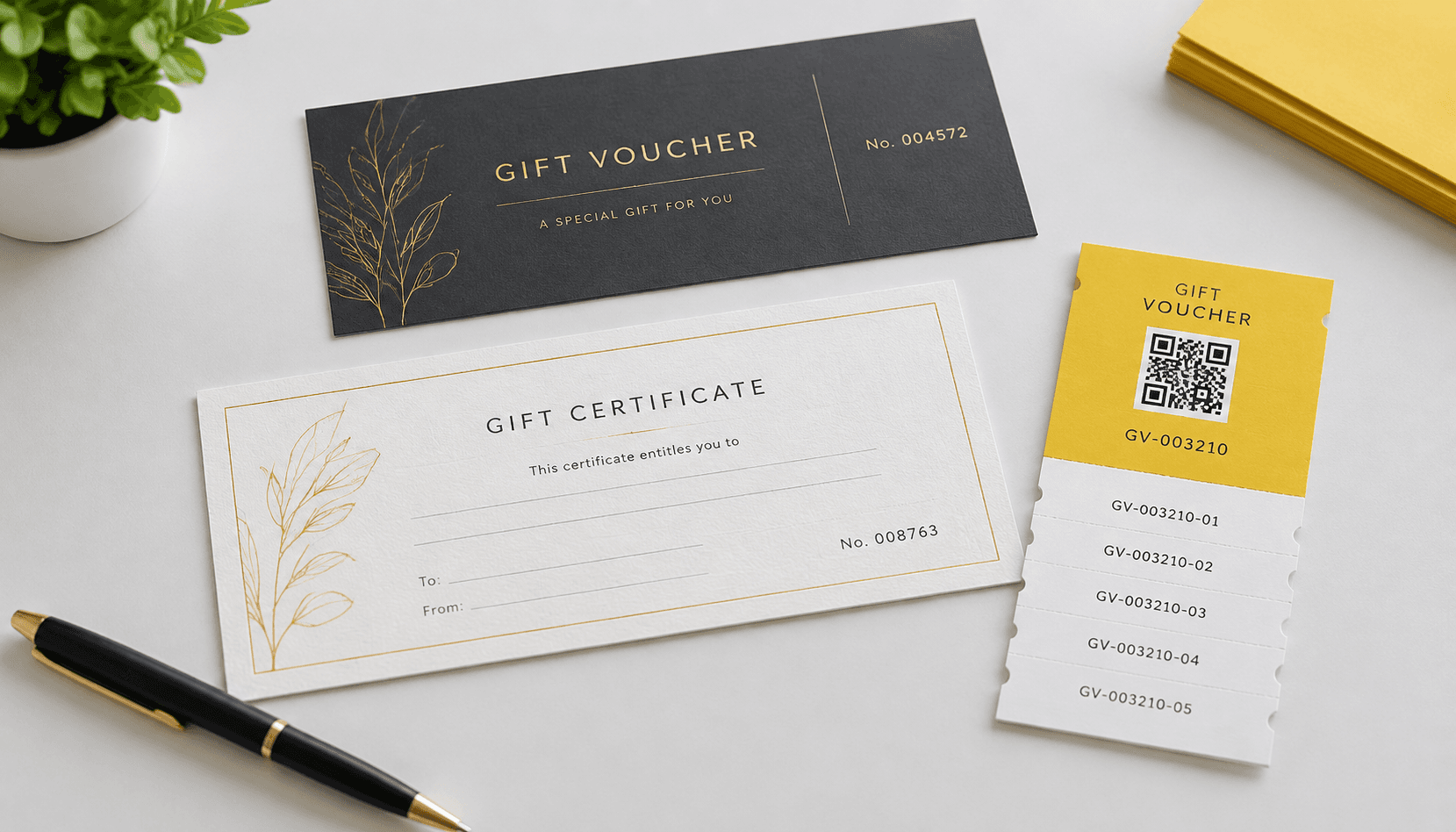
Custom gift certificate printing produces branded paper or cardstock vouchers with buyer-defined values, terms, numbering and redemption features. Unlike a generic promotional card, the document may represent a redeemable entitlement and therefore needs controlled artwork, data and handling.
A project can range from simple writable certificates to serialized retail gift certificates linked to a point-of-sale or online database. Printing does not create the redemption system; it produces the physical voucher and any codes supplied or generated under an agreed data plan.
Gift Certificates, Gift Vouchers and Plastic Gift Cards
“Gift certificate” and “gift voucher” commonly describe paper-based products, although local usage varies. A plastic gift card is a different construction that may use a magnetic stripe, chip or printed code and normally requires a compatible activation platform.
Paper vouchers provide more space for terms, messages and presentation graphics. Heavy cardstock offers a card-like feel without becoming a plastic stored-value card. Buyers considering a compact paper format can review Lemon Printing’s heavy paper card printing options for relevant stock and finishing choices.
Who Controls Value, Expiration and Redemption Rules?
The certificate issuer—not the printer—controls monetary value, activation status, expiration rules, authorized locations and redemption records. These rules must be settled before variable codes and legal text are released for production.
The buyer should confirm applicable consumer, tax and expiration requirements with qualified advisers in each market. The printer needs final approved wording, but should not be expected to determine whether those terms comply with local law.
Gift Certificate Material and Format Comparison
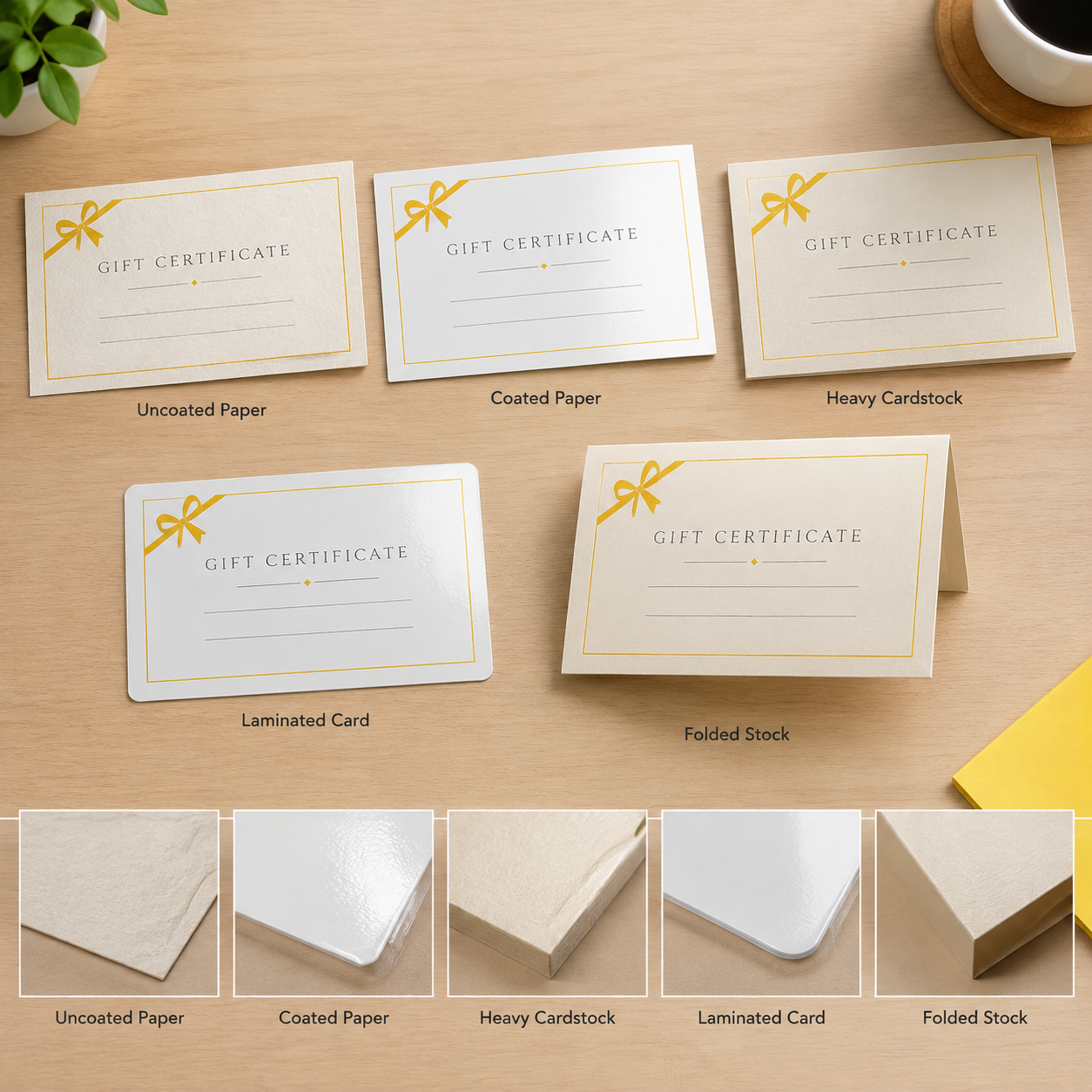
Paper selection should follow how the certificate will be written on, presented, scanned and stored. Coated stocks reproduce photographs strongly, while uncoated stocks are generally easier to write on.
| Material or format | Practical strengths | Main trade-offs | Typical use |
|---|---|---|---|
| Uncoated paper | Easy to write, stamp and initial | Less gloss and lower moisture resistance | Manually issued certificates |
| Coated paper | Sharp color and smooth photographs | Pens and stamps may smear or fail to dry | Preprinted promotional vouchers |
| Heavy uncoated cardstock | Premium feel with a writable surface | Higher weight and packing volume | Luxury retail or hospitality |
| Laminated cardstock | Added scuff and handling resistance | Not suitable for normal handwriting unless a writable panel is planned | Pre-encoded, fully printed vouchers |
| Folded certificate | More room for terms and presentation | Requires accurate scoring and folding | Corporate gifts and service packages |
Paper weights are measured in grams per square meter, abbreviated as gsm. A higher gsm usually feels more substantial, but stiffness also depends on fiber composition, caliper and coating.
Paper Certificates for Writing and Stamping
Writable gift certificates work best with uncoated paper or deliberately reserved uncoated panels. This is important when staff must add a recipient name, amount, issue date, signature or store stamp.
Test the actual pen, marker, stamp ink or thermal overprint process used at the issuing location. “Writable” is not a single standard: a stock that accepts a ballpoint pen may still perform poorly with a fast-drying stamp ink.
Heavy Cardstock for Premium Presentation
Heavy cardstock gives premium voucher printing more rigidity and can reduce corner curling during retail display. Common planning ranges may extend from sturdy card stock around 250 gsm to heavier stocks above 300 gsm, but the correct choice depends on the paper grade, fold structure, printer and packing method.
If the piece folds, the grain direction and scoring method matter. A heavy stock folded without a proper score may crack along the spine, especially where dark ink crosses the fold.
How to Plan Writable and Scannable Areas
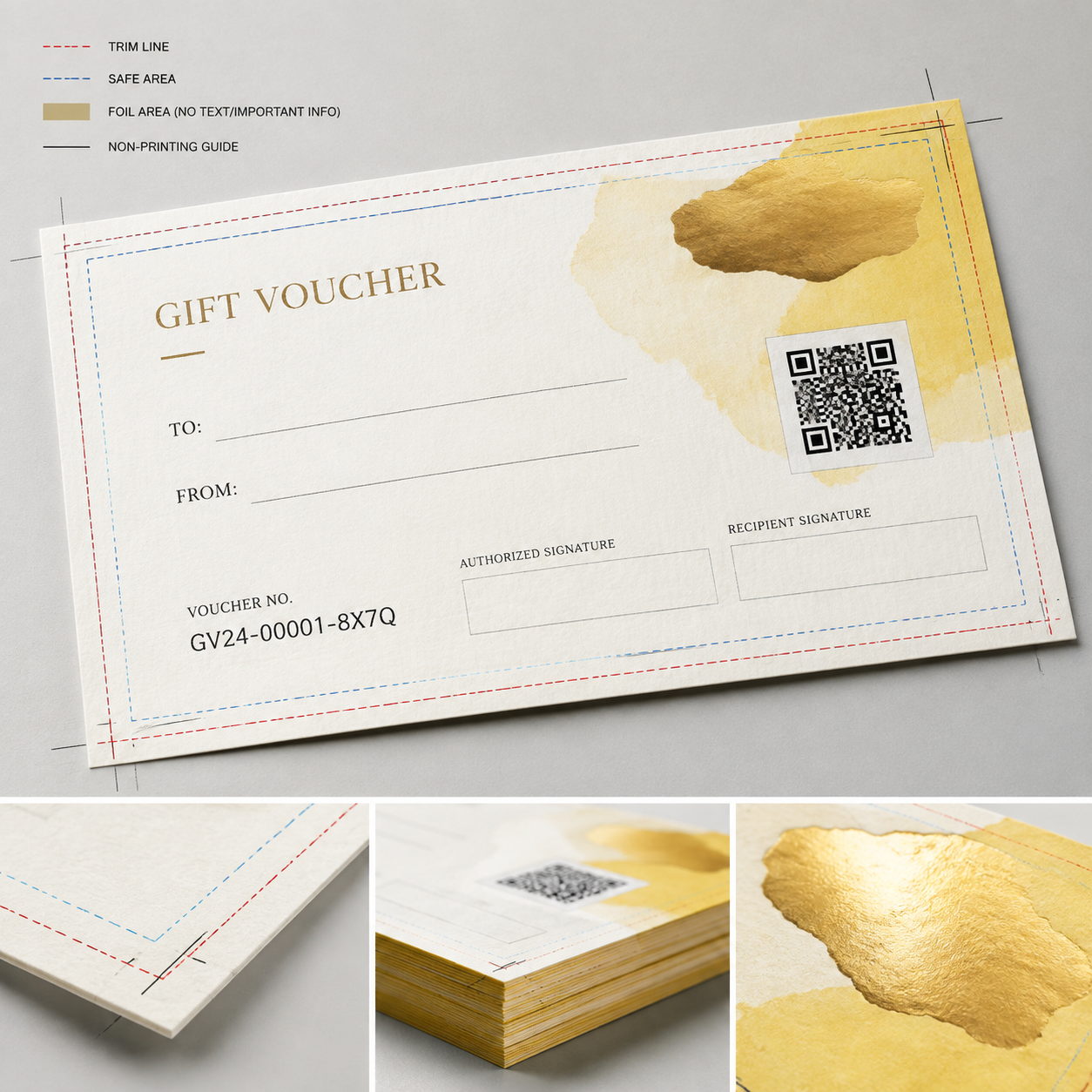
Writable fields and machine-readable codes should be treated as functional components rather than decoration. Their size, contrast, surface and surrounding clearance need to be fixed before premium finishes are added.
Create separate artwork layers for static graphics, variable data, writing fields, dielines and finishes. This makes prepress checking easier and reduces the chance that a coating or foil mask covers a working area.
Keep Coating Away from Signatures and Manual Entries
Gloss coating, lamination and UV varnish can prevent ink from adhering to a signature or amount field. Leave these areas uncoated, or use a stock and coating combination that has been physically tested with the intended writing instrument.
Do not rely only on a screen proof. A digital proof confirms position and wording, but it cannot accurately demonstrate pen adhesion, drying time or stamp behavior on the production surface.
Protect QR Codes and Barcodes from Decorative Finishes
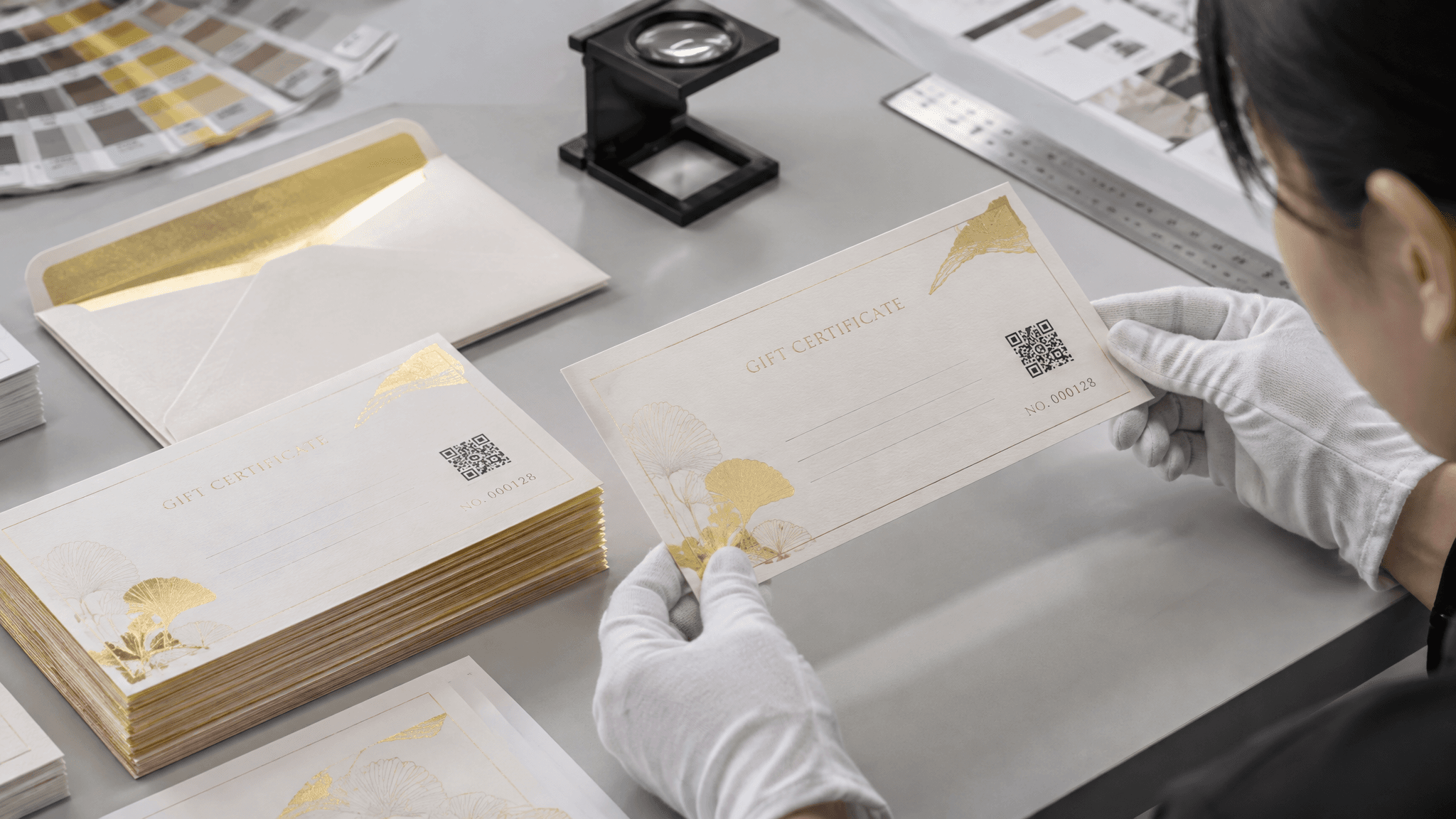
QR codes and barcodes need strong contrast, sufficient size and an undisturbed quiet zone—the blank area surrounding a code. Reflective foil, embossing, textured varnish, background patterns and folds can interrupt scanning.
For QR codes, preserve the code generator’s required quiet zone, commonly four modules on every side. A module is one small square in the QR grid. Final dimensions still depend on code density, print process, scanning distance and device quality, so test production-size samples rather than relying on a generic minimum.
Numbering and Security Options for Printed Vouchers

Numbering helps identify certificates, but the issuer’s validation database and staff procedures determine whether copies can be redeemed. A secure plan combines a unique identifier, controlled activation, redemption status and an audit trail.
Printed options can include sequential or randomized numbers, QR codes, barcodes, UV-visible elements, microtext and specialty foils. Similar variable-data principles are used for custom ticket printing with numbering and perforation, although the redemption rules for gift certificates may be different.
Serial Numbers and Human-Readable Backup Codes
Numbered gift certificates should include a human-readable identifier even when a QR code or barcode is the primary scanning method. Staff can enter the backup code if a camera fails, a corner is damaged or the customer presents an image on another device.
Specify the start and end values, number length, prefixes, leading zeros, font, position and packing order. Also define whether spoiled sheets are omitted, reprinted or recorded as void to prevent accidental duplicate serialized vouchers.
QR Codes for Digital Redemption Systems
QR code gift vouchers can link to a public webpage, but secure redemption normally requires a unique token that the issuer checks against a controlled database. A shared QR code leading to the same page on every voucher does not uniquely validate each certificate.
Before printing, test unused, active, redeemed, expired and invalid code states. Decide whether a scan displays value, marks the certificate as redeemed or requires staff confirmation. Avoid exposing predictable account data in the visible URL.
UV Ink, Microtext and Holographic Details
UV-visible ink, microtext and holographic details can support visual inspection, but each has limits. Standard decorative holographic foil may be commercially available to other buyers, while microtext can fill in if the type is too small for the chosen press and stock.
Ask for a physical proof or production sample where practical, and confirm how staff will inspect the feature. Availability, minimum line weight, tooling and registration tolerance must be reviewed for the actual construction. None of these details should replace serial validation.
Premium Finishes That Do Not Disrupt Use
Premium finishes should emphasize the brand while staying clear of writing, scanning and folding zones. Foil is effective for a logo or border; embossing adds a raised impression; spot UV creates localized gloss; and lamination can improve scuff resistance.
| Finish | Good application | Functional caution |
|---|---|---|
| Foil stamping | Logo, title or border | Keep away from codes and fine legal text |
| Embossing or debossing | Brand mark or seal | Avoid writing fields and reverse-side codes |
| Spot UV | Selected graphics on a coated area | Do not cover pen or stamp fields |
| Matte or gloss lamination | Fully printed, non-writable pieces | Allow a separate writable label or panel if manual entry is required |
| Rounded corners | Compact card formats | Keep text and codes away from trim and corner radius |
Lemon Printing’s printing and finishing capabilities provide context for discussing foil, spot treatments, paper construction and other production choices during quotation.
Gift Certificate Proofing and Production Steps

Proofing should verify both appearance and redemption function. A visually correct voucher can still fail if numbers repeat, codes lead to the wrong records or staff cannot write on the finished surface.
- Lock the specification. Confirm finished size, stock, quantity, printing, finishing, writable fields, numbering and packing.
- Supply artwork and data separately. Provide print-ready artwork plus a clearly structured CSV or agreed data file for variable codes.
- Run prepress checks. Review bleed, trim clearance, color mode, image resolution, overprint settings, code contrast and finish masks.
- Approve a variable-data proof. Check representative records, including the first and last sequence values and any long prefixes.
- Test physical use. Scan production-size codes and test pens or stamps on the specified surface.
- Inspect during production. Monitor print color, finishing registration, numbering legibility and sequence controls.
- Reconcile and pack. Record valid quantities, spoilage treatment, bundle ranges and carton identification.
Lemon Printing explains the broader workflow on its commercial printing production process page.
Common Voucher Printing Mistakes
The costliest voucher errors usually occur at the boundary between artwork and operations. Common examples include coating a signature field, placing a code over a fold, supplying duplicate numbers, using text that is too small and approving the print without testing the issuer’s database.
Treating a Decorative Finish as Unique Validation
Foil, embossing and spot UV can discourage casual copying, but they do not prove that a voucher is active or unused. A copied serial number on an otherwise genuine-looking certificate may still create a redemption dispute.
Use decoration as one inspection layer. Unique codes, activation records, redemption status and staff procedures should carry the main validation role.
Approving the Design Without Testing the Redemption Workflow
A design proof cannot confirm that every code exists in the issuer’s system. Before mass production, scan representative certificates using the same devices, network conditions and staff interface expected at redemption.
Test manual code entry as well. Document what employees should do when a code is unreadable, already redeemed, not activated or missing from the database.
Gift Voucher Printing Options from Lemon Printing
Lemon Printing can evaluate paper-based voucher specifications using its in-house prepress, offset and digital printing, finishing, inspection, packing and export-preparation workflow. The company was established in 2015 and operates a self-owned facility with more than 130 skilled workers and 8+ presses in the Guangzhou–Shenzhen manufacturing corridor.
| Configuration | Suitable application | Items to confirm |
|---|---|---|
| Writable paper certificate | Manual amounts, signatures or store stamps | Uncoated surface, pen test and optional numbering |
| Heavy premium voucher | Retail, hospitality and corporate presentation | Stock stiffness, foil area, embossing and packaging |
| Serialized voucher | Controlled issue and redemption | Data source, sequence rules, duplicates policy and bundle order |
| QR code voucher | Database lookup or digital redemption | Unique URL structure, quiet zone and live workflow test |
| Folded certificate | Long terms or gift presentation | Score position, grain direction, fold clearance and envelope size |
Inspection requirements should be agreed before production. Buyers can review Lemon Printing’s printing quality control checkpoints when preparing acceptance criteria.
Packaging Certificates for Retail or Corporate Distribution

Packaging should protect corners and finishes while preserving the sequence order needed by the issuer. Numbered certificates are commonly bundled in defined ranges, labeled and packed so receiving staff can reconcile cartons without opening every unit.
- Use protective interleaving where metallic foil or dark ink may rub.
- Confirm bundle counts and sequence ranges before production.
- Specify envelopes, sleeves, belly bands or presentation folders as separate components.
- Provide carton-label requirements, store allocations and any “do not bend” handling instructions.
- Avoid elastic bands or excessive pressure that may mark edges or embossed areas.
For multi-location programs, supply a distribution file showing the code range and quantity assigned to each destination.
Quote Information Checklist
A comparable gift voucher printing quote requires more than finished size and quantity. Supply the operational details that affect prepress, variable data, finishing, inspection and packing.
- Flat and finished size, orientation and fold structure
- Total quantity and number of artwork versions
- Paper type, color and preferred gsm or required stiffness
- Print colors on each side
- Writable areas and the pen, marker or stamp to be used
- Sequential numbers, random tokens, QR codes or barcodes
- Data format, sequence rules and replacement policy for spoiled pieces
- Foil, embossing, spot UV, lamination, perforation or rounded corners
- Proof type and scan-testing requirements
- Bundle order, envelopes, sleeves, carton labels and store allocation
- Delivery destination and target arrival date
Final MOQ, production time, price and shipping method depend on these specifications, the order quantity, finishing complexity and destination.
Frequently Asked Questions
These answers address common technical and sourcing questions about writable, numbered and QR-enabled gift certificates. Product-specific limits should still be verified during quotation and proofing.
Final Specification Check Before Production
Before authorizing production, confirm that the physical certificate and the digital redemption system use the same approved data. The sign-off record should identify the artwork version, stock, finishes, code file, sequence range and packing plan.
- All values, terms and legal wording are approved.
- Writing fields have a tested surface.
- Codes scan at final size and have manual backup numbers.
- No finish enters a code, signature or fold-clearance area.
- Duplicate prevention and spoilage replacement rules are documented.
- Bundle ranges and carton labels match the distribution plan.
Do not release high-value serialized vouchers based only on a visual PDF approval. Include physical-use and system tests appropriate to the project risk.
FAQ
What paper is best for writable gift certificates?
Uncoated paper or heavy uncoated cardstock is usually the safest starting point because it accepts common pens and stamps more readily than coated or laminated surfaces. Test the actual writing tool and stamp ink before production, especially if the certificate also includes varnish or foil.
Can every gift certificate have a different serial number?
Yes. Variable-data printing can produce numbered gift certificates with sequential or buyer-supplied unique codes. The buyer should define the sequence, prefixes, leading zeros, packing order and treatment of damaged or rejected pieces before production.
Can QR codes be printed on premium voucher stock?
Yes, provided the QR code has sufficient contrast, size and quiet-zone clearance. Keep foil, embossing, spot UV, folds and heavy background patterns away from the code, then test scans on the actual production-size proof.
Does a QR code make a gift voucher secure?
Not by itself. A shared or predictable QR code can be copied. Stronger validation uses a unique token linked to an issuer-controlled database that records activation, value, status and redemption. A readable backup code is also recommended.
Are foil and holographic finishes security features?
They can support visual inspection and discourage simple photocopying, but decorative finishes do not prove that a voucher is genuine, active or unused. Use them with unique identifiers and a controlled redemption workflow rather than as the only validation method.
Should serialized vouchers be packed in number order?
Usually, if the issuer distributes or audits certificates by range. Specify whether packing should be ascending, descending, randomized or divided among locations. Bundle and carton labels should clearly state the enclosed ranges without exposing sensitive data unnecessarily.
What affects the MOQ and production time for gift voucher printing?
MOQ and production time depend on quantity, size, paper, print process, variable data, finishing, proofing, packaging and destination. Serialized data checks, custom foil tooling, special paper or multi-location packing can add production steps. Final requirements should be confirmed through a project-specific quote.
Get a Clear Quote for Your Gift Certificate Project
Send Lemon Printing your product type, quantity, finished size, paper preference, printing, writable fields, numbering or QR requirements, premium finishes, packing method, delivery destination and target date. Include sample artwork and a description of the redemption workflow so the team can review both print and functional requirements.