Table of Contents
- What book packaging should protect against
- Match the packing method to the book construction
- Hardcover, paperback and saddle-stitched books
- Premium finishes and covers that need extra surface protection
- Build a safer carton-packing specification
- Carton strength, pack count and weight limits
- Corner protection, inner wrapping and void control
- Use moisture protection and palletization appropriately
- Pre-shipment checks before cartons leave the factory
- Carton marking, quantity verification and packing photos
- What to request in a book shipping quote
- FAQ: Export packaging for printed books
- Plan protected book shipping with Lemon Printing
Good book packaging for shipping protects against compression, corner impact, cover scuffing, carton movement and moisture. This guide explains how to match packing methods to book construction, set carton specifications, use pallets appropriately and verify export orders before dispatch.
What book packaging should protect against
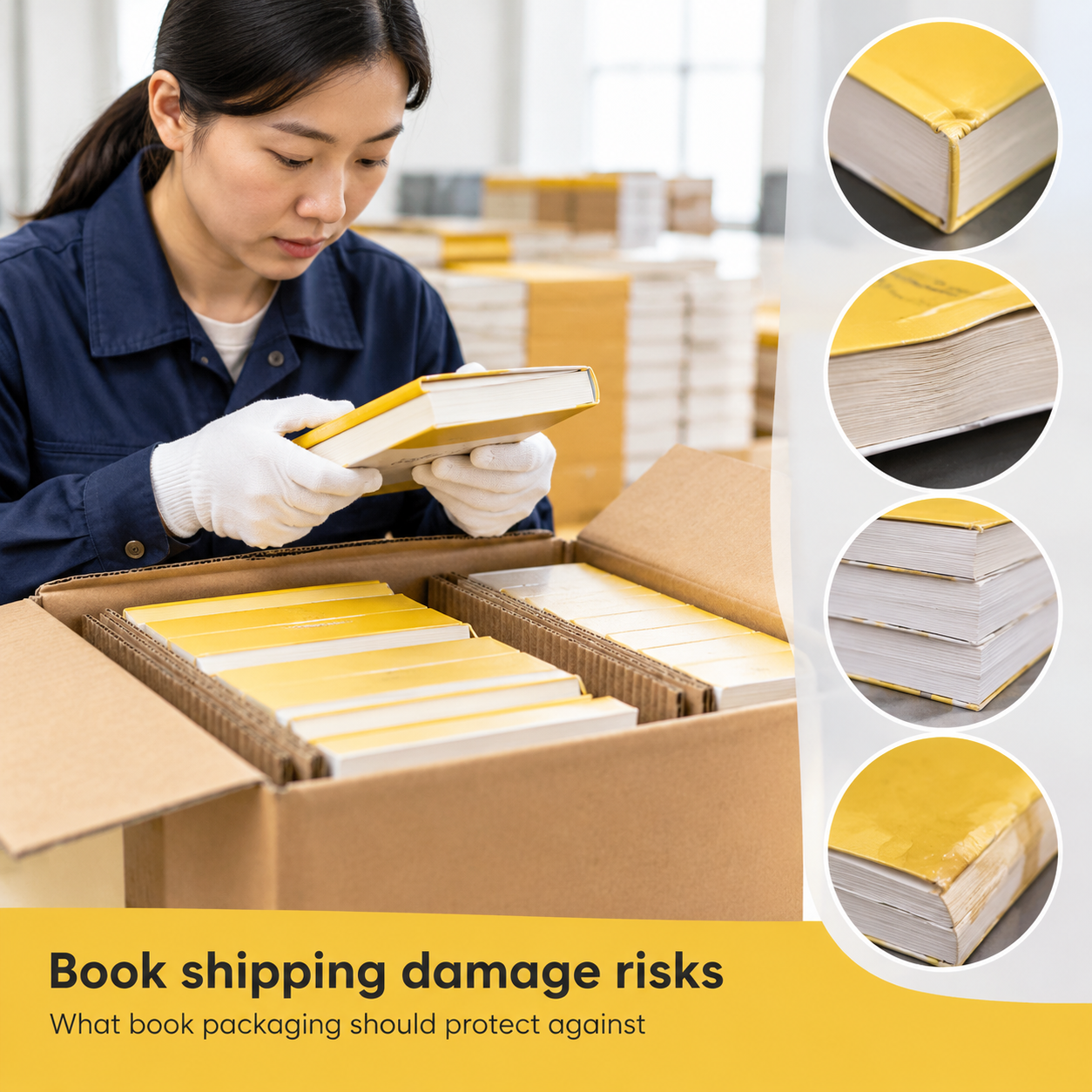
Book packaging for shipping should control compression, impact, abrasion, carton movement and moisture from the factory to the receiving location. A book may leave production in good condition and still arrive with crushed corners, rubbed covers, bent boards or damp pages if the packing specification is not matched to the book and freight route.
Key packing risks to review
- Compression: Cartons stacked too high or loaded beyond their practical strength can bow, collapse or transfer pressure to book edges.
- Impact: Dropped cartons and fork-truck contact commonly damage corners, especially on casebound and board books.
- Abrasion: Books that move against one another can develop cover scuffs, foil rub, scratches or polished spots on dark lamination.
- Moisture: Humid storage, rain during loading and condensation in ocean freight can affect paper, boards, glue and printed surfaces.
- Movement: An underfilled carton allows stacks to shift, while an overfilled carton can distort the covers or binding.
The correct solution is not always more material. It is a controlled combination of book orientation, stack size, carton dimensions, protective layers and pallet stability. For international orders, confirm these details before the final packing run rather than leaving them to the freight stage.
Match the packing method to the book construction
Pack books according to their binding, cover stiffness, surface finish, size and weight—not simply by title or page count. The same carton arrangement may work for a compact paperback but create damage on a large casebound book with a delicate jacket.
Start with a representative packed sample. Check whether the books sit squarely, whether the carton closes without pressure, and whether the stack can be lifted without spreading or sliding. Buyers ordering custom books can review binding and finishing choices through Lemon Printing’s custom book printing service before finalizing the export pack.
| Book type | Typical packing concern | Useful protection decision |
|---|---|---|
| Hardcover or casebound | High weight and vulnerable board corners | Use stable stacks, edge or corner protection and a carton that resists compression. |
| Paperback or perfect bound | Cover scuffing, spine pressure and edge curling | Control movement, avoid excessive carton pressure and separate highly abrasion-sensitive covers. |
| Saddle-stitched booklet | Lower thickness, shifting and folded corners | Use flat, even bundles and avoid loose space that allows the booklets to slide. |
| Wire-O or spiral-bound book | Binding loops can catch, deform or mark nearby covers | Use a consistent orientation and an inner layer that prevents metal or plastic parts from rubbing. |
Hardcover, paperback and saddle-stitched books
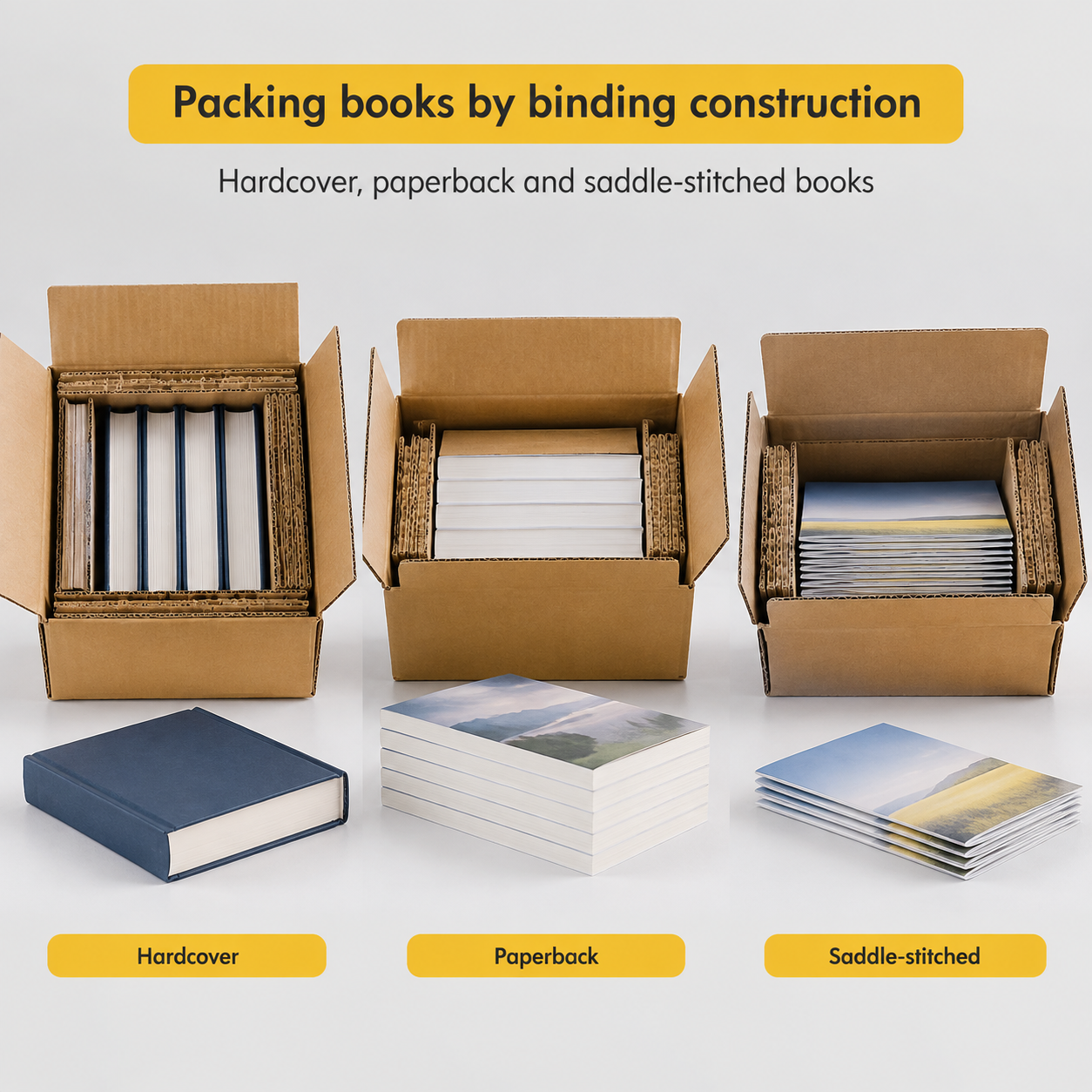
Hardcover books usually need the most attention to carton weight and corner support, while paperbacks need stronger abrasion and movement control; saddle-stitched books need even, flat loading. These differences should be written into the packing instruction supplied to the factory.
- Hardcover: Load books with the spine and fore-edge orientation kept consistent. Avoid a carton that is so tight that its top flaps press into the boards. Corrugated pads at the top and bottom can distribute pressure, while corner boards or a rigid inner frame can reduce edge impact.
- Paperback: Keep the stack square and do not rely on a tight carton to stop movement. Excessive pressure may mark the spine or create cover curl. For dark, laminated or coated covers, use an agreed inner wrap or interleaf if rubbing is visible in the packing trial.
- Saddle-stitched: Because the books are thinner and more flexible, they can fan or shift inside a carton. Use level bundles, a flat base and controlled void filling. Do not compress them so aggressively that the folded spine or cover edges are distorted.
For mixed-format orders, use separate cartons by size or construction whenever practical. Mixing tall hardcovers with smaller paperbacks usually creates unused spaces and uneven pressure, making carton packing for books less predictable.
Premium finishes and covers that need extra surface protection

Books with dark lamination, soft-touch coating, foil, spot UV, embossing, dust jackets or uncoated covers may need an additional surface-protection step. The risk is often not structural damage but visible rubbing, transfer, scuffing or pressure marks.
Inspect the finished surface after the books have been stacked and unstacked. If contact marks appear, options may include a thin interleaf, a protective paper wrap, individual polybags or a smaller bundle size. The choice depends on the finish, order volume, carton space and environmental conditions. Film should not be applied so tightly that it bows covers or traps unwanted moisture.
Dust jackets deserve particular attention because their loose edges can catch during loading. Fold them accurately, keep the jacketed books aligned and consider a protective sheet or inner sleeve when the cover material is easily scratched. Foil and raised finishes should be checked for rub resistance after packing, not only immediately after printing.
Build a safer carton-packing specification

A safer export carton is sized around the actual finished book and agreed pack count, with enough strength to support stacking but not so much empty space that the books can move. Specify the internal carton dimensions, wall construction, closure method, book orientation, bundle arrangement and gross weight target before production is complete.
A practical carton specification should include:
- Finished book dimensions, including any dust jacket, tabs or protruding binding parts.
- Number of books per carton and whether books are bundled, wrapped or individually protected.
- Carton internal and external dimensions, with the measurement basis clearly identified.
- Corrugated wall or board specification selected for the expected load and route.
- Top, bottom and side pads, dividers, corner boards or other protective inserts.
- Closure method, such as tape or strapping, and whether the carton will be palletized.
- Maximum agreed gross weight, based on handling, warehouse and freight requirements.
Do not approve the carton only from a drawing. Ask for a packing trial using the actual book, because cover thickness, binding swell and finishing can change the usable space.
Carton strength, pack count and weight limits
There is no universal number of books for one export carton. The correct pack count depends on finished size, paper weight, binding, carton strength, stacking pattern, manual handling requirements and destination. A carton that holds many light paperbacks may be unsuitable for fewer large hardcovers.
Use this process to set the count:
- Calculate the approximate weight of one finished book and the proposed full carton.
- Test several pack counts with the actual production sample, not a page-count estimate.
- Check whether the carton closes flat without bulging or crushing the top book.
- Lift and move the packed carton to identify spreading, shifting or weak seams.
- Confirm that the gross weight suits the warehouse, carrier, pallet and receiving operation.
For dense books, a lower count can reduce corner compression and make handling safer even if it increases the number of cartons. For lightweight booklets, a higher count may be practical if the carton remains square and does not become unstable. Final MOQ, production time, pricing and shipping depend on product specifications, quantity, finishing and destination, so the carton plan should be quoted with the order rather than assumed afterward.
Corner protection, inner wrapping and void control
To reduce crushed corners during book transport, keep the stack square and create a controlled protective boundary between the books and the carton walls. Most corner damage is worsened by a loose stack, a weak carton edge or direct impact against an unprotected side.
- Use corrugated pads above and below the stack to spread pressure.
- Add edge or corner boards when the book has rigid boards or a large trim size.
- Use paper wrap, interleaf sheets or a suitable inner sleeve when cover surfaces rub.
- Fill small voids with a material that will not shed, stain or create uneven pressure.
- Avoid large empty spaces and avoid packing so tightly that the books are bowed.
- Keep bundles aligned; loose books at the carton perimeter are more exposed to impact.
Loose-fill material is often a poor choice for heavy books because it can compress and allow movement. The best book carton protection is usually a fitted, repeatable arrangement that can be checked quickly during packing.
Use moisture protection and palletization appropriately
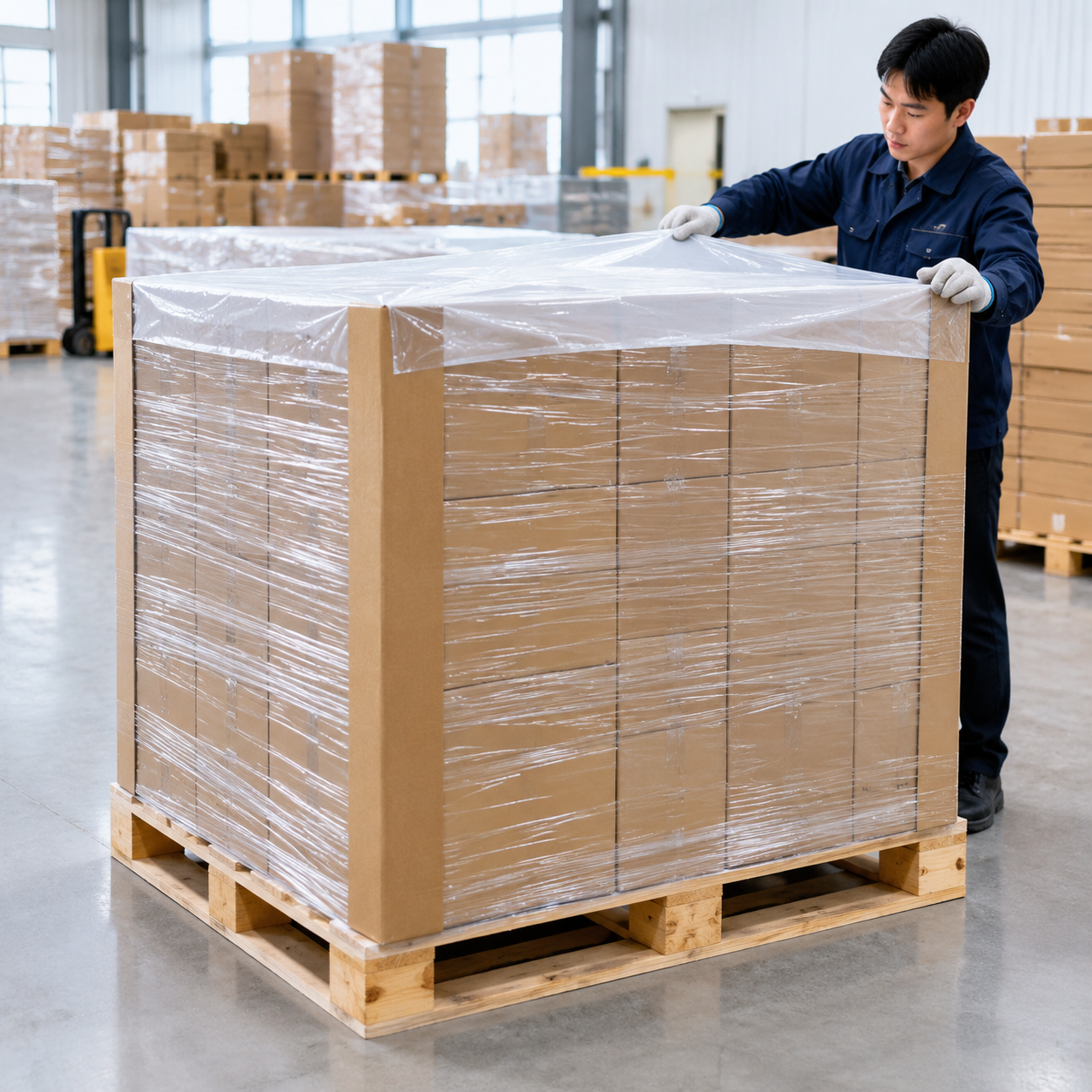
Printed books benefit from moisture protection when the route includes ocean freight, humid storage, seasonal rain or multiple outdoor loading points, but the barrier must be combined with dry storage and sound cartons. A plastic liner, sealed outer film or individual wrapping may reduce exposure; it cannot repair books that were packed damp or stored in condensation.
Discuss moisture barrier packaging with the factory when the order is shipping by sea, spending time in a humid climate or being delivered to a warehouse without climate control. Confirm whether the protection is applied at bundle level, carton level or pallet level. If desiccants or humidity indicators are requested, define their quantity, placement and handling instructions rather than adding them informally.
Pallets are useful but not mandatory for every order. Palletized book shipping is generally worth considering for many cartons, heavy casebound books, repeated handling, warehouse delivery or a route where cartons may be transferred several times. A pallet can keep cartons together and reduce direct floor contact, but poor stacking or excessive stretch wrap can still crush the lower cartons.
When pallets are used, agree on carton layout, maximum stack height, corner boards, top protection, stretch-wrap tension, strapping and any destination requirements for the pallet material. When pallets are not used, cartons should still be selected and marked for the expected handling method.
Pre-shipment checks before cartons leave the factory
Before dispatch, verify both the books and the packing system: sample cartons, count cartons, inspect labels, review photos and confirm the final shipping marks. A packing check should confirm that the approved method was used consistently, not just that one carton looks acceptable.
- Open cartons from different parts of the production run, including cartons from the middle and outside of the pallet or stack.
- Check book quantity, orientation, cover condition, corners, spine, page edges and any premium finish.
- Measure or record carton dimensions and gross weight against the approved specification.
- Inspect carton seams, tape, straps, corner boards, pallet wrap and signs of compression.
- Confirm the shipping marks, purchase order reference, carton numbering and handling symbols.
- Photograph the open carton, finished carton, pallet and labels for the project record.
Lemon Printing describes its production control around in-house prepress, printing, binding, finishing, quality inspection, packing and export preparation. Buyers can also review the company’s four-stage quality control approach and commercial printing process when defining approval checkpoints.
Carton marking, quantity verification and packing photos
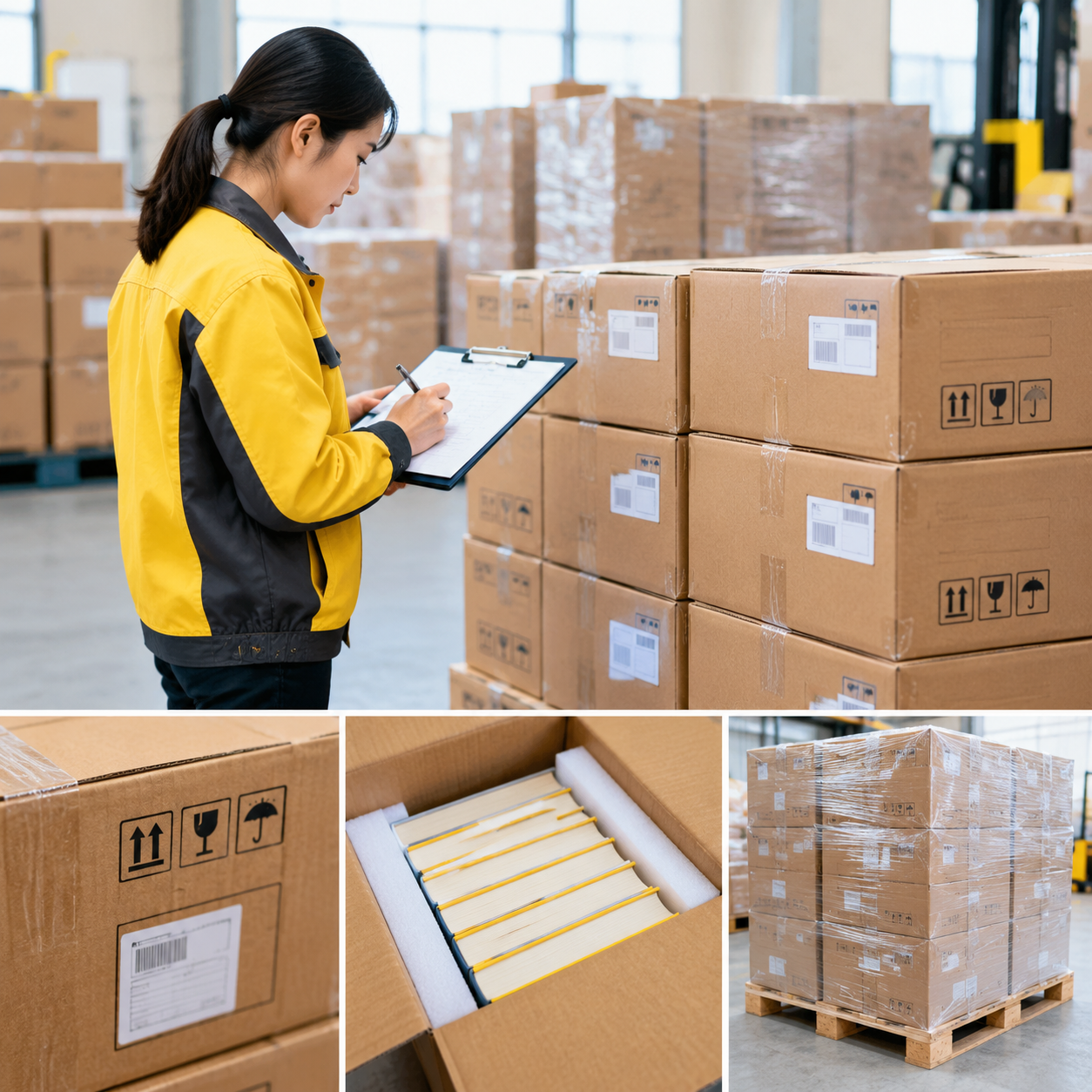
Carton marks should make the shipment identifiable without opening every box. At minimum, agree on the product or SKU name, purchase order reference, carton number, quantity per carton, gross weight where required, destination information and any handling marks.
For a multi-title order, separate titles clearly and keep the carton numbering sequence consistent with the packing list. Ask for a packing list showing total cartons, cartons per title, books per carton and any partial carton. Photos should show the actual finished packing arrangement, not only an empty sample carton. Keep these records with the approved quote and purchase order so a receiving team can compare the delivery efficiently.
What to request in a book shipping quote
A comparable book shipping quote should show the packing assumptions as clearly as the printing specifications. Ask the supplier to state what is included, what is optional and which details remain subject to the final quantity and destination.
- Book format, finished size, page count and approximate finished weight.
- Cover construction, paper type or GSM, binding method and any dust jacket.
- Finishes that may affect abrasion risk, such as lamination, foil, spot UV or embossing.
- Proposed books per carton, carton dimensions, carton material and estimated gross weight.
- Inner protection, bundle wrapping, corner protection and void-control method.
- Moisture barrier packaging, pallet use, pallet dimensions and pallet protection if required.
- Carton marks, packing list format, photos and inspection or approval checkpoints.
- Quantity, destination address or port, shipping method and delivery terms being quoted.
- Required delivery date and any warehouse, retailer or carrier handling restrictions.
Also ask whether the packing trial is included in the production review and whether a change in book count or carton size affects freight planning. Final MOQ, production time, pricing and shipping depend on product specifications, quantity, finishing and destination. A written packing specification makes supplier quotes easier to compare and reduces assumptions during dispatch.
FAQ: Export packaging for printed books
The safest export packaging plan is product-specific. The answers below cover common decisions, but the final carton should be validated with the actual finished book and shipping route.
Use the FAQ below as a checklist when discussing shipping books from China or another manufacturing location.
Plan protected book shipping with Lemon Printing
Book packaging should be agreed as part of production planning, not added after the books are finished. Lemon Printing is a factory-backed commercial printing manufacturer established in 2015 in the Guangzhou–Shenzhen manufacturing corridor. Its self-owned facility has more than 130 skilled workers and 8+ offset and digital presses, with prepress, printing, binding, finishing, inspection, packing and export preparation handled in-house.
For a bulk book order, provide the finished size, page count, paper, binding, cover finish, quantity, destination and target date. The factory can then review the likely carton arrangement, protective materials and pallet requirements alongside the printing specification. Final MOQ, production time, pricing and shipping depend on the complete project details.
FAQ
How should books be packed for international shipping?
Use a carton sized to the finished book, keep stacks square, control empty space, protect corners and confirm the carton strength and gross weight. Add inner wrapping or interleaf material for covers that may scuff, and consider moisture protection for humid or ocean-freight routes. Validate the arrangement with an actual packed sample.
How many books should go in one export carton?
There is no universal pack count. It depends on book size, paper weight, binding, carton strength, stacking pattern and handling requirements. Test several counts with the finished book and choose the highest practical count that closes without bulging, shifting or creating an unsafe gross weight.
Do printed books need moisture protection?
Moisture protection is often useful for sea freight, humid destinations, rainy loading conditions or extended warehouse storage. A liner, sealed film or individual wrapping can reduce exposure, but it should be combined with dry storage, sound cartons and appropriate ventilation or humidity-control decisions.
Are pallets necessary for bulk book shipments?
Not always. Pallets are useful for many cartons, heavy books, warehouse deliveries and routes with repeated handling because they keep cartons together and reduce direct floor contact. Smaller or lighter shipments may be practical without pallets if the cartons are strong, marked and suitable for the agreed handling method.
How can I reduce crushed corners during book transport?
Keep books aligned, avoid loose or overloaded cartons, use top and bottom corrugated pads, add corner or edge protection for rigid books, and prevent cartons from shifting on the pallet. A packing trial and inspection of cartons from different parts of the shipment can reveal weak points before dispatch.
What packaging details should be included in a book shipping quote?
Include finished book dimensions, weight, binding, cover finish, books per carton, carton dimensions and material, gross weight, inner protection, corner protection, moisture control, palletization, carton marks, destination, shipping method, quantity and target date. State which details are estimates and which will be confirmed after a packing trial.
Get a Clear Quote for Your Printing Project
Send Lemon Printing your product type, quantity, size, materials, binding or finishing requirements, delivery destination and target date. Our team will review the specifications and normally respond within one business day with practical production options, pricing and a project timeline.
Please include your preferred carton pack count, moisture protection or pallet requirements if these are already known.