Table of Contents
- Key takeaways before ordering a wall calendar
- Which specifications define a custom wall calendar?
- Finished size, orientation, page count, and printing sides
- Cover sheets, backing boards, and optional inserts
- Wall calendar format and binding comparison table
- Wire-O binding with a hanger versus a drilled hanging hole
- When saddle stitching can suit a lighter calendar format
- How to choose paper for images, date grids, and writing
- How to prepare wall calendar artwork correctly
- Keep critical content clear of trim and binding holes
- Audit every date, holiday, week start, and page sequence
- The wall calendar production process step by step
- Proofing checkpoints that prevent a full-run date error
- How calendars should be packed to protect wire and corners
- Custom wall calendar printing quote checklist
- What changes MOQ, production time, pricing, and shipping?
- Frequently asked questions about wall calendar printing
- Get a clear quote for a custom wall calendar
Plan a bulk wall calendar order around its two essential functions: presenting accurate dates and hanging reliably. This guide covers page architecture, paper, Wire-O binding, hanging hardware, artwork clearance, proofing, and export packing.
Key takeaways before ordering a wall calendar

Custom wall calendar printing must be planned as both a date-driven publication and a hanging mechanism. Correct color cannot compensate for an incorrect holiday, a grid hidden behind binding holes, or wire damaged during shipping.
Definition: A wall calendar is a bound or assembled sequence of dated sheets designed to hang vertically. Its specification includes the printed sheets, binding edge, hanger or hole, covers or backing, and protective packing—not just its finished dimensions.
- A typical single-sided 12-month Wire-O calendar uses 13 sheets: one cover and 12 monthly sheets. State both sheet count and printed sides because suppliers may count pages differently.
- Wire-O with an integrated hanger is usually the most practical format for frequent page turning and flat display.
- Writable grids generally perform better on uncoated stock or a tested matte surface.
- Use the printer’s binding template before placing dates, logos, or small text near the top edge.
- Approve date content, page sequence, hanging behavior, and packing—not only print color.
Lemon Printing’s custom calendar printing options include wall calendar formats with Wire-O or saddle-stitched construction.
Which specifications define a custom wall calendar?
A complete specification identifies the calendar’s dimensions, sheet architecture, stock, printing, binding, hanging method, finishing, and packing. These choices are interdependent: changing paper thickness may change wire diameter, carton quantity, and shipping weight.
| Specification | What the buyer should state | Why it matters |
|---|---|---|
| Format | Finished width × height, orientation, and bound edge | Controls imposition, artwork direction, and hanging balance |
| Content | Number of sheets, printed faces, months, and cover pages | Prevents page-count ambiguity |
| Materials | Paper type and GSM for text, cover, and backing | Affects image quality, writing, weight, and stiffness |
| Assembly | Binding, wire color, hanger, hole, or backing board | Determines how the calendar turns and hangs |
| Packing | Individual protection, units per carton, pallet needs | Controls corner and wire protection in transit |
GSM means grams per square meter and describes paper weight. It does not by itself define stiffness, because coated and uncoated papers of the same GSM can handle differently.
Finished size, orientation, page count, and printing sides
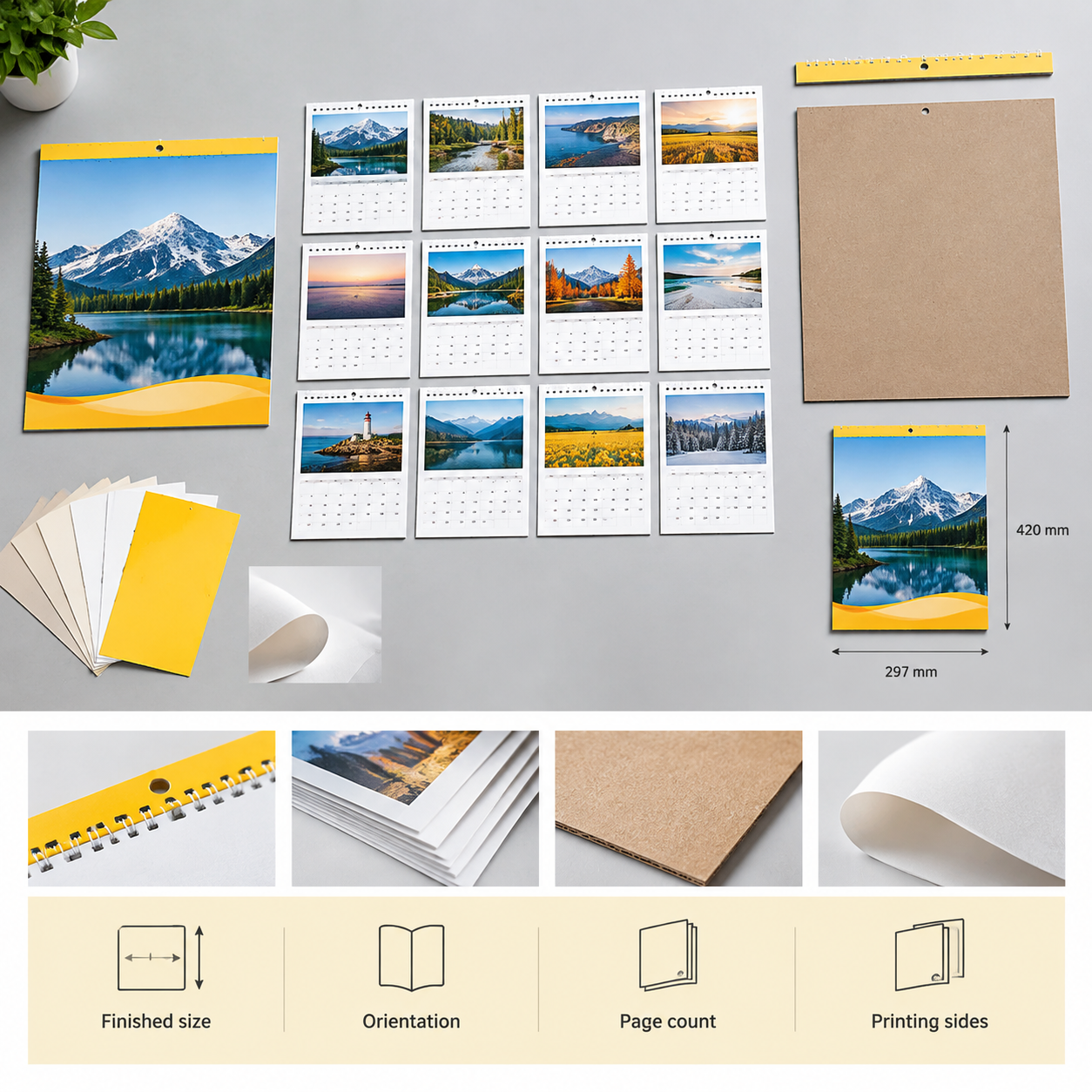
A 12-month wall calendar does not have one mandatory page count. A common Wire-O construction has 13 sheets—cover plus 12 months—but saddle-stitched calendars often use facing image-and-grid pages and therefore require a different pagination plan.
Specify the size as width × height after trimming, followed by portrait or landscape orientation and the binding edge. Also distinguish among sheets, faces, and printed pages. For example, 13 physical sheets have 26 faces even if only 13 faces are printed.
For a booklet-style calendar that hangs open, each month may occupy a two-page opening: an image above and a date grid below. Twelve openings use 24 content pages, with cover and other pages added according to the final structure. Ask the printer for an imposed page map before final artwork approval.
Cover sheets, backing boards, and optional inserts
Covers protect the first month, while backing boards add stiffness and can improve hanging stability. They should be specified separately from the monthly leaves.
A heavier cover can be laminated for handling resistance, but a thick laminated cover also affects punching and wire diameter. A backing board may be printed or plain and must fit the selected binding equipment. Optional advertising sheets, coupon pages, envelopes, or inserts need a defined position in the sequence. Loose components also require an assembly and packing method so they do not mark the calendar surface.
Wall calendar format and binding comparison table
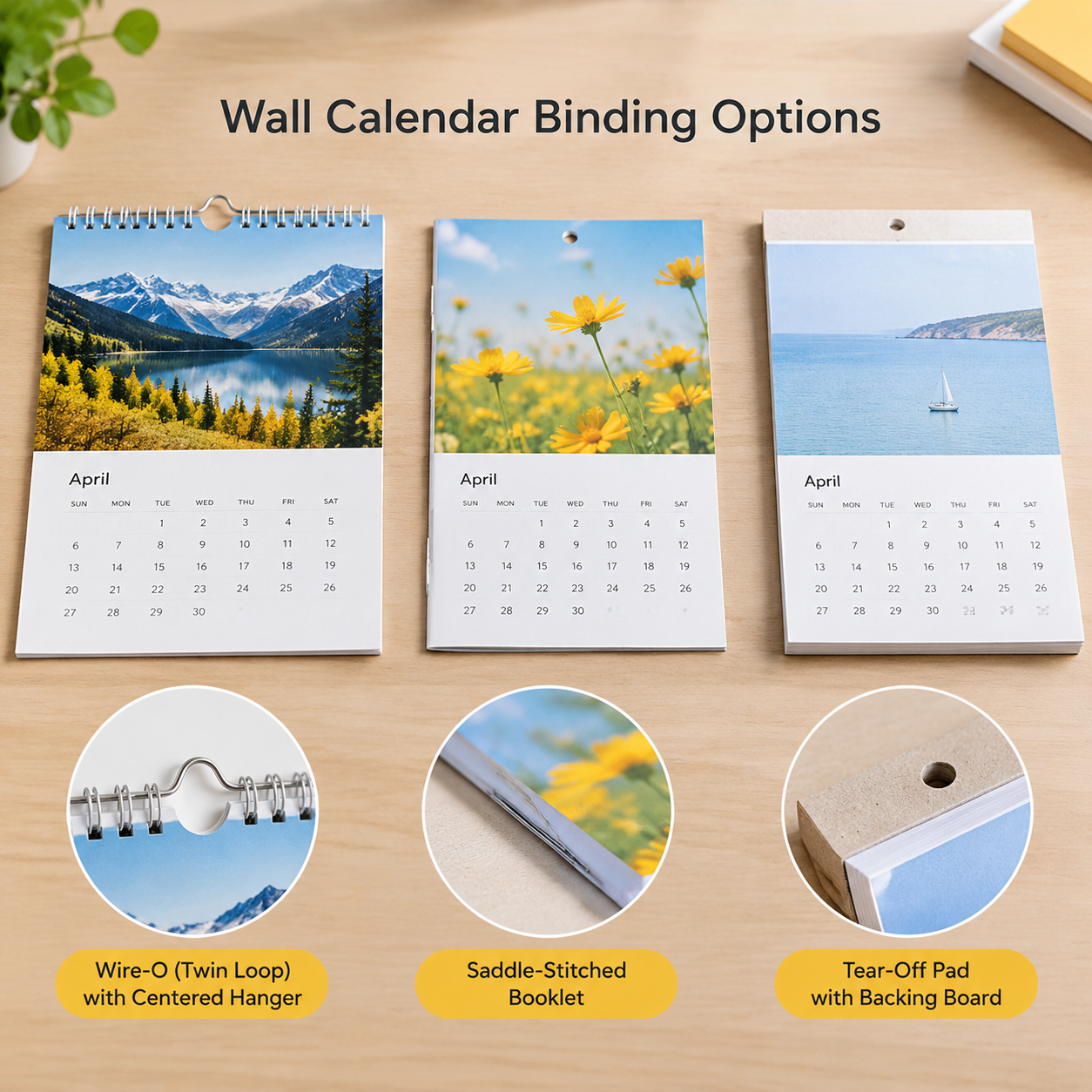
Wire-O with an integrated hanger is generally the best wall calendar binding for calendars that must turn easily and remain open. Saddle stitching is lighter and simpler, while tear-off pads suit disposable monthly sheets.
| Format | Typical construction | Main advantages | Points to confirm |
|---|---|---|---|
| Wire-O with hanger | Separate leaves punched and closed around twin-loop wire, with a centered hanger | Turns cleanly, lies flat, supports substantial covers | Wire diameter, punch pattern, hanger position, binding clearance |
| Wire-O with separate hanging hole | Wire-bound leaves plus a hole in an extended header, sheet, or backing | Can suit a specific display design | Prototype the hole location and confirm pages do not obstruct it |
| Saddle stitched | Folded nested sheets stapled through the fold, usually with a hanging hole | Lower component count and booklet-style image/grid openings | Page count in multiples of four, creep, fold behavior, hole reinforcement |
| Tear-off pad | Sheets glued at the top to a board or header | Simple month removal and large writing areas | Adhesive strength, backing stiffness, tear direction |
No format is universally best. The decision should follow intended use, monthly sheet weight, display life, and packing requirements.
Wire-O binding with a hanger versus a drilled hanging hole
A Wire-O hanger supports the calendar from the binding assembly; a drilled or punched hole supports it through the paper or backing material. The hanger is usually preferable when monthly pages must turn over the top without being removed from the wall.
The wire loop should be centered, close correctly, and leave enough space for pages to turn without catching. If a calendar hanging hole passes through paper, its diameter and distance from the edge must suit the intended nail or hook without creating an easy tear point. A physical dummy is useful because screen artwork cannot demonstrate balance, hole strength, or turning clearance.
Wire pitch—the number of binding holes per inch—and wire diameter are production decisions based on the stack thickness and equipment. Do not build final hole graphics until the printer supplies the applicable template.
When saddle stitching can suit a lighter calendar format
Saddle stitching works well for relatively light calendars designed to hang open like a booklet. It is less suitable when heavy leaves, rigid boards, or unrestricted page turning are required.
The folded sheets are nested and stapled through the spine. Page counts normally work in multiples of four, and thicker booklets experience creep, where inner sheets extend farther and require trim compensation. The hanging hole must align through the closed or open structure, depending on how the calendar will be displayed. Test the center spread, fold memory, and whether the lower half hangs flat against the wall.
How to choose paper for images, date grids, and writing
Use uncoated paper for a calendar grid that must accept pencil, ballpoint, or stamps reliably; use coated paper when image reproduction is the priority. If one sheet contains both photography and a writable grid, a matte or uncoated sample should be tested with the intended writing tools.
| Calendar paper stock | Typical use | Trade-off |
|---|---|---|
| Uncoated offset paper | Writable grids, planners, educational calendars | Easy to write on, but photographs appear softer than on coated stock |
| Matte or silk coated paper | Mixed photography and calendar information | Sharper images, but writing performance varies by coating and pen |
| Gloss coated paper | Image-led promotional calendars | Strong visual contrast, but glare and slow-drying ink can reduce usability |
| Heavy cover stock or board | Front cover, header, or backing | Adds protection and stiffness, but increases punching and shipping load |
Common starting points include medium-weight text stocks for monthly leaves and heavier stock for covers, but the correct GSM depends on size, ink coverage, binding, and expected display life. Ask for samples rather than approving by GSM alone. Also confirm that any lamination or varnish is limited to areas that do not need to be written on.
How to prepare wall calendar artwork correctly
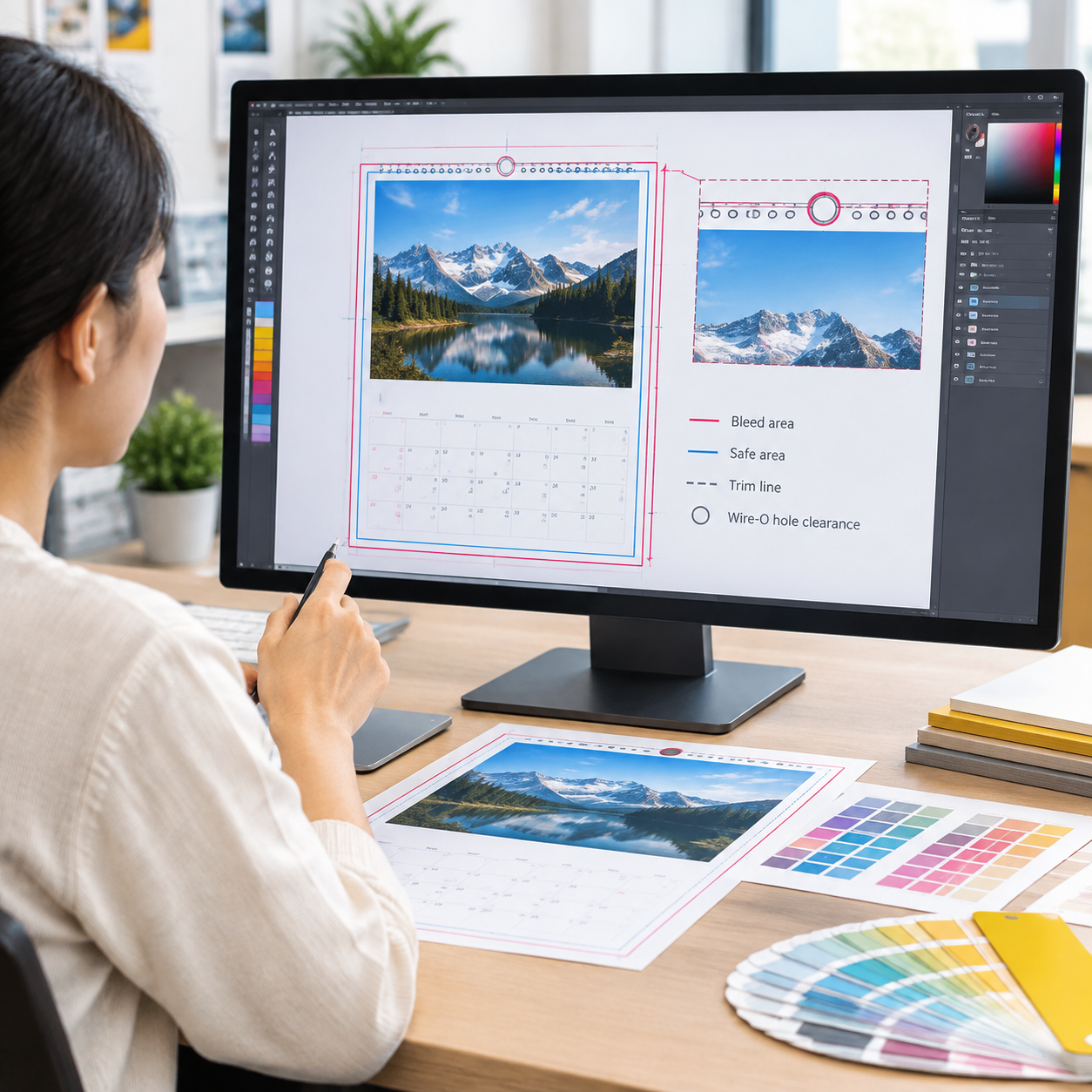
Calendar artwork setup should begin with the printer’s final-size and binding template. Build pages at finished size, add the requested bleed, use CMYK images, and submit a correctly ordered PDF with fonts embedded.
- Use approximately 300 ppi images at their placed size unless the printer specifies otherwise.
- Extend background images through the bleed, commonly 3 mm or 0.125 inch.
- Keep fine grid lines and small text as vectors where possible.
- Use a consistent black specification for small date text rather than an uncontrolled four-color black.
- Name or number pages clearly and include blank backs in the sequence when required.
- Provide special colors, foil, varnish, or die-cut elements on clearly named separate layers.
Bleed is artwork extending beyond the trim line so normal cutting variation does not expose an unintended white edge.
Keep critical content clear of trim and binding holes
As an initial planning allowance, keep critical text and logos about 12–15 mm inside the bound trim edge, then replace that assumption with the printer’s exact punch template. Critical artwork should also remain at least a few millimeters clear of the actual hole cut.
Wire-O hole size and position vary with punch tooling, pitch, paper stack, and wire diameter. Background colors and photographs may extend behind the punched area, but dates, captions, faces, and logos should not. Apply a normal safe margin on the other three trim edges as well. A centrally positioned hanger also needs a clear area if the wire or hook would visually cross a logo.
Audit every date, holiday, week start, and page sequence
The buyer or content owner should approve every date and holiday; a press inspection cannot determine whether a regional observance or campaign date is correct. Complete the content audit before color approval.
- Confirm the calendar year, leap-year status, and number of days in each month.
- Check the selected week start: Sunday, Monday, or another local convention.
- Verify weekday alignment for the first and last day of every month.
- Confirm holidays by country, state, province, religion, or audience.
- Check repeated miniature calendars showing previous or following months.
- Review page sequence against the binding direction and identify intentional blank backs.
- Proofread contact information, QR codes, promotional deadlines, and legal text.
Use a signed date-control sheet or spreadsheet independent of the designed PDF. Comparing two representations helps reveal copied grid errors that ordinary proofreading can miss.
The wall calendar production process step by step
Production should move from a locked specification to preflight, proofing, printing, finishing, assembly, inspection, and packing. Binding hardware should not be finalized independently of the paper stack.
- Lock the specification: Confirm size, sheet count, stock, printing sides, binding, hanger, finishes, quantity, and packing.
- Issue templates: Establish trim, bleed, punch zone, hanger center, and any drilled-hole position.
- Preflight files: Check dimensions, color mode, image resolution, fonts, overprint settings, and page order.
- Approve proofs: Review date content, pagination, color expectations, finishing placement, and a construction dummy where appropriate.
- Print the sheets: Use digital or offset production according to quantity, format, quality requirements, and the approved plan.
- Finish and trim: Apply approved lamination, varnish, or other finishes before final trimming and punching as required.
- Bind and assemble: Punch the stack, insert the wire and hanger, close the wire, and add loose components.
- Inspect and pack: Test page turning and hanging, check sequence and appearance, then protect corners and wire for shipment.
See Lemon Printing’s commercial printing process for the broader workflow from specification review through export preparation.
Proofing checkpoints that prevent a full-run date error
Use separate approvals for content, print appearance, and mechanical construction. One proof rarely demonstrates all three accurately.
- PDF proof: Best for text, dates, page order, trim position, and obvious file problems.
- Printed color proof: Useful for judging images and brand colors within the stated proofing method’s limits.
- Bound dummy or prototype: Shows actual size, page turning, binding clearance, hole position, and hanging balance.
- Production sample or press approval: Confirms the approved production setup but should not be the first date audit.
Record approvals by file version and date. If one month is corrected, regenerate and review the complete PDF rather than approving an isolated replacement page. Lemon Printing’s printing quality control process covers checks at prepress, production, post-press, and packing stages, but buyers remain responsible for approving supplied calendar content.
How calendars should be packed to protect wire and corners

Calendar packaging should prevent pressure on the Wire-O edge and stop the calendar corners from carrying the full shipping load. A calendar that leaves the bindery flat can arrive unusable if cartons allow movement or compression.
- Use an individual bag, paper sleeve, shrink wrap, or fitted carton according to retail and environmental requirements.
- Add flat divider sheets or pads so wire loops do not mark neighboring covers.
- Select cartons that fit closely without squeezing the hanger or binding edge.
- Use corner and edge protection for large or heavy formats.
- Set a carton weight that can be handled without dropping or corner impact.
- Consider palletization, moisture protection, and stacking limits for export shipments.
Retail presentation packing and export transit packing serve different purposes. If calendars will be mailed individually after arrival, test the mailing pack separately from the master carton. The packing specification should state units per inner pack, units per carton, carton labeling, pallet requirements, and any plastic-free preference.
Custom wall calendar printing quote checklist
A bulk wall calendar quote needs enough detail to calculate material use, printing, binding labor, packing volume, and freight. Send the following information in one specification sheet:
- Calendar type and intended use
- Order quantity and any split delivery quantities
- Finished width × height, orientation, and bound edge
- Number of physical sheets, printed pages, and printing sides
- Color specification, including any spot colors
- Paper type and GSM for leaves, covers, and backing
- Binding style, wire color, hanger type, or hanging-hole requirements
- Lamination, varnish, foil, die cutting, or other finishing
- Individual packing and master-carton requirements
- Delivery country, city, postal code, and preferred shipping terms if known
- Target arrival date and artwork readiness
- Required digital proof, physical proof, or bound dummy
Attach reference photos or an existing sample if the hanging mechanism is unusual. A photograph alone is not a specification, so include measurements and materials.
What changes MOQ, production time, pricing, and shipping?
Final MOQ, production time, pricing, and shipping depend on product specifications, quantity, finishing, and destination. They cannot be determined accurately from finished size alone.
Quantity and press method affect setup cost per unit. Nonstandard sizes may use paper less efficiently. Heavy stock increases material use, wire size, carton weight, and freight. Lamination, special colors, foil, unusual punching, hand-inserted components, retail boxes, and multiple versions add production steps. Physical proofs and custom tooling also need to be included in the schedule.
Shipping depends on packed dimensions as well as gross weight. Air transport may be sensitive to volumetric weight, while sea freight requires additional transit and destination planning. Provide the complete delivery address and target arrival date so production and transport options can be evaluated together.
Frequently asked questions about wall calendar printing
The answers below cover the most common questions about wall calendar binding, pagination, writable paper, artwork clearance, and quote preparation. Final construction should always be confirmed against the printer’s production template and a specification-based quote.
Get a clear quote for a custom wall calendar
A reliable wall calendar begins with a coordinated specification rather than separate choices for artwork, paper, and binding. Lock the page architecture first, obtain the binding template, audit every date, and approve a packing method that protects both wire and corners.
Lemon Printing handles prepress, printing, binding, finishing, inspection, packing, and export preparation in its self-owned facility in China’s Guangzhou–Shenzhen manufacturing corridor. Share a complete specification to receive practical production options for your calendar rather than an estimate based only on size and quantity.
FAQ
What binding is best for a custom wall calendar?
Wire-O binding with an integrated hanger is generally the most practical choice for a wall calendar that must remain open and turn easily. Saddle stitching can suit a lighter booklet-style calendar, while tear-off binding works for disposable monthly sheets. The best option depends on sheet weight, page architecture, display life, and packing.
How many pages should a 12-month wall calendar contain?
A common single-sided Wire-O calendar contains 13 sheets: one cover and 12 monthly sheets. Those 13 sheets have 26 physical faces, even if only 13 are printed. A saddle-stitched calendar with separate image and grid pages may use 24 monthly content pages plus its cover pages. Always specify sheets, faces, printed pages, and intentional blanks.
What paper should be used for a writable calendar grid?
Uncoated offset paper is usually the safest choice for writing with pencils, ballpoint pens, or stamps. Matte coated paper can provide stronger image reproduction, but it should be tested with the intended pen. Avoid gloss coatings or lamination over areas that need dependable writing performance.
How much space should artwork leave around Wire-O holes?
As a planning allowance, keep critical text, dates, faces, and logos about 12–15 mm inside the bound trim edge. Then adjust the artwork to the printer’s exact punch template and leave critical elements several millimeters clear of the actual holes. Punch position varies with tooling, pitch, paper stack, and wire diameter.
What details are required for a bulk wall calendar quote?
Provide the quantity, finished size, orientation, bound edge, sheet and page count, printing sides, colors, paper and GSM, cover or backing, binding, wire color, hanger or hole, finishing, individual packaging, carton requirements, delivery destination, target date, artwork status, and proofing needs. Final MOQ, timing, price, and shipping depend on these specifications.
Get a Clear Quote for Your Printing Project
Send Lemon Printing your product type, quantity, finished size, page count, materials, binding or finishing requirements, packing needs, delivery destination, and target date. Our team will review the specifications and normally respond within one business day with practical production options, pricing, and a project timeline. A free prepress file check can also be arranged for supplied calendar artwork.