Brochure Printing · Formats & construction
Door Hanger Printing
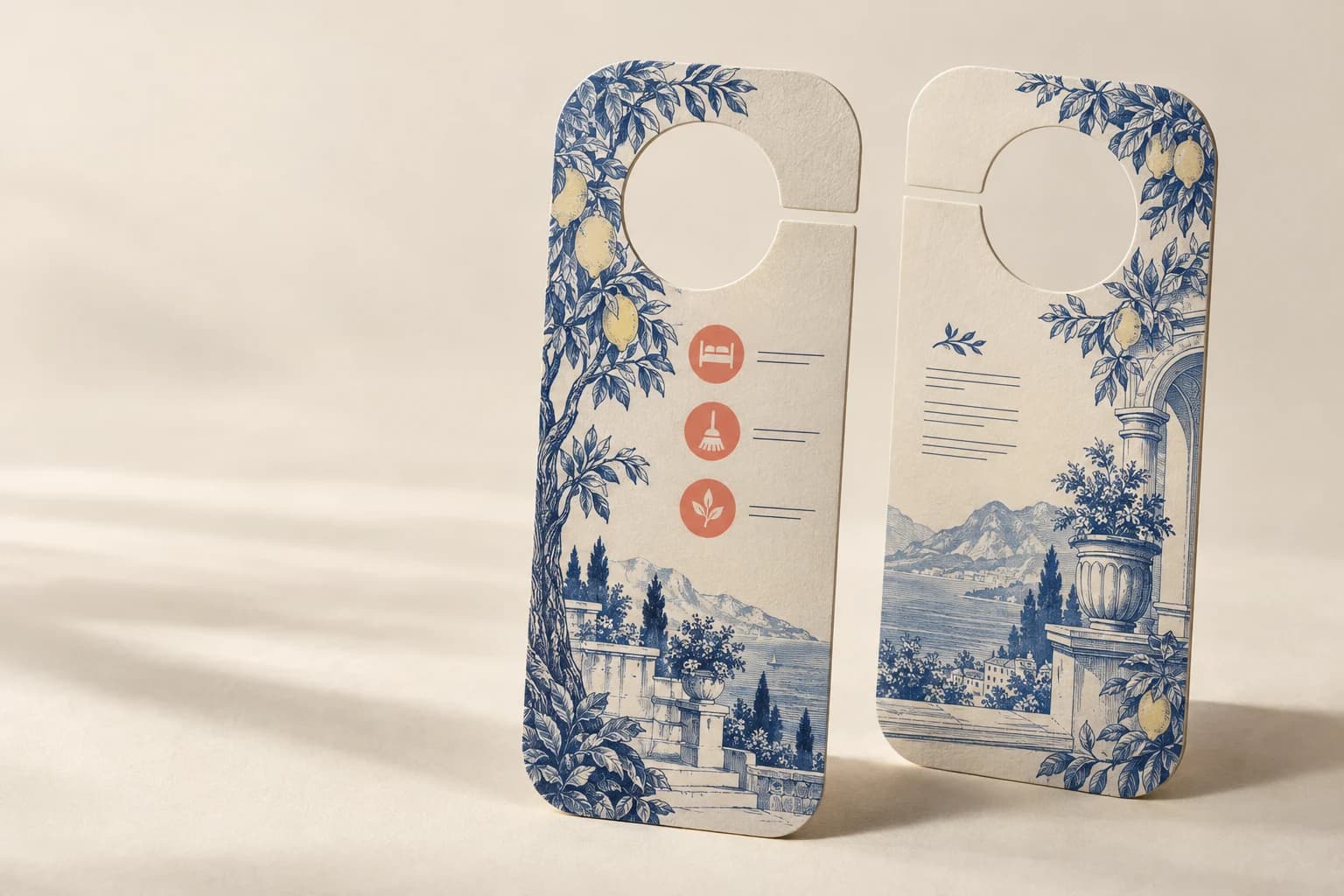
Door hangers use a shaped opening or slit to fit a door handle while presenting a message.
- Dimensioned hole, entry slit and neck width
- Coated card
- Hotel message
Start with the intended use, finished size and quantity. The material and construction can follow.
The product in use
A visible message shaped around the intended handle
A door hanger carries a visible message on a card shaped to fit a handle. The opening, entry slit and remaining neck form its attachment structure. The message panels and hanging direction are composed around that cutout and the intended hardware.
What makes up the finished product?
- Message panels
- The printed face is read while the card hangs from the intended handle.
- Hole and entry slit
- The cut opening provides installation access; its remaining neck carries the card.
- Card structure
- Stiffness and cut geometry work together to resist bending and tearing during use.
Specifications and materials
Door Hanger Printing specifications
Use these reference options to build the project brief. Dimensions are design examples; material availability, tooling and production timing depend on the confirmed specification.
| Parameter | Reference or option | Why it matters |
|---|---|---|
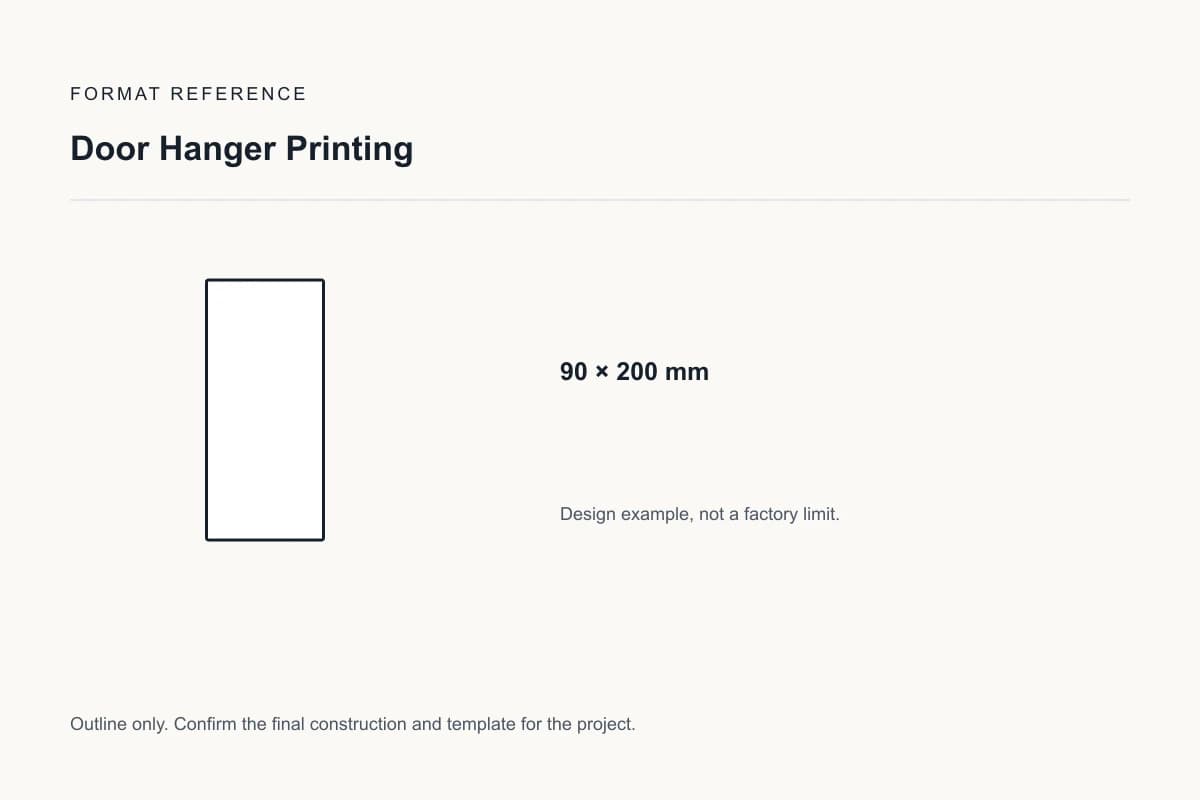
| Finished dimensions | 90 × 200 mm | This layout example needs a separately dimensioned handle hole and slit. Design reference, not a factory limit. |
| Handle opening | Dimensioned hole, entry slit and neck width | The hole must fit the handle while leaving enough material around the slit to resist tearing. |
| Print and functional layout | Print sides, writing areas, code areas and any numbered versions | Check the design at final size using the pen, printer, handle or display position it is intended for. |
| Converted dimensions | Finished size, flat layout and separate cut, fold, glue or perforation positions | A visible panel or finished rectangle does not determine the whole production template. |
| Material construction | Coated card or Uncoated card | Compare the actual grade and construction. Compare a trimmed sample for stiffness and surface handling. |
| Format and order unit | complete finished pieces or assembled sets per artwork version | List components and versions separately so quantities refer to the same finished unit. |
| Finishing choice | Coating can protect indoor handling surfaces; outdoor exposure needs a specific material assessment. | Approve the proposed material and process combination on an appropriate sample. |
Compare the material and its effect.
Choose the surface and construction for the way the finished product will be used. The options below are selection references, not a guaranteed inventory list.
Coated card
300 or 350 g/m² supplier reference grades
Smooth coated card supports printed illustrations. Equal GSM does not ensure equal thickness, rigidity or opacity.
Sample check: Compare a trimmed sample for stiffness and surface handling.
Uncoated card
White or colored uncoated card
An open surface suits handwriting and a tactile finish. Ink appearance and fine detail change with the surface.
Sample check: Test the intended pen or stamp on the finished surface.
Selected sample focus — Coated card: Compare a trimmed sample for stiffness and surface handling.
Format & usable space
Door Hanger Size, Handle Hole & Slit Geometry
90 × 200 mm
This layout example needs a separately dimensioned handle hole and slit.
This is a design reference, not a required size or a manufacturing limit.
Handle opening
Dimensioned hole, entry slit and neck width
The hole must fit the handle while leaving enough material around the slit to resist tearing.
View the original format reference
Surface finish options
Display panels and printed faces
Compare low-glare film and a brighter gloss alternative under the intended lighting. Check creases, trimming and surface cleaning needs. These options do not establish outdoor durability or waterproof performance.
 Matte lamination View effect & artwork guidance
 Gloss lamination View effect & artwork guidance
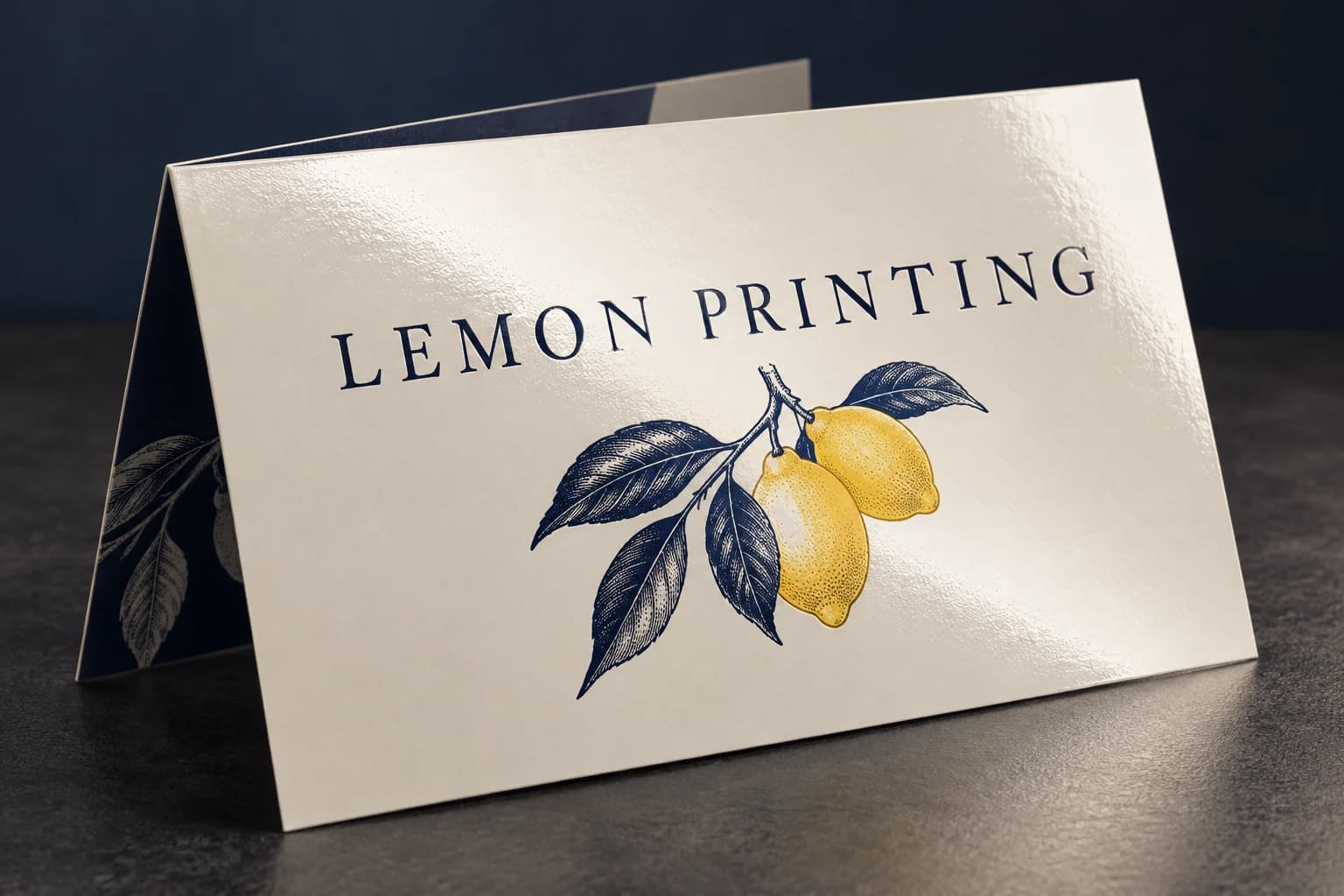 Varnish & coating View effect & artwork guidance
Illustrative finish samples, not photographs of this product. Final suitability follows the confirmed stock, construction and approved sample.
Compare all surface finishes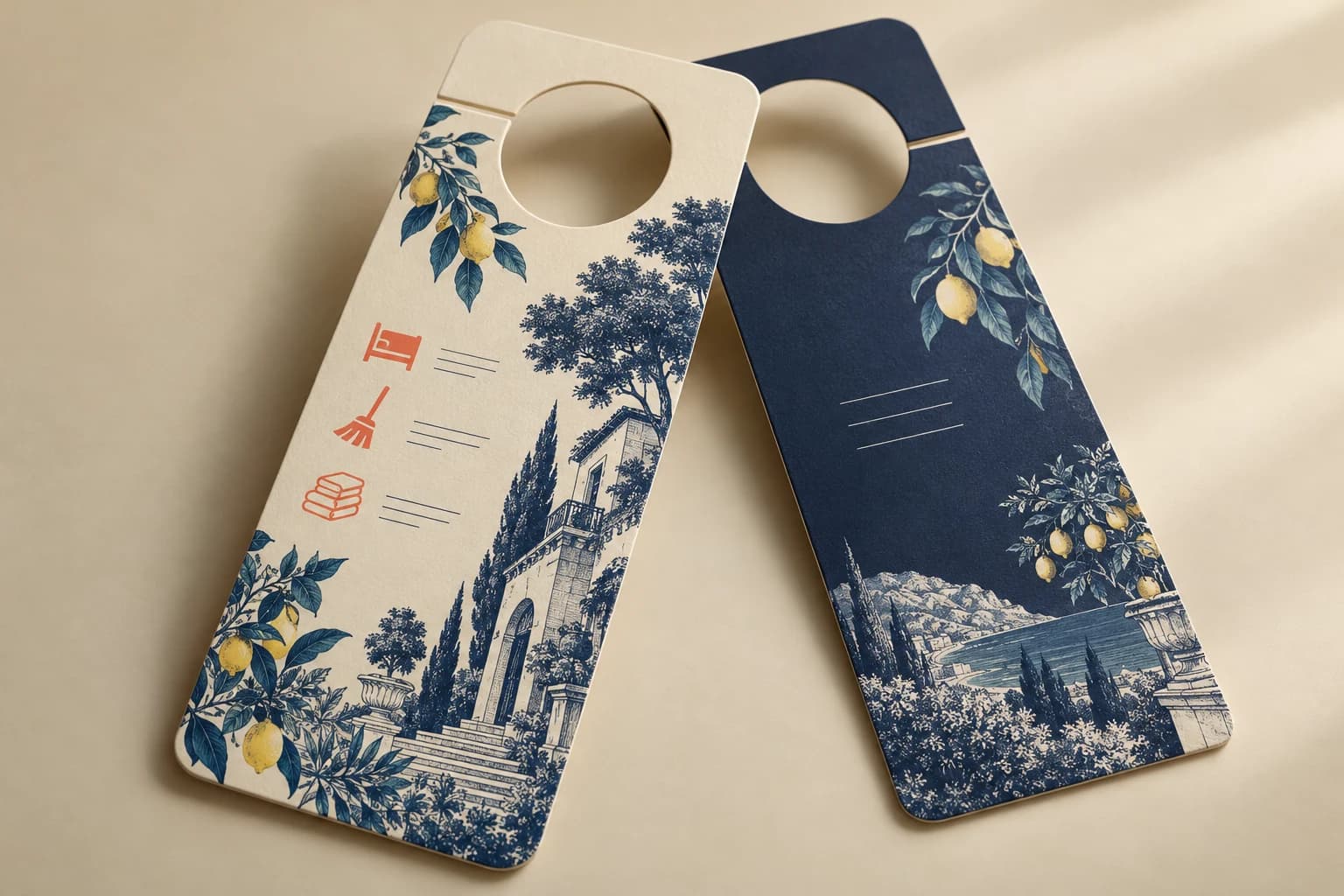
Details that change the finished product
Inspect the printed and converted format
Fit the cut to the actual handle
Measure the handle or knob and choose the cut profile around it. Leave enough material around the opening to support normal placement and removal.
Handle opening
The hole must fit the handle while leaving enough material around the slit to resist tearing. A converted sample checks the fold, cut, glued edge or other functional feature at full size.
Surface and finishing compatibility
Coating can protect indoor handling surfaces; outdoor exposure needs a specific material assessment. Smooth coated card supports printed illustrations. Equal GSM does not ensure equal thickness, rigidity or opacity. Compare a trimmed sample for stiffness and surface handling.
Hotel Messages & Promotional Door Hangers
Hotel message
Fit the hole and slit to the actual handle and test repeated placement.
Promotional hanger
Keep message space and the top neck strong enough for the distribution method.
Solve the risk before production
Check Handle Fit & Tearing at the Slit
The critical finished-product check
A hanger tears at the slit when the cut leaves a narrow neck. Revise the geometry and trial the sample on the intended handle.
The hanger does not fit the handle
Why it happens: The entry slit and hole are designed from a drawing rather than the intended hardware.
Fix and check: Trial the cut sample on the actual handle and check both installation and hanging.
When to choose another format
Door Hangers, Table Tents & Loose Handouts
| Alternative | Use and trade-off |
|---|---|
| Table Tent Printing | A tabletop display communicates from a free-standing panel instead of attaching to a handle. |
| Postcard Printing | A loose handout removes the hanging geometry and needs a different distribution plan. |
Sample and approval
Test the Cut Door Hanger on the Intended Handle
Free samples are available, with preparation completed within 15 days. Confirm the sample scope; courier arrangements and transit time are separate.
Structural sample
Checks dimensions, fit and assembly using unprinted or representative materials. It does not establish final color.
Printed proof
Checks text, image reproduction and artwork on the agreed proof medium. It may not reproduce final assembly or every finish.
Complete finished sample
A converted sample checks the fold, cut, glued edge or other functional feature at full size.
From brief to delivery
Order Details for Door Hanger Printing
Build and approve the order in five steps
Send the project brief
Send handle geometry, hole and slit drawing, placement environment and artwork versions. Include finished dimensions, quantity by version, destination and required arrival date. If a configuration is undecided, describe the intended use.
Compare the quoted configuration
Compare the same quantity basis: complete finished pieces or assembled sets per artwork version. Check that the quote identifies materials, finishing, included components, sample scope, packing and freight.
Approve the appropriate sample
A converted sample checks the fold, cut, glued edge or other functional feature at full size. A print proof checks artwork and color; a complete finished sample also checks assembly. Record what the selected sample does and does not reproduce.
Confirm files and release production
Approve the final artwork revision and the handle opening specification. Record the agreed quantity, payment conditions, packing and production schedule in the order.
Confirm packing and dispatch
Define pieces per bundle or complete assemblies, component quantities and version labels. Confirm production completion and transit as separate dates, using the delivery destination and required arrival date.
- Identify finished and flat dimensions separately. Supply a print-ready PDF with fonts embedded and cut or fold geometry on separate named layers where needed.
- Extend edge-to-edge trim artwork by 3 mm unless the approved template specifies a different bleed. Use approximately 300 effective ppi for continuous-tone images at their placed size; keep fine linework as vectors where possible.
Project questions
Planning Door Hanger Printing
Can one hole fit every door handle?
Do not assume a universal fit. Provide the target handle dimensions or a reference sample, then check placement and retention with a structural prototype before approving the artwork template.
How should I specify quantities and versions?
Count complete finished pieces or assembled sets per artwork version. State handle geometry, hole and slit drawing, placement environment and artwork versions; components, language versions and different structures must be listed separately.
What determines the minimum quantity and delivery schedule?
The selected stock, construction, finishing, version count and sample scope determine production planning. Request quantity breaks for the same configuration and an arrival-date plan that separates sampling, manufacturing and transit. No minimum or lead time is implied by the design examples above.
Specify the finished product.
Send handle geometry, hole and slit drawing, placement environment and artwork versions. Include finished dimensions, quantity by version, destination and required arrival date.