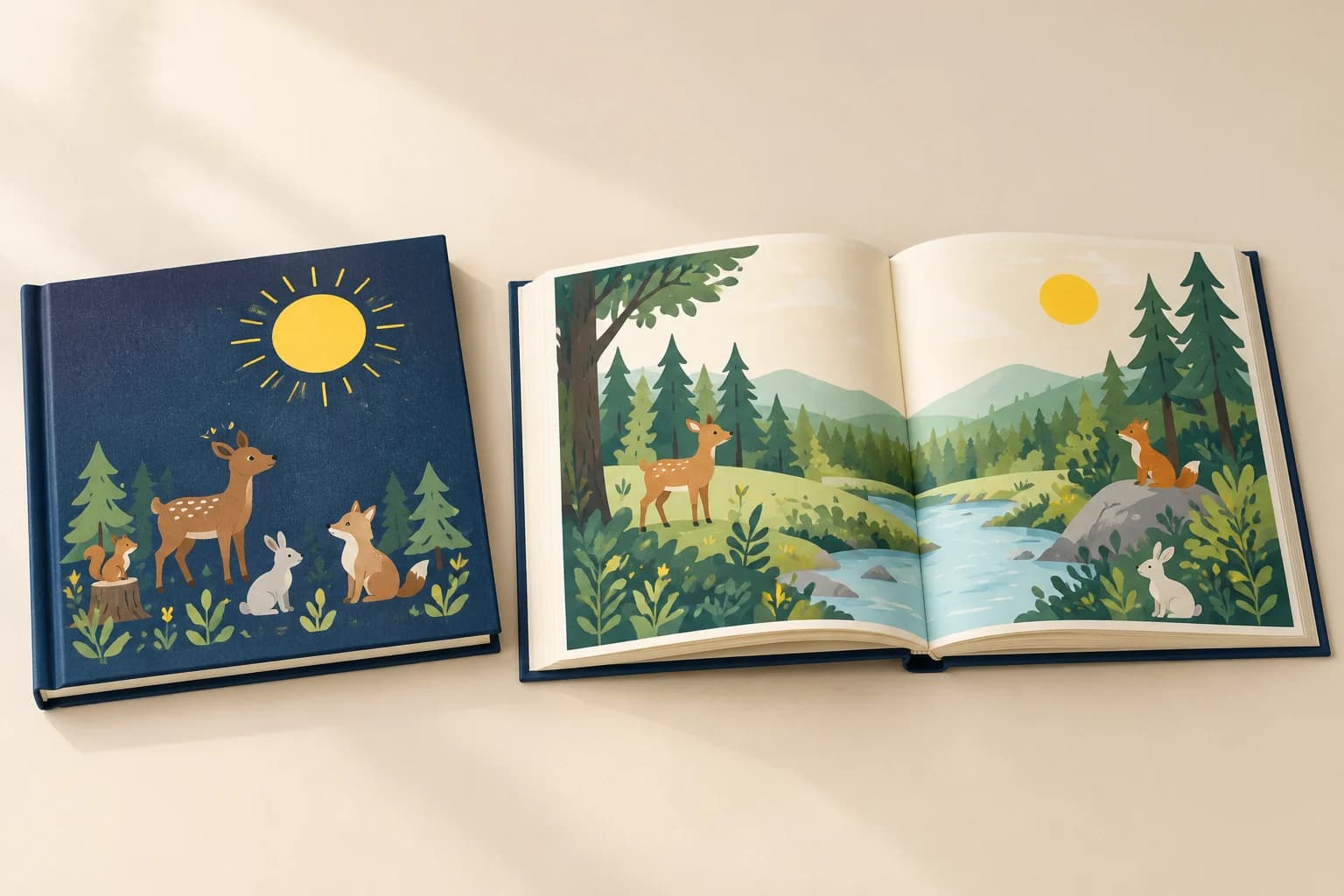
Book Printing · Formats & construction
Hardcover Children’s Book Printing
Give an illustrated story a rigid cover and a bound paper page block. Plan picture-book spreads around page turning, shared reading and the intended age group.
- Rigid case with paper reading pages
- Page sequence, endpapers and spread planning
- Age and destination inform material review
Start with the intended use, finished size and quantity. The material and construction can follow.
The product in use
A picture book with paper pages and a rigid case
A hardcover picture book uses individual paper leaves inside a separate board case. It differs from a board book, whose thick leaves form the reading pages themselves. Large illustrations and short text need room around the gutter, and the endpapers can establish the story before the first numbered page.
What makes up the finished product?
- Rigid illustrated case
- Printed cover paper wraps a separate board case.
- Endpapers
- The connecting leaves may also introduce the story or repeat a visual motif.
- Paper story pages
- The leaf construction distinguishes this product from a board book.
Specifications and materials
Hardcover Children’s Book Printing specifications
Use these reference options to build the project brief. Dimensions are design examples; material availability, tooling and production timing depend on the confirmed specification.
| Parameter | Reference or option | Why it matters |
|---|---|---|
| Trim size | 210 × 210 or 210 × 297 mm design references | Choose around illustration shape and shared-reading distance. |
| Page paper | 115, 150 or 170 g/m² coated references | Compare opacity, glare and turning behavior with the artwork. |
| Case and endpapers | Wrapped boards with separate endpapers | Endpaper artwork and page counting must be explicit. |
| Binding | Sewn or adhesive-bound paper block | Approve opening using a bound sample; hardcover is not a lay-flat guarantee. |
| Audience | Reading age and destination market | Added play features or young-child use change the compliance assessment. |
Compare the material and its effect.
Choose the surface and construction for the way the finished product will be used. The options below are selection references, not a guaranteed inventory list.
Coated picture paper
115, 150 or 170 g/m² references
Changes stiffness, opacity and image appearance.
Sample check: Read a printed spread under normal room lighting.
Cover wrap
Printed paper with selected laminate
Provides the illustrated outside surface.
Sample check: Inspect corners, film adhesion and hinge flex.
Endpapers
Paper selected for attachment and decoration
Connect the case to the block and can carry artwork.
Sample check: Do not count them ambiguously as ordinary story pages.
Selected sample focus — Coated picture paper: Read a printed spread under normal room lighting.
Format & usable space
Hardcover Children’s Book Printing: Format & Configuration
210 × 210 mm
A square design reference balances portrait characters and wider scenes.
This is a design reference, not a required size or a manufacturing limit.
Reading-page construction
Paper-leaf picture book or thick-leaf board book
Use this hardcover format for a paper-page story. For a different handling age or thick leaves, compare the board-book construction rather than adding weight indiscriminately.
See the trim proportions.
These are publishing references, not required sizes. Compare the usable page shape before adapting an existing layout.
Selected: Square picture book. Proportions only; not actual size.
Trim dimensions describe the cut page. Artwork bleed, cover overhang, tabs and modules are separate allowances.
View the original format reference
Surface finish options
Printed covers and jackets
Choose the finish for the printed cover or jacket, not automatically for the interior. Check color, rub marks, hinges and compatibility with the cover stock. Cloth and synthetic wraps need a separate material trial.
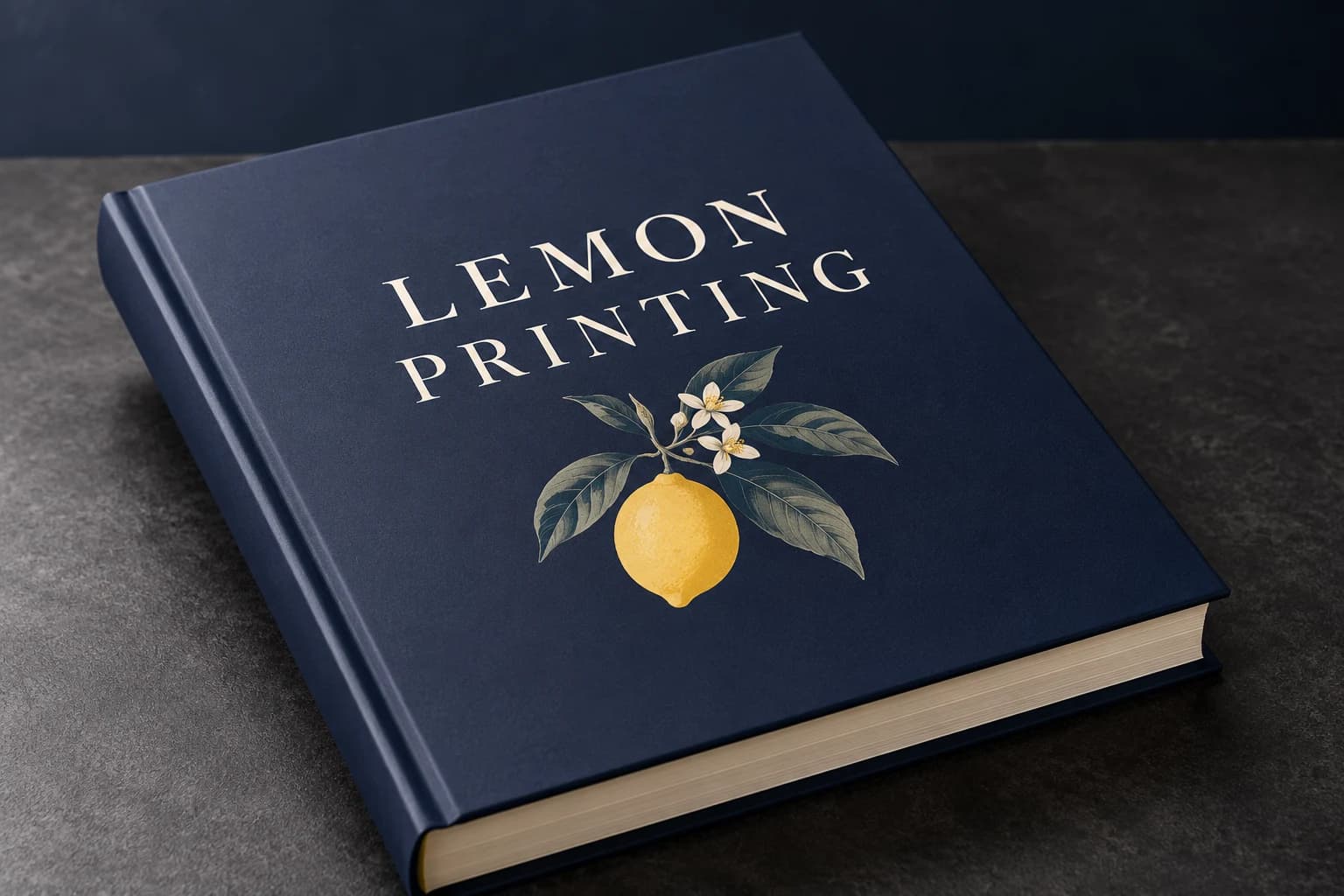 Matte lamination View effect & artwork guidance
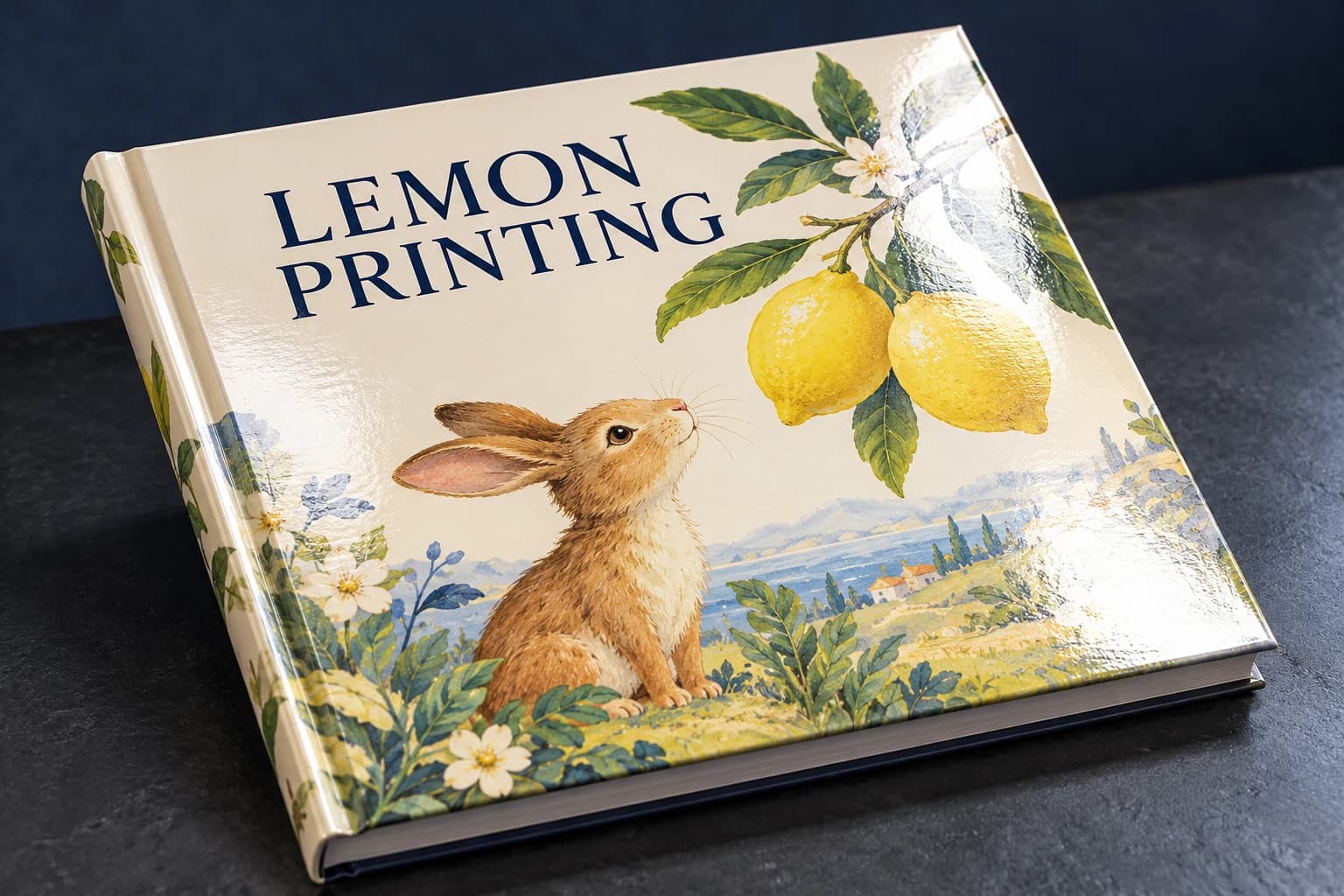 Gloss lamination View effect & artwork guidance
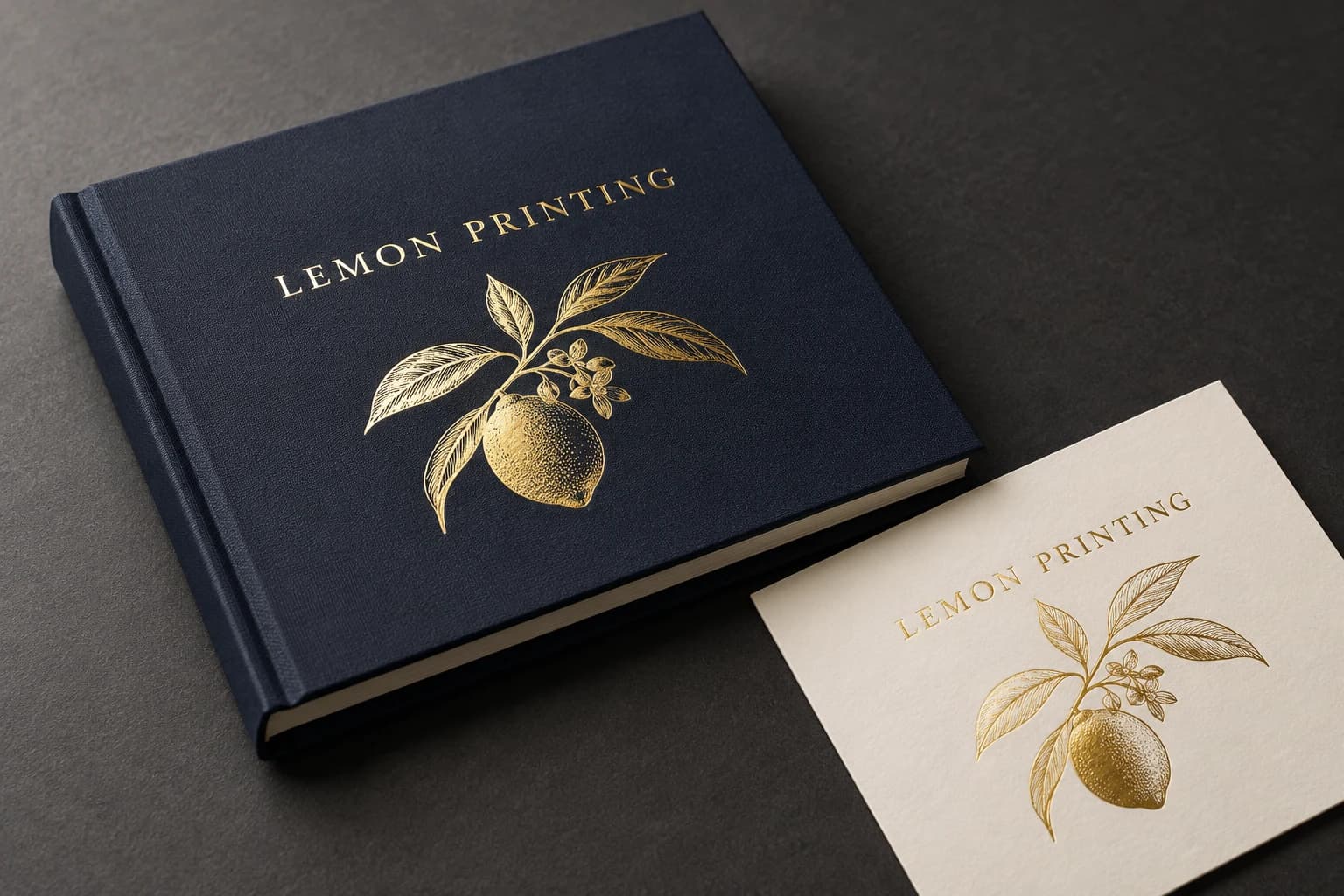 Gold foil stamping View effect & artwork guidance
 Spot UV View effect & artwork guidance
Illustrative finish samples, not photographs of this product. Final suitability follows the confirmed stock, construction and approved sample.
Compare all surface finishes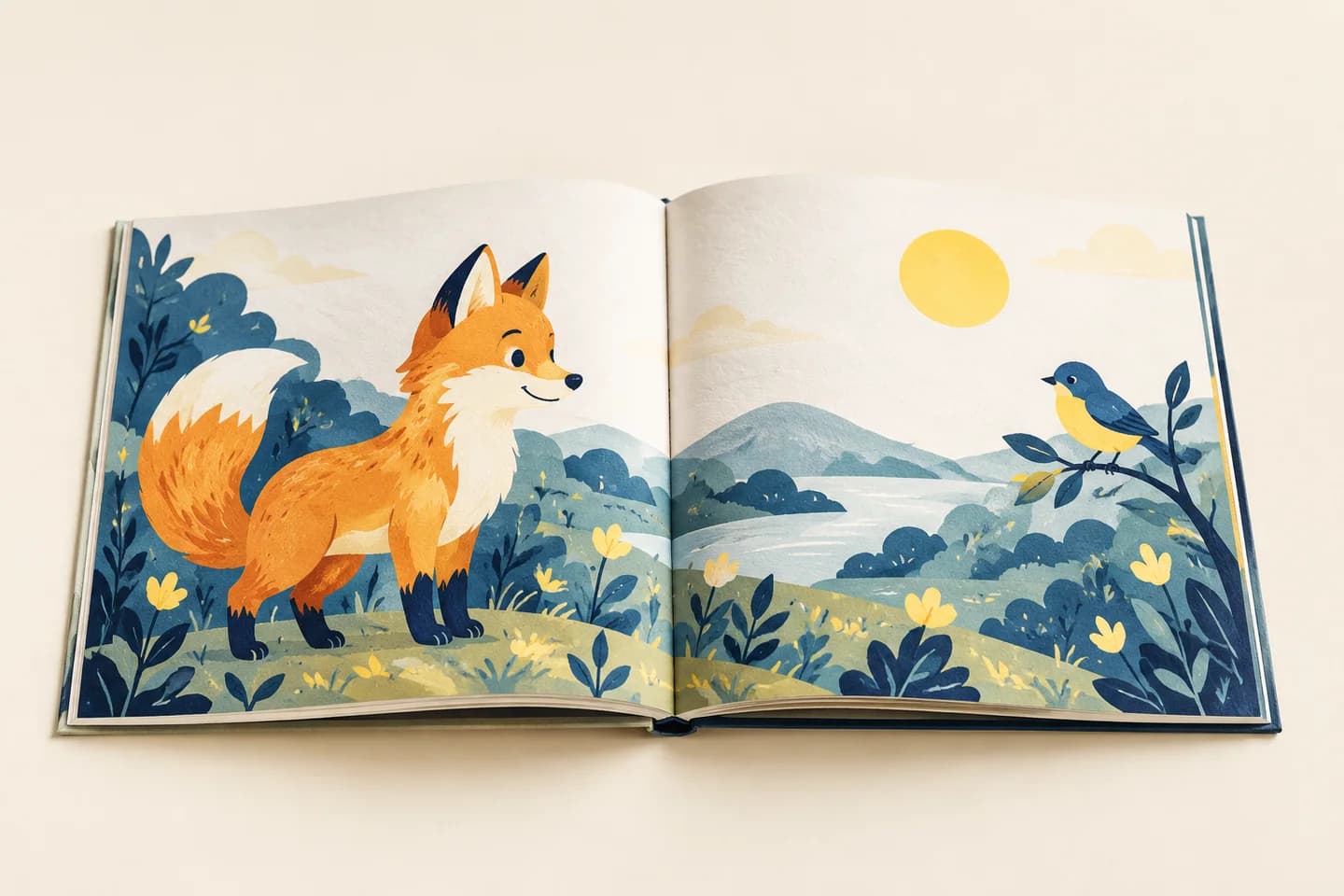
Details that change the finished product
Design the story around the bound opening
Count the story and endpapers clearly
Identify whether front matter and endpapers carry story content. The final reading-order file must preserve every intended opening.
Protect the illustration at the join
Keep faces, speech and essential action clear of the gutter. A spread reference helps review the scene, but final print files follow the agreed single-page workflow.
Select the surface for actual reading
Gloss can emphasize color but reflect overhead light. Compare glare, fine text and page opacity on the proposed stock.
Hardcover Children’s Book Printing: Uses & Configurations
Illustrated stories
Plan each opening around the story’s reveal and readable text placement.
Classroom read-alouds
Check picture scale and glare while the book is held for a group.
Gift editions
Use endpapers and a durable case design to develop the edition without adding unnecessary loose components.
Solve the risk before production
Hardcover Children’s Book Printing: Finished-Product Checks
The critical finished-product check
A character’s face or a short line of text can disappear into a tight opening. Move critical content outward, review the final bound spread and treat the center join as a design constraint.
A scene loses its key detail
Why it happens: Critical content crosses a restrictive gutter.
Fix and check: Reposition the detail and check the bound opening at normal reading angle.
The product is treated as automatically compliant
Why it happens: Age, play value or accessories are ignored.
Fix and check: Review the complete construction for the destination; obtain applicable evidence rather than inferring it from the word book.
When to choose another format
Alternatives to Hardcover Children’s Book Printing
| Alternative | Use and trade-off |
|---|---|
| Board Book Printing | Board books use thick reading leaves and a different assembly; a hardcover picture book has a rigid cover around paper pages. |
| Children's Book Printing | The wider children’s-book range helps compare reading formats; this page focuses on a rigid-case paper-page edition. |
Sample and approval
Sample & Proof Checks for Hardcover Children’s Book Printing
Free samples are available, with preparation completed within 15 days. Confirm the sample scope; courier arrangements and transit time are separate.
Structural sample
Checks dimensions, fit and assembly using unprinted or representative materials. It does not establish final color.
Printed proof
Checks text, image reproduction and artwork on the agreed proof medium. It may not reproduce final assembly or every finish.
Complete finished sample
Read the book aloud while turning every page. Check text size, picture continuity, hinge movement, endpaper sequence and the assembled material specification.
From brief to delivery
Order Details for Hardcover Children’s Book Printing
Build and approve the order in five steps
Define age and use
State audience, destination, languages and complete-book quantity.
Plan every opening
Supply trim, story pagination, endpapers and critical crossovers.
Review the bound sample
Read through for sequence, glare, text visibility and opening.
Approve materials and artwork
Record the exact components, file revision and any required evidence.
Pack by language
Protect cases and label cartons so each language edition remains identifiable.
File preparation
Artwork checklist for Hardcover Children’s Book Printing
Artwork and production workflow- Provide the complete reading-order PDF, identify blanks and separate endpaper artwork.
- Use the final case template for spine, boards, joints and turn-ins; start paper-page edge designs with the agreed bleed.
- Preserve text as embedded fonts and inspect small type and illustrations at the final size.
Project questions
Planning Hardcover Children’s Book Printing
Is this the same as a board book?
No. This format has paper reading pages in a rigid case; a board book has thick board-like reading leaves and a different construction.
Can the endpapers carry story artwork?
Yes, but identify that artwork and its reading order explicitly. Pastedown and free-leaf areas behave differently.
Does hardcover mean safe for every child age?
No. Age, materials, play features and destination requirements need an assessment of the complete product.
Will all illustrated spreads open flat?
No. Paper, block construction and the case attachment affect opening. Review the actual critical spreads in a bound sample.
Specify the finished product.
Send the intended age range and destination, trim, page count, complete books per language, interior artwork and cover plan. Identify interactive parts separately.