Brochure Printing · Formats & construction
Invoice Book Printing
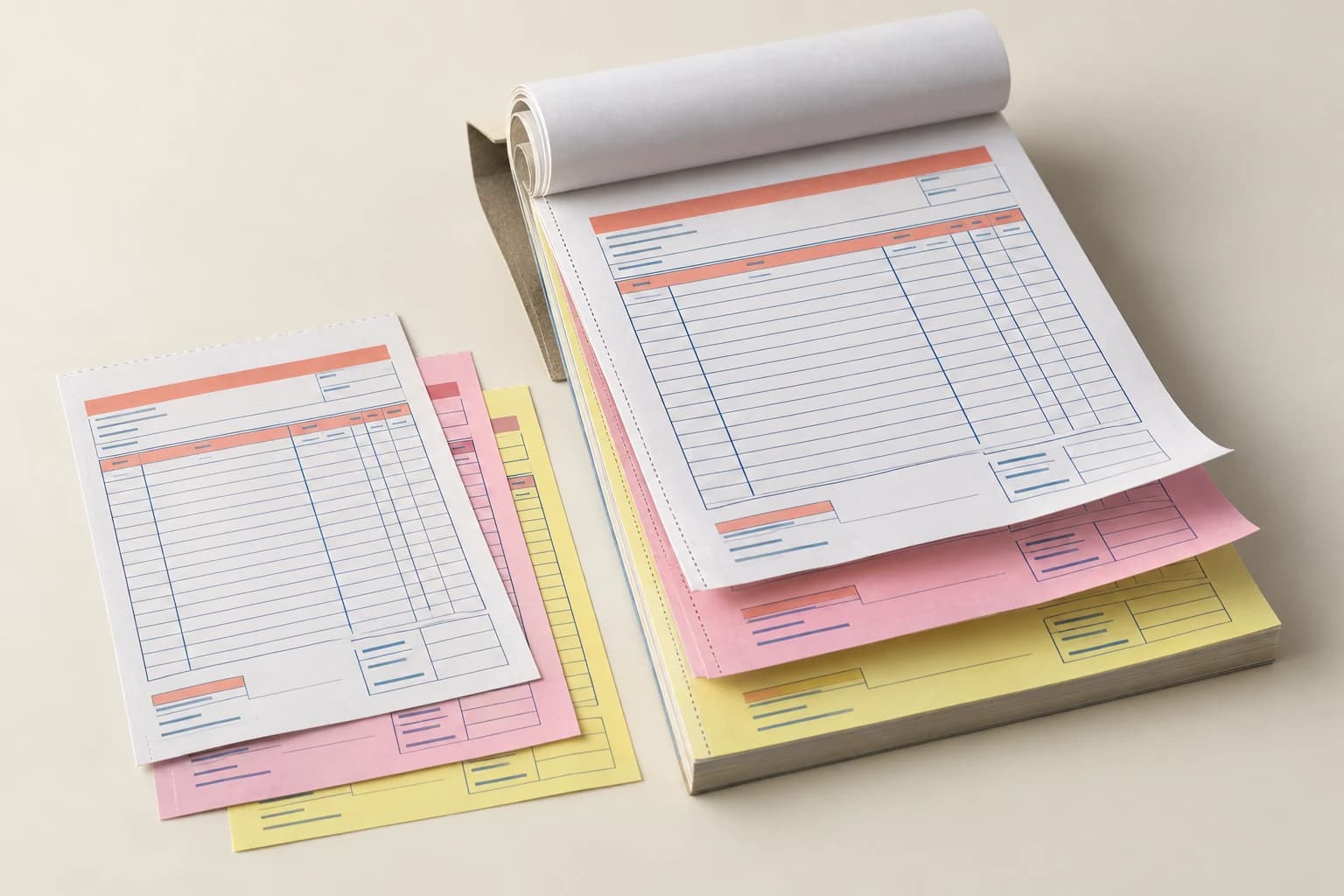
Invoice books organize repeated forms into removable or retained sets.
- Two-part CB/CF or three-part CB/CFB/CF; sets per book
- Two-part carbonless set
- Two-part transaction
Start with the intended use, finished size and quantity. The material and construction can follow.
The product in use
Numbered carbonless sets with a defined retained copy
An invoice book keeps pressure-transfer record sets in a bound sequence. A two-part set uses a CB top sheet and CF receiving sheet; a three-part set adds a CFB middle layer. Numbering, perforation and the retained copy connect the printed form to the recordkeeping workflow.
What makes up the finished product?
- Transfer set
- CB/CF or CB/CFB/CF layers form a complete pressure-transfer record set.
- Numbering and form fields
- Matching sheet identifiers keep the transaction and its copies connected.
- Bound and detachable edges
- Binding retains the book; perforation determines which completed copies detach.
Specifications and materials
Invoice Book Printing specifications
Use these reference options to build the project brief. Dimensions are design examples; material availability, tooling and production timing depend on the confirmed specification.
| Parameter | Reference or option | Why it matters |
|---|---|---|
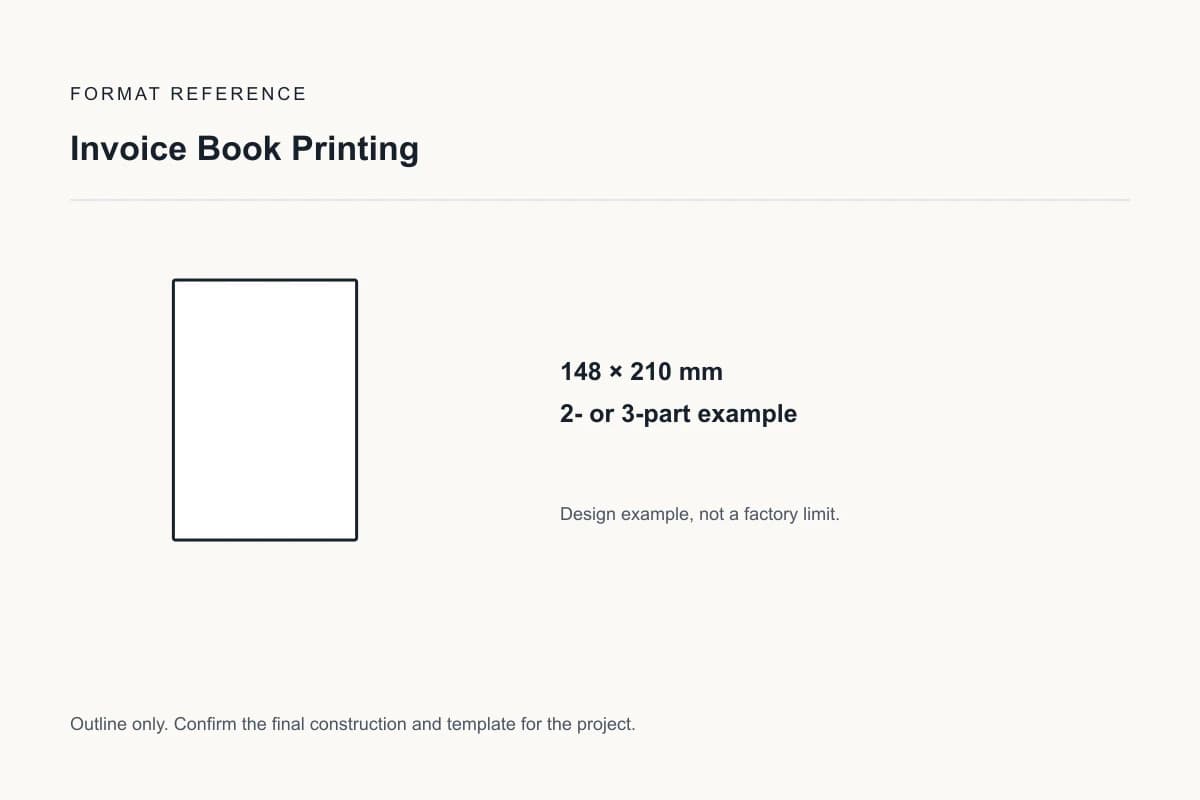
| Finished dimensions | 148 × 210 mm; 2- or 3-part example | An A5 example supports a compact form; the number of parts is separate from sets per book. Design reference, not a factory limit. |
| Set composition | Two-part CB/CF or three-part CB/CFB/CF; sets per book | Copy transfer relies on coated faces and sequence; retained copies and perforations need their own positions. |
| Print and functional layout | Print sides, writing areas, code areas and any numbered versions | Check the design at final size using the pen, printer, handle or display position it is intended for. |
| Converted dimensions | Finished size, flat layout and separate cut, fold, glue or perforation positions | A visible panel or finished rectangle does not determine the whole production template. |
| Material construction | Two-part carbonless set or Three-part carbonless set | Compare the actual grade and construction. Write on the top sheet and inspect the matching lower copy. |
| Format and order unit | assembled books, with parts per set and sets per book stated separately | List components and versions separately so quantities refer to the same finished unit. |
| Finishing choice | Perforation and padding need a removal check; a protective writing guard can prevent marking the next set. | Approve the proposed material and process combination on an appropriate sample. |
Compare the material and its effect.
Choose the surface and construction for the way the finished product will be used. The options below are selection references, not a guaranteed inventory list.
Two-part carbonless set
CB top sheet + CF receiving sheet
Pressure transfers a mark from the top sheet to the receiving sheet. The coating sequence is part of the construction.
Sample check: Write on the top sheet and inspect the matching lower copy.
Three-part carbonless set
CB top + CFB middle + CF bottom
A coated middle sheet receives and passes on the mark, creating an additional copy within the same set.
Sample check: Verify transfer through all layers and keep each numbered set together.
Selected sample focus — Two-part carbonless set: Write on the top sheet and inspect the matching lower copy.
Format & usable space
Invoice Size, Carbonless Parts & Sets per Book
148 × 210 mm; 2- or 3-part example
An A5 example supports a compact form; the number of parts is separate from sets per book.
This is a design reference, not a required size or a manufacturing limit.
Set composition
Two-part CB/CF or three-part CB/CFB/CF; sets per book
Copy transfer relies on coated faces and sequence; retained copies and perforations need their own positions.
View the original format reference
Surface finish options
Writable sheets and functional areas
Omit added surface treatment from writing and copying areas. Confirm pen, printer or carbonless-copy performance for the specified stock and keep envelope glue and seal areas clear. Cover or backing decoration is a separate specification.
Illustrative finish samples, not photographs of this product. Final suitability follows the confirmed stock, construction and approved sample.
Compare all surface finishes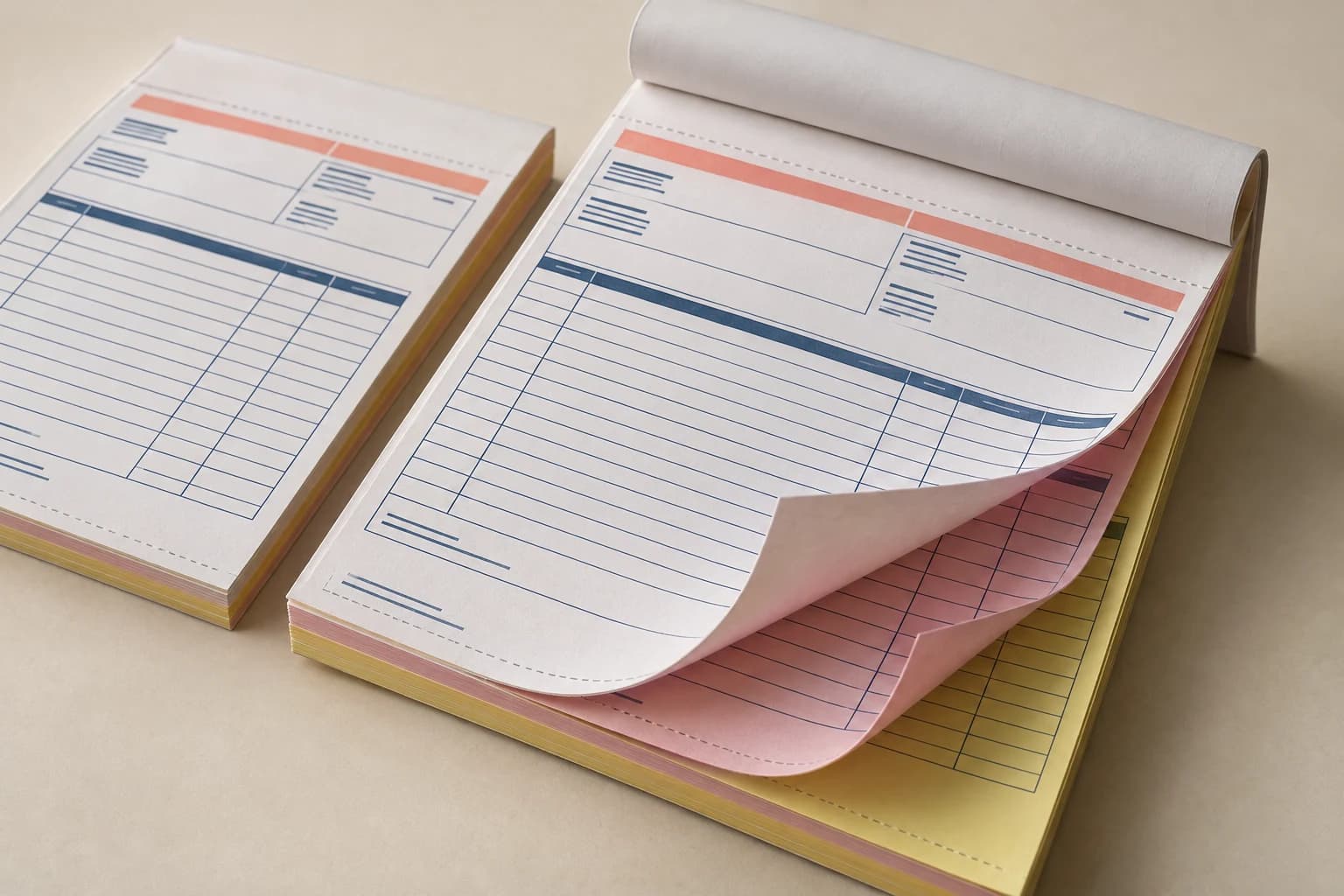
Details that change the finished product
Inspect the printed and converted format
Assemble carbonless parts in the correct order
For carbonless sets, define coated-back top sheets, coated-front-and-back middle sheets when used, and coated-front bottom sheets. Identify retained and detachable parts.
Set composition
Copy transfer relies on coated faces and sequence; retained copies and perforations need their own positions. A converted sample checks the fold, cut, glued edge or other functional feature at full size.
Surface and finishing compatibility
Perforation and padding need a removal check; a protective writing guard can prevent marking the next set. Pressure transfers a mark from the top sheet to the receiving sheet. The coating sequence is part of the construction. Write on the top sheet and inspect the matching lower copy.
Two-Part Transactions & Three-Part Records
Two-part transaction
Use CB/CF sheets, define the retained copy and verify shared numbering.
Three-part record
Use CB/CFB/CF sequence and test transfer through the assembled set with a writing guard.
Solve the risk before production
Check Copy Transfer, Sheet Order & Matched Numbers
The critical finished-product check
The lower copy can be faint or blank if sheets are reversed or the coating order is wrong. Test handwriting through a complete assembled set and verify number matching.
Copies tear away out of sequence
Why it happens: Perforation and binding leave the retained copy or numbering in the wrong position.
Fix and check: Detach a full completed set and verify which sheet remains in the book.
When to choose another format
Carbonless Invoice Books, Notepads & Tickets
| Alternative | Use and trade-off |
|---|---|
| Notepad Printing | A single-sheet pad cannot substitute for pressure-transfer duplicate records. |
| Event Ticket Printing | A detachable ticket has a different quantity and tracking workflow from a carbonless record book. |
Sample and approval
Test Handwriting through a Complete Invoice Set
Free samples are available, with preparation completed within 15 days. Confirm the sample scope; courier arrangements and transit time are separate.
Structural sample
Checks dimensions, fit and assembly using unprinted or representative materials. It does not establish final color.
Printed proof
Checks text, image reproduction and artwork on the agreed proof medium. It may not reproduce final assembly or every finish.
Complete finished sample
A converted sample checks the fold, cut, glued edge or other functional feature at full size.
From brief to delivery
Order Details for Invoice Book Printing
Build and approve the order in five steps
Send the project brief
Send parts per set, sets per book, sheet colors, retained copies and numbering range. Include finished dimensions, quantity by version, destination and required arrival date. If a configuration is undecided, describe the intended use.
Compare the quoted configuration
Compare the same quantity basis: assembled books, with parts per set and sets per book stated separately. Check that the quote identifies materials, finishing, included components, sample scope, packing and freight.
Approve the appropriate sample
A converted sample checks the fold, cut, glued edge or other functional feature at full size. A print proof checks artwork and color; a complete finished sample also checks assembly. Record what the selected sample does and does not reproduce.
Confirm files and release production
Approve the final artwork revision and the set composition specification. Record the agreed quantity, payment conditions, packing and production schedule in the order.
Confirm packing and dispatch
Define pieces per bundle or complete assemblies, component quantities and version labels. Confirm production completion and transit as separate dates, using the delivery destination and required arrival date.
- Identify finished and flat dimensions separately. Supply a print-ready PDF with fonts embedded and cut or fold geometry on separate named layers where needed.
- Extend edge-to-edge trim artwork by 3 mm unless the approved template specifies a different bleed. Use approximately 300 effective ppi for continuous-tone images at their placed size; keep fine linework as vectors where possible.
Project questions
Planning Invoice Book Printing
Are sheets and invoice sets the same quantity?
No. One set contains the specified number of parts. State sets per book, parts per set and the number of finished books; also identify which parts are retained and which are perforated for removal.
How should I specify quantities and versions?
Count assembled books, with parts per set and sets per book stated separately. State parts per set, sets per book, sheet colors, retained copies and numbering range; components, language versions and different structures must be listed separately.
What determines the minimum quantity and delivery schedule?
The selected stock, construction, finishing, version count and sample scope determine production planning. Request quantity breaks for the same configuration and an arrival-date plan that separates sampling, manufacturing and transit. No minimum or lead time is implied by the design examples above.
Specify the finished product.
Send parts per set, sets per book, sheet colors, retained copies and numbering range. Include finished dimensions, quantity by version, destination and required arrival date.