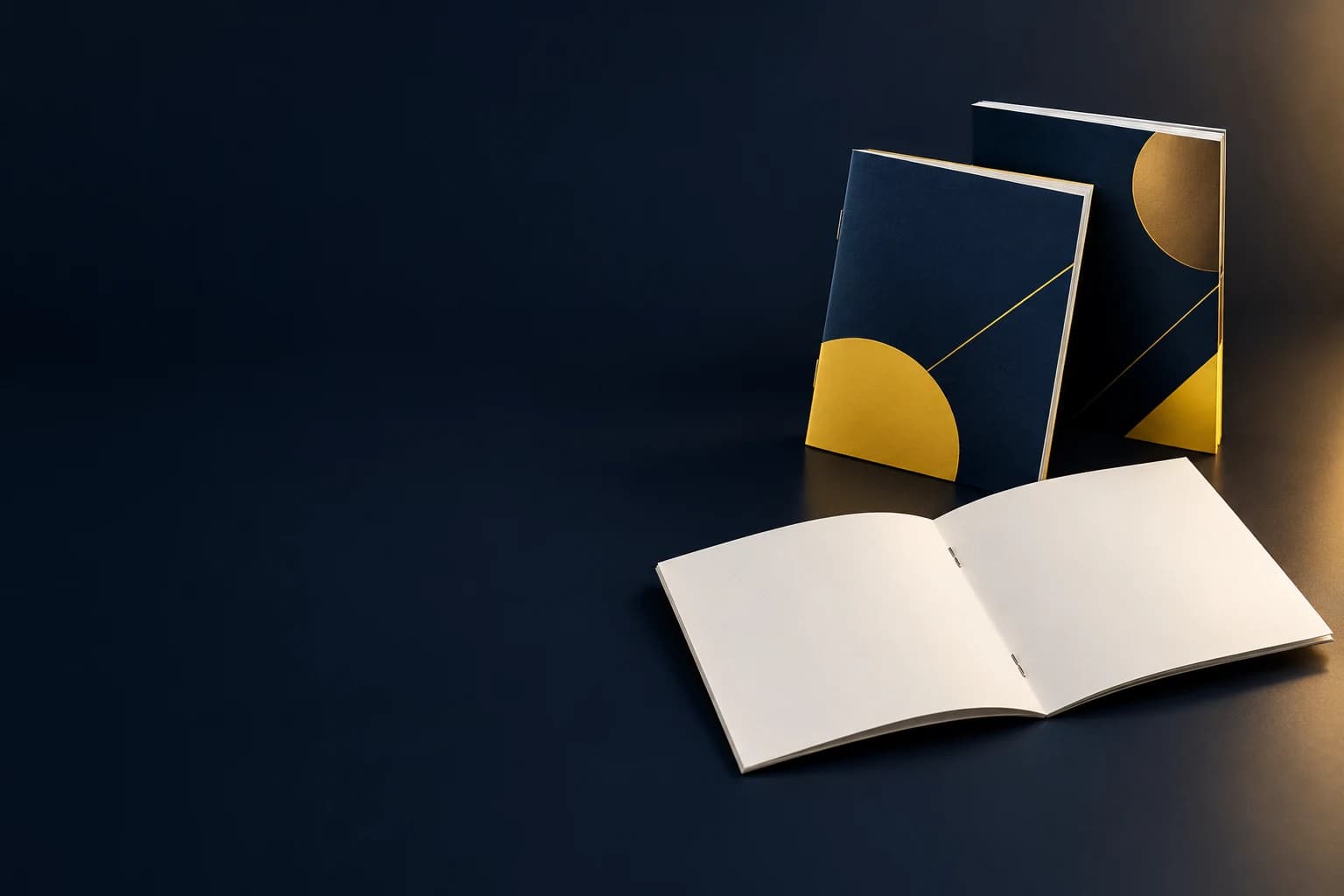
Book Printing · Formats & construction
Saddle Stitch Book Printing
Print slim books for event programs, short teaching units and illustrated editions. Choose a self-cover or a separate cover, then balance page count and paper thickness for a clean folded spine.
- Wire-stapled center fold for slim editions
- Self-cover or separate four-page cover
- Page-count and creep guidance for the chosen paper
Start with the intended use, finished size and quantity. The material and construction can follow.
The product in use
A slim folded spine with a useful center spread
Folded sheets nest inside one another and are secured through the center fold with wire staples. This gives a lightweight book without a glued, printable spine. The center spread lies across one sheet, making it useful for a map or continuous illustration; other spreads meet separate sheets and still need alignment checks. As the nested stack grows, inner sheets extend farther toward the fore-edge. That movement affects margins and trimming, so pagination and paper selection belong in the same decision.
What makes up the finished product?
- Nested folded sheets
- Each sheet contributes four page faces. Its position in the stack determines which pages meet at a spread.
- Fold-line staples
- Metal stitches secure the sheets through the center fold. This construction is distinct from a glued spine or a sewn text block.
- Self-cover or separate cover
- The outer folded sheet can match the interior, or use a different heavier grade. A separate cover still contributes four counted faces.
Specifications and materials
Saddle Stitch Book Printing specifications
Use these reference options to build the project brief. Dimensions are design examples; material availability, tooling and production timing depend on the confirmed specification.
| Parameter | Reference or option | Why it matters |
|---|---|---|
| Finished dimensions | A5: 148 × 210 mm; A4: 210 × 297 mm; half-letter: 139.7 × 215.9 mm | Reference formats, not factory size limits. Landscape formats change the fold direction and layout. |
| Format and component count | Nested folded sheets; wire staples through the center fold | Count complete books, not loose sheets. The folded spine has no square surface for a conventional spine title. |
| Pagination | Total page counts in multiples of four; examples: 16, 24, 32 or 48 pages | One sheet folded once gives four pages. Blank pages and cover faces count; these examples are not an approved page range. |
| Coated interior stock | 115, 130 or 150 g/m² coated art paper as selection references | Smooth image reproduction; added sheet mass and caliper increase spine bulk. Supplier grades do not establish Lemon inventory. |
| Cover construction | Self-cover on the interior stock, or a separate four-page cover; 200 or 250 g/m² coated cover references | A separate cover adds stiffness and may need creasing. Its four faces must be included in the page plan. |
| Writing surface | Woodfree uncoated paper, selected by opacity and actual caliper | Useful for exercises and notes. Check show-through with the darkest reverse-side content; GSM alone cannot predict it. |
| Print and surface options | CMYK artwork; named spot-color separations where required; matte or gloss cover lamination | Choose a proof on the intended surface and keep handwritten areas free of film. Do not assign a color tolerance without a measured reference. |
| Artwork preparation | Reading-order PDF pages; 3 mm trim bleed as the project starting brief; approximately 300 effective ppi for photographs | Use the approved template and output profile. Keep fine linework as vectors; prepress applies imposition and measured creep. |
Compare the material and its effect.
Choose the surface and construction for the way the finished product will be used. The options below are selection references, not a guaranteed inventory list.
Coated picture pages
115, 130 or 150 g/m² supplier reference grades
A smooth coated sheet supports photographic detail; heavier sheets increase the nested stack.
Sample check: Compare the same image on candidate surfaces and measure the chosen caliper before deciding the page plan.
Uncoated exercise pages
Woodfree uncoated; selected by opacity and caliper
An unlaminated surface suits notes and exercises, while dense reverse-side printing can show through.
Sample check: Test writing and dark reverse-side artwork on the proposed grade rather than selecting by GSM alone.
Separate cover
200 or 250 g/m² coated cover references
Adds stiffness and a distinct outside surface. The crease and any laminate must still flex at the fold.
Sample check: Inspect the folded cover for whitening, cracking or film lift before adopting the finish.
Selected sample focus — Coated picture pages: Compare the same image on candidate surfaces and measure the chosen caliper before deciding the page plan.
Format & usable space
Match the format, cover and page plan
A5 portrait: 148 × 210 mm
A5 makes a compact program or short reading book. A4 gives diagrams more space; half-letter aligns with US document formats. Choose the reading area first, then check how the finished format fits the press sheet.
This is a design reference, not a required size or a manufacturing limit.
Cover counting example
16 interior pages + four cover pages = 20 total pages
Use a self-cover when every sheet should feel consistent. Choose a separate heavier cover when the outside needs more stiffness; count its four pages independently from the interior. That is five folded sheets in the complete book. The arithmetic describes pagination, not usable thickness or press-sheet yield.
See the trim proportions.
These are publishing references, not required sizes. Compare the usable page shape before adapting an existing layout.
Selected: Compact program. Proportions only; not actual size.
Trim dimensions describe the cut page. Artwork bleed, cover overhang, tabs and modules are separate allowances.
View the original format reference
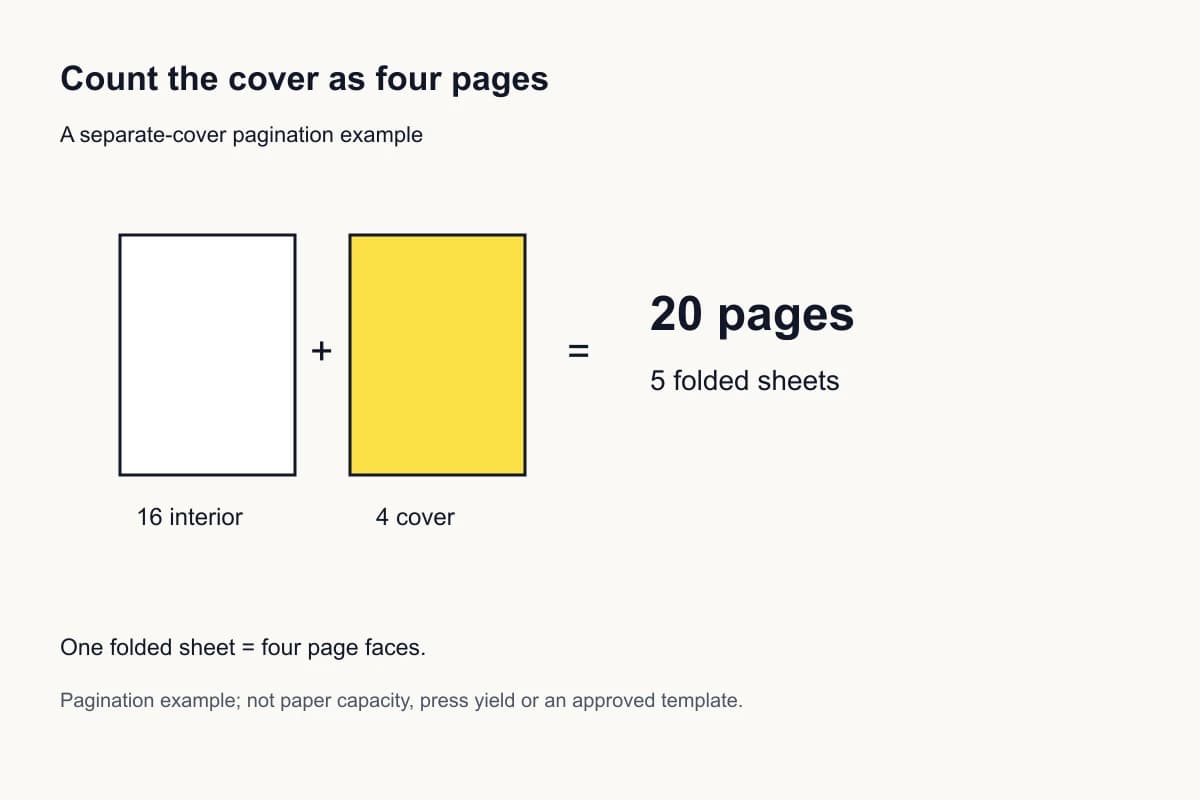
Build a four-page pagination plan
One sheet folded once creates four page faces. A separate cover adds four faces; a self-cover is already included in the total.
20 total pages
5 folded sheets per complete book
16 interior + 4 cover pages
These are counting examples, not approved page limits. They do not calculate creep, paper capacity, press-sheet yield or price. Blank pages count; check the measured paper stack before production.
Surface finish options
Printed covers and jackets
Choose the finish for the printed cover or jacket, not automatically for the interior. Check color, rub marks, hinges and compatibility with the cover stock. Cloth and synthetic wraps need a separate material trial.
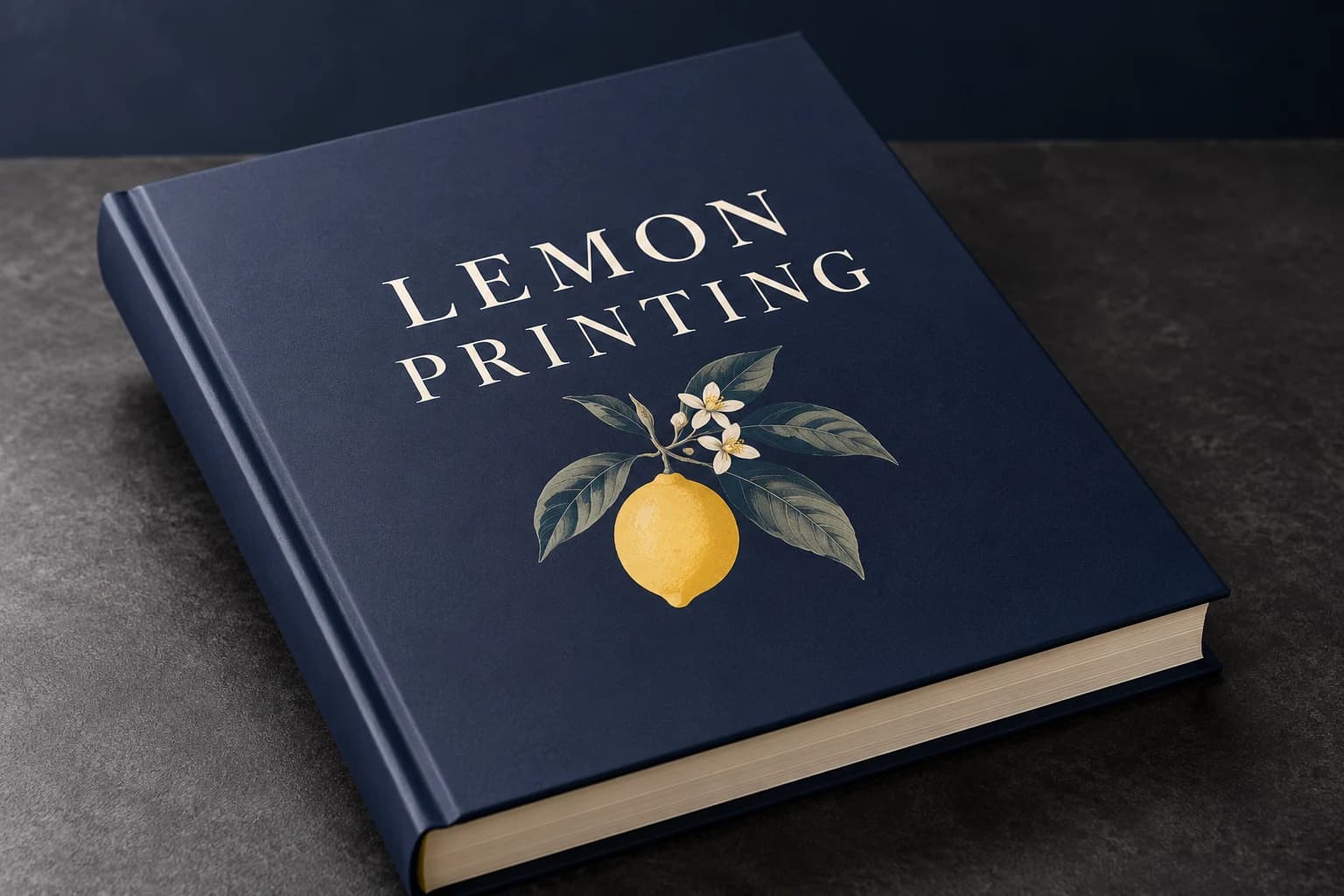 Matte lamination View effect & artwork guidance
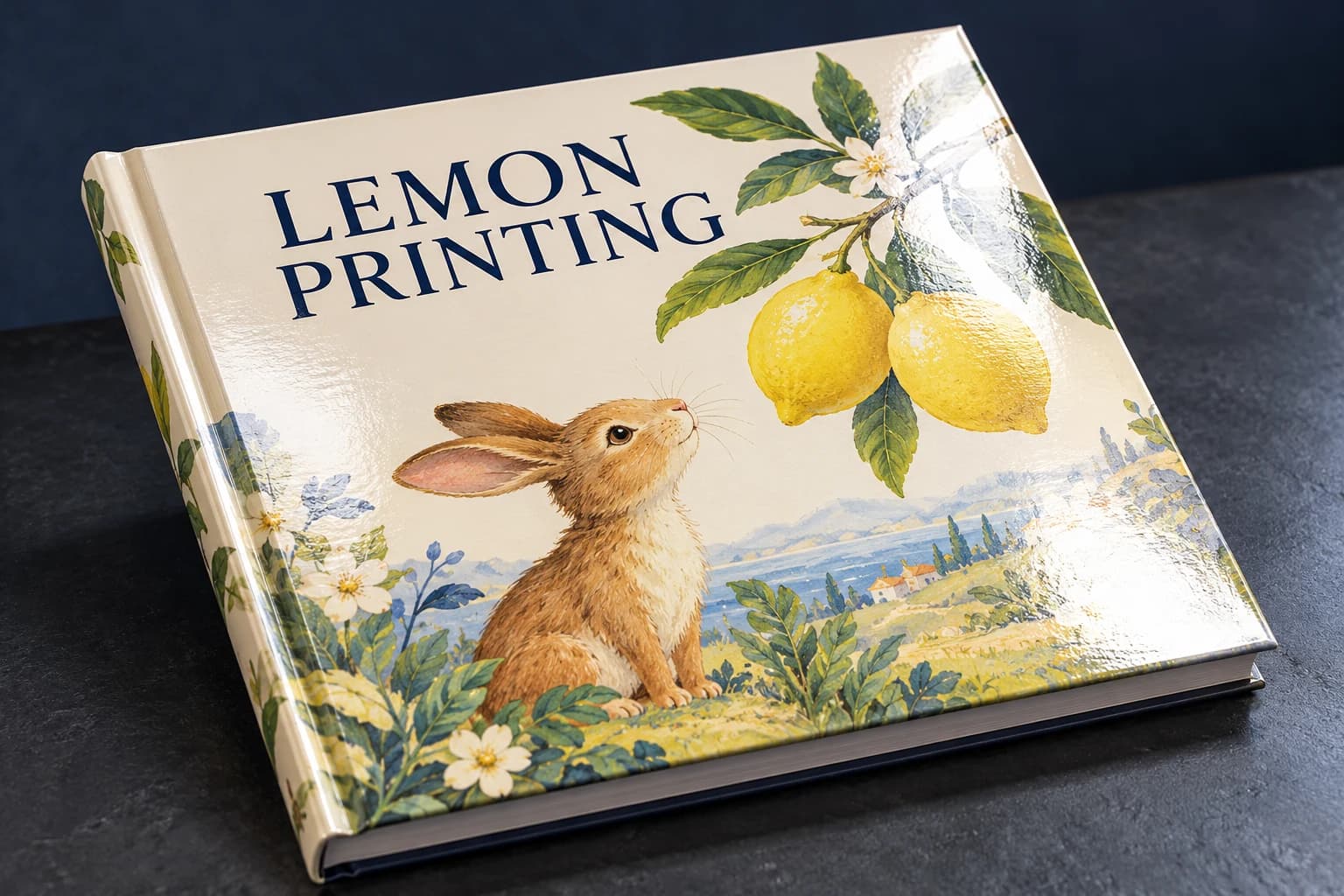 Gloss lamination View effect & artwork guidance
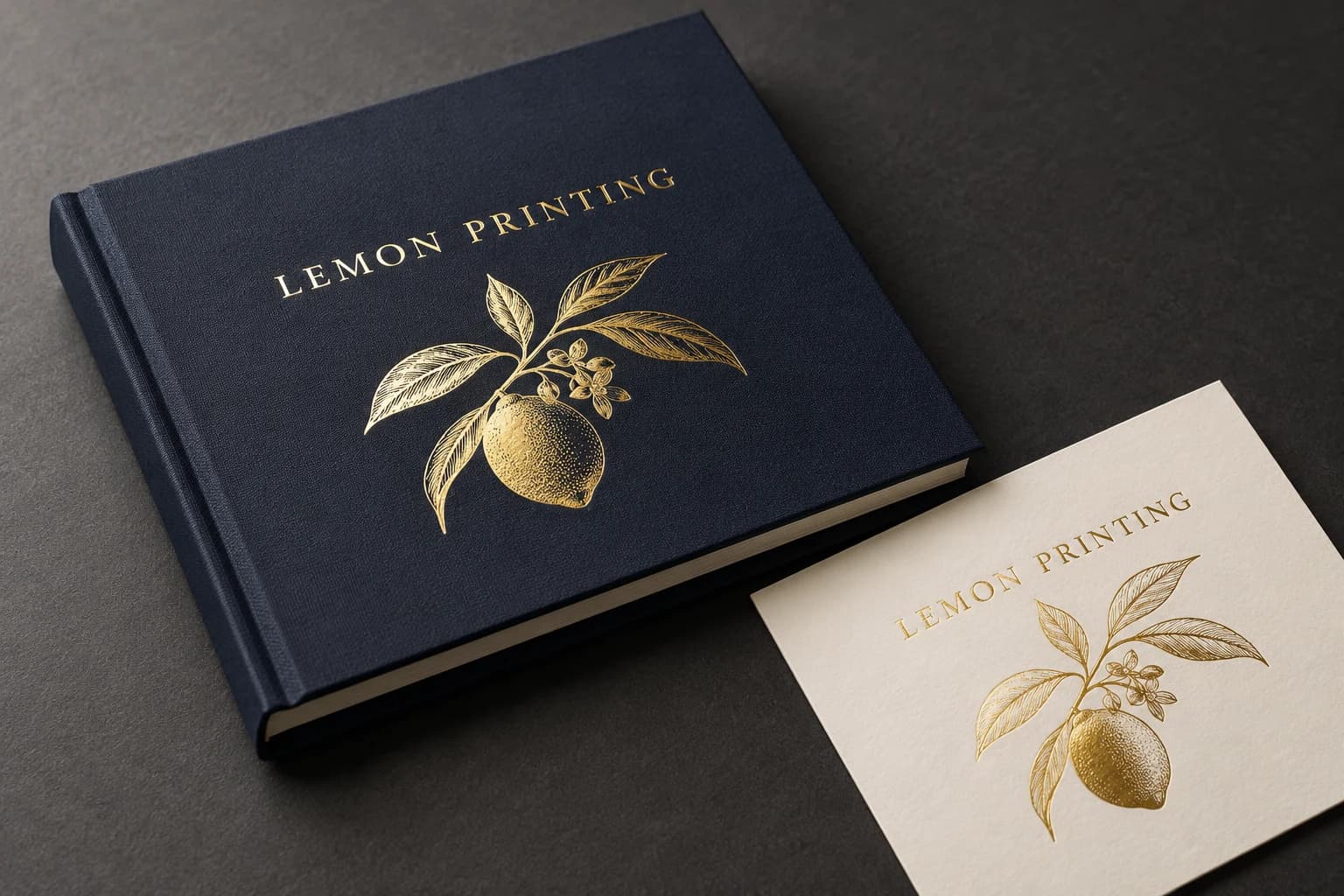 Gold foil stamping View effect & artwork guidance
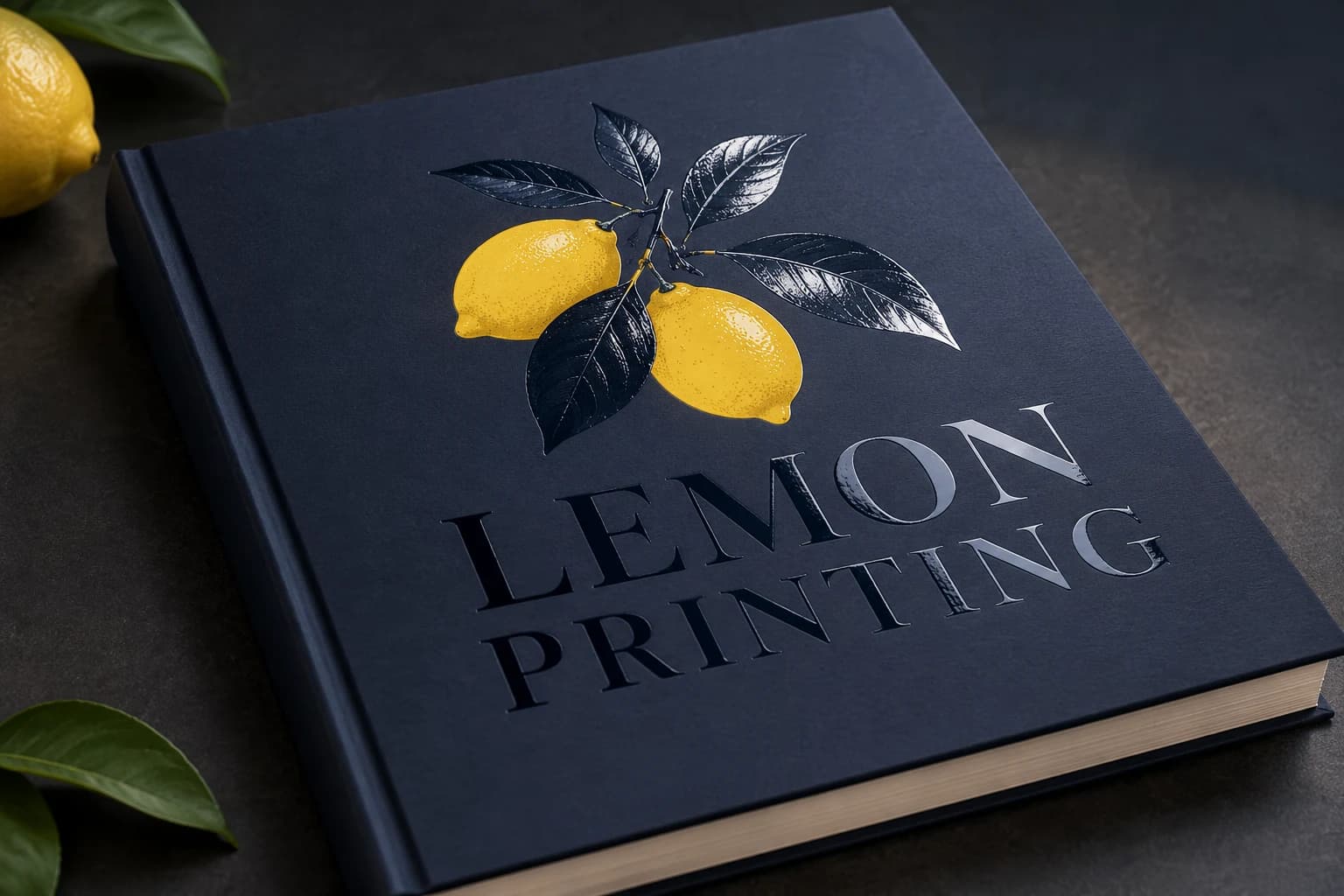 Spot UV View effect & artwork guidance
Illustrative finish samples, not photographs of this product. Final suitability follows the confirmed stock, construction and approved sample.
Compare all surface finishes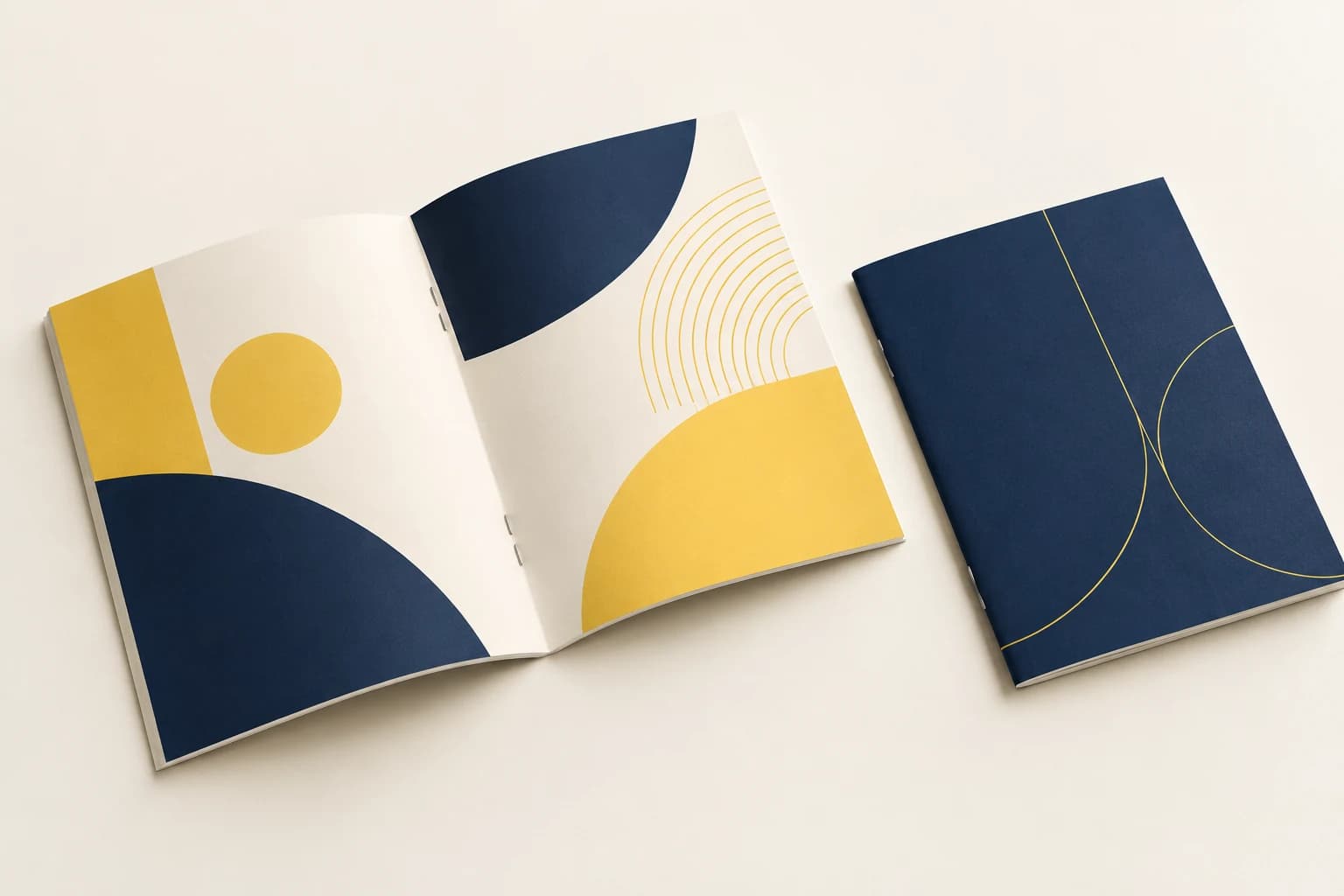
Details that change the finished product
From folded sheets to a trimmed, stapled book
Fold and nest the sections
Sheets are folded and gathered inside one another. The center opening belongs to the innermost folded sheet; other facing pages come from different sheets. Check page sequence and crossover artwork on a bound mock-up before releasing an illustrated edition.
Stitch through the fold
Wire passes through the nested fold and is clinched inside the center spread. A typical slim configuration uses two stitches. Inspect the fold alignment, secure clinching and page attachment; staple spacing and wire are production decisions for the assembled stack.
Trim after the stack is formed
Trimming creates a flush fore-edge, but removes more protruding material from inner sheets. Prepress compensates the layouts using the selected paper and fold. Keep page numbers and borders away from the trim edge instead of relying on an arbitrary universal creep value.
Prepare the cover for repeated folding
A matte or gloss laminated separate cover can protect printed surfaces during handling. Keep the fold flexible and check for whitening or film lift on a folded sample; leave writing pages unlaminated.
Configurations for programs, teaching and short editions
Event programs and festival guides
A compact self-cover edition keeps the program light to distribute. Put a venue map at the center opening and check that the staples do not obscure its key.
Short teaching units
Use uncoated writing pages and a separate cover when the unit is handled repeatedly. Compare opacity with answers or dark illustrations printed on the reverse.
Illustrated short editions and zines
Coated stock serves image-heavy pages; uncoated stock changes the tactile and printed appearance. Position important crossovers deliberately rather than assuming every opening behaves like the center spread.
Solve the risk before production
Prevent fold cracking, creep loss and crossover jumps
The critical finished-product check
Page count alone does not establish whether a book will stitch well. The measured paper thickness, cover stiffness, fold and finished format determine the stack at the spine.
Innermost page numbers lose their outer margin
Why it happens: The nested sheets project progressively before the final fore-edge trim.
Fix and check: Apply measured creep compensation, allow working margin, and inspect the trimmed inner pages.
The cover cracks or springs open
Why it happens: A stiff or poorly prepared cover puts stress into the fold.
Fix and check: Test grain direction, creasing and coating on a folded sample; reduce cover stiffness if it fights the intended opening.
Crossovers jump between facing pages
Why it happens: Most openings meet two separate sheets, even though the center spread is continuous.
Fix and check: Proof the bound reading sequence, allow for alignment variation and keep critical details away from the join.
When to choose another format
Saddle stitch, glued spines and Wire-O
| Alternative | Use and trade-off |
|---|---|
| Booklet Printing | Use the booklet guide to plan a short program by its purpose; this page focuses on the wire-stapled construction and pagination decisions. |
| Paperback Book Printing | A glued paperback gives a square printable spine and a different block structure; it does not open like a slim nested booklet. |
| Wire-O Bound Book Printing | Wire-O turns individual punched leaves and supports fold-back use, but adds exposed loops and a punched binding margin. |
Sample and approval
Inspect the fold and trimmed reading sequence
Free samples are available, with preparation completed within 15 days. Confirm the sample scope; courier arrangements and transit time are separate.
Structural sample
Checks dimensions, fit and assembly using unprinted or representative materials. It does not establish final color.
Printed proof
Checks text, image reproduction and artwork on the agreed proof medium. It may not reproduce final assembly or every finish.
Complete finished sample
Open the center and several outer spreads. Check sequence, staple clinching, fold cracking, crossover alignment and the remaining margin around innermost-page numbers.
From brief to delivery
Order a complete stitched edition
Build and approve the order in five steps
Define the page plan
State complete books per version, finished format, interior count and cover counting convention. Identify writing pages and crossovers.
Compare one consistent configuration
Request quantity breaks using the same cover, interior stock, page plan and finish so the quotations remain comparable.
Check the assembled sample
Review page order, fold, clinching, trimmed margins and critical spreads. Record whether the sample also establishes printed color and finishing.
Approve the production files
Approve the named PDF revision, paper, cover, finishing and sample scope. Record payment and production dates in the order.
Pack by version and dispatch
Keep bundles identified by artwork version and protect cover corners. Confirm carton count, destination and arrival planning separately from production completion.
- Supply single pages in reading order, including blanks. For a separate cover, identify its four faces and state whether the interior count excludes them. Do not supply imposed printer spreads unless prepress requests them.
- Use the agreed PDF/X output preset with embedded fonts and the specified color profile. Provide approximately 300 effective ppi at placed size for photographs and vector artwork for fine rules or text.
- Start the brief with 3 mm bleed for edge-to-edge trim artwork, then follow the approved template. Leave space for text and folios after creep compensation; the correct margin depends on the actual sheet stack.
- Mark crossovers and critical center-spread elements in the page plan. Export finishing masks as separately named spot-color layers and keep fold-sensitive decorations clear of the stitch positions.
Project questions
Planning Saddle Stitch Book Printing
Does a 24-page interior need another four pages for the cover?
With a separate cover, yes: 24 interior pages plus four cover faces makes 28 total pages. With a self-cover, the outermost folded sheet is already part of the stated total. Identify the counting convention in both the artwork and quotation.
Can a 30-page manuscript be saddle stitched?
A conventional nested construction needs a total divisible by four. A 30-page total therefore needs two planned pages to reach 32, or an editorial change to reach 28. Use credits, notes or purposeful blanks rather than allowing unreviewed automatic padding.
Can an illustration run across the center spread?
The center spread is printed across one folded sheet, so it avoids the sheet-to-sheet join of other openings. The fold and staples remain visible. Keep faces, small lettering and other critical details away from the stitch positions, and check the finished opening.
When should we choose perfect binding instead?
Switch when a square printable spine, a thicker block or a different cover structure matters more than the slim folded format. There is no universal crossover page count: compare the measured paper stack, opening behavior and finished sample with the proposed adhesive-bound book.
How do we prevent cover cracking and page-number loss?
Test the selected cover with the production fold or crease before approval. Check printed fold areas for whitening, and check the innermost pages after trimming for missing folios or tight borders. Adjust cover preparation and layout margins before bulk printing.
What determines the quantity and schedule?
Quote complete books per version using one consistent page plan, paper and finish. Ask for quantity breaks for that configuration. The confirmed order separates sample preparation, bulk production and freight transit; design examples do not promise a minimum quantity or production lead time.
Specify the finished product.
Send finished width × height, interior page count, self-cover or separate four-page cover, paper preferences, quantity per artwork version and delivery destination. Identify any center-spread artwork and required arrival date.