
Label construction & application planning
Custom Sticker & Label Printing
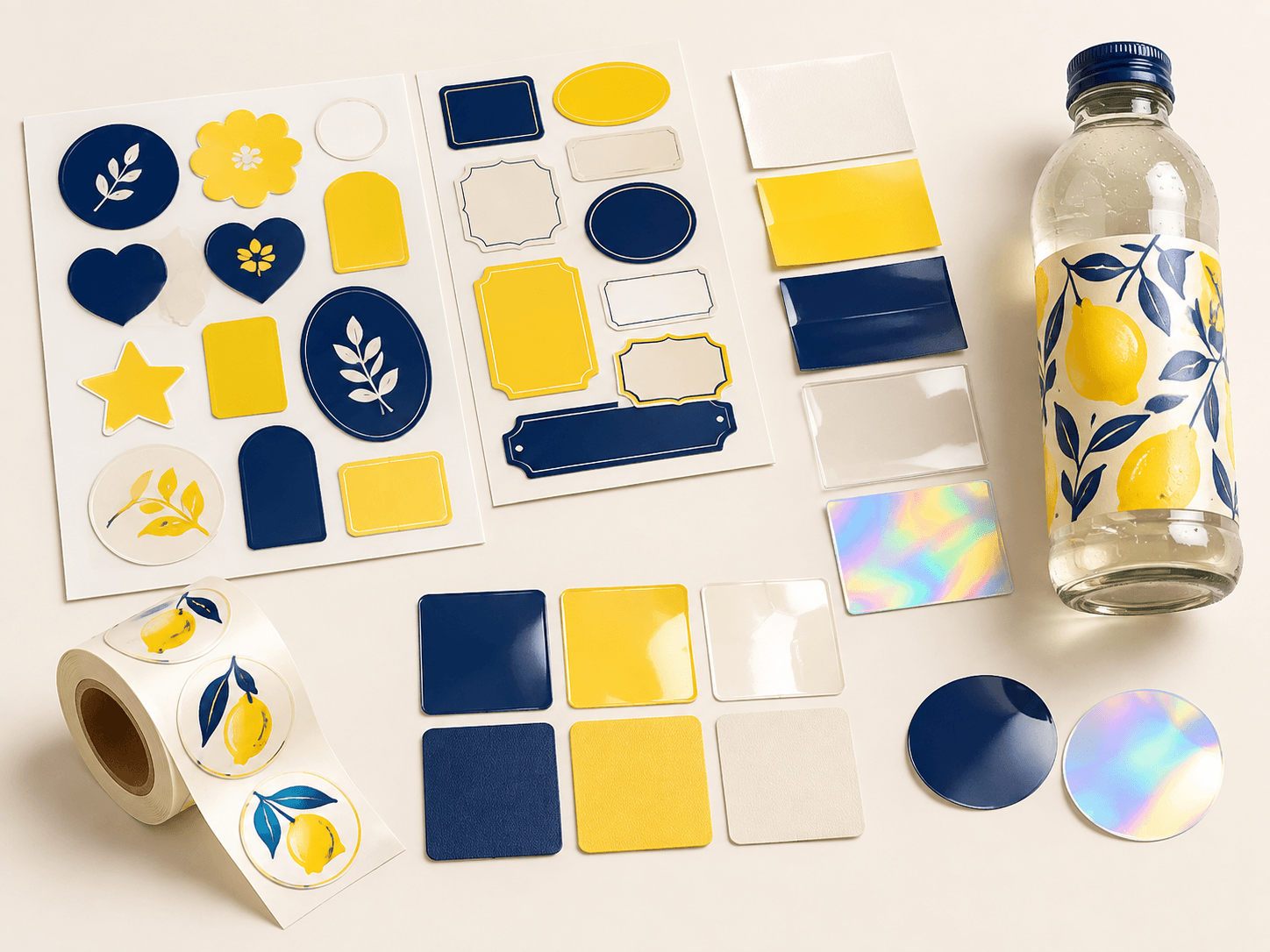
Stickers and labels suit product identification, packaging information and promotions. The face material, adhesive and supply format must fit the application surface and environment.
- Layered construction
- Shape and backing
- Roll or sheet
Illustrative product configuration
Product overview
Match the printed face to its application.
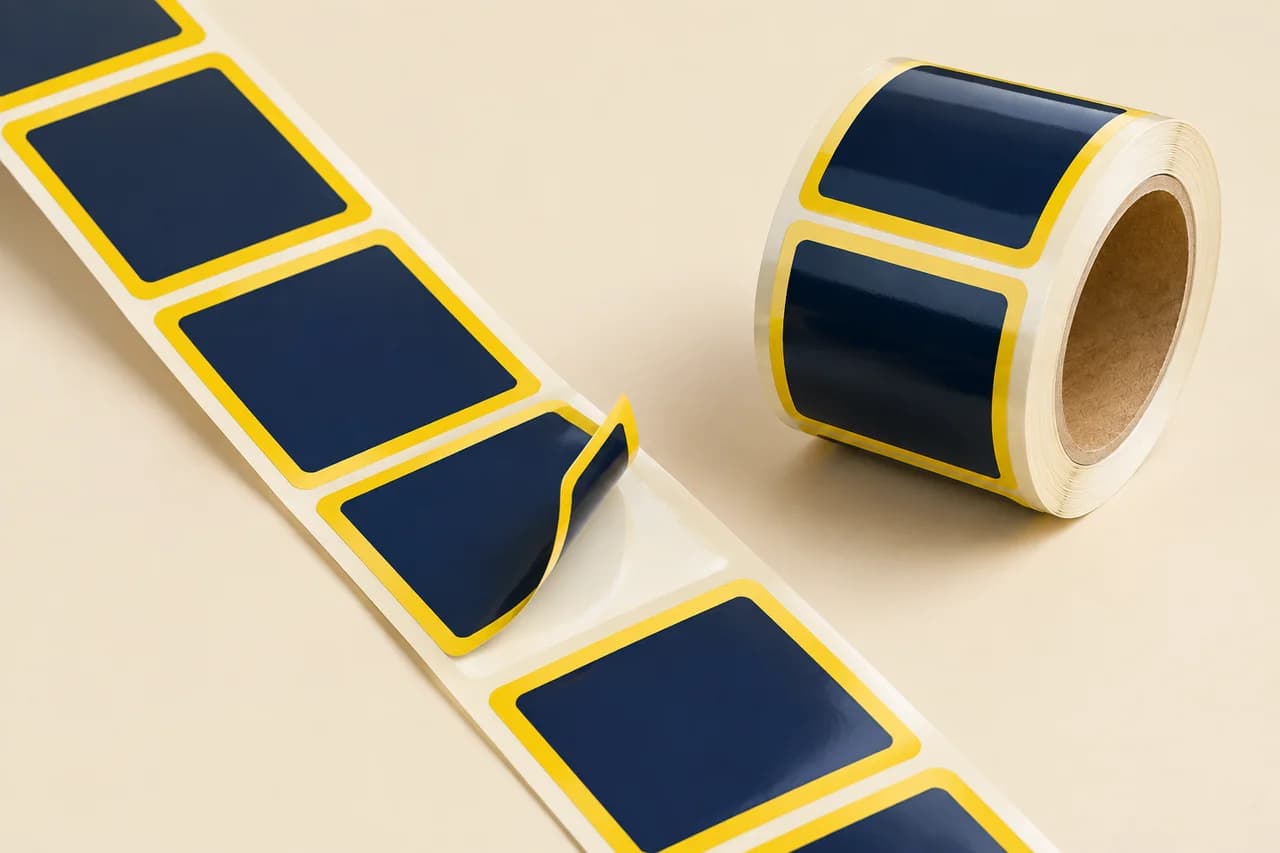
A pressure-sensitive label combines a printable face, adhesive and a release liner. Paper offers a distinct surface character; film can suit applications where flexibility or moisture exposure matters. Adhesive selection depends on the actual container surface and both application and service conditions. Roll geometry and unwind direction control feeding, while kiss cutting should leave the liner usable.
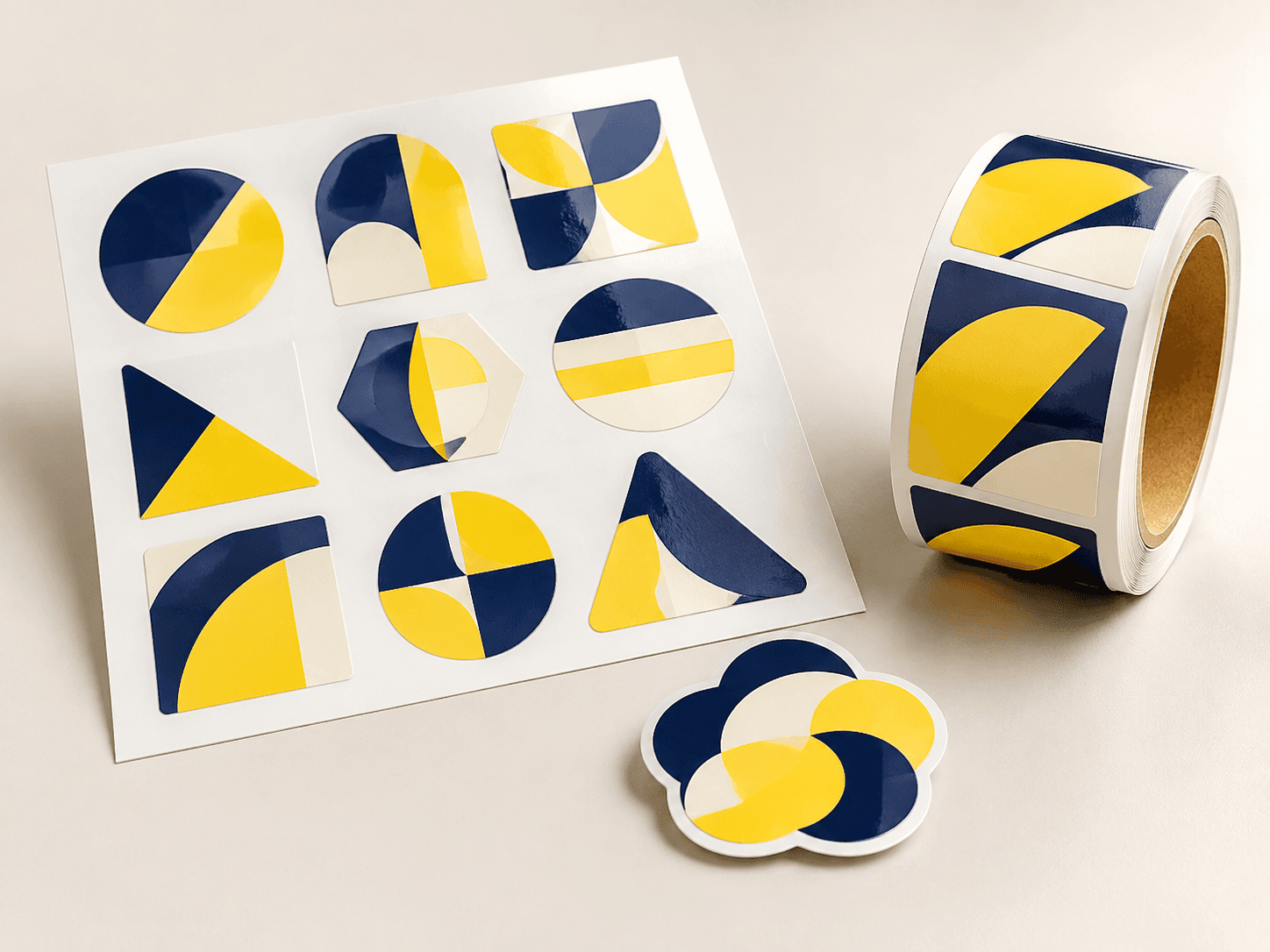
Layered construction
Face stock, adhesive and release liner each perform a different part of the label's function.
Shape and backing
Die-cut and kiss-cut formats determine what separates from the liner.
Roll or sheet
Converted format changes how labels are handled manually or fed to an applicator.
Specifications & materials
Match the Label to the Surface and Applicator
Start with label width × height in mm; shape and corner radius. Then compare the material and construction choices below.
Use these options to prepare your specification. Material grades, weights, thicknesses and feasible dimensions are confirmed for the quoted construction. A paper weight is not a finished thickness or a strength rating.
| Parameter | Options or Information to Supply | Why It Matters |
|---|---|---|
| Finished dimensions | Compact label example: 50 × 30 mm; Square label example: 80 × 80 mm | Design examples, not applicator limits. Check corner shape, gap and roll direction against the actual container and equipment. |
| Format and component count | Labels per SKU; labels per roll or sheet; total rolls if relevant | Total labels, labels per roll and number of rolls are different quantities; break out each SKU and conversion setup. |
| Face material | Paper or film selected for appearance and exposure | State moisture, oil, abrasion or other conditions the label will encounter. |
| Adhesive | Permanent, removable or another specifically evaluated adhesive | Specify container material and texture, application temperature and service conditions separately. |
| Supply format | Roll, sheet or individually cut labels | For rolls, state core diameter, maximum outside diameter, gap and unwind direction using the applicator specification. |
| Liner and conversion | Liner and die-cut or kiss-cut arrangement | Check release and feeding on the intended equipment; a flat print proof cannot confirm applicator fit. |
| Print and protection | Process and protective finish selected for the actual label construction | Provide color references and scan requirements; confirm the production route after material and quantity are reviewed. |
Swipe the table to compare selection checks.
Compare materials and construction
Choose around the intended use. These are alternatives to discuss, subject to the confirmed specification.
Paper face stock
- Suitable for
- Labels for a surface and service environment compatible with paper.
- Check before selection
- Trial adhesion on the actual container; check moisture, oil and rub where relevant.
Quoted film face stock
- Suitable for
- A different appearance or specified exposure requirement.
- Check before selection
- Confirm film grade, adhesive and liner as a system; film alone does not guarantee adhesion.
Surface finish options
Compatible label face stock
Select film or coating only after checking the face stock, ink, adhesive and application surface. Test edge adhesion, flexibility and readability. Protection alone does not establish weather resistance, removability or food-contact suitability.
 No added surface treatment View effect & artwork guidance
 Matte lamination View effect & artwork guidance
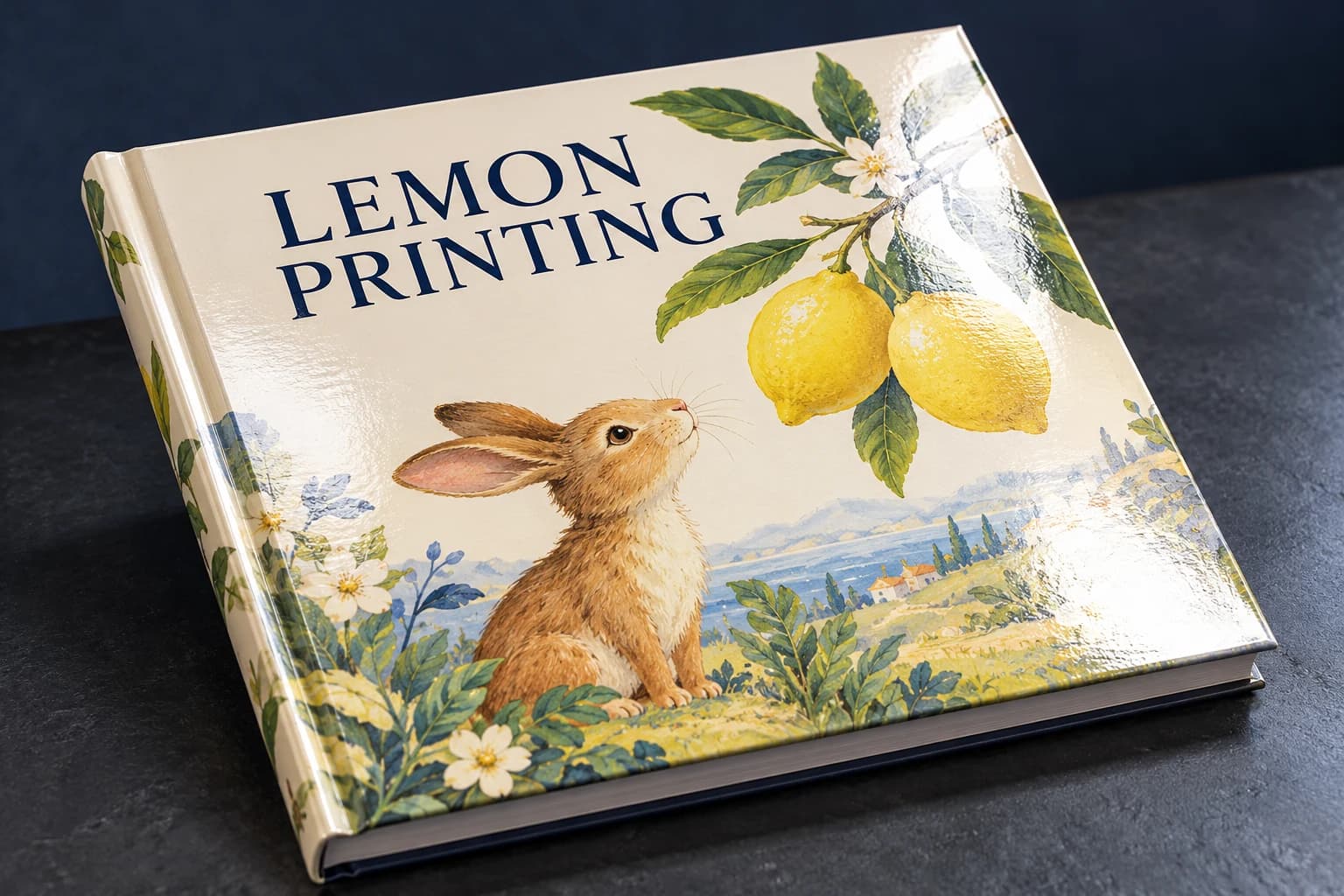 Gloss lamination View effect & artwork guidance
Illustrative finish samples, not photographs of this product. Final suitability follows the confirmed stock, construction and approved sample.
Compare all surface finishesConstruction & finishing
Check Adhesion and Feeding on the Actual Container
Focus the review on adhesion on the actual surface, code readability and dispensing from the final format.
01 / SELECTION CHECK
Trial adhesion on the real surface
Identify container material, texture and cleanliness alongside application and service temperatures. These are separate conditions. Evaluate the quoted adhesive on the intended surface instead of inferring performance from a generic permanent label name.
02 / SELECTION CHECK
Specify the converting format
Match core, roll diameter, gap and unwind direction to the actual applicator. Check liner release and printed-code use on the converted sample; a flat artwork proof cannot establish machine-feed compatibility.
Label construction & application planning
Match face stock, adhesive and roll format to the real application
A label is a layered system: printable face, pressure-sensitive adhesive and release liner. Choose the construction for the actual surface, application temperature, service conditions and dispensing equipment, then trial it on the intended container.
Compare dimensions and usable space
Design examples are labeled; they are not production limits or approved templates.
Compact label example · 50 × 30 mm
Compact label design example; reserve readable identification and the complete scan symbol with its quiet zone.
Read every format’s selection note
- Compact label example: 50 × 30 mm. Compact label design example; reserve readable identification and the complete scan symbol with its quiet zone.
- Square label example: 80 × 80 mm. More graphics area; check whether container curvature and face stiffness increase edge-lift risk.
- Face stock: paper or film
- Adhesive: matched to surface and use
- Release liner: roll direction & core
Select the material by its finished behavior
Paper and film face stocks have different appearance and flexibility. Permanent and removable adhesives describe different jobs, not universal performance grades. Application temperature, later service exposure, surface texture and dispensing equipment need separate specification.
Production checks that prevent avoidable rework
Describe the surface and application
Identify the container material, curvature, surface energy, cleanliness and whether it is dry, dusty, cold or damp at application. Adhesive selection depends on the actual substrate and conditions.
Separate application temperature from service temperature
State the temperature when the label is applied and the conditions it experiences afterward. These are different performance questions; validate the complete label on the real package.
Match the roll to the applicator
Provide label gap, web width, core diameter, maximum roll outside diameter and unwind direction from the equipment specification. Test dispensing and sensor registration using a production-format roll.
Use-case selection
Choose a configuration for the job it has to do
Product packaging label
Choose paper or film face based on appearance, moisture exposure and container shape, then test on the filled package.
Trade-off: A material that works on a flat dry box may fail on a curved or squeezable container.
Chilled or frozen product
Tell the converter whether the package is labeled before or after chilling and how condensation is handled.
Trade-off: An adhesive's application and service limits are product-specific; do not infer them from a generic label sample.
Automatic application
Specify the machine, roll orientation and dispensing direction, then test a roll on the actual line.
Trade-off: A correct die-cut label can still stop a line if the roll direction or gap is wrong.
Problem → cause → solution
Resolve the failure points before production
Edges lift after application
Why it happens: Adhesive and face stiffness do not suit the surface energy, texture or container curvature.
How to prevent it: Apply samples to the actual container under the expected conditions and assess initial tack, dwell and service exposure.
The roll jams or the liner breaks
Why it happens: Core, outside diameter, gap, unwind direction or die-cut depth does not suit the applicator.
How to prevent it: Use the machine specification for roll setup, then test feeding, release and liner integrity with converted samples.
Alternative formats
When another construction is a better fit
| Alternative | Structural difference | Selection trade-off |
|---|---|---|
| Printed coupon | Loose or detachable paper piece. | No adhesive or dispensing liner; suited to handouts rather than a fixed container label. |
Sampling & production
Choose a Sample That Answers Your Main Concern
A structural sample, a print proof and a finished sample answer different questions. Confirm the sample scope before approval. Free samples are prepared within 15 days; courier arrangements and transit time are separate.
Material and application trial
Review face material and adhesive with the proposed dimensions and component count. Agree whether the sample uses production materials or substitutes. An unprinted construction sample does not approve printed color.
Print and artwork proof
Review representative artwork at finished size on the agreed proof condition. Check liner and conversion. A screen proof cannot establish physical feel or the performance of the finished assembly.
Complete finished sample
Assess adhesion on the actual surface, code readability and dispensing from the final format with the specified components and finishing present. Record the approved revision and any differences to resolve before production.
How to Order Sticker & Label
Send your project brief
Send label width × height in mm; shape and corner radius. Specify labels per SKU; labels per roll or sheet; total rolls if relevant. State the number of labels per SKU, with labels per roll or sheet stated, delivery destination and required arrival date. Tell us which options are undecided.
Compare the quotation
Ask for pricing by labels per SKU, with labels per roll or sheet stated. Compare the same configuration at each quantity. The quotation should identify materials, finishing, sample scope, packing and freight, plus payment and order terms.
Review the right sample
Choose a sample that can demonstrate adhesion on the actual surface, code readability and dispensing from the final format. Confirm what the free sample includes and any differences from the intended production specification. Preparation is completed within 15 days; courier arrangements and transit time are separate.
Approve the production version
Confirm the specification, file revision and sample decisions in writing. Production scheduling follows the agreed approvals and order release conditions; changes may require a revised quote or schedule.
Confirm packing and delivery
Label rolls or sheets by SKU and batch, protect converted edges and agree storage and transit conditions for the selected adhesive construction. Agree the destination and shipping arrangement, with production, dispatch and transit dates listed separately.
Details to Confirm in the Quotation
- Order unit and price breaks
- Specify labels per SKU, with labels per roll or sheet stated. Request the feasible minimum and quantity breaks for that exact configuration; a change of material, version or component count can change the price.
- Sample scope and delivery
- State whether you need a material trial, a print proof or a complete finished sample. Free samples are available, with preparation completed within 15 days. Confirm the included materials and processes; courier arrangements and transit time are separate.
- Approval and schedule
- State the required arrival date and whether versions ship together or to separate destinations. The quote must distinguish sample work, production and transit; a requested date is not a confirmed schedule.
- Packing and identification
- Label rolls or sheets by SKU and batch, protect converted edges and agree storage and transit conditions for the selected adhesive construction.
- 01
Supply the cut outline and print separately from liner or converting requirements. Identify SKU data, code clear areas and the confirmed unwind and roll specification.
- 02
Use the PDF/X export preset and output condition confirmed with prepress. Embed fonts and identify the approved file revision.
- 03
Check continuous-tone images at about 300 effective pixels per inch (ppi) at their final placed size. Fine linework can require a different resolution or vector artwork.
- 04
Extend trim artwork by 3 mm unless the approved template specifies otherwise. Keep structural, folding and binding clearances separate from trim bleed.
- 05
Identify named spot colors or physical references and the intended substrate. Agree proof acceptance and keep finishing separations distinct. A screen PDF does not approve printed color.
Configuration details
Separate the cut method from the supply format.
Kiss cutting releases a sticker while leaving its liner intact; cutting through the liner produces an individual piece. A sheet or roll describes how labels are supplied, not which adhesive they use. Clear and holographic materials also need a print-opacity decision before color approval.
- Cut construction
Face and adhesive cut; liner intact or cut through
Test peel, release and the smallest cut feature on the intended material.
- Application brief
Surface, container curvature, temperature and dispensing method
Use the actual applied sample; a good-looking label on its liner does not prove adhesion or readable color.
Explore the relevant formats
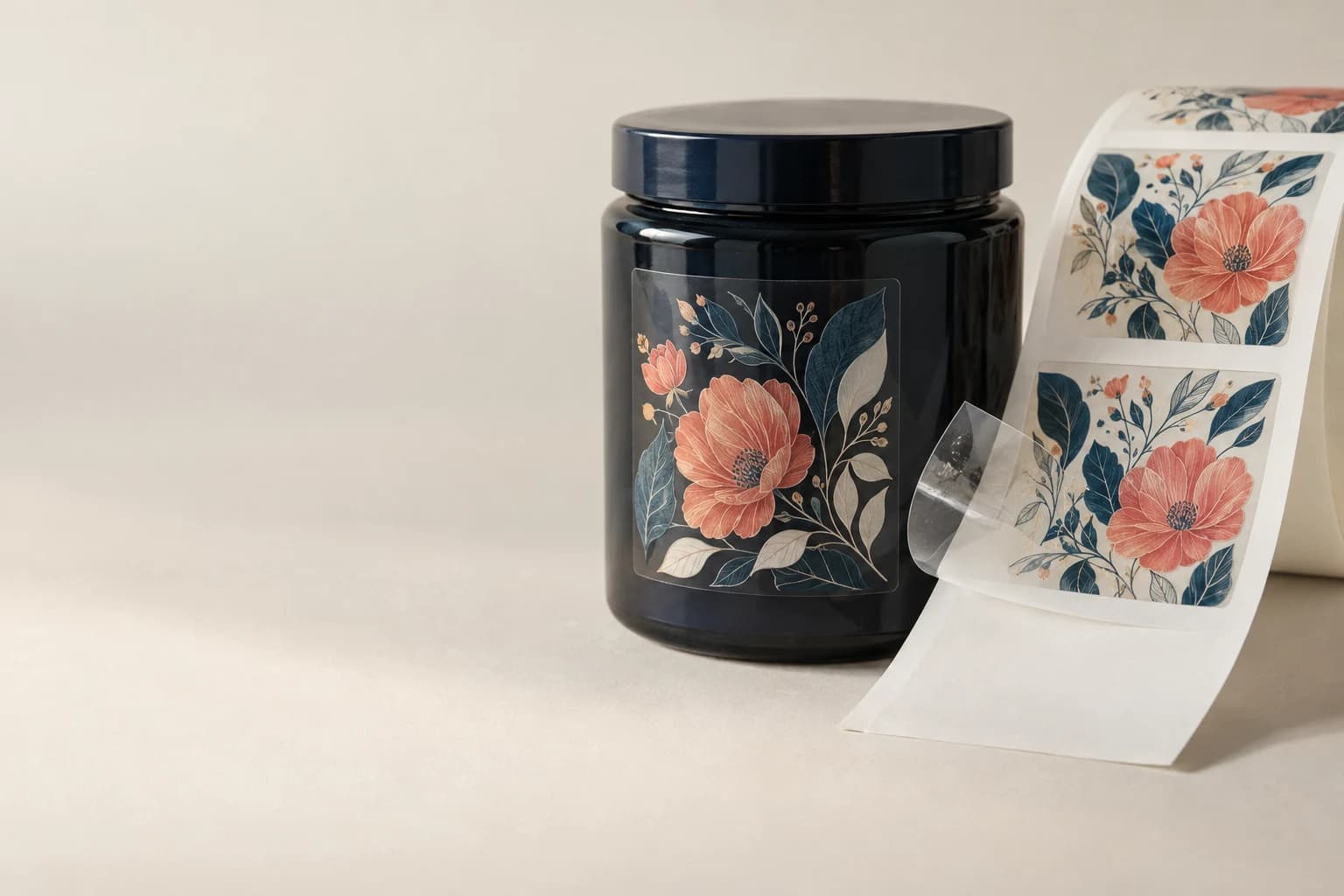
Clear Sticker Printing
Clear stickers let the application surface remain visible around printed artwork.
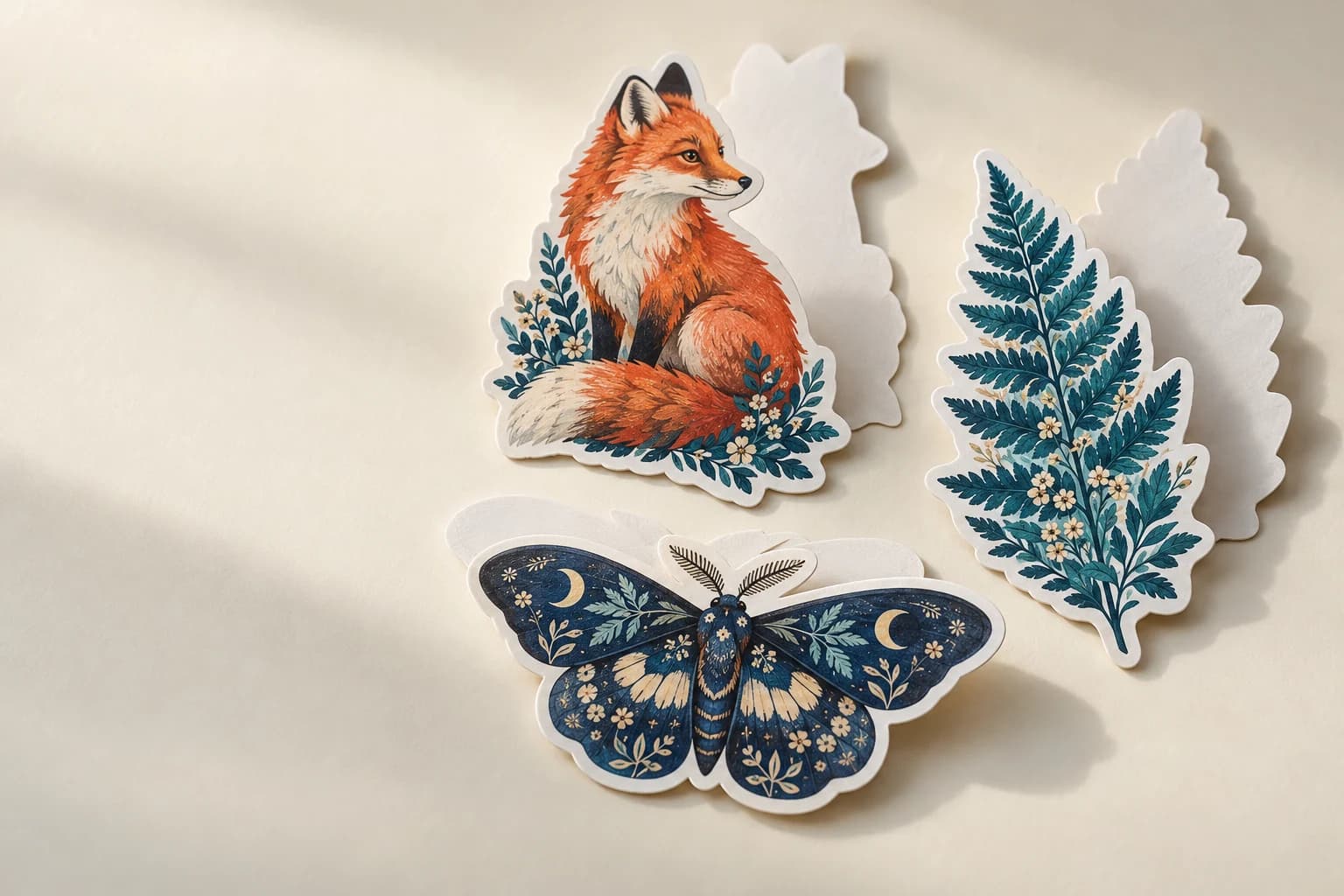
Die-Cut Sticker Printing
Die-cut individual stickers are cut through both the face material and release liner to create separate pieces.

Kiss-Cut Sticker Printing
Kiss-cut stickers cut the face material and adhesive while leaving the backing liner intact.
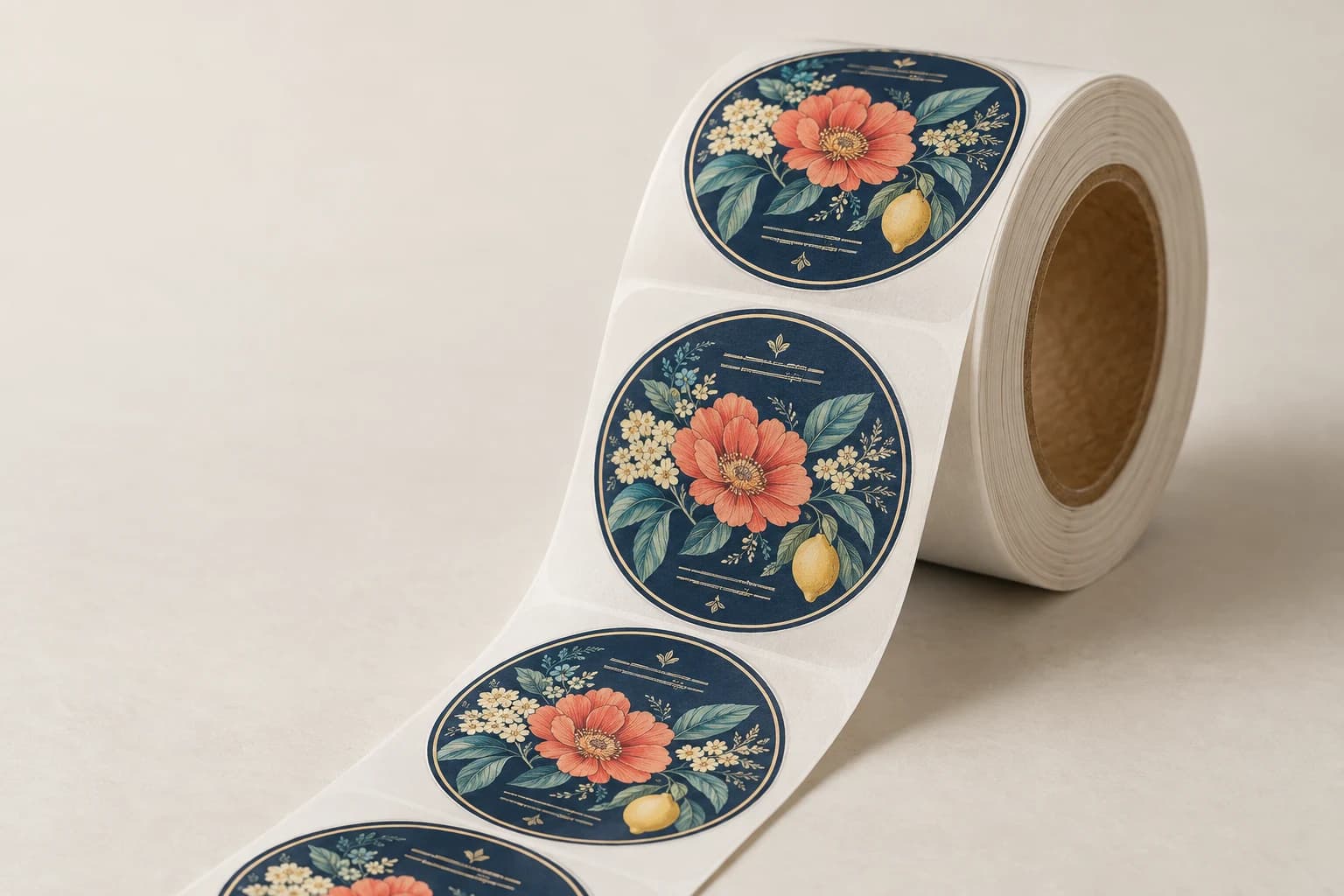
Roll Label Printing
Roll labels pair printed adhesive stock with a liner and winding arrangement for dispensing.

Sticker Sheet Printing
A sticker sheet holds several peelable designs on one carrier; spacing, kiss cuts and liner margins determine how easily each lifts.

Holographic Sticker Printing
Holographic stickers use a reflective face effect beneath or around the printed design.
Engineering & purchasing FAQ
Questions Before Ordering Sticker & Label
Are application and service temperature the same?
No. The temperature when the label is applied and the environment it experiences afterward can differ. State both conditions and the substrate so the adhesive selection and trial address the real use.
What information does a roll-label order need?
Provide core and maximum roll diameters, gap, label orientation, unwind direction and quantity per roll or SKU. Confirm those against the applicator rather than using one default winding for every machine.
Can a label be removable from every surface?
No. Removal depends on the adhesive, surface, time and exposure. Provide the actual container or a representative surface and define the removal result you need for a material trial.
Which sample should I request first?
Start with the uncertainty that could change the specification: adhesion on the actual surface, code readability and dispensing from the final format. If the concern is physical, request the relevant material or functional sample. If it is print appearance, agree a suitable proof. Confirm the sample scope before approval. Free sample preparation is completed within 15 days; courier arrangements and transit time are separate.
How should I state quantities for a quote?
Use labels per SKU, with labels per roll or sheet stated. Separate versions and give a delivery destination and required arrival date. This lets the quote distinguish the production quantity, packing and shipping scope.
Your project specification
Plan Your Sticker & Label Order
Send label width × height in mm; shape and corner radius. Specify labels per SKU; labels per roll or sheet; total rolls if relevant. State the number of labels per SKU, with labels per roll or sheet stated, delivery destination and required arrival date. Tell us which options are undecided.