Table of Contents
- What makes a custom sound book safe and durable?
- Safety questions to resolve before production
- Buttons, battery access, wires, and small components
- Age grading, intended use, and compliance responsibility
- Durability checklist for pages, hinges, and sound controls
- Sound book construction options and risk trade-offs
- Thick board pages and rounded corners
- Module placement, cover protection, and repeated handling
- What to test in a prototype and pre-production sample
- Mechanical handling and button-cycle checks
- Audio activation, battery performance, and packing checks
- Questions to ask a sound book manufacturer
- FAQ: sound book safety and durability
- Request a custom sound book production review
A sound book can look finished and still have weak hinges, unreliable buttons, or a battery compartment that needs closer review. Use this checklist to define prototype tests, clarify US compliance responsibilities, and ask suppliers for useful production records.
What makes a custom sound book safe and durable?
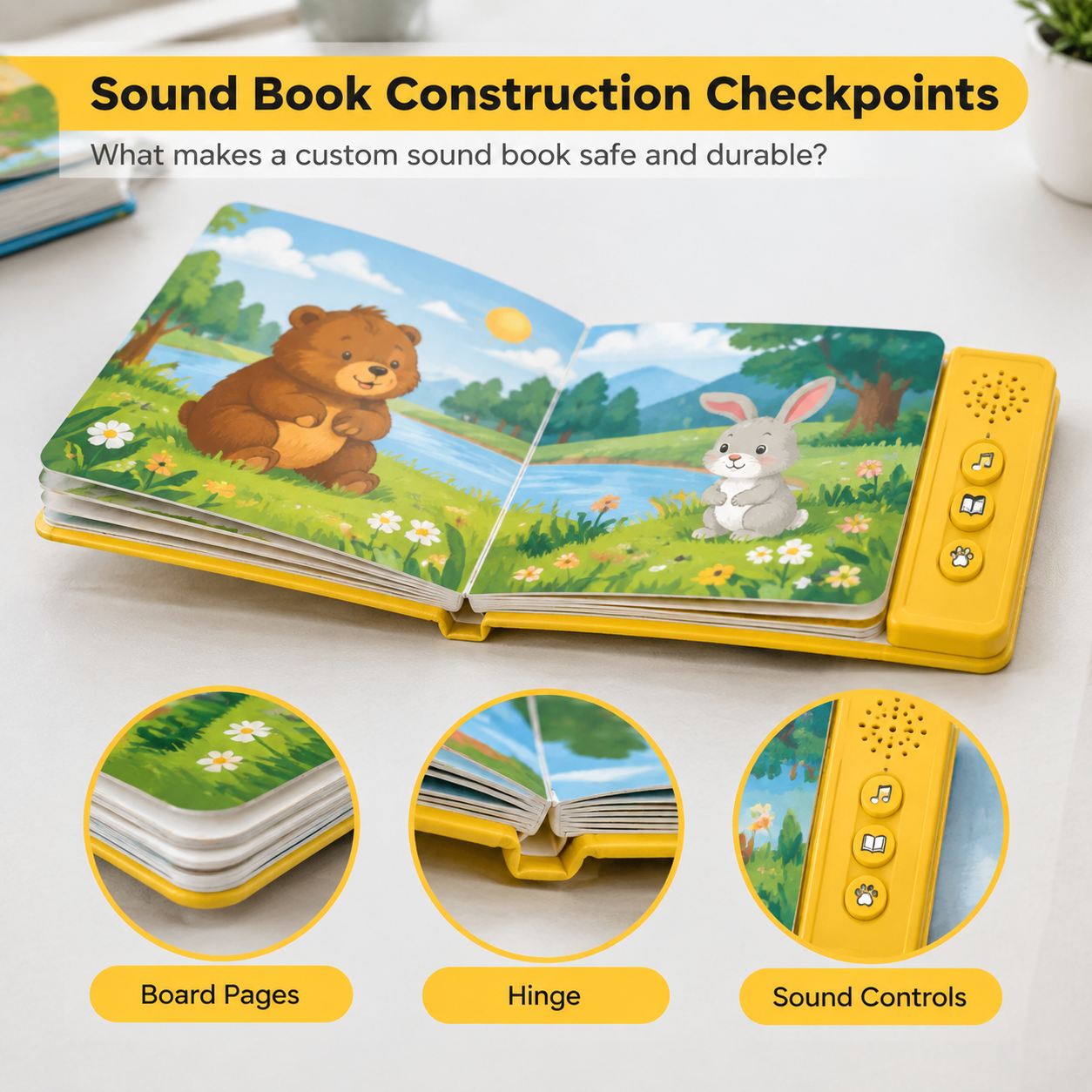
A safe, durable sound book combines secure electronic components with book construction that can withstand its intended handling. Review the button, battery access, wiring, module enclosure, page hinges, corners, audio function, and shipping protection as one assembled product—not as separate parts.
A glossy prototype can conceal problems that emerge after repeated use: a button becomes intermittent, a cover flexes around the module, a battery door loosens, or carton pressure damages the sound controls. Before production, define who supplies and assembles the module, what tests will be performed, and what evidence the buyer needs.
Key takeaways
- Check retention and access for every small or electronic component.
- Test the assembled book through repeated page, button, and handling cycles.
- Assess battery and sound performance using the intended battery type and operating instructions.
- Confirm applicable compliance requirements with the responsible importer and qualified testing provider.
Lemon Printing has an in-house book production facility, with prepress, printing, binding, finishing, inspection, and packing handled in-house. Ask which sound-module integration and testing tasks are within the agreed scope; do not assume they are included in a print quote. See the company’s custom book printing capabilities.
Safety questions to resolve before production
Resolve component, age-grade, testing, and responsibility questions before approving a production order. A late change to the module, battery type, enclosure, or intended age can affect construction and the compliance plan.
Start with a written product description: intended age range, use environment, sound controls, power source, battery access method, and whether batteries are supplied. Identify which party sources the module, installs it, checks it, and keeps its technical documentation. Specify whether the finished book will be tested as a complete product or whether separate component reports are being provided.
For US-bound products, “children’s book” is not enough information to determine applicable requirements. Product design, intended users, materials, electronic components, and importer obligations can all matter. Treat a supplier’s general statement that a product is safe as insufficient evidence; request documents for the actual configuration and confirm requirements with a qualified compliance professional.
Buttons, battery access, wires, and small components

Check that buttons, battery covers, wires, and module parts remain secure during expected use and handling. Also verify that battery access works as designed: it should not open unexpectedly, and it should be serviceable according to the product instructions.
- Button retention: Look for rocking, lifting edges, cracks, sticking, or inconsistent response after repeated presses.
- Battery compartment safety: Inspect the cover, closure method, fit, and signs of loosening after handling. Confirm that the specified battery is held correctly and that polarity markings are clear where needed.
- Wires and contacts: Check for pinching, exposed conductors, sharp ends, or movement when the book flexes.
- Small parts: Examine the assembled product and any parts that could detach. The appropriate evaluation depends on the product’s age grade and applicable requirements.
Ask for a documented inspection method and clarify whether the supplier can test the complete sound assembly or only the printed book. A sound module’s specification sheet does not prove that it is securely installed in the finished cover.
Age grading, intended use, and compliance responsibility
The responsible US buyer or importer should confirm which compliance requirements and tests apply to the finished product. A manufacturer can provide production information and support agreed checks, but responsibility cannot be inferred from a factory inspection or transferred by an informal assurance.
Share the intended age grade, sales market, product description, materials, battery details, and component documentation with a qualified testing provider. Confirm whether testing must cover the completed book, specific materials, electronic components, labeling, or other product aspects. If a design or component changes after testing, ask whether the existing evidence remains applicable.
For practical US children’s book compliance screening, record the responsible party for each action: test planning, sample submission, report review, labeling decisions, and record retention. This article is production guidance, not a legal determination.
Durability checklist for pages, hinges, and sound controls

Evaluate durability at the points where the book flexes, where a child presses, and where the electronics meet the printed construction. A stable sound module cannot compensate for a weak hinge, and a strong board page does not confirm reliable button operation.
Review the finished size, board thickness, page count, hinge construction, cover reinforcement, module position, and planned finish together. Check page opening and closing for binding cracks, delamination, misaligned layers, or interference with the sound controls. Run buttons through repeated use based on a test plan agreed with the supplier; record the sample, method, number of cycles, and observed failures rather than relying on “passed” without context.
For interactive book quality control, define acceptance criteria before sampling. Examples include no loose component, no visible hinge separation, consistent activation of each sound control, and no damage that prevents the book from functioning. Set the criteria to match the product and buyer’s risk assessment.
Sound book construction options and risk trade-offs
Construction choices affect both handling and inspection access. Compare options against the actual module design, user age, expected play, and packing method; no single feature makes every sound book safe or durable.
| Construction decision | Potential benefit | Risk or trade-off to check |
|---|---|---|
| Thick board pages | Stiff pages can be easier to turn and less prone to folding than thin paper pages. | More board thickness and page weight can increase hinge stress and carton weight; inspect folds and opening behavior. |
| Rounded corners | Can reduce sharp corner feel and help finish a toddler-oriented format. | Does not address detachable parts, battery access, pinching, material, or electronic risks. |
| Recessed or protected controls | May help reduce accidental activation or direct impact, depending on design. | Can be harder to press or inspect; verify activation and module fit in the final construction. |
| Cover-mounted module | May simplify access to a sound panel or controls. | Creates a concentrated flex and impact area; check attachment, cover layers, and protection in transit. |
| Separate module enclosure | Can organize electronic components as a discrete assembly. | Adds interfaces and parts that need retention checks; confirm responsibilities for assembly and testing. |
These are design considerations, not substitutes for a risk assessment or applicable testing.
Thick board pages and rounded corners

Rounded corners are useful as a finishing choice, but they are not enough to make a sound book safe. The corner radius does not evaluate the button, battery compartment, loose parts, hinge, surface materials, or sound module.
For board book rounded corners, inspect the cut for consistent shape, clean edges, and no exposed or separating layers. Check that the page stack opens without forcing the hinge and that the board does not crack or delaminate where it meets the spine. The appropriate board and hinge construction depends on format, page count, module location, and intended handling.
Request a physical sample when the relationship between page stiffness and module placement is difficult to judge from a PDF or photograph. Lemon Printing can review book specifications and print construction; agree in writing who is responsible for electronic parts and their assembly.
Module placement, cover protection, and repeated handling
Place the module where it can be secured and protected without weakening the cover or blocking normal page use. The best location depends on the module dimensions, button layout, book format, and how the book is likely to be held and stored.
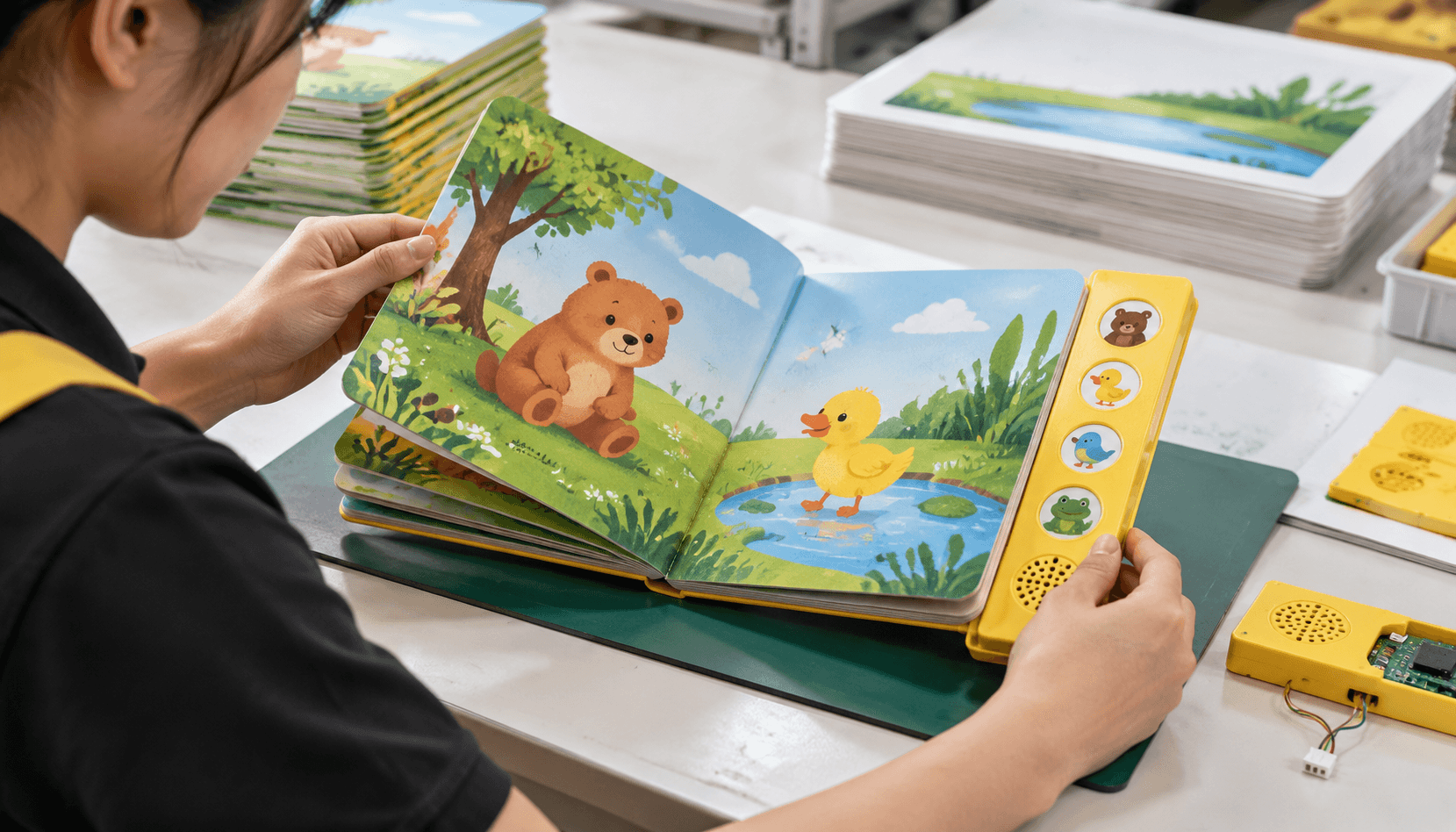
During a physical review, press each control while opening, closing, and holding the book in different normal positions. Check for cover bulging, page obstruction, shifting components, pinched wires, and controls that activate when the book is placed down. Then assess what happens after repeated flexing around the module and hinge. A working module in a loose, unbound sample is not evidence that the final laminated and bound structure will behave the same way.
Include module location, enclosure, attachment method, wiring path, and service access in the approved specification. If any of these changes, review the sample again.
What to test in a prototype and pre-production sample

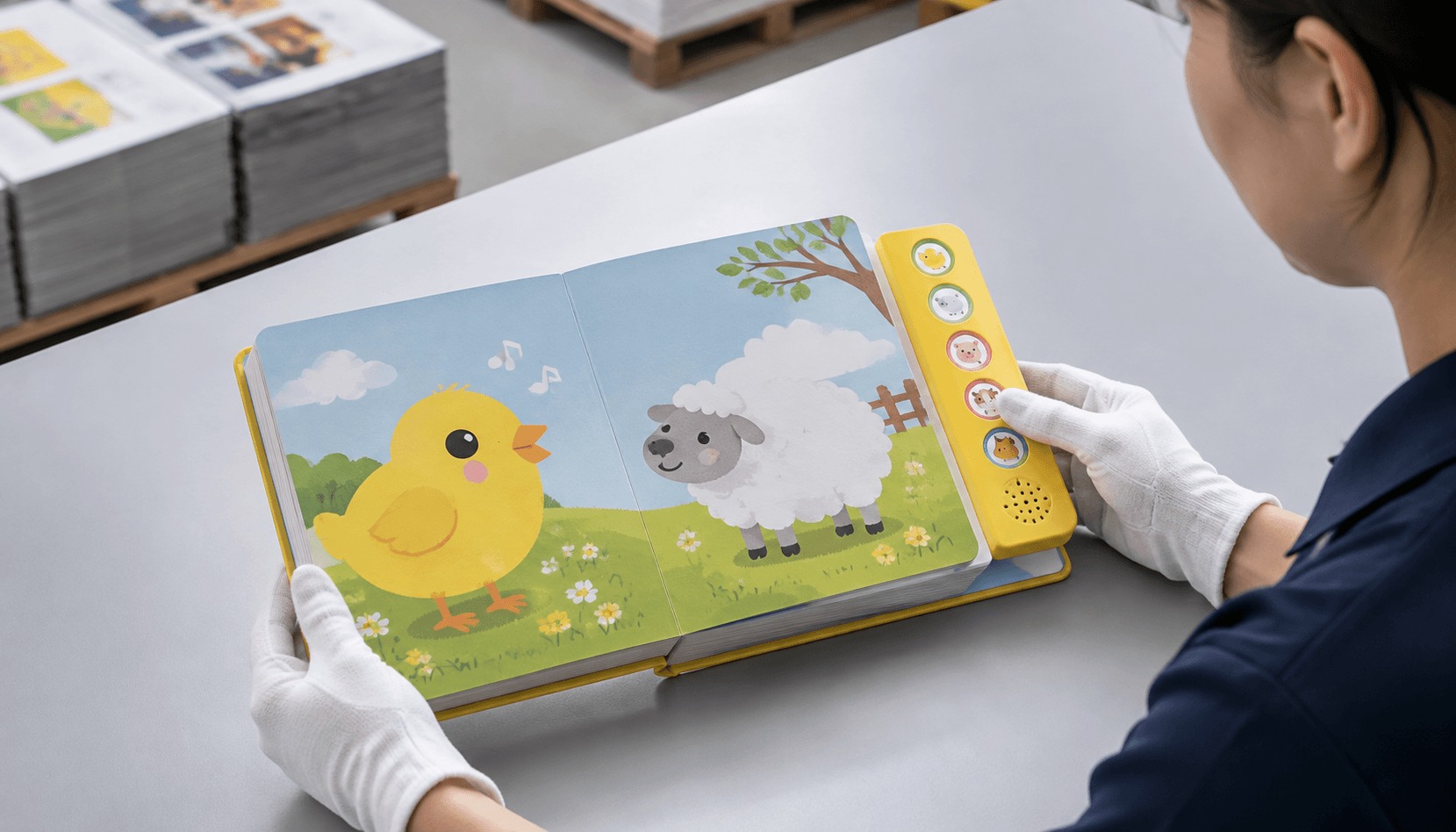
Test a fully assembled sample that matches the proposed production materials, module, binding, and packing—not only a printed dummy or loose electronic unit. A prototype is most useful when each check has a defined method, record, and acceptance decision.
- Freeze the configuration: Record size, page and board specifications, finish, module model, battery type, control layout, and assembly details.
- Inspect the physical build: Check edges, hinge, cover fit, component retention, battery closure, and access to controls.
- Exercise the book: Open and close pages, press every control repeatedly, and handle the book as its intended user would.
- Check function after handling: Confirm that sounds still activate consistently and that no component has shifted or become loose.
- Simulate packing and transport risks: Review the packed sample for compression, rubbing, and impact exposure, then inspect and operate it again.
- Record the outcome: Keep dated photos, sample identification, test notes, failures, corrective actions, and approval status.
Agree test quantities, methods, and pass criteria with the supplier and testing provider. These depend on product design and buyer requirements; do not treat a single sample as statistical proof of a production run.
Mechanical handling and button-cycle checks
Repeated handling checks should look for gradual failures, not just obvious breakage. Cycle each button under consistent conditions and check whether it still activates, releases, and sits securely; agree the number of cycles and inspection method before testing.
Also open and close the book repeatedly, flex the cover near the module, and inspect hinge edges for cracking, delamination, or separation. Apply only handling conditions that are relevant to the intended product and any applicable test plan. Record intermittent faults as failures to investigate rather than dismissing them because the button worked on a later press.
Audio activation, battery performance, and packing checks

Check each sound control for correct audio, reliable activation, and consistent behavior using the approved battery configuration. Record whether batteries are installed, supplied separately, or excluded; confirm that storage and shipping instructions account for the chosen arrangement.
Battery performance depends on the module, battery type, storage, use pattern, and shipping conditions. Agree what will be checked and how results will be recorded; a brief activation check does not establish battery life. For sound module testing, verify that the approved sound files and button-to-audio mapping match the sample, and repeat the function check after handling and packing review.
For bulk packing, inspect the packed configuration for pressure on buttons, movement inside the carton, abrasion, and damage to covers or corners. Confirm carton strength and internal protection against the expected distribution route with the packaging supplier. After a packing or transit simulation, inspect the book and test the controls again. Lemon Printing handles packing and export preparation in-house; define any module-specific packing and battery requirements in the order specification.
Questions to ask a sound book manufacturer
A capable supplier should explain its production scope, inspection records, sample process, and the limits of its testing. Ask for specific answers tied to your product configuration rather than general assurances.
- Which party supplies, installs, and tests the sound module, buttons, wiring, and batteries?
- Can you make or review a fully assembled pre-production sample with the intended printed materials and binding?
- What component-retention, button-cycle, audio-function, and packing checks are included, and how are results documented?
- Can you identify samples and production lots and record corrective actions if an issue is found?
- Which compliance documents can you provide for the exact components and finished configuration, and what remains the importer’s responsibility?
- How will you control changes to module, battery, artwork, materials, assembly, or carton specifications after sample approval?
Lemon Printing describes its in-house workflow across prepress, printing, binding, finishing, inspection, packing, and export preparation. Buyers should confirm whether sound-module sourcing, assembly, and specialized electronic testing are included in a specific project. For general questions, review the printing FAQ and clarify project-specific scope before quotation.
FAQ: sound book safety and durability
Use these answers to focus supplier discussions and prototype review. Requirements and test methods depend on the product’s design and market.
Request a custom sound book production review
A sound book order is easier to evaluate when the printed construction, electronic assembly, testing scope, and compliance responsibilities are written down together. Before approving production, retain the approved sample, specification, test records, and packing configuration as the reference for the order.
Final MOQ, production time, pricing, and shipping depend on product specifications, quantity, finishing, and destination.
FAQ
What safety features should a custom sound book have?
Features depend on the age grade and design. Assess secure buttons and module parts, battery access, wiring, edges, hinge construction, materials, and packing as a complete product. Rounded corners alone are not enough.
How can buyers check sound book battery access and button durability?
Review the battery cover and closure on a fully assembled sample, then check retention after handling. Press each button repeatedly using a documented, agreed test method and verify reliable activation, release, and secure fit. Confirm the actual battery type and configuration.
What should be tested before ordering children's sound books in bulk?
Test a production-representative sample for component retention, battery access, repeated page and button use, hinge condition, audio activation, and packing protection. Confirm applicable compliance testing separately with the responsible importer and a qualified testing provider.
Who is responsible for US children's product compliance testing?
The responsible buyer or importer should confirm applicable obligations for the product and market with a qualified compliance professional. A manufacturer may provide component and production information or support agreed testing, but factory quality checks alone do not establish compliance.
Can a manufacturer provide sound book quality-control and testing information?
Ask what checks are included, which product configuration was tested, how samples and results are recorded, and what is outside the supplier’s scope. Request evidence tied to the actual components and assembled product; the available information varies by manufacturer and project.
Get a Clear Quote for Your Printing Project
Send Lemon Printing your product type, quantity, finished size, page count, board or cover materials, module and battery details, binding or finishing requirements, delivery destination, and target date. Include your intended age grade and any testing or packing requirements. Our team will review the specifications and normally respond within one business day with practical production options, pricing, and a project timeline. Final MOQ, production time, pricing, and shipping depend on product specifications, quantity, finishing, and destination.