Table of Contents
- Key Takeaways for Parking Pass Buyers
- What Is Custom Parking Pass Printing?
- Parking Pass Format Comparison Table
- How to Choose Size, Layout and Viewing Orientation
- Numbering, QR Codes and Access-Zone Data
- Materials and Finishes for the Expected Environment
- Parking Pass Production and Proofing Steps
- Common Parking Permit Printing Failures
- Custom Parking Pass Options from Lemon Printing
- Quote and Packing Requirements Checklist
- Frequently Asked Questions
- Final Specification Check Before Ordering
Key Takeaways for Parking Pass Buyers
Custom parking pass printing starts at the checkpoint: decide what attendants must read, from which direction, and how access will be verified. A tidy screen layout can become unreadable through a windshield, while a misplaced hang opening can remove critical information or leave a weak attachment.
- Choose the format around its display position and the checkpoint procedure.
- Make the date, parking zone and access level readable before adding decorative elements.
- Match every printed serial and QR code to the approved access record.
- Test a finished sample for mirror fit, visibility, scanning and expected exposure.
- Specify packing by number range, date or zone before production begins.
What Is Custom Parking Pass Printing?
Definition: Custom parking pass printing produces physical permits with an organization’s parking information, display format and identification data. The permit communicates where and when a vehicle may park; the operator’s procedures determine how that permission is checked.
A parking permit printing specification should therefore cover both the object and its use: placement, readable fields, verification method, expected lifespan and distribution groups.
Temporary Event Passes Versus Longer-Term Permits
Temporary passes prioritize clear dates and quick distribution; longer-term permits need construction suited to repeated handling and vehicle exposure. A single-day concert pass and a season-long staff permit should have separate material specifications.
For temporary permits, make expiration unmistakable. For longer use, evaluate curling, fading and wear around the hang opening as well as surface damage.
Visual Inspection Versus Scanner-Based Access
Visual checks need prominent dates and zone labels. Scanner-based access needs a readable code connected to the correct record in the operator’s system.
QR code parking passes should retain a human-readable serial for manual checks. Confirm whether attendants scan through glass or receive the pass by hand: windshield reflections, tint, viewing angle and the device used can change scanning performance.
Parking Pass Format Comparison Table
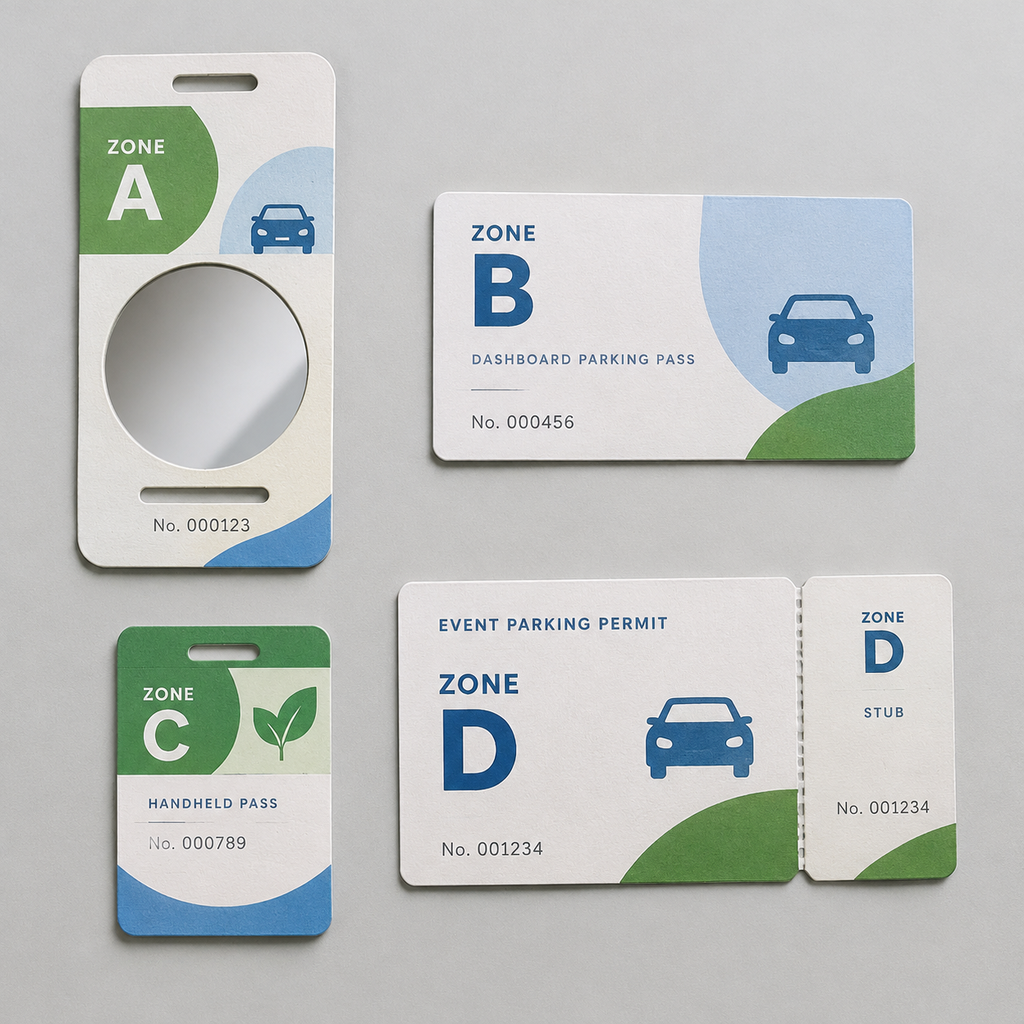
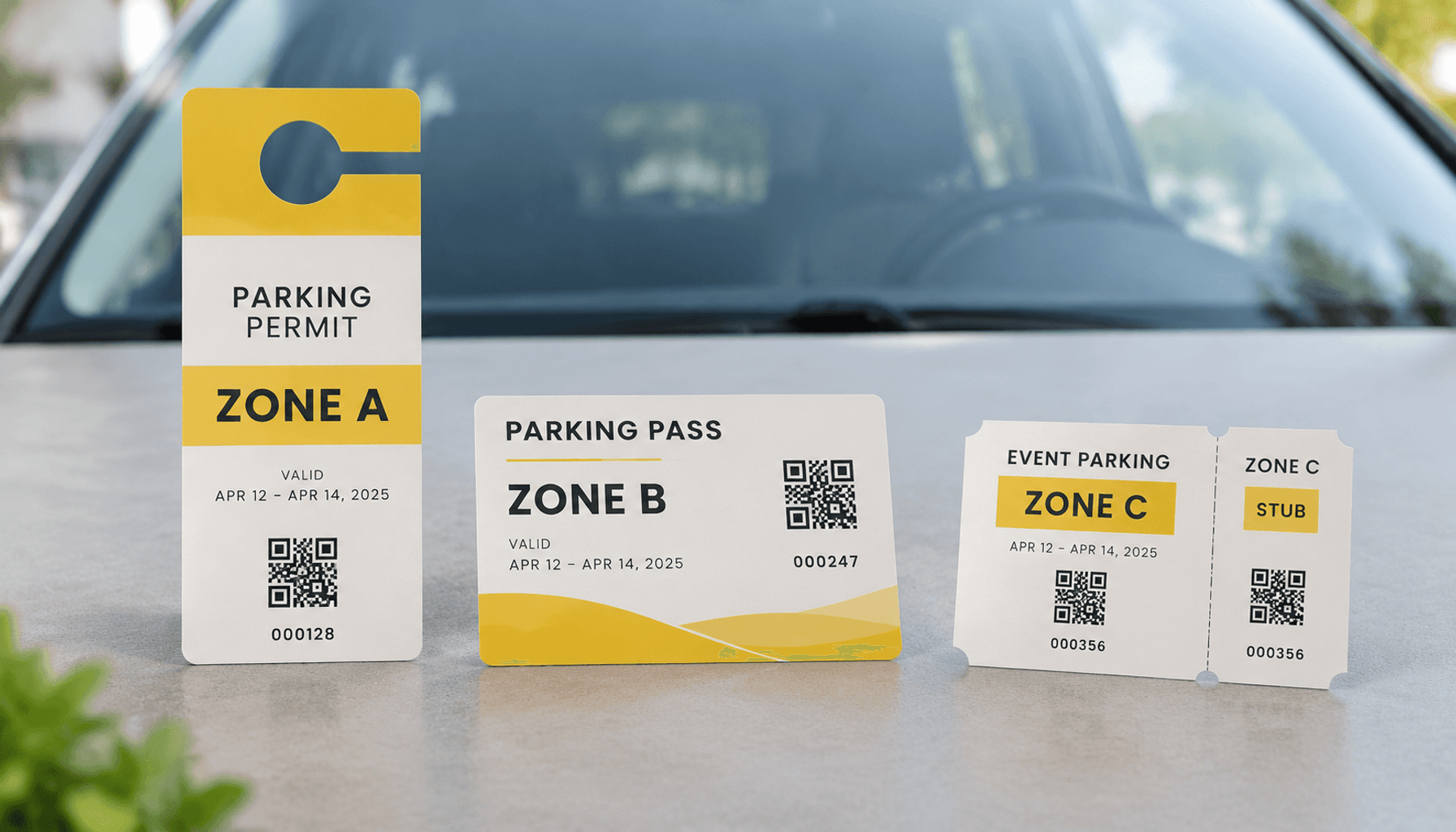
The best printed parking pass format depends on its display position and verification method. Hang tags suit repeated front-facing visual checks, dashboard cards suit short visits with suitable visibility, and perforated permits suit workflows that need a detachable record.
| Format | Useful application | Specification priority | Main limitation |
|---|---|---|---|
| Rearview-mirror hang tag | Staff, resident or recurring venue access | Opening fit, hanging direction, stiffness and visible data area | Mirror geometry varies; the opening can become a tear point |
| Dashboard card | Visitor parking and short event visits | Viewing angle, contrast and resistance to curling | The dashboard lip or windshield angle may hide information |
| Handheld pass | Entry checks where drivers present a credential | Readable identifiers and convenient handling size | It needs a separate display plan if inspected after entry |
| Perforated permit with stub | Paid parking or entry-record collection | Matching identifiers and controlled tear position | Tearing can damage the retained display section |
Rearview-Mirror Hang Tags
Hang tag parking passes should place the main information below an opening designed for the intended mirror stem. Die cutting uses a shaped tool to cut the outline, hole and entry slot.
Test a cut sample on representative vehicles. Check that the pass hangs in the intended direction, stays readable and has enough material around the opening to withstand fitting and removal.
Dashboard Cards and Handheld Passes
Dashboard cards work when attendants can see the required fields through the windshield. Handheld passes work when the entry procedure includes direct presentation.
Review custom card printing for dashboard formats, then confirm the required stiffness and finished dimensions. Test visibility from outside the vehicle, including whether the dashboard hides the lower text line.
Stubbed or Perforated Event Parking Permits
A detachable stub helps when attendants retain a parking-entry record while the driver keeps the display portion. Perforation is a line of small cuts that guides the tear.
Use ticket printing formats as the starting point for detachable event parking passes. Repeat the required identifier on both portions, and keep the retained pass’s date, zone and code clear of the tear line.
How to Choose Size, Layout and Viewing Orientation
Size should follow the available display space and the information attendants need. Establish portrait or landscape orientation before preparing final artwork.
For an initial mock-up, try 90 × 140 mm for a hang tag or 100 × 150 mm for a dashboard card, then adjust after fit and visibility testing. These are illustrative starting dimensions. Quote width × height, identify the top edge and specify how the back should read on two-sided passes.
Design for the Attendant's Viewing Distance
Put the information used for the first access decision in the largest, clearest area. For a lot-based system, that may be the lot letter and valid date.
Print the mock-up at actual size and inspect it from the attendant’s position. If the check happens from 2 meters away, test at that distance through the windshield. Move instructions and secondary details below the primary access fields.
Keep Data Clear of Hang Openings and Die-Cut Edges
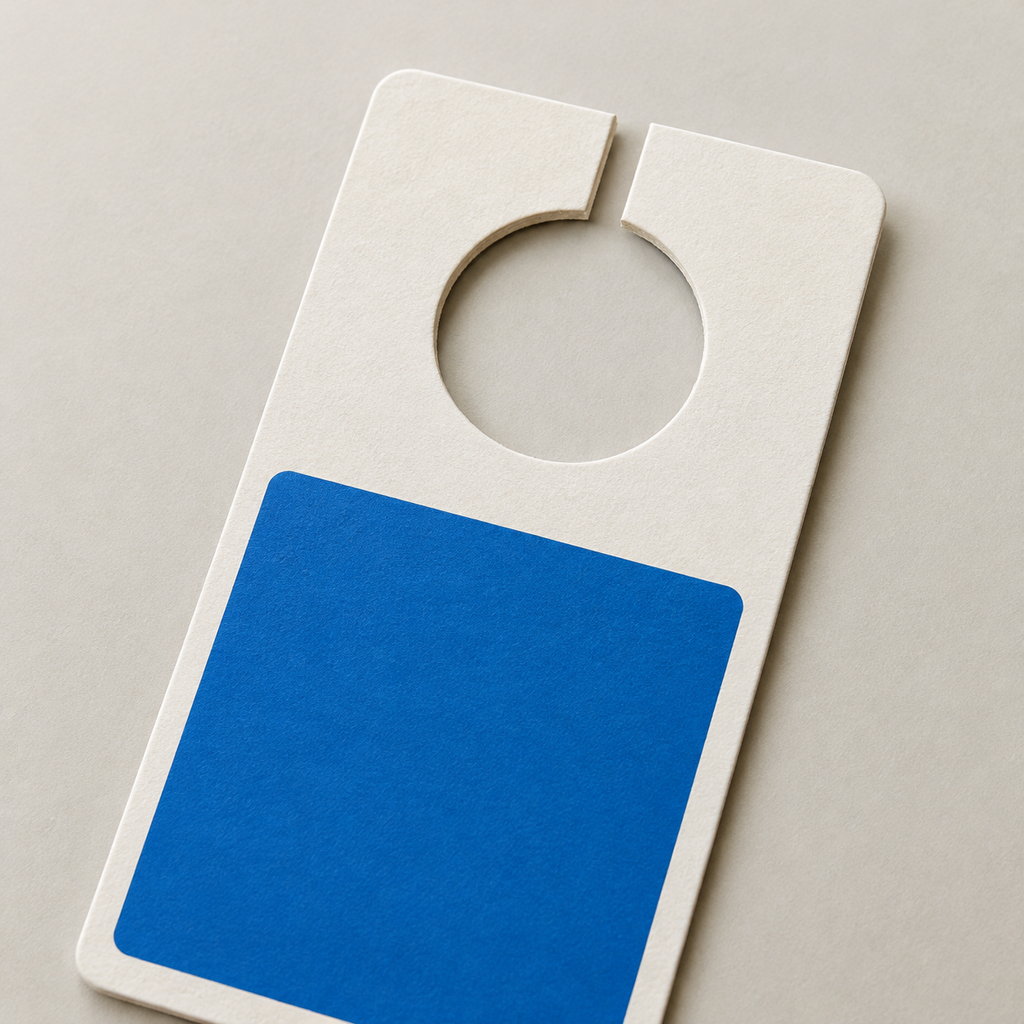
Position the hang opening above the main data panel, with sufficient material around its hole and entry slot. Keep dates, serials and codes inside the approved safe area around every cut.
Ask the printer to specify bleed, minimum material width around the opening and acceptable cutting variation. Bleed is artwork extending beyond the cut line; cutting tolerance is the allowed movement of that cut relative to the print. Confirm the proposed shape against Lemon Printing’s printing and finishing capabilities before artwork approval.
Numbering, QR Codes and Access-Zone Data
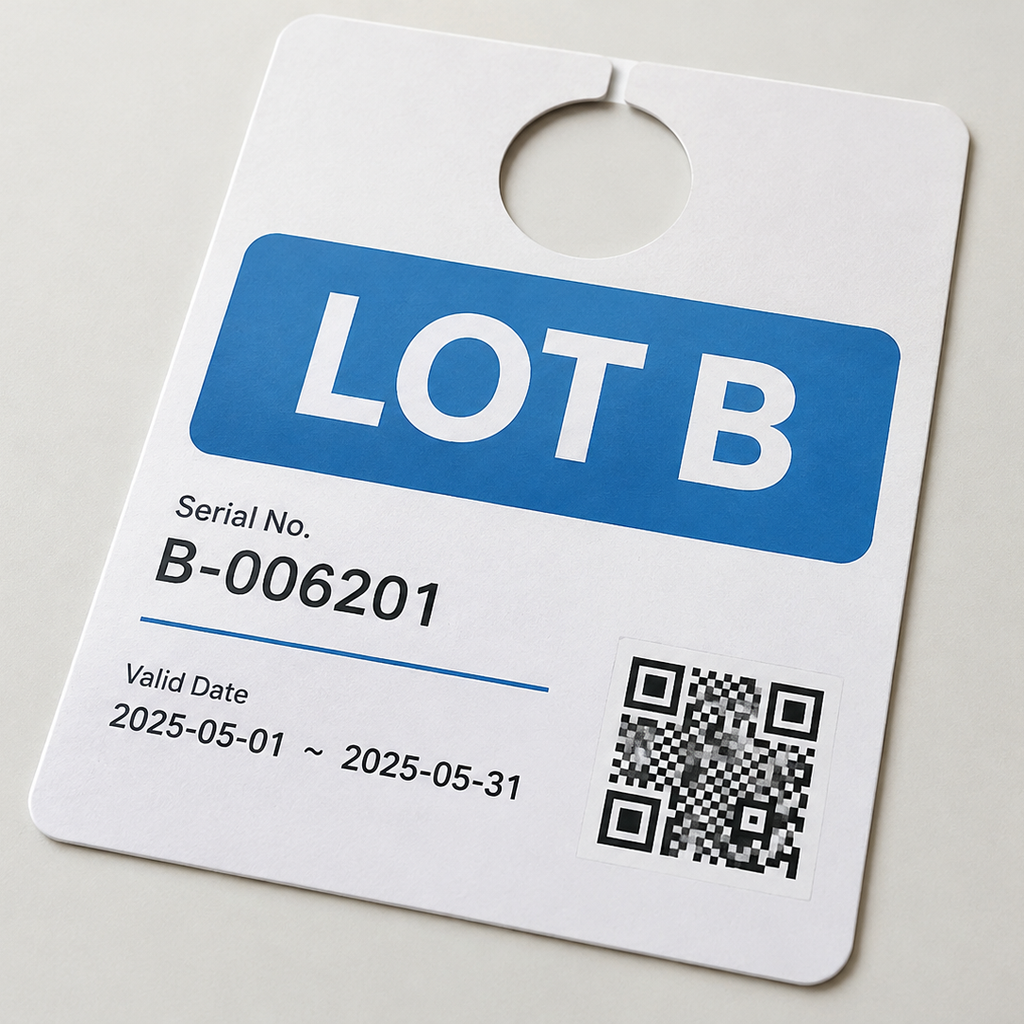
Parking passes can include sequential numbers and QR codes using variable-data printing, which changes selected fields between copies. Supply one approved record per permit, linking its identifier, printed serial, zone, valid date and QR payload—the information encoded in the symbol.
Use strong code contrast and preserve the quiet zone, the clear margin around the symbol. A standard QR code needs at least four modules, or small code squares, of clear space on each side. Test finished codes with the intended devices, including the densest code in the dataset.
Unique Serials for One-Time or Assigned Access
Serialized parking permits need a unique identifier and an agreed rule for how it is used. A printed number or QR code alone does not enforce one-time entry; the access system must track use and re-entry.
For 1,000 Lot B permits, an example range is B-006201 through B-007200. Preserve leading zeros and reconcile the record count. If numbering restarts by date or lot, include that field in the unique identifier.
Color Coding by Date, Lot or Access Level
Color can speed up visual sorting, but every color should also have a clear text label. Venue parking passes marked with both a blue panel and “LOT B” remain easier to interpret under changing lighting.
Approve a version matrix showing each date, zone, color and access level. Check that the visible label agrees with the QR record and the packing label.
Materials and Finishes for the Expected Environment
Temporary parking permits used inside a dry vehicle may suit paperboard. Permits exposed directly to rain or repeated wet handling need a water-resistant stock or protective construction verified for that exposure.
For single-day dry use, 250–350 gsm paperboard can be a starting sample range, subject to stiffness and fit testing. GSM means grams per square meter; it measures weight, not thickness. For wet use, ask about suitable synthetic stock and confirm printability, stiffness and heat performance. Lamination can protect surfaces while leaving paper edges vulnerable.
Why Durability Claims Require a Defined Use Period
A useful durability requirement states the use period and exposure conditions. “Durable” by itself does not tell a printer whether the pass needs to survive one afternoon or an entire season.
Specify expected heat, sunlight, humidity, wetting and removal cycles. Agree sample tests and acceptance criteria for curling, fading, surface damage and opening tears. A short handling test offers limited evidence about months of vehicle exposure.
Glare, Writing and Moisture Considerations
Finish selection should support reading, scanning and any handwritten fields. A matte surface can reduce reflections, but performance still needs checking through the intended windshield.
If attendants write a plate number or expiry date, specify a compatible writing area and test the actual pen for drying and smearing. Check whether moisture reaches exposed edges, the hang slot or perforations, even when the main surface is protected.
Parking Pass Production and Proofing Steps
Approve the display format, data and packing plan as one connected specification. A PDF proof checks layout and content; a finished physical sample checks construction and handling.
- Define the checkpoint: record viewing distance, display position and verification method.
- Confirm construction: approve stock, finish, die line, opening dimensions and cutting tolerance.
- Validate data: check all source records for completeness, unique identifiers and correct field mapping.
- Review proofs: inspect actual-size artwork, longest fields, first and last serials, and two-sided orientation.
- Test finished samples: verify mirror fit, tearing, visibility, writing and scanning with actual devices.
- Release production: approve the data-file version, quantity reconciliation, bundle labels and carton allocation.
Use the commercial printing process to identify the approvals required before printing and finishing.
Common Parking Permit Printing Failures
A pass can fail even when its print looks clean: information may be unreadable, codes may point to the wrong records, or batches may arrive in the wrong order. Approval should connect artwork, variable data and packing controls.
Small Data That Cannot Be Read at the Checkpoint
Small type, low contrast and crowded codes become operational problems when attendants cannot verify a pass quickly. A monitor preview cannot reproduce the viewing conditions through a windshield.
Check the longest date or access label at actual size. Keep patterns out of code backgrounds, preserve the quiet zone and test the finished surface under expected lighting. Enlarge the fields used for the first decision before reducing everything to fit.
Mixed Number Sequences During Packing and Distribution
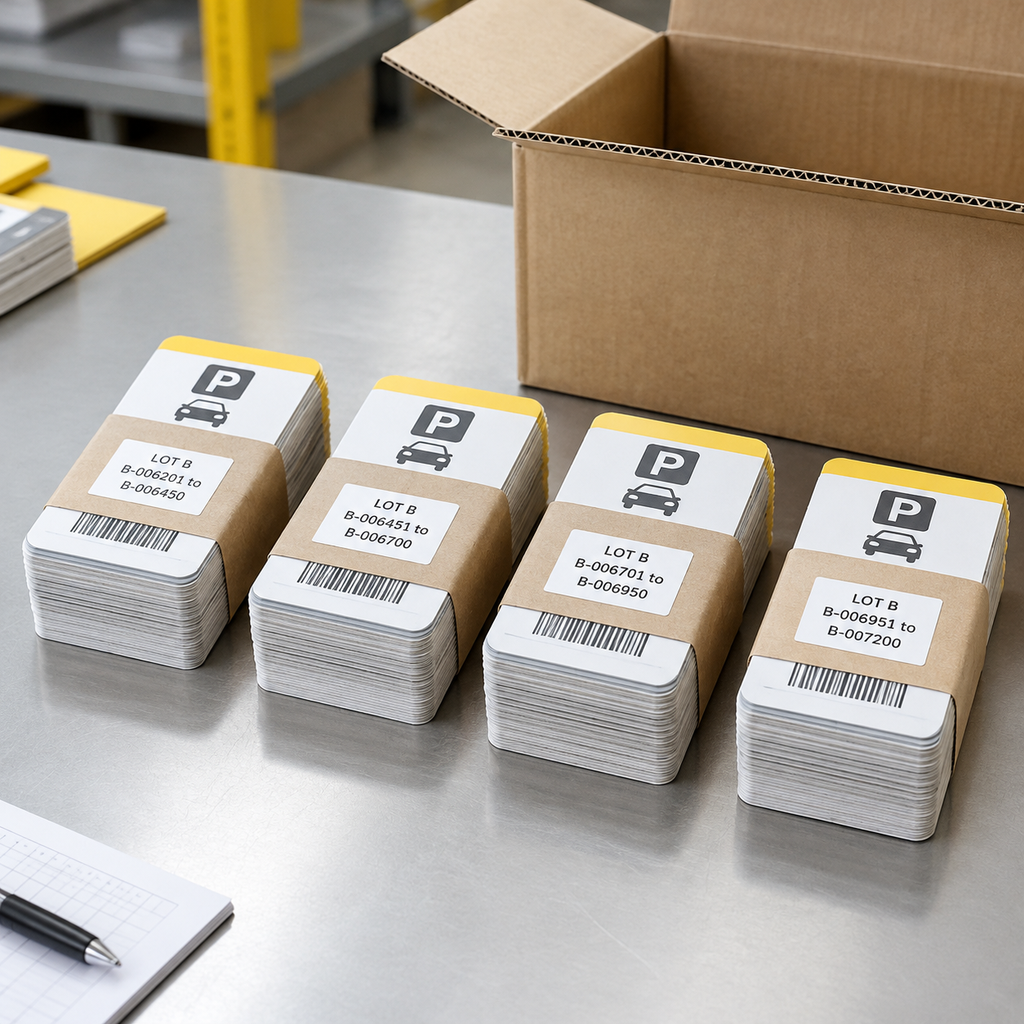
Packing can be specified by number range, date, parking zone or a combination, subject to production confirmation. Define the sorting priority and which end of each sequence sits on top.
For example, a 250-piece Lot B bundle could cover B-006201 through B-006450. Label its quantity, range and zone, then reconcile packed counts with the approved file. Agree how spoiled numbers are replaced or reported. Sampling alone cannot establish that every serial is present. Specify packing checks alongside Lemon Printing’s quality inspection process.
Custom Parking Pass Options from Lemon Printing
According to Lemon Printing, the company was established in 2015 and operates a self-owned factory in China’s Guangzhou–Shenzhen manufacturing corridor, with more than 130 workers and 8+ offset and digital presses. Prepress, printing, finishing, inspection, packing and export preparation are handled in-house.
Use these configurations for a specification review. Confirm stock availability, custom cutting and variable-data handling for the actual order.
| Parking pass configuration | Details to quote | Proof priority |
|---|---|---|
| Die-cut hang-format pass | Size, opening drawing, stock, finish and data fields | Mirror fit, hanging direction and material around the opening |
| Dashboard or handheld card | Dimensions, stiffness, printed sides and verification method | Windshield visibility, orientation and code readability |
| Perforated parking permit | Retained display area, stub size and matching identifiers | Controlled tearing and usable information after separation |
Quote and Packing Requirements Checklist
A comparable quote needs a complete physical specification and a clear data and packing brief. Include:
- Format, quantity per version, finished width × height and printed sides.
- Use period, display position, and expected moisture and heat exposure.
- Stock, GSM or thickness, finish, writing areas and sample requirements.
- Die line, opening dimensions, cutting tolerance and perforation position.
- Data file, serial ranges, leading zeros, QR payloads and zone/date mapping.
- Bundle quantities, sorting priority, label fields, carton allocation and reconciliation requirements.
- Delivery destination with postal code, target receipt date and preferred shipping approach.
Frequently Asked Questions
What format is best for a printed parking pass?
Use a hang tag for repeated visual checks from the front of a parked vehicle, a dashboard card for short visits with suitable visibility, and a perforated pass when a detachable record is needed. Confirm the choice at the actual checkpoint.
Can parking passes include sequential numbers and QR codes?
Yes. Sequential numbers and unique QR codes can be printed from an approved data file. Verify the printed serial-to-code relationship and test scanning on a finished sample. One-time access requires a system that tracks use and defines re-entry rules.
How should a rearview-mirror hang opening be positioned?
Place the opening above the main data area and size the hole and entry slot for the intended mirror stem. Keep critical information outside the opening and cutting safety zones. Test a die-cut sample for fit, hanging orientation and tear resistance.
What material should be used for temporary outdoor parking permits?
For dry use inside a vehicle, suitable paperboard may be sufficient. For direct rain or repeated wet handling, ask for a water-resistant stock or protective construction and test a sample over the intended use period. Lamination alone does not make exposed paper edges waterproof.
Can parking passes be packed by number range, date or parking zone?
Yes, these grouping methods can be included in the packing specification, subject to production confirmation. Define bundle quantities, sorting priority, range labels and carton allocation before printing. Reconcile delivered counts and any approved sequence gaps against the data file.
Final Specification Check Before Ordering
Order when the vehicle-display mock-up is readable, the opening fits without tearing, codes match the approved data and the packing plan matches gate distribution. Keep the signed specification, proof, data-file version and carton plan together so a reorder uses the same control points.
Get a Clear Quote for Your Printing Project
Send Lemon Printing your parking pass format, quantity, finished size, material, numbering or QR requirements, finishing, packing groups, delivery destination and target date. Request a specification-based quote and a free prepress file check when artwork is available. Our team normally responds within one business day with practical production options, pricing and a project timeline.
Final MOQ, production time, pricing and shipping depend on product specifications, quantity, finishing and destination.