Table of Contents
- Key takeaways for custom notebook printing
- Notebook specification summary table
- Choose paper based on the writing tool
- Paper weight, opacity, and show-through
- Smoothness, absorbency, and drying behavior
- White, natural, and recycled-looking stocks
- Plan ruling and printed interior pages
- Lined, dotted, grid, and blank layouts
- Ruling weight, margins, and registration
- Repeated pages versus mixed content sections
- Compare notebook binding options
- Wire-O and spiral notebooks
- Perfect-bound softcover notebooks
- Casebound and sewn journals
- Specify the cover, endsheets, and accessories
- Lamination, foil, embossing, and debossing
- Elastic closures, ribbons, pockets, and pen loops
- Notebook proofing and production workflow
- Test writing performance before bulk production
- Check ruling, pagination, and binding position
- Confirm accessories and packed presentation
- Common notebook manufacturing problems and fixes
- Custom notebook and journal printing from Lemon Printing
- What to send for an accurate notebook quote
- Frequently asked questions
- Get a custom notebook printing quote
Key takeaways for custom notebook printing
Custom notebook printing should start with the pages people will write on. A cover sample cannot tell you whether gel ink feathers, a grid stays aligned, or the notebook opens comfortably. Decide the writing experience first, then specify branding and accessories.
Definition: Custom notebook printing means producing writing notebooks or journals to a buyer’s specification, including interior paper, ruling, binding, cover branding, and packing.
- Approve the actual paper with the intended pens; weight alone does not establish writing performance.
- Dimension ruling and margins from the finished page, allowing space for the binding.
- Choose binding by opening behavior, durability, and presentation.
- Include endsheets, accessories, and packaging in the specification before comparing quotes.
Notebook specification summary table
Compare notebook configurations using the same finished size and interior page count. These examples are starting points for sampling, not fixed product packages or guarantees of pen compatibility.
| Notebook format | Paper to sample | Layout and binding | Main check |
|---|---|---|---|
| Meeting notebook | 80–100 gsm uncoated | Lined; Wire-O or softcover | Everyday pen performance |
| Classroom notebook | 80–100 gsm uncoated | Grid, dots, or lines; Wire-O or spiral | Usable area beside punched holes |
| Daily journal | 100–120 gsm uncoated | Lined or blank; sewn casebound | Ink behavior and opening resistance |
| Retail gift journal | Approved writing stock | Selected ruling; hardcover construction | Accessory assembly and packed appearance |
State dimensions in millimeters: A5, for example, is 148 × 210 mm. A specification of 160 interior pages means 80 leaves when both sides count; identify covers and endsheets separately.
Choose paper based on the writing tool
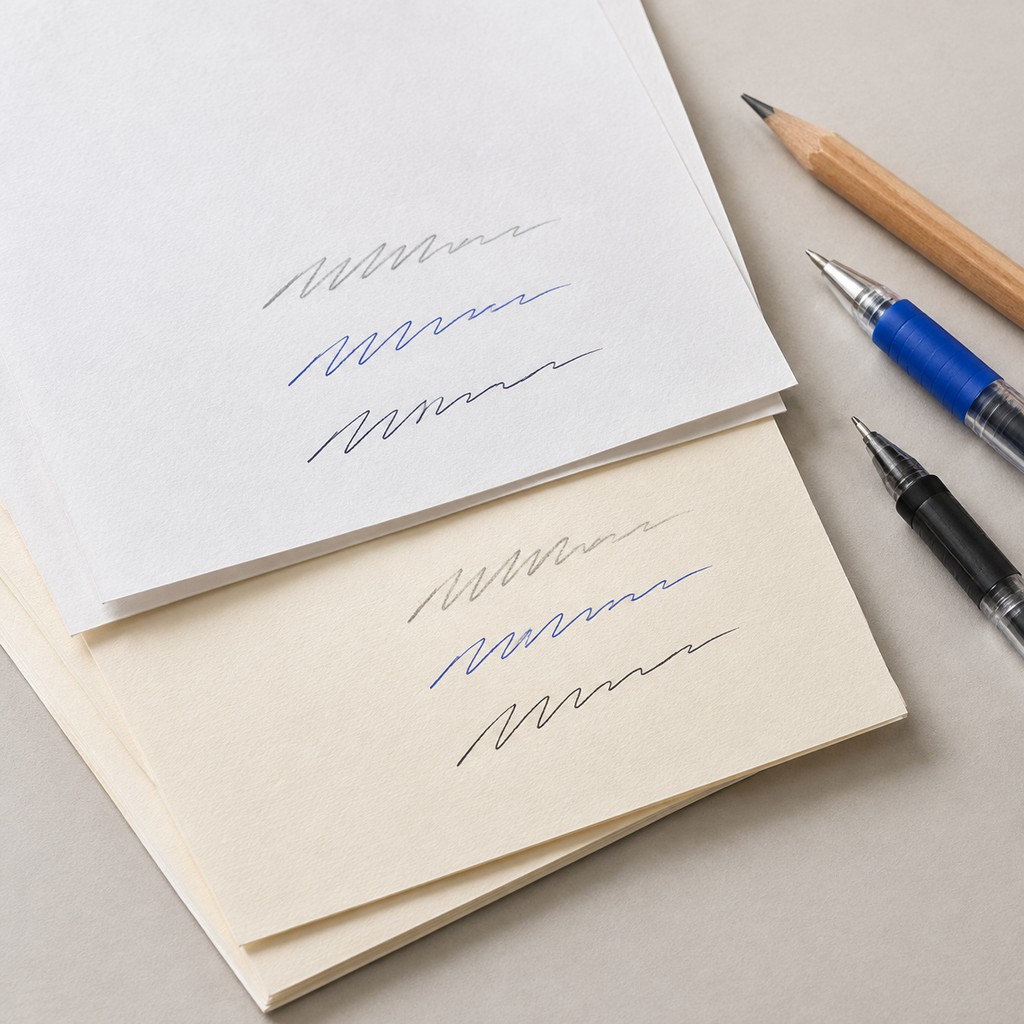
The best paper weight depends on the pen and the acceptable level of show-through. Sample 80–100 gsm uncoated writing paper for pencil and ballpoint use; include 100–120 gsm candidates when testing gel, rollerball, or fountain pens. These are trial ranges, not universal recommendations.
Uncoated writing paper is a sensible starting point because it lacks the surface coating used on many picture-book papers. Marker ink can penetrate even heavier sheets, so identify the marker type. For sewn and adhesive-bound journals, request paper grain parallel to the spine to help pages bend and turn naturally.
Paper weight, opacity, and show-through
Notebook paper weight is measured in gsm, meaning grams per square meter. It describes mass, not thickness, opacity, or resistance to liquid ink.
Show-through is writing visible through the sheet without ink passing through it. Bleed-through means ink has penetrated to the reverse side. Compare both on actual stock. Also request caliper, the sheet’s measured thickness: two papers with the same gsm can produce different spine widths, binding requirements, packed weights, and freight costs.
Smoothness, absorbency, and drying behavior
A smooth sheet may feel pleasant while keeping wet ink on its surface longer. A more absorbent sheet may dry faster but allow feathering, where ink spreads into fuzzy edges along paper fibers.
Surface sizing—the treatment that controls liquid penetration—affects this balance. Test normal writing, pauses at the end of strokes, and rubbing after a recorded interval. Include left-handed writing if relevant, because the hand can pass over fresh ink. Printed ruling should also remain stable under the selected pen or highlighter.
White, natural, and recycled-looking stocks
Paper shade changes both the reading experience and the appearance of printed ruling. Compare white and warm cream samples under the lighting in which the notebook will be used.
A flecked or kraft-like appearance does not establish recycled content. If recycled fiber is required, specify the required percentage and request supporting material information. For repeat orders, record the approved stock reference and shade; replacing paper with another sheet of the same gsm can change feel, line contrast, and ink behavior.
Plan ruling and printed interior pages
Specify custom ruled pages as measured artwork, including spacing, line color, writing area, and margins. Dimension the layout from the finished trim and reserve space for punched holes or the bound gutter—the inner margin beside the spine.
Keep branding clear of the writing area. A small footer or ownership page may be useful; a large repeated logo can interfere with notes, diagrams, and scanning.
Lined, dotted, grid, and blank layouts
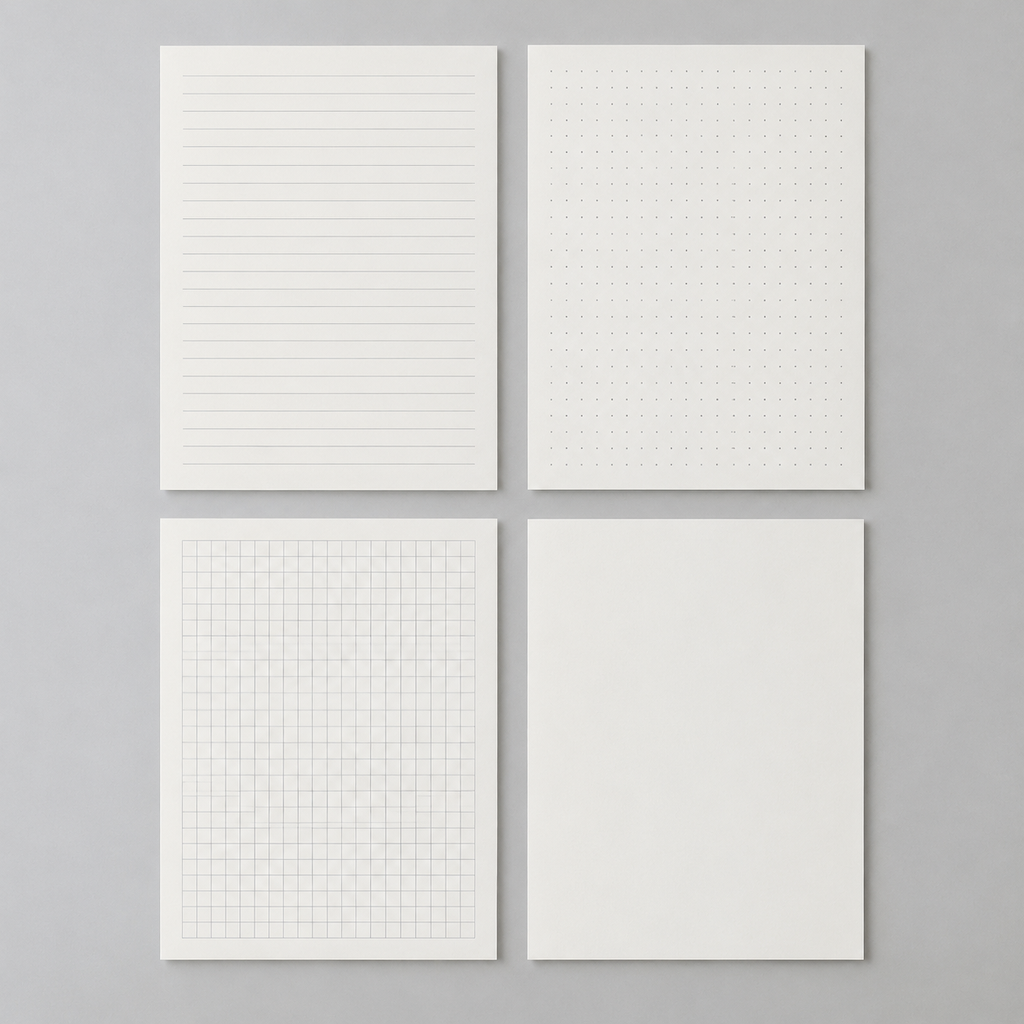
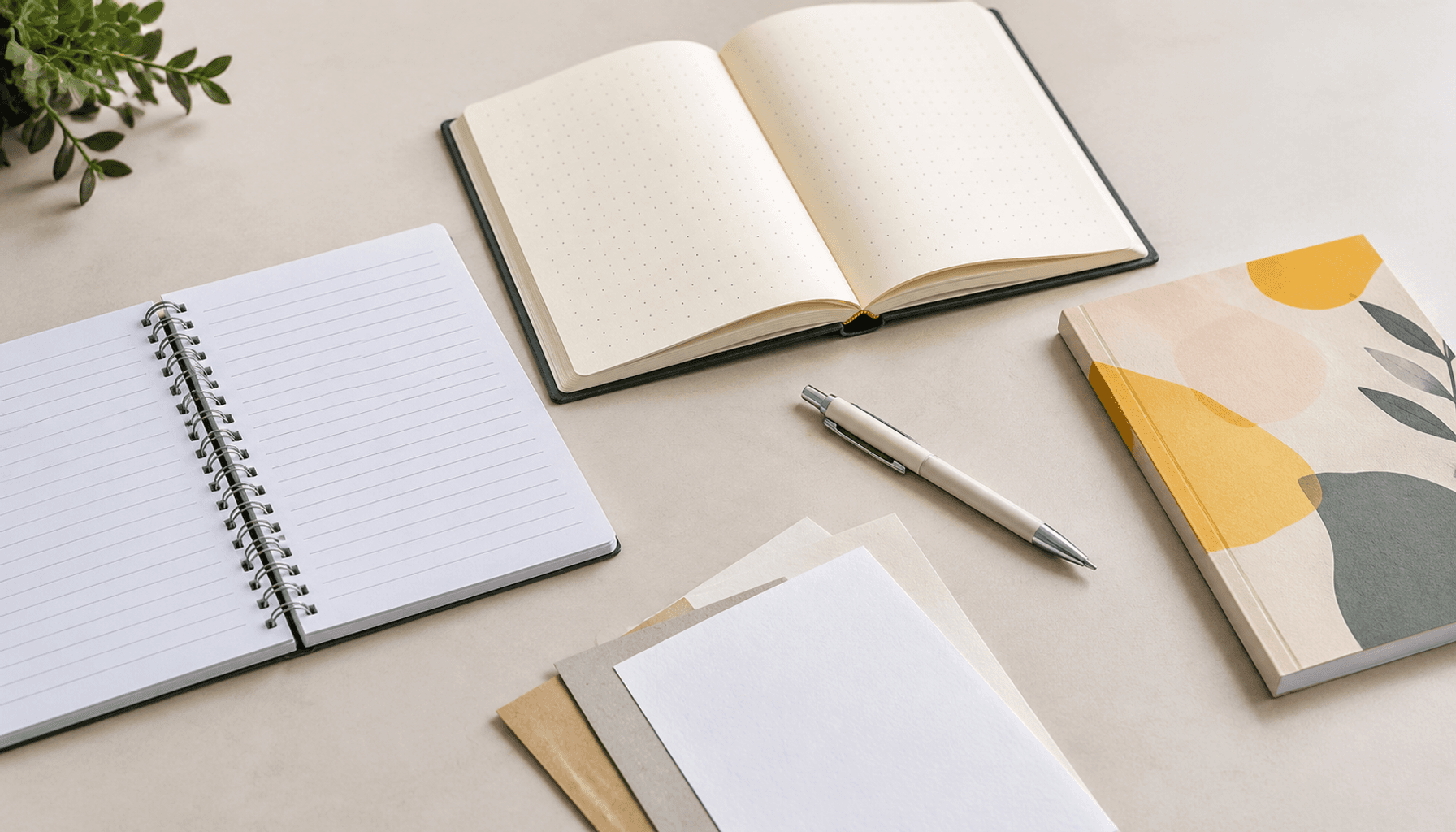
Choose the layout around the work users will do. Lined pages support continuous notes; dots provide flexible alignment; grids suit tables and diagrams; blank pages leave space for sketches.
A 7 mm line pitch or 5 mm grid is a design choice, not a manufacturing standard. Print a full-size sample and write on it. Check whether headings, dates, and page numbers reduce usable space, especially in smaller notebooks.
Ruling weight, margins, and registration
Ruling needs a defined line thickness and ink value; “light gray” is insufficient. If visual weight matters, compare proposed 0.15 mm and 0.2 mm lines on the selected stock.
Registration means alignment between printed elements, including ruling on opposite sides. Agree acceptable variation in front-to-back alignment, trimming, and hole position. For example, a 15 mm top inset with a proposed ±1 mm variation is a buyer specification to confirm with the printer, not a universal factory tolerance. Check facing pages together, where uneven line positions become easy to see.
Repeated pages versus mixed content sections
Yes, every notebook page can have different printed content. Supply a complete, ordered interior PDF for a fixed sequence of planners, reference pages, ruled sections, or branded inserts.
For repeated pages, state the repeat count and identify exceptions such as title pages and dividers. Confirm page-count requirements for folded, sewn sections, and include intentional blanks in the pagination. Different content between individual copies is a separate personalization requirement that needs production review. Mixed-color sections and extra inserts can also change setup and assembly costs.
Compare notebook binding options
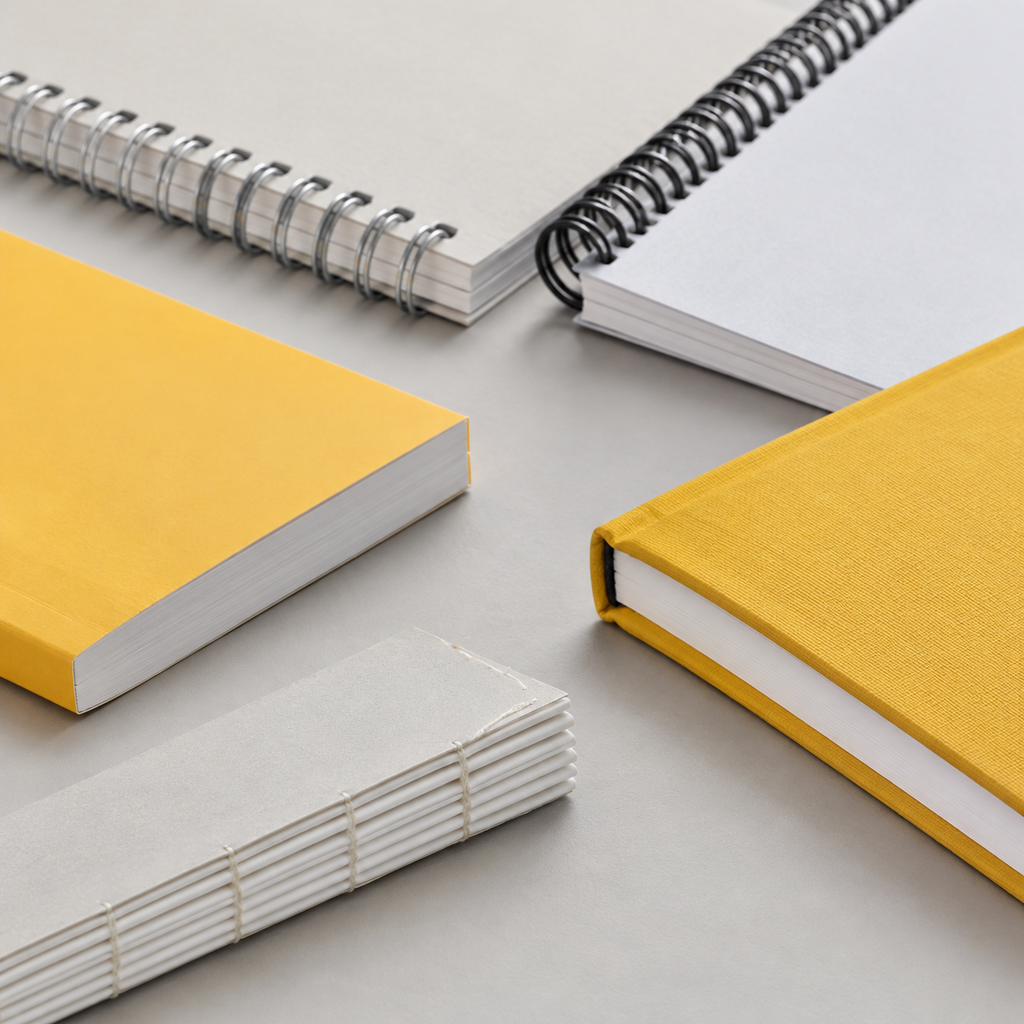
Wire-O and spiral binding are practical choices for flat opening in classrooms or training sessions. Sewn journals can also open comfortably, but cover hinges, paper grain, and spine construction must be checked on a finished sample.
| Binding | Opening behavior | Buyer trade-off |
|---|---|---|
| Wire-O | Flat opening; pages can turn back | Metal loops need protection against crushing |
| Spiral | Flat opening; pages can turn back | Coil projects beyond the page edge |
| Perfect-bound softcover | Usually resists opening near the gutter | Clean spine, but less convenient for writing close to it |
| Sewn casebound | Depends on sewing, spine, and hinge construction | Structured presentation with additional assembly stages |
Wire-O and spiral notebooks
Wire-O notebook printing uses twin-loop metal wire to hold punched pages. Spiral binding uses a continuous coil, often plastic. Confirm the material, color, hole pattern, and binding diameter.
Diameter should suit the actual page-block thickness and cover construction. Undersized binding restricts turning; excessive clearance lets the block move loosely. Inspect hole clearance from ruling, wire closure, and coil ends. Test the intended cover arrangement to confirm that pages turn back as expected, then protect the exposed binding during packing.
Perfect-bound softcover notebooks
Perfect binding glues the page block into a flexible cover and provides a continuous printable spine. It can suit notebooks where compact presentation matters more than unrestricted opening.
Allow a generous inner writing margin because some page area becomes difficult to reach near the spine. Assess opening force, page retention, and cover creasing on a bound sample. Specify the selected adhesive system and allow the manufacturer’s required curing period before evaluating the binding.
Casebound and sewn journals
Casebound describes a page block fitted into a rigid cover; it does not automatically mean sewn. Sewing joins folded groups of pages, called signatures, with thread.
For hardcover journal printing, specify both the case construction and how the interior is bound. Opening behavior depends on paper grain, sewing, adhesive, and hinge space. Examine the first, middle, and last spreads without forcing them flat. A central spread that opens well does not establish comfortable writing throughout the journal.
Specify the cover, endsheets, and accessories
For custom journal printing, define the cover construction before selecting decoration. A printed card cover, a paper-wrapped rigid case, and a fabric-like wrap require different artwork and finishing checks.
Record cover material, board thickness where applicable, corner shape, and the cover’s extension beyond the pages. Endsheets are the sheets that connect a hardcover’s page block to its case. Specify their paper and any printing separately, including ownership pages or inside-cover branding. Confirm accessory availability and attachment methods as part of the same specification.
Lamination, foil, embossing, and debossing
Lamination adds a protective film; foil adds a stamped metallic or colored design. Embossing raises a design, while debossing presses it below the surface. Suitability depends on the selected cover material.
Provide separate finishing artwork and specify position, foil reference, and intended relief. Review fine details, edges, hinge areas, and adhesion on a sample. Matte, gloss, and soft-touch surfaces differ in feel and visible scuffing. Review Lemon Printing’s printing and finishing capabilities when checking which treatments fit the chosen cover material.
Elastic closures, ribbons, pockets, and pen loops
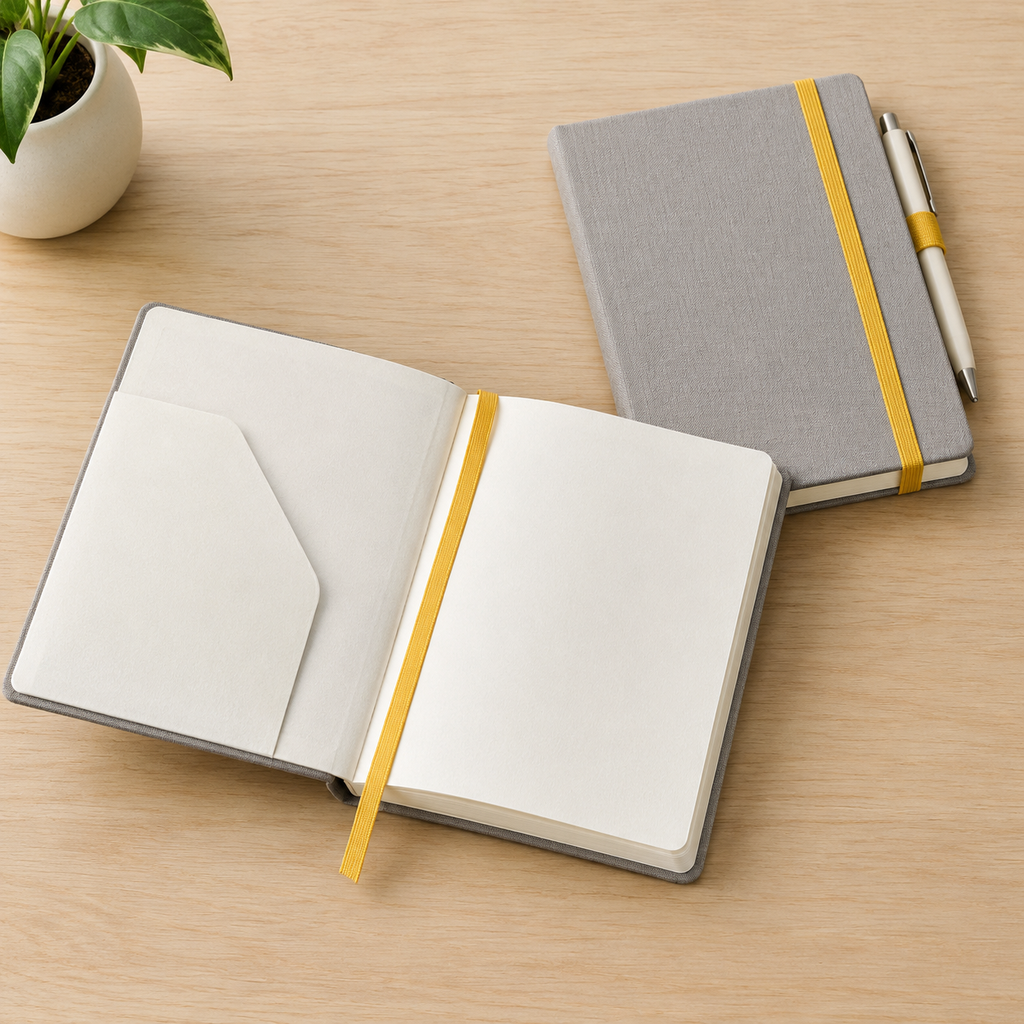
Treat each accessory as a separately confirmed component with dimensions, material, color, and attachment position. A rendering rarely shows whether it works comfortably.
- Elastic: check tension, anchoring, and whether it dents the cover.
- Ribbon: specify count, width, usable length, and end treatment.
- Pocket: define capacity and test the fold and adhesive with intended contents.
- Pen loop: test it with the actual pen diameter and clip.
Approve the assembled notebook, since accessories can interfere with page turning, closing, or packaging.
Notebook proofing and production workflow
Use separate approvals for files, writing paper, construction, and packing. A digital proof checks content and layout; physical samples are needed to assess paper and opening behavior.
- Lock the specification and review print-ready files.
- Test paper samples with the intended writing tools.
- Approve ruling, color, pagination, and cover finishing references.
- Review a bound and assembled sample; record what it represents.
- Confirm inspection criteria and packed presentation before shipment.
Use Lemon Printing’s commercial printing process to agree where each approval occurs.
Test writing performance before bulk production
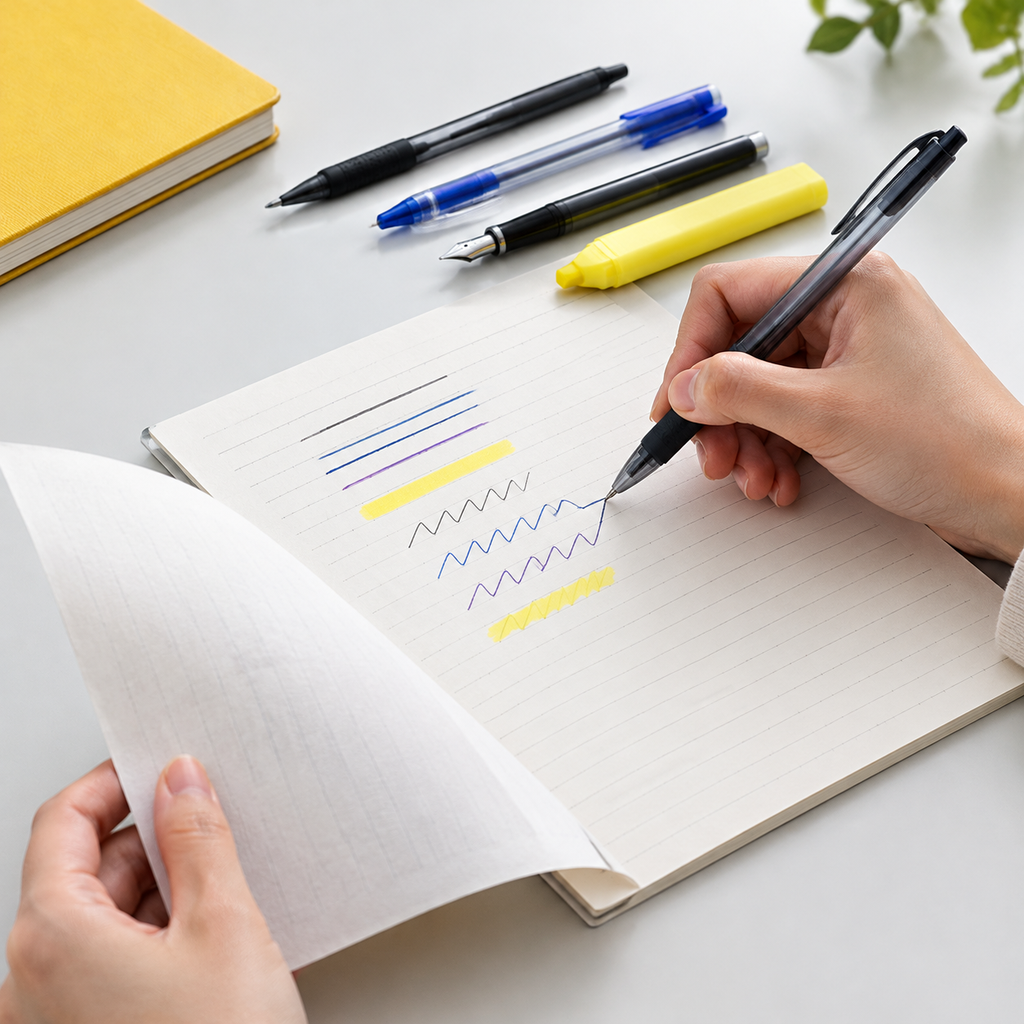
Test the exact candidate stock, ideally with production-representative ruling. Use the intended pens and markers, including their actual ink types.
- Write ordinary notes, slow strokes, and overlapping marks.
- Record drying intervals and check smearing using the same method on each stock.
- Inspect the reverse for show-through and bleed-through after drying.
- Try highlighting and erasing where relevant.
- Write on both sides and assess whether the second side remains comfortable to use.
Keep a labeled reference sample with the stock name and pen details. Define acceptable results before approving the paper.
Check ruling, pagination, and binding position
Inspect a finished sample against the approved dimensions and page sequence. Match bleed, safe areas, and punch clearance to the printer’s template.
Measure ruling pitch and margins on several pages, then compare facing spreads and front-to-back alignment. Verify section transitions, intended blanks, and page-number sequence. For punched notebooks, turn pages through the complete block and check for torn holes or trapped sheets. For bound journals, check squareness and confirm that the inner writing area remains usable near the beginning and end.
Confirm accessories and packed presentation
Approve an assembled and packed sample, including any sleeve, band, individual wrap, or gift box. Check that ribbons lie correctly, pockets are secure, and elastic does not distort the cover.
Specify carton quantities and protection against corner damage, surface rubbing, and binding compression. For retail projects, confirm barcode position and visibility through the chosen packaging. Agree these checks alongside Lemon Printing’s quality control process.
Common notebook manufacturing problems and fixes
Diagnose a failed sample by checking material, artwork, and construction separately. Increasing paper weight or changing binding without identifying the cause can add cost without resolving the problem.
| Problem | What to check | Practical response |
|---|---|---|
| Writing shows through | Opacity and intended ink | Compare alternative stocks at the same and higher gsm |
| Ink feathers or smears | Surface sizing, absorbency, drying | Test another writing stock with the same pens |
| Ruling appears uneven | Artwork, registration, trimming | Correct dimensions and agree measurable inspection limits |
| Journal resists opening | Grain, hinges, spine construction | Revise construction and evaluate a bound sample |
| Binding or cover arrives dented | Accessory pressure and packing compression | Revise protection, spacing, and carton arrangement |
Custom notebook and journal printing from Lemon Printing
Lemon Printing’s custom book printing range includes notebooks and journals with softcover, hardcover, sewn, Wire-O, and spiral formats. For branded notebook printing, confirm the complete construction rather than approving only a cover rendering.
According to Lemon Printing, the company was established in 2015 and operates a self-owned facility in China’s Guangzhou–Shenzhen manufacturing corridor, with more than 130 workers and eight or more offset and digital presses. Prepress, printing, binding, finishing, inspection, packing, and export preparation are handled in-house. Confirm the proposed stock, accessories, proof type, and inspection requirements during specification review.
What to send for an accurate notebook quote
An accurate quote starts with one written specification. Final MOQ, production time, pricing, and shipping depend on product specifications, quantity, finishing, and destination. MOQ means minimum order quantity.
- Order: notebook or journal type, quantity, and number of design variants.
- Format: finished dimensions, interior page count, and separately identified covers, endsheets, and inserts.
- Paper: stock reference or sample request, gsm, shade, and intended pens.
- Interior: ruling, ink colors, margins, repeated pages, or complete mixed-content PDF.
- Construction: binding, cover material, finishing, accessories, and proof requirements.
- Delivery: packaging, destination postal code, target receipt date, and any required shipping arrangement.
More finishing operations, accessory assembly, proof rounds, and packaging components can add production stages. Compare quotes on the same approved specification and landed-cost basis.
Frequently asked questions
- What paper weight is best for custom notebook printing?
- There is no single best weight. Sample 80–100 gsm uncoated paper for pencil and ballpoint use, and include 100–120 gsm candidates for wetter inks. Approve opacity, feathering, drying, and bleed-through using the intended pens.
- Which notebook binding lays flat for training or classroom use?
- Wire-O and spiral binding generally provide flat opening and allow pages to turn back. Confirm this with the selected cover construction. Sewn journals may also open comfortably, but a hardcover alone does not establish flat-opening performance.
- Can every notebook page have different printed content?
- Yes. Supply a complete interior PDF showing the page sequence, section changes, and intentional blanks. Repeated pages need a repeat count. Different content between individual copies is a separate personalization requirement to discuss with the printer.
- How should buyers test notebook paper for pens and markers?
- Use the exact candidate stock and intended writing tools. Test ordinary writing, slow strokes, drying, rubbing, and both sides of the sheet. Record pen and ink details, inspect feathering and bleed-through, and keep an approved reference sample.
- What affects MOQ, pricing, production time, and shipping for custom notebooks?
- Paper availability, size, page count, quantity, design variants, binding, finishing, accessory assembly, proofing, and packaging affect production planning. Packed weight, dimensions, destination, and transport method affect shipping. Confirm project-specific MOQ, pricing, and timing against the complete specification.
Get a custom notebook printing quote
A useful notebook specification starts with approved writing paper and a page layout that fits its binding. Add cover decoration and accessories once those decisions are settled, then price the complete construction and packed presentation as one project.
FAQ
What paper weight is best for custom notebook printing?
There is no single best weight. Sample 80–100 gsm uncoated paper for pencil and ballpoint use, and include 100–120 gsm candidates for wetter inks. Approve opacity, feathering, drying, and bleed-through using the intended pens.
Which notebook binding lays flat for training or classroom use?
Wire-O and spiral binding generally provide flat opening and allow pages to turn back. Confirm this with the selected cover construction. Sewn journals may also open comfortably, but a hardcover alone does not establish flat-opening performance.
Can every notebook page have different printed content?
Yes. Supply a complete interior PDF showing the page sequence, section changes, and intentional blanks. Repeated pages need a repeat count. Different content between individual copies is a separate personalization requirement to discuss with the printer.
How should buyers test notebook paper for pens and markers?
Use the exact candidate stock and intended writing tools. Test ordinary writing, slow strokes, drying, rubbing, and both sides of the sheet. Record pen and ink details, inspect feathering and bleed-through, and keep an approved reference sample.
What affects MOQ, pricing, production time, and shipping for custom notebooks?
Paper availability, size, page count, quantity, design variants, binding, finishing, accessory assembly, proofing, and packaging affect production planning. Packed weight, dimensions, destination, and transport method affect shipping. Confirm project-specific MOQ, pricing, and timing against the complete specification.
Get a Clear Quote for Your Printing Project
Send Lemon Printing your notebook or journal type, quantity, finished size, interior page count, paper, ruling, binding, finishing, accessories, delivery destination, and target date. Request a specification-based quote using your approved samples or material requirements. Our team will review the specifications and normally respond within one business day with practical production options, pricing, and a project timeline.