A printing quote is a map of the production choices behind a finished product. It is more useful to ask what assumptions it includes than to look for a universal price. Two jobs with the same quantity can differ in format, paper, color, finishing, packing, proofing, and freight. A complete brief makes those differences visible before a team compares proposals.
Cost control does not mean removing every option. It means separating requirements that cannot change from alternatives that can be evaluated. When suppliers are asked to price the same product outcome, their assumptions can be compared fairly and the team can decide which trade-offs best serve the reader, campaign, schedule, and delivery plan.
Understand setup and quantity effects
Some production work happens before repeated copies are made: file review, setup, proofing, plates or other preparation, and finishing preparation. These steps can influence the cost structure of a job. As quantity changes, their contribution changes too, but there is no useful fixed threshold that applies to every format, material, or production method.
Ask for quantity options only when the specification stays clear. A useful comparison keeps the same trim size, pages, stock, color, binding, finishing, packing, and delivery basis unless the purpose is to evaluate one deliberate alternative. The printing capabilities overview can help identify which production routes should be considered for the product.
Compare tiers on a like-for-like basis
If quantity tiers are requested, label them clearly and ask for the assumptions behind each one. A larger run may change carton counts, pallet handling, storage needs, or the production route as well as the number of printed copies. Record whether proofs, special finishes, delivery, or versioned files are included at every tier. A lower total that omits a necessary stage is not an equivalent comparison.
Specify format, pages, and paper
Trim size, orientation, page count, fold pattern, and ink coverage shape material use and production handling. A small page-count change can alter a signature plan or binding requirement. A larger format can change imposition, packing, and movement. Include a final PDF or page plan whenever possible, and identify covers, inserts, gatefolds, tabs, or other parts that do not follow the standard page pattern.
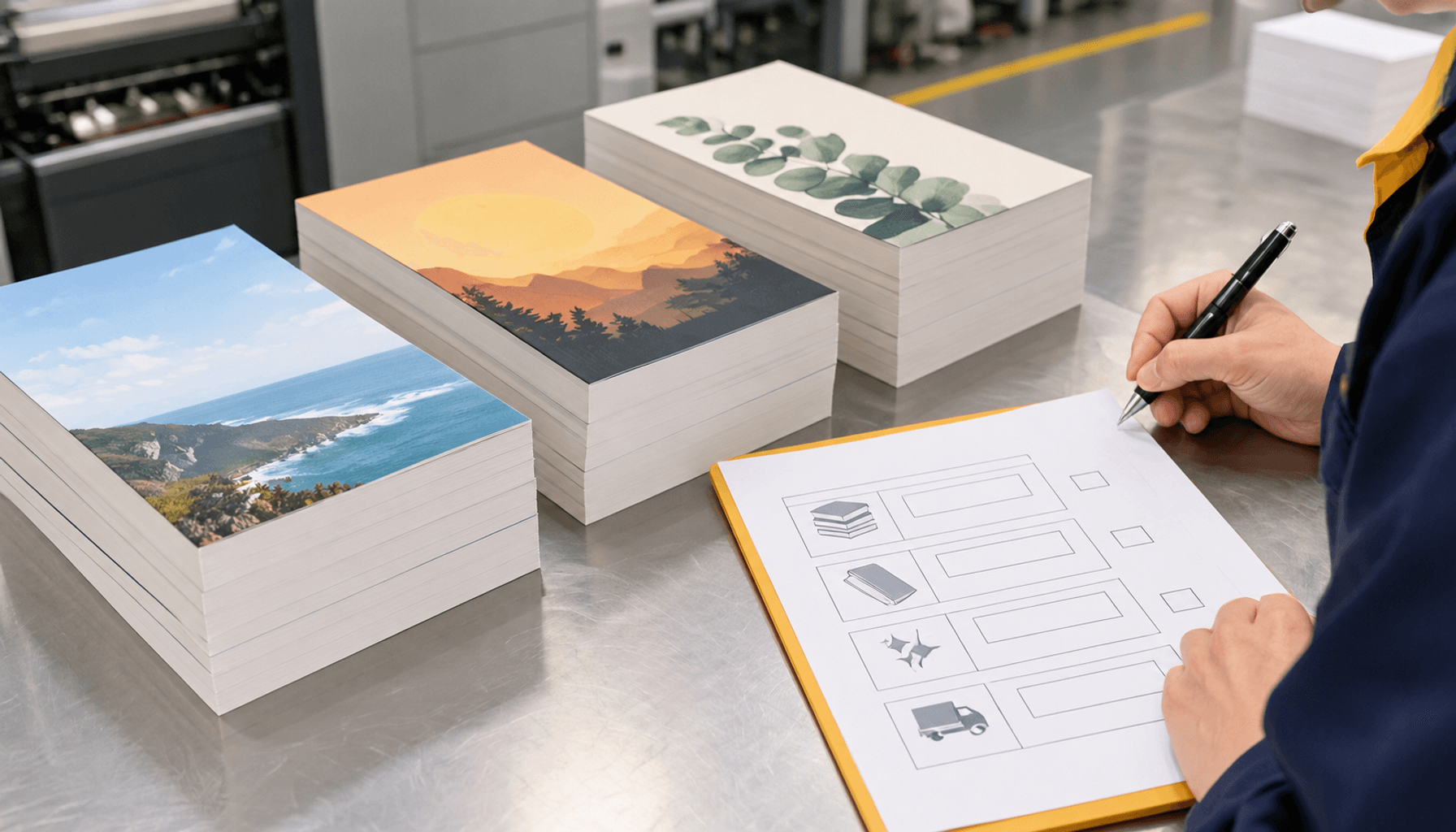
Paper choice affects print appearance, opacity, thickness, spine width, and finished weight. Describe what the stock must do: support photographs, accept writing, minimise show-through, feel substantial, or keep a mailed item manageable. For books, compare these choices through book printing requirements rather than treating paper as a generic line item.
Yield is also part of the format discussion. The way a finished size fits a production sheet can influence material use, trimming, and waste, but it should never be guessed from a page mock-up alone. Share the preferred size and any acceptable alternatives, then ask whether a small format change would affect the product experience, production plan, or pack-out. This makes a potential trade-off explicit instead of allowing it to appear as an unexplained difference between quotes.

Choose method and binding by the job
Print method is one cost driver among many. Artwork stability, color needs, versioning, schedule, materials, and run requirements all affect which route is practical. Request an explanation of the assumptions rather than relying on a broad claim that one method is always cheaper. When comparing alternatives, hold the product definition steady so the difference being discussed is meaningful.
Binding changes both the product and the quote. Perfect binding, case binding, stitching, wire binding, and other constructions require different materials and handling. State whether the item must open flat, carry a thick page count, include inserts, display on a desk, or withstand repeated reference use. Those conditions help define construction more usefully than a binding preference without context.
Account for finishing, proofing, and checks
Lamination, foil, embossing, die-cutting, varnish, rounded corners, bands, inserts, and special folds can add separate production steps. They may support a reader or campaign, but should be named in the first brief. Clarify whether a finish applies to the cover, interior, or both, and describe the intended visual or tactile outcome rather than relying on an informal label.
Proofing and quality checks deserve their own discussion. A digital proof, physical sample, color review, file preflight, and packing check answer different questions. Review the quality planning page and agree what must be checked before the full job is released. An approval stage is easier to schedule and compare when it is explicit rather than assumed.
Ask how an approved sample or PDF will be referenced during production and which elements are inspected in the finished packs. That might include pagination, trim, binding, color-critical pages, finishing placement, inserts, carton labels, or quantities per carton. The list should reflect the risks of the actual product, not a generic promise about results.
Include packing and freight in the comparison
Finished goods need cartons, labels, protection, and a route to the destination. Books and printed packs can be heavy; cartons, pallets, split shipments, storage rules, and delivery appointments can matter. Provide the receiving address, number of destinations, and any labelling or inventory requirements early. A complete delivery brief prevents a production-only figure from being mistaken for a delivered comparison.
Freight must be compared on the same delivery basis. Ask whether the quote includes packing, collection, delivery to a named place, customs handling where applicable, or only a portion of the route. The production process can help identify where packing and delivery information belongs. Confirm carton limits and receiving access before freight is booked.
Finished weight is cumulative. A slight change in page stock or cover board can be multiplied across every copy, then multiplied again across cartons. Ask for the expected packed form when freight is a meaningful part of the decision, and keep this information with the specification. It helps a buyer compare delivery approaches without pretending that one variable tells the entire cost story.
Timing is another input to record rather than an implicit expectation. Name the file-ready date, proof decision date, required arrival date, and any dates when the receiver cannot accept goods. A schedule request that includes those gates gives the supplier an opportunity to identify dependencies among preflight, production, finishing, packing, and freight before a last-minute change creates a cost or delivery surprise.
Create comparable quote inputs
- Give product type, trim size, orientation, page count, quantity, and source files.
- List paper, color, binding, finishing, proofing, and quality-review needs.
- State packaging, labels, delivery locations, and required arrival date.
- Mark non-negotiable requirements and alternatives you are willing to evaluate.
- Ask suppliers to list assumptions, exclusions, and delivery scope in plain language.
Keep the approved brief with the selected quote. It becomes the reference for later proofing, production questions, and delivery checks, and it makes a future reorder easier to describe without assuming that every material, schedule, or freight condition is unchanged.
Where priorities conflict, decide explicitly which outcome has precedence: a particular material, a finish, a flexible schedule, a packing requirement, or a delivered budget. A supplier can then explain the consequence of an alternative without silently changing the product definition.
Explore the printed product range to define the product, then use the quote request contact page to send comparable inputs. A clear request makes trade-offs visible before production: for example, whether a change in format, stock, finish, pack-out, or delivery approach preserves the outcome that matters most.