Table of Contents
- What Sets Short-Run Book Printing and Binding Minimums?
- Printing, Binding and Finishing Constraints: Quick Comparison
- Confirm Order Feasibility With a Three-Step Quote Checklist
- Short-Run Book Printing FAQs
Learn how to verify per-title finished-book minimums, separate setup costs from true MOQs, and compare factory, domestic, and print-on-demand options for US delivery.
What Sets Short-Run Book Printing and Binding Minimums?
Short run book printing and binding does not have a universal minimum quantity. A short run means a relatively small production batch, but the copy count is not fixed across suppliers or specifications. The useful minimum is the number of complete, trimmed, bound and packed books the supplier will make for each title—not simply the number of sheets a digital press can output.
Short run: A small book production batch without a universal copy-count definition. The practical threshold depends on the supplier, format, quantity per title, binding and finishing.
MOQ: Minimum order quantity. This is the lowest quantity a supplier requires for a defined product and specification. Ask whether the MOQ applies per title, per SKU, per binding setup or to the complete purchase order.
Setup cost: A charge for preparing plates, covers, dies, tools, machines or manual production steps. A setup charge can make a small order less economical without meaning that the supplier refuses to produce it.
For a buyer, the key distinction is between a true finished-product minimum and a cost threshold. A factory may accept 40 finished books but charge a binding setup fee that makes 40 copies unattractive. Another supplier may require 100 finished copies per title because the binding line or finishing process is not practical below that level. Those are different situations and should appear separately on the quote.
Digital printing can make the printing stage flexible because it generally does not require offset plates. It does not automatically remove setup, trimming, cover preparation, binding, lamination, inspection or packing requirements. A supplier can print a small stack of interiors and still decline, surcharge or limit the finished bound-book order.
What Should a Supplier’s Minimum Statement Contain?
Ask the supplier to state the following points in writing:
- Finished copies required per title or SKU.
- Whether quantities from different titles may be pooled.
- Whether the minimum applies to printed interiors, covers or complete finished books.
- Any binding, finishing, tooling, proofing or packing setup charge.
- Any restrictions caused by page count, size, paper, cover construction or special finishing.
For example, MOQ 100 is incomplete unless the supplier explains whether it means 100 copies of one title, 100 total copies across identical titles, or 100 printed book blocks before binding. Three titles at 75 copies each equal 225 books in total, but that total may not satisfy a 100-copy-per-title rule.
Lemon Printing’s paperback service is a quote-dependent product example, not a blanket promise to accept every small order. A supplier must review the exact quantity, size, page count, materials, binding, finishing and destination before confirming feasibility.
Printing, Binding and Finishing Constraints: Quick Comparison
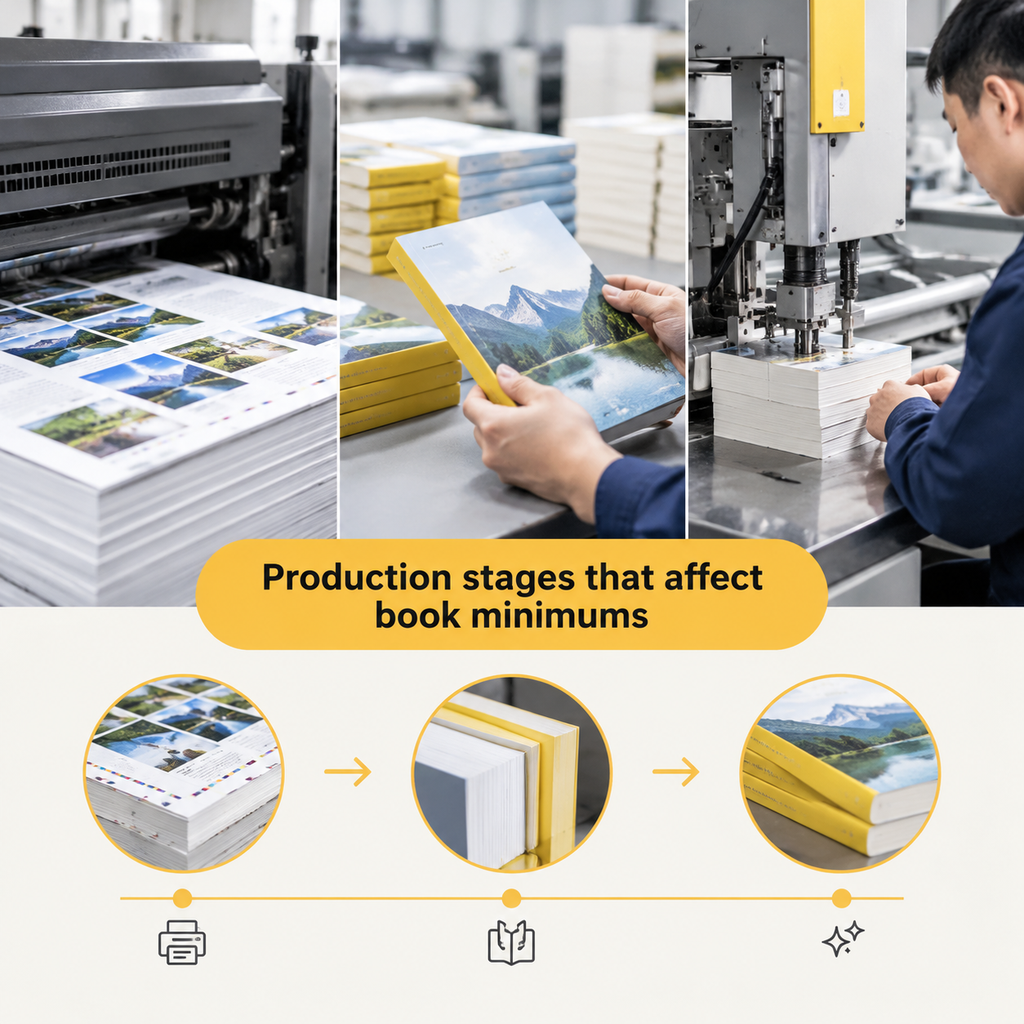
Printing, binding and finishing can each create a different constraint. The lowest quantity available from a digital press is not automatically the lowest quantity available as a finished bound book. Ask the supplier to evaluate all three stages together.
| Stage | What can set the minimum | What to ask the supplier |
|---|---|---|
| Printing | Digital or offset press setup, sheet size, paper availability, color sides, file preparation and imposition. Imposition is the arrangement of pages on a printed sheet before folding or trimming. | Does the minimum apply to printed sheets or trimmed interiors? Is it per title? Are the cover and interior quoted as separate setups? |
| Binding | Machine preparation, page count, book-block thickness, cover or spine preparation, line run length and manual handling. | What is the minimum number of finished bound copies? Is a binding setup fee separate? Can different titles share the same run? |
| Finishing | Lamination, foil, spot UV, die-cutting, inserts, rounded corners, shrink-wrap and special packing. Each may add tooling, setup or handwork. | Does the selected finish have a separate minimum or tooling charge? Can it be removed without changing the core binding? |
On the printing side, digital production may avoid plate-making, but the supplier still has to check file quality, paper size, color coverage, trimming and cover fit. Offset printing can have a different cost pattern because press setup and sheet planning are handled differently. Neither method alone establishes the finished-book MOQ.
Binding is a separate production decision. The printed pages must be gathered, trimmed and joined to the cover or other components. Page count and book-block thickness can affect whether the requested construction is suitable for the equipment. Very small batches may require manual handling, which can be feasible but may add labor or setup charges.
Finishing can create another threshold. Matte or gloss lamination, foil, spot UV, die-cutting and inserts may require additional passes or tools. A simpler finish may make a small batch easier to quote, but the supplier still needs to confirm the exact format and quantity. If a quote lists only a setup charge, do not treat that charge as an automatic refusal; ask whether the order is technically feasible and what quantity would improve the economics.
The practical question is therefore not only which press can print the pages. It is whether the selected press, binding method and finish can produce the required number of complete books with acceptable handling, inspection and packing.
Confirm Order Feasibility With a Three-Step Quote Checklist

The fastest way to verify feasibility is to send a per-title specification sheet and ask for three separate answers: finished MOQ, setup costs and US delivered cost. Do not ask only whether a supplier can print a small number of pages. Ask whether it can produce the complete product you intend to receive.
- Confirm copies per title.
- Lock the complete production specification.
- Compare the US delivered total.
Use one specification row for every title
A multi-title project is easier to evaluate when each title has its own row. The following is a format example, not a universal recommendation or minimum.
| Book specification | Example entry | Why it matters |
|---|---|---|
| Title or SKU | Title A training manual | Suppliers need to know which files and covers belong to each finished product. |
| Quantity per title | 75 copies | Shows whether the requested quantity meets the supplier’s per-title rule. |
| Finished size | 6 × 9 in, portrait | Size affects paper layout, trimming, cover dimensions and packing. |
| Page count | 96 interior pages, cover excluded | Page count affects paper usage, spine or book-block thickness and binding feasibility. |
| Interior paper and color | 80 gsm text stock, color specification to be confirmed | Paper weight, opacity and color coverage affect production planning and quote accuracy. |
| Cover and finish | 250 gsm cover stock with matte lamination | Cover stock and lamination can create separate material or finishing setups. |
| Binding and packing | Perfect bound paperback; export cartons | Binding and packing must be included in the finished-product minimum and delivered-cost review. |
Check 1: Confirm copies per title
Ask for the minimum per title before relying on the total order quantity. List every title, ISBN or SKU, and the exact number of finished copies required. Then ask whether the supplier’s MOQ is per title, per cover, per binding setup, or for the whole purchase order.
Different titles usually require separate files, covers, page sequences, approvals and quality checks. They therefore cannot automatically be combined just because they use the same paper and binding. Some suppliers may consolidate production when specifications are identical, but that permission must be confirmed rather than assumed. Ask what must match: finished size, page count, paper, color, binding, finish and packing may all matter.
For example, a request for three titles at 75 copies each should be quoted as 75, 75 and 75, not only as 225 total. If the supplier requires 100 finished copies per title, ask whether the shortfall can be handled through a different setup, a simplified finish or a revised quantity. Do not assume that extra copies of one title can satisfy the minimum for another.
Check 2: Send complete production specifications
A book type and approximate size are not enough for a reliable minimum check. Include the following in the first request:
- Product type, such as paperback book, workbook, training manual or catalog.
- Quantity for each title or SKU.
- Finished trim size, orientation and any rounded or custom shape.
- Interior page count, including whether the cover is excluded.
- Interior and cover paper, with GSM defined as grams per square metre.
- Color requirement, such as black and white or full color on one or both sides.
- Binding method and any cover or spine requirements.
- Lamination, foil, spot UV, inserts, perforation, die-cutting or other finishing.
- Proofing preference, file status and packaging requirements.
A complete specification prevents a supplier from confirming the printing stage while leaving the binding or finishing stage unresolved. Page count can affect the book block and spine, while paper thickness affects the finished thickness and carton plan. If you are evaluating small batch paperback printing, Lemon Printing’s custom paperback printing page is a useful product starting point, but the actual minimum still depends on the submitted specification.
It is also useful to review the supplier’s printing and finishing capabilities before requesting a quote. Lemon Printing was established in 2015 in the Guangzhou–Shenzhen manufacturing corridor and operates a self-owned facility with more than 130 workers and 8+ offset and digital presses. Prepress, printing, binding, finishing, inspection, packing and export preparation are handled in-house. That integrated workflow allows printing and post-press requirements to be reviewed together, but it does not eliminate job-specific minimums.
Ask the supplier to return a line for finished MOQ, a separate line for book binding setup costs or other tooling, the proof method, the estimated production time and the packing method. A quote that separates these items is easier to compare with other suppliers.
Check 3: Compare the US total landed cost
For a US buyer, compare the total landed cost rather than the factory unit price alone. Total landed cost is the amount required to receive the books at the intended destination. Depending on the quotation and shipping terms, it may include:
- Printing, paper, cover materials and binding.
- Per-title setup, proofing, tooling and finishing.
- Cartons, protective packing and export preparation.
- International freight and any selected shipping service.
- Customs duties, taxes, brokerage or other import charges where applicable.
- Domestic delivery or handling to the final US address.
Provide the destination ZIP code, requested shipping method if known, carton or delivery requirements and target date. Ask the supplier to distinguish production time from transit time. Freight can change with carton count, packed weight, dimensions, service level and destination, so a low unit print price may not produce the lowest delivered result.
This is also the point to compare factory batch production with a domestic printer or print on demand. A factory batch may fit a project with stable specifications, a planned inventory requirement or repeatable title quantities. A domestic printer may be worth comparing when the quantity is very small, local replenishment or simpler returns matter, or international freight changes the economics. Print on demand is a different service model in which copies are produced as individual orders arrive; compare its per-copy charge, fulfillment, storage, available specifications and delivery process with the complete batch quote. Do not assume that a factory book quotation includes print-on-demand fulfillment.
Use the same title quantities, specifications, delivery address and target date for every comparison. If the batch is technically feasible but the delivered cost is not attractive, ask whether a simpler finish, different binding setup or revised quantity changes the quote. If the supplier cannot meet the finished-product minimum, compare another production model instead of comparing unit prices only.
- Proceed to a full quote when the supplier confirms finished copies per title, accepts the complete specification and can calculate delivery to the US destination.
- Revise the specification when the only obstacle is a setup or finishing charge and the product can still meet its intended use with a simpler option.
- Compare alternatives when the required quantity per title remains below the supplier’s feasible minimum or the total landed cost does not fit the project.
Once these fields are ready, a specification-based quote request will produce a more useful answer than a request that lists only the words small run. Final MOQ, production time, pricing and shipping depend on product specifications, quantity, finishing and destination.
Short-Run Book Printing FAQs
Most short-run MOQ questions can be answered only after the supplier sees the finished-book specification. These answers explain what to verify before treating a small batch as feasible.
Is there a standard minimum quantity for short-run book printing and binding?
No. There is no universal book printing minimum order quantity for every supplier, title or binding method. The minimum may apply per title, per setup or to the full order, and it may be different for printing, binding and finishing. Ask for a finished-copy MOQ tied to your exact size, page count, paper, binding and finish.
Does digital printing guarantee a low minimum for a finished bound book?
No. Digital printing can reduce some press preparation requirements, but it does not guarantee a low minimum for the completed book. Binding, trimming, cover preparation, lamination, inspection and packing can still require setup, labor or a practical run size.
Can copies of different titles be combined to meet a book-printing MOQ?
Not automatically. Different titles normally have separate interiors, covers, files, approvals and quality checks. A supplier may allow pooling when specifications are sufficiently identical, but ask whether the rule is per title, per SKU, per binding setup or total order before counting different titles together.
Can simpler binding or finishing make a smaller book order viable?
It can sometimes improve feasibility or reduce setup and handling, but it is not a guarantee. A simpler finish may remove a tooling or manual step, while a different binding may still have page-count or equipment restrictions. Ask the supplier to quote the original specification and one practical alternative if the quantity is below the preferred level.
When should US buyers compare factory batch printing with domestic printing or print on demand?
Compare them when the batch quantity is below a supplier’s finished minimum, when the total landed cost is uncertain, or when storage, replenishment and fulfillment are important. Use identical specifications and the same destination when comparing. Print on demand is a fulfillment model rather than proof that a batch manufacturer accepts one-copy production, so confirm the service scope separately.
Bottom line: A short order is not approved by the word digital alone. Verify finished copies per title, complete production requirements, setup charges and the US delivered total before choosing a supplier or changing the specification.
FAQ
Is there a standard minimum quantity for short-run book printing and binding?
No. There is no universal book printing minimum order quantity for every supplier, title or binding method. The minimum may apply per title, per setup or to the full order, and it may be different for printing, binding and finishing. Ask for a finished-copy MOQ tied to your exact size, page count, paper, binding and finish.
Does digital printing guarantee a low minimum for a finished bound book?
No. Digital printing can reduce some press preparation requirements, but it does not guarantee a low minimum for the completed book. Binding, trimming, cover preparation, lamination, inspection and packing can still require setup, labor or a practical run size.
Can copies of different titles be combined to meet a book-printing MOQ?
Not automatically. Different titles normally have separate interiors, covers, files, approvals and quality checks. A supplier may allow pooling when specifications are sufficiently identical, but ask whether the rule is per title, per SKU, per binding setup or total order before counting different titles together.
Can simpler binding or finishing make a smaller book order viable?
It can sometimes improve feasibility or reduce setup and handling, but it is not a guarantee. A simpler finish may remove a tooling or manual step, while a different binding may still have page-count or equipment restrictions. Ask the supplier to quote the original specification and one practical alternative if the quantity is below the preferred level.
When should US buyers compare factory batch printing with domestic printing or print on demand?
Compare them when the batch quantity is below a supplier’s finished minimum, when the total landed cost is uncertain, or when storage, replenishment and fulfillment are important. Use identical specifications and the same destination when comparing. Print on demand is a fulfillment model rather than proof that a batch manufacturer accepts one-copy production, so confirm the service scope separately.
Get a Clear Quote for Your Printing Project
Send Lemon Printing your product type, quantity per title, finished size, page count, paper, binding or finishing requirements, delivery destination ZIP code and target date. Our team will review the specifications and normally respond within one business day with practical production options, pricing and a project timeline. Final MOQ, production time, pricing and shipping depend on product specifications, quantity, finishing and destination.