Packaging Box Printing · Formats & construction
Kraft Box Printing
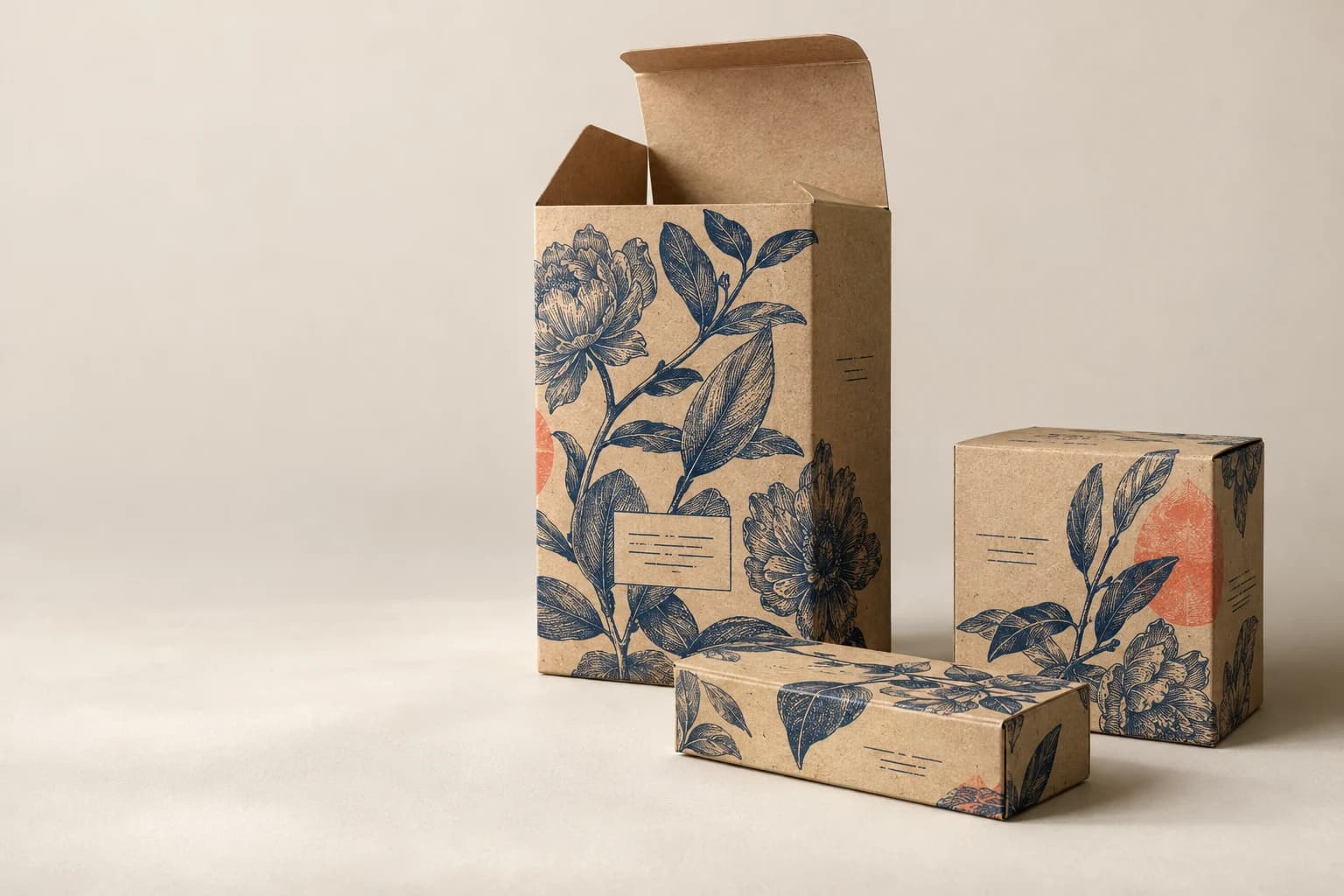
Kraft packaging exposes a brown or natural-looking paper surface as part of the design.
- Kraft paperboard or a separately specified corrugated structure
- Kraft folding board
- Natural-look pack
Start with the intended use, finished size and quantity. The material and construction can follow.
The product in use
Natural material appearance with a defined protective structure
Kraft packaging uses a natural brown or specified white-faced material as part of its appearance. Solid kraft paperboard and kraft-faced corrugated board are different structures. The selected liner, board or flute controls stiffness and protection, while the brown face changes printed color contrast.
What makes up the finished product?
- Natural paper surface
- Kraft board contributes a brown background to the print. State whether the actual structure is folding paperboard or corrugated board.
- Specified box structure
- Cut, crease and closure geometry follow the selected box style; the kraft surface alone does not define strength or fit.
- Contents fit
- Check the actual item and any protective insert in the finished cavity; the brown paper surface does not establish a load rating.
Specifications and materials
Kraft Box Printing specifications
Use these reference options to build the project brief. Dimensions are design examples; material availability, tooling and production timing depend on the confirmed specification.
| Parameter | Reference or option | Why it matters |
|---|---|---|
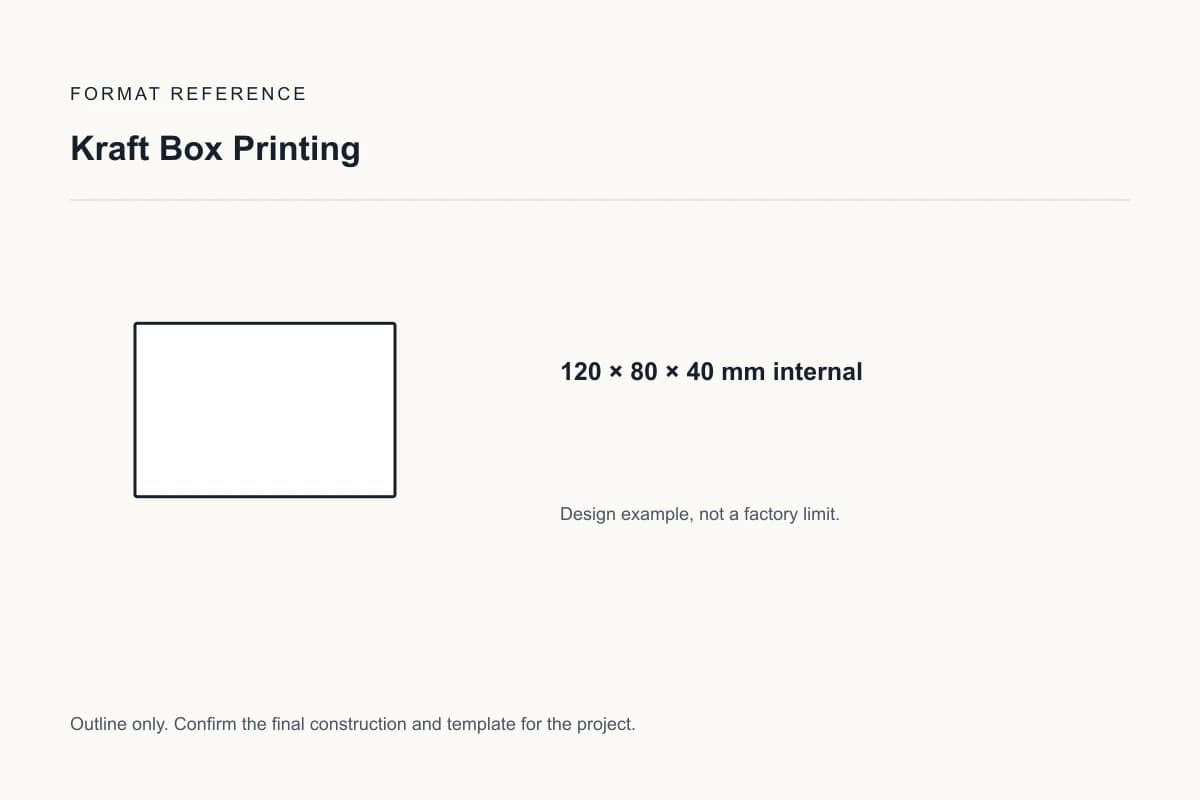
| Finished dimensions | 120 × 80 × 40 mm internal | This small-pack example leaves the structure open; folding kraft board and corrugated kraft are different builds. Design reference, not a factory limit. |
| Kraft construction | Kraft paperboard or a separately specified corrugated structure | Brown paper changes ink appearance; kraft describes the substrate rather than a single box structure. |
| Dimension basis | Inside cavity and outside finished dimensions, with the order of length × width × height | The packed product must fit the usable cavity, not merely the stated outside size. |
| Contents and insert | Actual item dimensions and mass; cavity, divider or retention requirements | Trial insertion and removal using the real contents before approving the structure. |
| Material construction | Kraft folding board or Kraft-faced corrugated board | Compare the actual grade and construction. Proof pale artwork on the actual shade and inspect creased corners. |
| Format and order unit | complete packs per structure, size and artwork version | List components and versions separately so quantities refer to the same finished unit. |
| Finishing choice | The word kraft describes a paper choice, not a finished load rating, recycled content or certification. | Approve the proposed material and process combination on an appropriate sample. |
Compare the material and its effect.
Choose the surface and construction for the way the finished product will be used. The options below are selection references, not a guaranteed inventory list.
Kraft folding board
Brown kraft paperboard
A natural brown surface changes the appearance of transparent printing inks. A folding board can make a compact retail carton.
Sample check: Proof pale artwork on the actual shade and inspect creased corners.
Kraft-faced corrugated board
Liner, fluting and flute profile specified separately
Corrugation adds a separate cushioning structure; it is not the same material as a thicker solid kraft sheet.
Sample check: Test the filled pack and identify whether a separate shipping carton is required.
Selected sample focus — Kraft folding board: Proof pale artwork on the actual shade and inspect creased corners.
Format & usable space
Kraft Box Size, Board Structure & Artwork Contrast
120 × 80 × 40 mm internal
This small-pack example leaves the structure open; folding kraft board and corrugated kraft are different builds.
This is a design reference, not a required size or a manufacturing limit.
Kraft construction
Kraft paperboard or a separately specified corrugated structure
Brown paper changes ink appearance; kraft describes the substrate rather than a single box structure.
View the original format reference
Surface finish options
Natural kraft surface and limited accents
Leaving kraft without added treatment preserves its paper feel. Foil can be discussed after checking transfer on the actual textured stock. Do not assume film, relief, moisture resistance or environmental claims from the kraft appearance.
 No added surface treatment View effect & artwork guidance
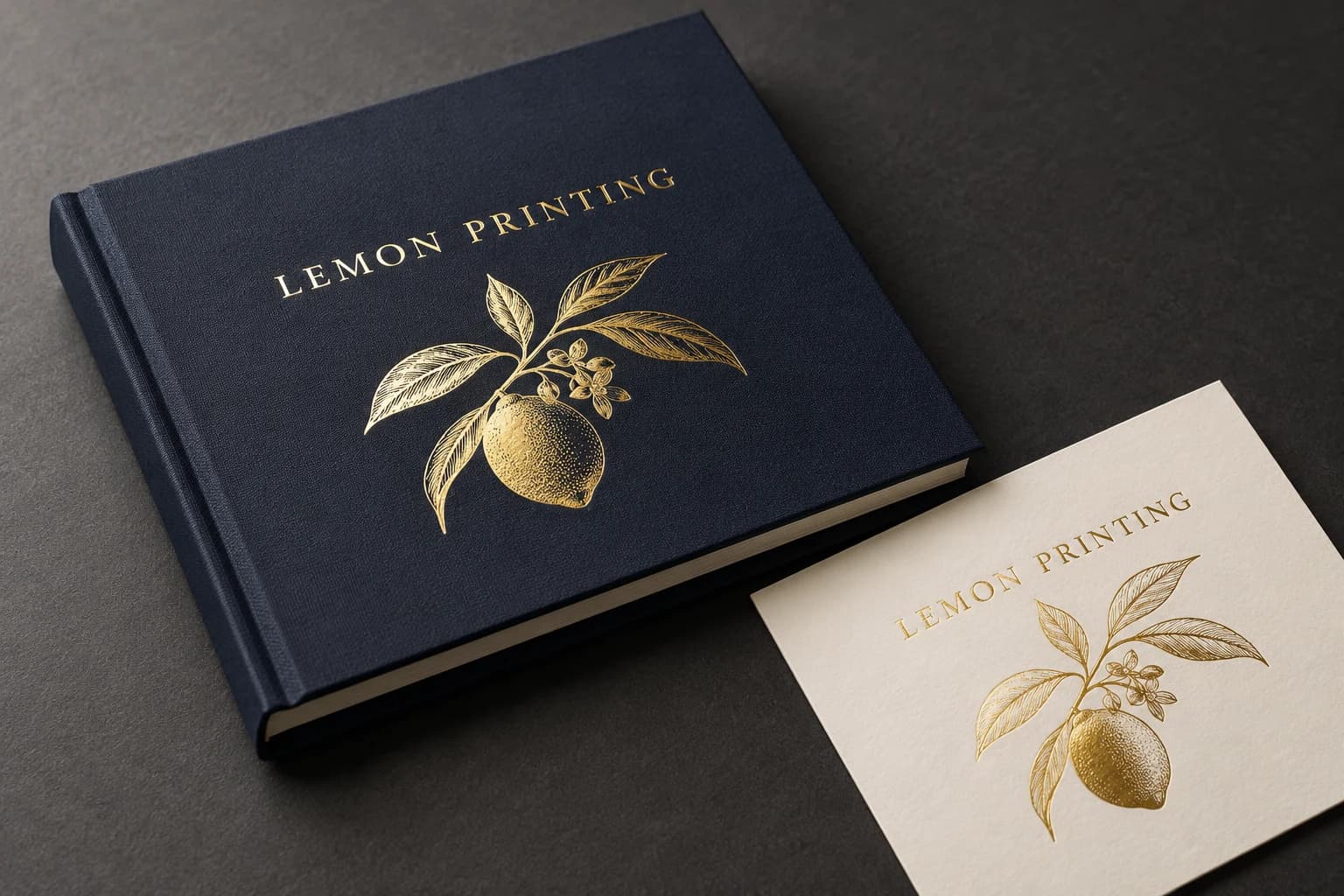 Gold foil stamping View effect & artwork guidance
Illustrative finish samples, not photographs of this product. Final suitability follows the confirmed stock, construction and approved sample.
Compare all surface finishes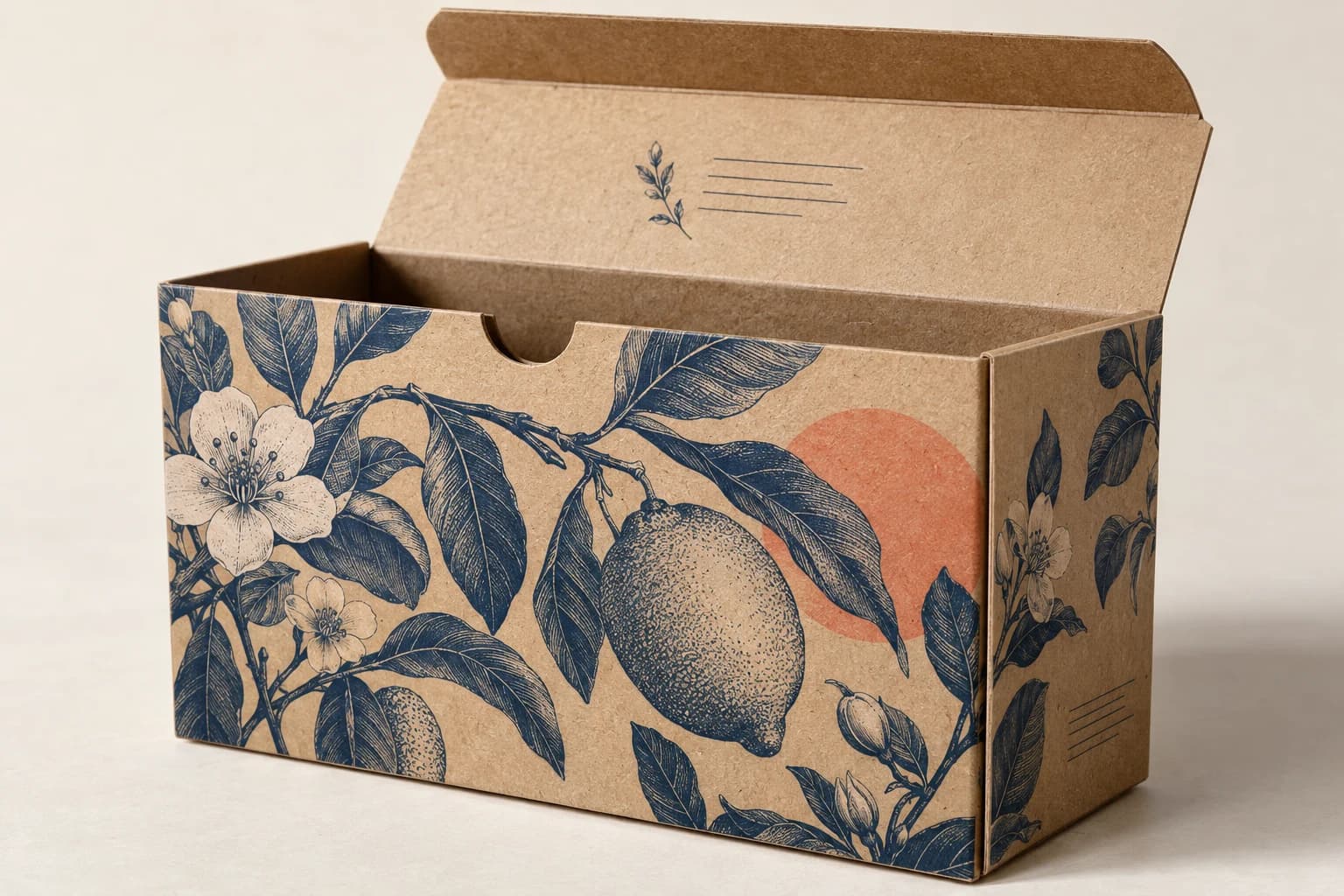
Details that change the finished product
Inspect the structure, wrap and contents fit
Allow for the brown substrate in the design
Approve important colors on the actual brown surface. CMYK ink does not create the same white base available on coated white board.
Kraft construction
Brown paper changes ink appearance; kraft describes the substrate rather than a single box structure. A structural sample checks fit, opening, erection and the insert with the actual contents.
Surface and finishing compatibility
The word kraft describes a paper choice, not a finished load rating, recycled content or certification. A natural brown surface changes the appearance of transparent printing inks. A folding board can make a compact retail carton. Proof pale artwork on the actual shade and inspect creased corners.
Natural-Look Packs & Protective Outer Boxes
Natural-look pack
Use the brown surface deliberately; review color on the actual kraft grade.
Protective outer pack
Specify a corrugated construction when needed instead of treating all kraft boxes as equal.
Solve the risk before production
Keep Artwork Legible on the Brown Kraft Surface
The critical finished-product check
Pale artwork can lose contrast over brown paper. Simplify the palette or specify a feasible opaque print area, then assess the material proof.
A board upgrade does not fix the structure
Why it happens: GSM is increased without changing a weak bottom, closure or corrugated construction.
Fix and check: Test the filled pack and change the structural feature that fails, not only the sheet mass.
When to choose another format
Kraft Surfaces, White Cartons & Rigid Gift Boxes
| Alternative | Use and trade-off |
|---|---|
| Folding Carton Printing | White folding board gives a different artwork base while retaining a creased carton construction. |
| Rigid Box Printing | A rigid gift shell emphasizes shape and presentation, with a different shipping volume. |
Sample and approval
Review Printed Kraft & the Assembled Box Separately
Free samples are available, with preparation completed within 15 days. Confirm the sample scope; courier arrangements and transit time are separate.
Structural sample
Checks dimensions, fit and assembly using unprinted or representative materials. It does not establish final color.
Printed proof
Checks text, image reproduction and artwork on the agreed proof medium. It may not reproduce final assembly or every finish.
Complete finished sample
A structural sample checks fit, opening, erection and the insert with the actual contents.
From brief to delivery
Order Details for Kraft Box Printing
Build and approve the order in five steps
Send the project brief
Send structure, contents, brown-paper reference and colors that need controlled contrast. Include finished dimensions, quantity by version, destination and required arrival date. If a configuration is undecided, describe the intended use.
Compare the quoted configuration
Compare the same quantity basis: complete packs per structure, size and artwork version. Check that the quote identifies materials, finishing, included components, sample scope, packing and freight.
Approve the appropriate sample
A structural sample checks fit, opening, erection and the insert with the actual contents. A print proof checks artwork and color; a complete finished sample also checks assembly. Record what the selected sample does and does not reproduce.
Confirm files and release production
Approve the final artwork revision and the kraft construction specification. Record the agreed quantity, payment conditions, packing and production schedule in the order.
Confirm packing and dispatch
State flat or erected delivery, inserts per box, protection between finished surfaces and carton counts. Confirm production completion and transit as separate dates, using the delivery destination and required arrival date.
- Use the approved vector dieline at 1:1 scale, with cut, crease and glue areas on separate named layers. Mark inside and outside dimensions explicitly.
- Extend edge-to-edge trim artwork by 3 mm unless the approved template specifies a different bleed. Use approximately 300 effective ppi for continuous-tone images at their placed size; keep fine linework as vectors where possible.
Project questions
Planning Kraft Box Printing
Will colors match a proof printed on white paper?
The brown substrate changes the appearance of ink. Use a representative kraft sample for the final visual decision, and agree which parts of the artwork need opacity rather than assuming white-paper colors will transfer unchanged.
How should I specify quantities and versions?
Count complete packs per structure, size and artwork version. State structure, contents, brown-paper reference and colors that need controlled contrast; components, language versions and different structures must be listed separately.
What determines the minimum quantity and delivery schedule?
The selected stock, construction, finishing, version count and sample scope determine production planning. Request quantity breaks for the same configuration and an arrival-date plan that separates sampling, manufacturing and transit. No minimum or lead time is implied by the design examples above.
Specify the finished product.
Send structure, contents, brown-paper reference and colors that need controlled contrast. Include finished dimensions, quantity by version, destination and required arrival date.