Table of Contents
- Board book packaging: Which construction fits your set?
- Define slipcases, folding cartons, and rigid boxes
- Identify retail presentation and transit protection requirements
- Comparison table: Access, support, presentation, assembly, and packing
- How to size packaging around completed board books
- Measure the assembled stack and agree on fit allowances
- Check mixed-size books, inserts, and repeated removal
- Five steps to approve packaging and the complete set
- How to specify kitting, barcode placement, and component verification
- Quote checklist for board book sets and packaging
- Lemon Printing board book, packaging, and kitting options
- FAQ: Slipcases and boxes for board book sets
- Key takeaways: Approve the assembled set
Board book packaging: Which construction fits your set?
Board book packaging should be designed around the complete, measured set, not just an attractive box drawing. A slipcase favors exposed spines and repeated access. A folding carton or rigid box provides a closed retail unit, but each needs a different fit and packing plan.
Start with how the customer will use the books, then validate dimensions, removal, assembly, and protection together. Use Lemon Printing’s custom book printing information to establish the book specification first. Confirm availability of the proposed slipcase or box construction during quoting.
Define slipcases, folding cartons, and rigid boxes
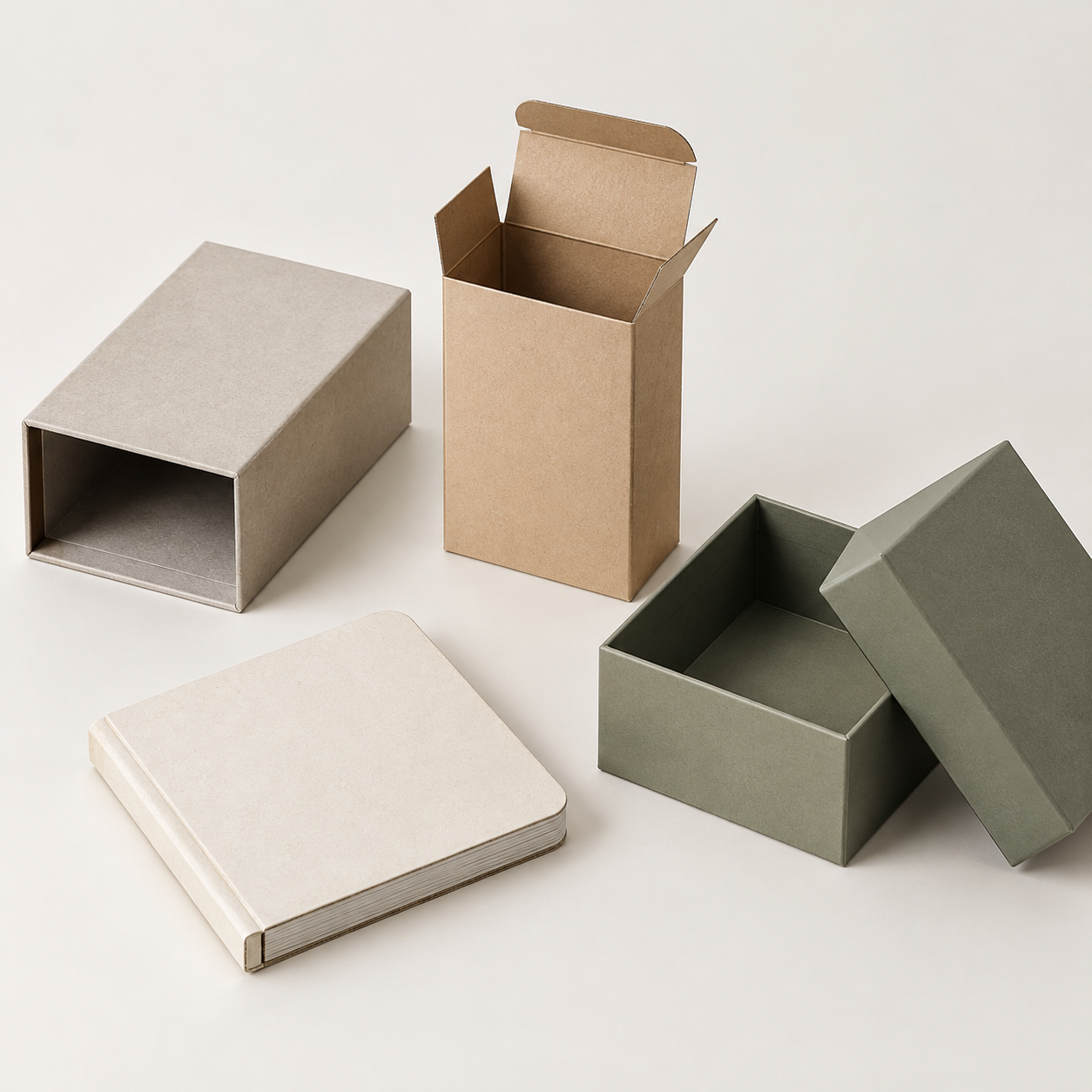
A slipcase describes an open-ended shape; a folding carton and a rigid box describe different constructions. These categories can overlap, so a quotation needs more detail than the word “box.”
- Slipcase
- A sleeve-like enclosure with one open end, commonly leaving book spines visible. It supports the set around the other sides while allowing books to slide out.
- Folding carton
- A paperboard package cut and scored so it can fold into shape. Scoring creates controlled fold lines. Closure may use tuck flaps or another agreed design.
- Rigid box
- A stiff-board structure, commonly covered with printed or decorative wrapping material. A lift-off-lid version separates into a base and lid and does not usually fold flat.
For book slipcase packaging, specify whether the structure is folded paperboard or wrapped rigid board. The comparison below uses a wrapped-board slipcase, a folding carton, and a wrapped-board lift-off-lid box.
Identify retail presentation and transit protection requirements
Retail board book packaging does not replace export shipping protection. The retail unit groups and presents the books; an outer packing system must protect those units through the agreed distribution route.
Separate three requirements before selecting the construction:
- Shelf presentation: exposed spines, a front-facing illustrated panel, a visible title list, or a gift-opening experience.
- Customer use: one-time opening versus repeated storage, easy book removal, and reliable replacement in the intended order.
- Distribution: bulk cartons for stores, warehouse handling, or individual ecommerce parcels. These are different packing conditions.
A snug slipcase can still allow books to slide out during handling. A rigid box can still suffer crushed corners or surface scuffing. Specify outer cartons, restraint, and internal protection separately, using the printing and export-preparation process to connect retail approval with final pack-out planning.
Comparison table: Access, support, presentation, assembly, and packing
Choose a slipcase for spine-led access, a folding carton for an enclosed foldable structure, or a rigid box for a more substantial opening experience. Actual support depends on material, dimensions, joints, and the loaded set—not the construction name alone.
| Construction | Access | Support | Presentation | Assembly | Packing requirements |
|---|---|---|---|---|---|
| Wrapped-board slipcase | Books slide through one open end; spines remain accessible. | Surrounds the set on other sides; the opening leaves an edge exposed. | Spine-led shelf display with artwork on case panels. | Usually supplied assembled; loading direction and book order matter. | Prevent slide-out and exposed-edge scuffing during distribution. |
| Folding carton | Flaps must open; repeated use depends on flap design and stock. | Panel stiffness and seams must suit the loaded weight. | Continuous printed panels with a closed retail appearance. | Often supplied flat; erection and closure add handling steps. | Check panel deformation, closure retention, and carton support. |
| Lift-off-lid rigid box | Lid lifts away; books may need grip clearance or an insert. | Stiff base and lid; unsupported spans and corners still need checking. | Gift presentation with a separate opening sequence. | Base, lid, and any insert must be matched during assembly. | Restrain lid movement and protect wrapped surfaces and corners. |
Board book gift boxes with separate parts or inserts add component checks and assembly work. Compare the complete assembled cost and packing volume, not only the empty package price.
How to size packaging around completed board books
Use completed, production-equivalent book samples for final packaging dimensions. Artwork establishes trim size and graphics, but does not prove finished thickness, cover projection, or the space needed for comfortable removal.
Fit specification: record book set packaging dimensions as a measured contents envelope, agreed internal clearances, and calculated external package dimensions. Mark the opening direction and measurement axes on the drawing. Internal cavity dimensions and outside dimensions are not interchangeable.
Measure the assembled stack and agree on fit allowances

Measure the books together in their intended packing orientation, without squeezing them into a smaller reading. Check the widest occupied dimensions, including covers, spine shape, and any inserts or separators.
- Confirm finished condition. Measure after binding, adhesive setting, and the agreed finishing. Use multiple representative books and sets, not just one unusually thin sample.
- Record the occupied envelope. For upright books with spines facing the slipcase opening, record book height, spine-to-fore-edge depth, and combined thickness across the row. Use one measurement unit consistently.
- Add construction-specific clearances. Allow for loading, removal, seams, wrapped edges, and closure behavior. Agree these clearances through sample trials rather than copying a universal value.
Fit allowance is the planned extra space around the contents. Manufacturing tolerance is the permitted variation in a dimension. They are different: a design can have intentional clearance and still require controlled production tolerances.
For illustration, three completed 150 × 150 mm books measuring 18 mm thick each occupy approximately 150 mm high × 150 mm deep × 54 mm across the row. Those are contents dimensions, not approved cavity dimensions. Clearances come next; board thickness, wraps, folds, and joints determine the outside size.
Too little space can scrape covers or stress seams. Too much can let the books shift and make the set feel poorly fitted.
Check mixed-size books, inserts, and repeated removal
One package can accommodate different book sizes if the arrangement and support are designed together. Size the complete occupied envelope, then check whether smaller books need a spacer, divider, or tray to prevent shifting.
For example, an 180 mm-tall primer paired with two 150 mm-tall books may need support to keep the shorter books in position. A spacer also consumes space, adds an assembly step, and can obstruct removal if poorly placed. Confirm its material and construction during quoting.
Test the set through repeated removal and replacement using an agreed cycle count and acceptance criteria. Check for:
- Cover scuffing, snagging corners, or excessive pulling force.
- Loose books falling out when the package is handled.
- Flaps, seams, lids, or inserts losing their intended function.
- Difficulty returning books after an insert has been removed.
Include the actual insert quantity and location in the trial. A stack of promotional cards tucked behind the books can change the fit enough to invalidate an earlier empty-package approval.
Five steps to approve packaging and the complete set
Approve the package as part of the assembled product. Artwork approval, physical fit approval, and packed-set approval answer different questions.
- Freeze the contents. Record every title, edition, quantity, and insert. Confirm the arrangement and opening direction. Changes to page count or board caliper—the board’s thickness—reopen the fit review.
- Approve an unprinted structural sample. Load completed books or production-equivalent book dummies into packaging made to the proposed construction. Check clearances, seams, corners, closures, and removal without forcing the set.
- Approve artwork and finishes separately. Review panel orientation, spine order, folds, and barcode location. Where wraps or finishing may affect fit, check a representative physical sample. A screen PDF does not prove structural fit.
- Approve the fully assembled retail unit. Use the actual component list and kitting instructions. Check title/version accuracy, condition, insert placement, closure, and scanning. Keep an approved reference sample, photos, and a revision-controlled specification.
- Approve a pilot pack-out. Pack finished sets into the proposed export carton at the specified count. Check movement, gross weight, and opening-side restraint. Agree any transport test protocol and pass/fail criteria before testing; appearance alone does not validate transit performance.
Confirm the available sample and proofing routes, their costs, and what each approval covers before starting. Use Lemon Printing’s printing quality control information to discuss inspection checkpoints, sampling, defect definitions, and records. Approval should identify the specification revision, not merely say “looks good.”
How to specify kitting, barcode placement, and component verification
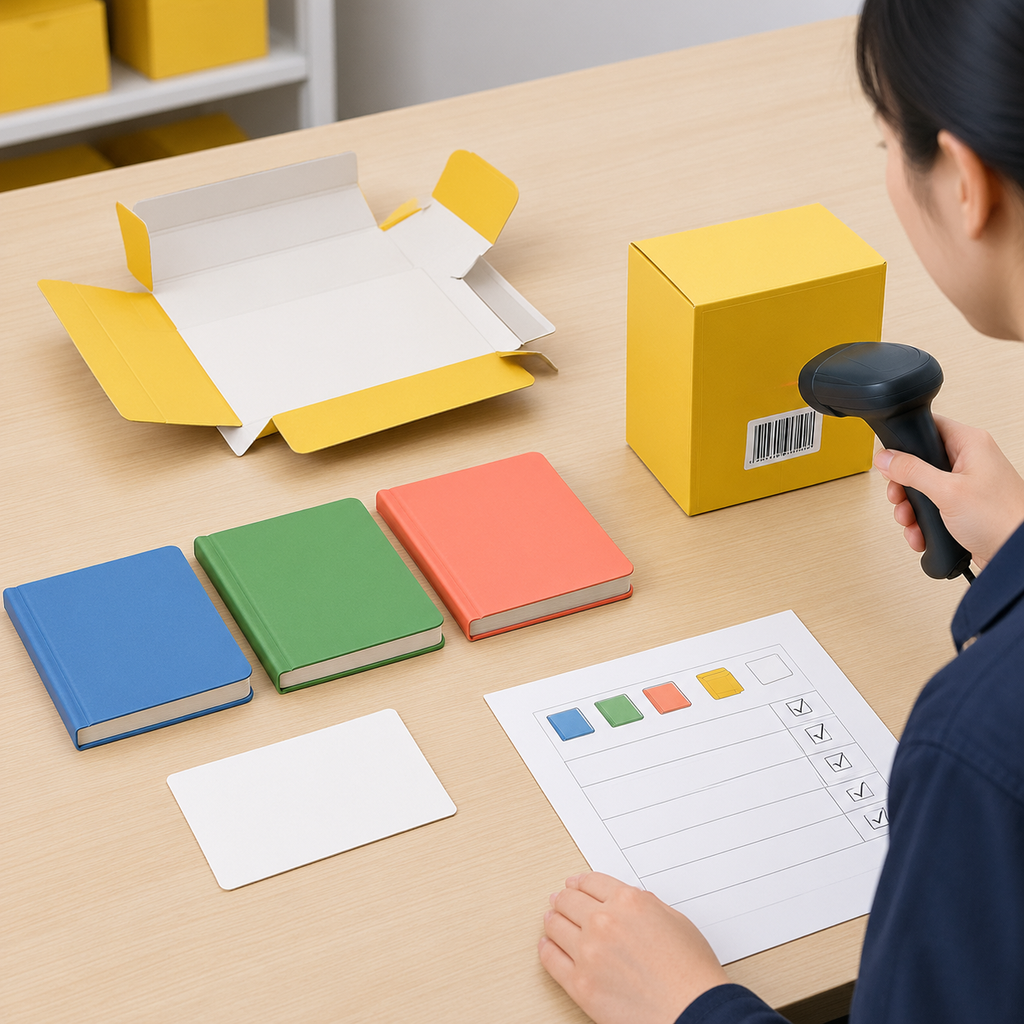
Board book kitting means assembling the correct books, packaging, and inserts into one saleable set. Control it with a bill of materials and illustrated packing instructions, not only a total book count.
A bill of materials is the component list for one finished unit. Include:
- Identity: title, edition, language, component code, and quantity for each book, insert, and packaging part.
- Arrangement: book sequence, spine direction, insert location, and a photo or diagram of the approved configuration.
- Verification: checks for missing or duplicate titles, wrong versions, damage, glue residue, poor fit, and closure problems.
- Pack-out: packed sets per carton, carton marking, and a clear distinction between set quantity and individual-book quantity.
For retail book packaging, place the set’s barcode on an accessible external panel according to retailer requirements. Confirm the identifier, symbol type, printed size, and whether individual-book barcodes should remain visible during set scanning.
Keep the code away from folds, corners, lid joints, and decorative effects. Preserve its quiet zone—the required clear space beside or around the symbol. Test the final printed surface, including any coating or outer wrap, with the intended scanning setup.
A complete-set inspection should verify component accuracy as well as appearance, fit, removal, closure, and barcode performance. Weight checks can help detect omissions, but cannot reliably distinguish two different titles with similar weights.
Quote checklist for board book sets and packaging
A comparable quote needs the books, retail package, assembly, and outer packing defined together. State clearly which dimensions are measured and which remain provisional.
- Quantities: finished sets, titles and copies per set, per-title production quantities, and any separately supplied books or spare components.
- Book specifications: finished dimensions, page count for each title, board/material construction, binding, corner shape, and surface finish.
- Packaging proposal: slipcase, folding carton, or rigid box; opening style; proposed materials; printing; and finishing. Request construction availability confirmation.
- Fit information: measured contents envelope, intended orientation, internal and external dimensions, agreed allowances, and dimensional tolerances.
- Additional components: inserts, dividers, trays, labels, or wrapping, with dimensions, versions, quantities, and placement.
- Kitting instructions: component list, title sequence, verification method, external barcode requirements, and packed sets per carton.
- Approval requirements: structural sample, artwork proof, finished-set sample, inspection criteria, and any specified transport testing.
- Delivery brief: destination country and postal code, distribution route, target arrival date, and required shipping scope.
Ask the quotation to distinguish book production, packaging, tooling or samples, kitting, and shipping. That makes differences in scope visible without assuming the lowest empty-box price produces the lowest assembled or landed cost.
Lemon Printing board book, packaging, and kitting options
Use one project brief covering the books, proposed packaging, and assembly requirements. Confirm the available slipcase or box construction and who supplies each component before approval.
Lemon Printing was established in 2015 and operates a self-owned facility in China’s Guangzhou–Shenzhen manufacturing corridor, with more than 130 skilled workers and 8+ offset and digital presses. Prepress, printing, binding, finishing, quality inspection, packing, and export preparation are handled in-house.
| Component | Specify | Confirm during quoting |
|---|---|---|
| Board books | Each title’s size, page count, materials, binding, and finish. | Feasible construction, finished thickness, and sample route. |
| Retail package | Proposed slipcase or box, opening, materials, and artwork. | Availability, production responsibility, tooling, and fit approval. |
| Printed inserts | Size, stock, version, quantity, and placement. | Proofing, component identification, and occupied space. |
| Assembled set | Component list, orientation, barcode, and carton count. | Kitting scope, verification checkpoints, and pack-out requirements. |
Review these requirements alongside Lemon Printing’s manufacturing and finishing capabilities. Keep proposed options separate from the confirmed production specification.
FAQ: Slipcases and boxes for board book sets
What is the difference between a slipcase and a box for a board book set?
A slipcase has one open end and usually leaves the book spines exposed. A box encloses the set with a lid or flaps. Either can need additional restraint and outer packing for shipping; the name alone does not specify strength.
Should packaging dimensions come from artwork or completed book samples?
Use completed or production-equivalent book samples for final fit approval. Artwork provides trim and panel dimensions, but not the complete thickness of boards, adhesives, binding, and finishes. Record approved internal dimensions and fit allowances on the packaging drawing.
Can one package accommodate board books of different sizes?
Yes, if their arrangement and support are designed together. A spacer or tray may keep shorter books from shifting, but it also occupies space and adds assembly work. Validate the full mixed-size set in a physical sample.
What should a complete-set inspection check before packing?
Check every required title and version, book count, sequence, inserts, packaging condition, removal and closure, and the external barcode. Confirm the packed-set quantity on carton labels. Weight checks can assist but cannot identify every wrong-title substitution.
Does retail board book packaging replace export shipping protection?
No. Retail packaging presents and groups the books; export packing protects packed units through the agreed distribution route. Specify corrugated cartons, internal protection, carton counts, and any required transport testing separately. Ecommerce parcel shipment may need a different outer package.
Key takeaways: Approve the assembled set
The useful approval is not simply “the box looks right.” It is a documented set that fits, contains the correct components, opens as intended, and has an agreed outer packing plan.
FAQ
What is the difference between a slipcase and a box for a board book set?
A slipcase has one open end and usually leaves the book spines exposed. A box encloses the set with a lid or flaps. Either can need additional restraint and outer packing for shipping; the name alone does not specify strength.
Should packaging dimensions come from artwork or completed book samples?
Use completed or production-equivalent book samples for final fit approval. Artwork provides trim and panel dimensions, but not the complete thickness of boards, adhesives, binding, and finishes. Record approved internal dimensions and fit allowances on the packaging drawing.
Can one package accommodate board books of different sizes?
Yes, if their arrangement and support are designed together. A spacer or tray may keep shorter books from shifting, but it also occupies space and adds assembly work. Validate the full mixed-size set in a physical sample.
What should a complete-set inspection check before packing?
Check every required title and version, book count, sequence, inserts, packaging condition, removal and closure, and the external barcode. Confirm the packed-set quantity on carton labels. Weight checks can assist but cannot identify every wrong-title substitution.
Does retail board book packaging replace export shipping protection?
No. Retail packaging presents and groups the books; export packing protects packed units through the agreed distribution route. Specify corrugated cartons, internal protection, carton counts, and any required transport testing separately. Ecommerce parcel shipment may need a different outer package.
Get a Clear Quote for Your Printing Project
Send Lemon Printing your product type, set quantity, titles per set, book dimensions and page counts, materials, binding or finishing requirements, preferred packaging style, and kitting instructions. Include the delivery destination and target date.
Our team will review the specifications and normally respond within one business day with practical production options, pricing, and a project timeline. Final MOQ, production time, pricing, and shipping depend on product specifications, quantity, finishing, and destination.