Table of Contents
- What Should You Decide Before Shipping a Bulk Printing Order?
- Confirm product specifications, quantity, destination, and receiving requirements
- Separate production questions from freight and customs questions
- How Are Books, Cards, Calendars, and Tickets Packed for Export?
- Evaluate cartons, corner protection, moisture barriers, and palletization
- Plan inner packs, retail units, kits, and labeling
- Which Information Belongs in a Freight Quote?
- Provide carton dimensions, estimated weights, quantities, and delivery address
- Clarify shipping terms, destination handling, and required documents
- How Does Factory Quality Control Reduce Shipping Risk?
- Check finished goods, carton counts, packing lists, and pallet condition
- How to Plan a Repeat Order With Consistent Packaging
- Retain product, carton, labeling, and packing specifications
- What Affects Final MOQ, Production Time, Pricing, and Shipping?
- FAQ: Shipping Bulk Printed Products From China
- Can a printing manufacturer arrange export preparation and packing?
- How early should shipping requirements be discussed with the printer?
Shipping bulk printed products from China requires more than selecting an ocean or air freight service. This guide explains how to prepare specifications, design export packaging, provide freight data, verify packing, and plan repeat orders.
What Should You Decide Before Shipping a Bulk Printing Order?
Short answer: Freeze the product specification, packed quantity, destination, delivery requirement, and shipping responsibility before production is released. These decisions determine how the goods are packed and what information a freight provider needs.
- Product: finished size, page count where applicable, paper, binding, printing method, and finishing.
- Quantity: total units, units per inner pack, units per carton, carton count, and pallet count if used.
- Destination: port or door address, postal code, receiving hours, dock or forklift access, and any retailer or warehouse rules.
- Commercial terms: who books transport, who handles import clearance, and who pays duties or destination charges.
Shipping bulk printed products from China is more predictable when the printer, buyer, and forwarder work from the same packed-cargo assumptions.
Confirm product specifications, quantity, destination, and receiving requirements
Start with the finished product rather than an approximate unit count. A book, card set, calendar, or ticket can have very different carton requirements depending on its dimensions, paper weight, binding, coatings, and accessories.
- Record the finished size, open size if relevant, page or panel count, and product variants.
- Specify paper type and weight, color process, binding, lamination, varnish, foil, perforation, numbering, or other finishing.
- State the total quantity and whether products must be sorted by SKU, language, campaign, retailer, or destination.
- Provide the delivery address and receiving constraints before carton design is finalized.
Paper density affects both product weight and packed volume. For a practical review of paper choices, see Lemon Printing’s guide to coated versus uncoated paper for printing. Also confirm whether the receiving location requires pallet labels, appointment delivery, barcode formats, or a specific carton quantity.
Separate production questions from freight and customs questions
Separate the printer’s production responsibilities from the freight forwarder’s transport and customs responsibilities. The printer can confirm what is being manufactured and how it will be packed; the forwarder or importer normally confirms routing, booking, customs procedures, and destination charges.
- Production questions: Can the requested paper, binding, finishing, and pack format be produced? When will the cargo be ready?
- Freight questions: Should the shipment move by ocean, air, courier, FCL, or LCL? What are the transport and destination costs?
- Customs questions: Which party provides the HS classification, importer information, permits, origin documents, and tax instructions?
FCL means a full-container-load shipment, while LCL means less-than-container-load cargo consolidated with other shipments. Print method may affect production setup and scheduling, but it does not by itself determine the best freight method. Lemon Printing’s offset and digital printing comparison can help with the production decision.
How Are Books, Cards, Calendars, and Tickets Packed for Export?

Export packing should protect printed surfaces from crushing, abrasion, dirt, and moisture while keeping the shipment easy to count and handle. The correct approach depends on the product’s format, rigidity, surface finish, weight, and final receiving process.
For shipping printed books internationally, cartons normally need enough compression resistance for stacking and enough internal support to prevent movement. Cards, calendars, and tickets may need separate protection for corners, folds, perforations, or variable numbering. The goal of commercial printing export packaging is not simply to use more material; it is to match protection to the actual handling risks.
Evaluate cartons, corner protection, moisture barriers, and palletization
Carton design should balance product fit, stacking strength, handling weight, and freight efficiency. A carton that is too large allows movement and edge damage; one that is too tight can compress covers, corners, folds, or finished surfaces.
- Cartons: Select corrugated board and carton dimensions for the packed product and intended stacking pattern. Avoid excessive empty space.
- Internal protection: Use dividers, edge boards, sleeves, or other supports when the product can shift or deform.
- Moisture control: Consider polybags, liners, or other barriers for the route and environment. Do not seal goods that are not fully dry, because trapped moisture can create problems.
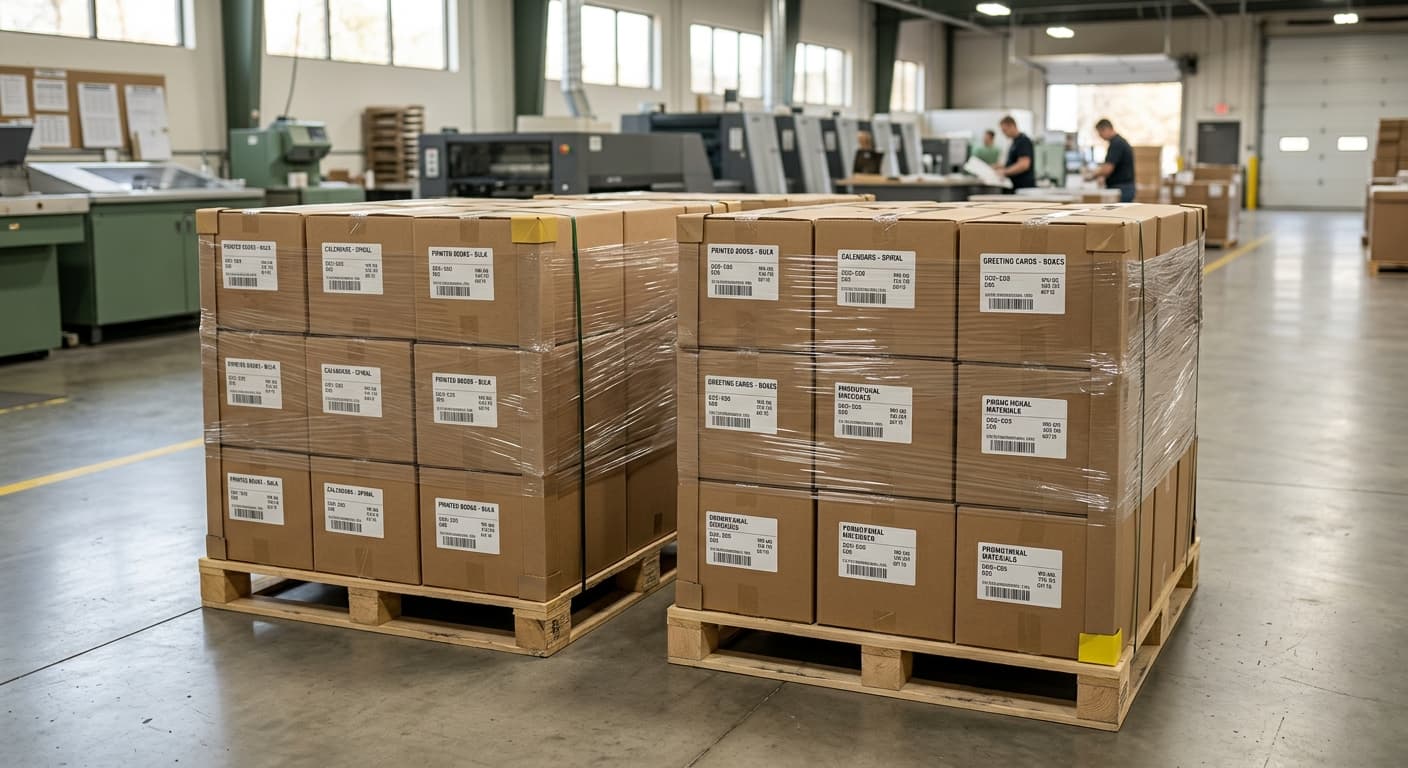
- Pallets: Stack cartons squarely, protect the bottom layer, and use stretch film or straps without crushing the cartons. Confirm the maximum pallet height and weight with the receiver or forwarder.
- Wood packaging: If wooden pallets or crates are used, check whether the destination requires compliant treated material and marks such as ISPM 15.
Ask for the proposed carton and pallet configuration before production if the shipment has strict warehouse, container, or retailer requirements. Lemon Printing’s bulk book printing guide provides related guidance on paper, binding, quality control, and shipping considerations.
Plan inner packs, retail units, kits, and labeling
Define the smallest handling unit before the packing team begins. Inner packs make counting and distribution easier, while retail units and kits may require a different sequence of assembly, wrapping, labeling, and carton packing.
- State the required quantity per inner pack and whether each pack needs a label, barcode, or SKU.
- Separate variants clearly; do not assume mixed cartons are acceptable unless the purchase order permits them.
- For kits, list every component and specify whether assembly occurs before export packing.
- Use carton labels that identify the purchase order, SKU, quantity, carton number, and destination where required.
- Confirm whether labels must be placed on two sides, a pallet, or an outer-facing location for scanning.
For example, a calendar program for several corporate recipients may need each design separated by recipient or campaign rather than packed only by production sequence. Lemon Printing’s guidance on branded calendar formats and packaging planning is relevant when calendars are distributed as gifts or campaign sets.
Which Information Belongs in a Freight Quote?

A useful freight quote is based on packed cargo, not only the number of printed units. The forwarder needs enough information to calculate transport, handling, and destination charges without making broad assumptions about carton size or weight.
Good printed product freight planning separates estimated data at the quotation stage from confirmed data after final packing. Ask the printer to update the packing list when the actual carton count, dimensions, and weights are known.
Provide carton dimensions, estimated weights, quantities, and delivery address
Send the forwarder a single cargo summary using the same packing assumptions as the print quotation. Include the following details:
- Total finished units and the number of units per inner pack and carton.
- Number of cartons and, if used, number of pallets.
- Carton dimensions in the agreed unit, normally length × width × height.
- Estimated net weight of the printed goods and gross weight including packaging.
- Estimated total cubic meters, or CBM, if available. CBM is the volume occupied by the packed cargo.
- Factory pickup location, cargo-ready date, transport mode, and preferred origin port if relevant.
- Final delivery address, postal code, receiving hours, contact person, dock access, and appointment requirements.
Estimated dimensions and weights are suitable for an initial quote, but the final freight calculation should use measured pack-out data. Ask whether the carrier charges by actual weight, dimensional weight, volume, container space, or a combination.
Clarify shipping terms, destination handling, and required documents
State the agreed Incoterm and named place in the quotation. Incoterms allocate key transport costs, delivery points, and responsibilities, but they do not replace the buyer’s need to confirm local customs and tax requirements.
- EXW: The buyer takes on most transport responsibilities from the supplier’s premises.
- FOB: The seller’s responsibility generally extends to export delivery at the named port, while the buyer arranges the main carriage.
- CIF: The seller pays cost, insurance, and freight to the named port, while import and destination handling remain to be clarified.
- DAP: The seller delivers to the named destination, while the buyer normally handles import clearance and duties.
- DDP: The seller takes on most delivery and import obligations where legally and operationally possible.
Confirm the applicable Incoterms version, named location, insurance scope, port or terminal charges, last-mile delivery, customs broker, duties, taxes, and storage or appointment fees. Typical documents may include a commercial invoice, packing list, bill of lading or air waybill, and additional origin or customs documents where required. Do not guess the HS code; the importer and customs professional should confirm classification for the destination.
How Does Factory Quality Control Reduce Shipping Risk?
Factory quality control reduces shipping risk by checking the product and its packing before the cargo leaves the facility. It cannot remove every carrier, weather, customs, or destination-handling risk, but it can make packing errors and shipment discrepancies easier to detect.
Lemon Printing operates a self-owned facility in the Guangzhou-Shenzhen manufacturing corridor. Its workflow keeps prepress, printing, binding, finishing, quality inspection, packing, and export preparation in-house, supported by more than 130 skilled workers and 8+ offset and digital presses.
Check finished goods, carton counts, packing lists, and pallet condition
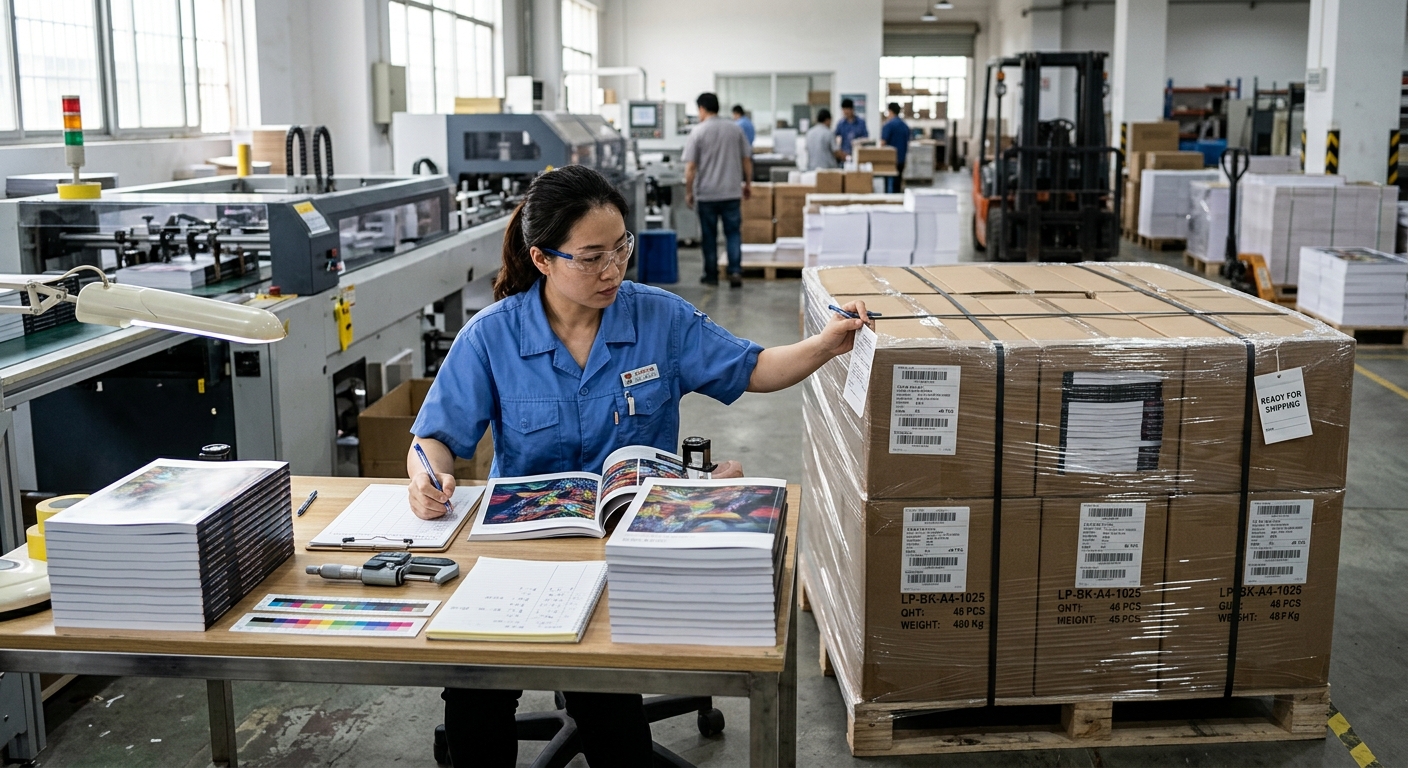
Before loading, compare the finished shipment with the approved product and packing instructions. A practical pre-dispatch checklist includes:
- Inspect representative finished units for trim, page order, color consistency, binding, perforation, lamination, and other specified features.
- Verify the quantity per inner pack and carton, then reconcile the total carton count with the purchase order.
- Check carton labels for SKU, quantity, carton sequence, destination, and any buyer-required reference.
- Measure or record final carton dimensions, net weight, gross weight, and pallet count for the packing list.
- Inspect carton seals, exposed corners, stretch film, straps, pallet boards, and stack stability.
- Compare the final packing list with the freight booking and provide discrepancies to the buyer or forwarder before dispatch.
For higher-value or multi-SKU orders, buyers may request packing photographs, a carton-by-carton list, or a pre-shipment inspection. These records support traceability if a carton is short, mislabeled, or damaged in transit.
How to Plan a Repeat Order With Consistent Packaging

Repeat-order packaging becomes more consistent when the first shipment creates a controlled packing specification, not just a finished product sample. Retain the approved configuration and review it whenever the product, quantity, destination, or transport method changes.
Packaging consistency helps the buyer compare freight quotes and prepare warehouse capacity, but the printer should still verify actual pack-out data for each production run.
Retain product, carton, labeling, and packing specifications
Create one approved record for the product and its export packing. It should identify the artwork revision, finished size, paper, binding, finishing, quantity, pack count, carton construction, pallet method, and label layout.
- Save approved product and carton photographs, including the orientation of the product inside the carton.
- Record units per inner pack, units per carton, cartons per pallet, and the intended SKU separation.
- Record carton dimensions, packaging materials, gross and net weight, pallet dimensions, and wrapping or strapping instructions.
- Retain label data such as purchase order, SKU, carton sequence, barcode, destination, and handling marks.
- Assign a revision number and update it when paper, page count, binding, finishing, quantity, or destination changes.
Artwork changes can alter page count, trim, or product thickness. Use a documented prepress process, such as Lemon Printing’s guide to preparing artwork for commercial printing, before asking the factory to reuse a previous packing specification.
What Affects Final MOQ, Production Time, Pricing, and Shipping?
Final MOQ, production time, pricing, and shipping cannot be determined from product category alone. They depend on the product specifications, quantity, finishing, packing method, and destination, and should be confirmed in the project quotation.
- MOQ: Minimum order quantity can be affected by press setup, paper purchasing, format, binding, finishing, color requirements, and whether separate variants need separate production or packing.
- Production time: The schedule may include artwork checks, proof approval, material preparation, printing, binding, finishing, inspection, packing, and export preparation. Cargo-ready date is different from arrival date.
- Pricing: Separate print manufacturing, special materials, finishing, cartons, pallets, inland transport, freight, duties, taxes, and destination charges where possible.
- Shipping: Freight depends on packed carton dimensions, actual or dimensional weight, mode, origin, destination, shipping term, carrier conditions, customs processing, and delivery requirements.
When requesting a quote, ask which figures are estimates and which are confirmed. Request the expected cargo-ready date and the transport estimate as separate milestones. Final MOQ, production time, pricing, and shipping depend on the agreed specifications, quantity, finishing, and destination.
FAQ: Shipping Bulk Printed Products From China
Discuss shipping requirements during quotation and before production is released. The printer can then design the packing around the actual receiving and freight requirements instead of treating export preparation as a last-minute step.
Can a printing manufacturer arrange export preparation and packing?
Yes, a factory-backed printer can often manage production-side packing and export preparation, but freight booking and customs responsibility must be stated separately. Lemon Printing handles prepress, printing, binding, finishing, quality inspection, packing, and export preparation in-house at its self-owned facility.
Ask the quotation to identify whether the agreed scope includes carton design, palletization, shipping marks, final packing lists, pickup coordination, freight booking, export documentation, customs brokerage, and destination delivery. The answer may vary by shipping term and destination. The importer or forwarder should confirm local customs, tax, labeling, and clearance requirements.
How early should shipping requirements be discussed with the printer?
Discuss shipping requirements when requesting the print quotation, and confirm them before the product and packing method are approved. Provide the destination, receiving rules, preferred shipping term, intended mode, and any carton or pallet limits as early as possible.
If these requirements arrive after packing, the factory may need to revise carton quantities, labels, palletization, or documents. A final freight quote should be updated with actual pack-out data after production and inspection. This timing gives the buyer a clearer distinction between print completion, cargo readiness, departure, customs clearance, and final delivery.
FAQ
Can a printing manufacturer arrange export preparation and packing?
Yes. Lemon Printing handles prepress, printing, binding, finishing, quality inspection, packing, and export preparation in-house at its self-owned facility. Freight booking, customs brokerage, import clearance, duties, and destination delivery should be listed separately in the quotation because responsibility depends on the agreed shipping term and destination.
How early should shipping requirements be discussed with the printer?
Discuss them at the quotation stage and confirm them before production and packing are finalized. Share the destination, receiving rules, preferred shipping term, transport mode, carton or pallet limits, labeling requirements, and target date. The final freight figures should be updated using the actual carton dimensions, weights, and counts after pack-out.
Request a Shipping-Ready Printing Quote
Tell Lemon Printing what you need to produce and where it must be delivered. Include the product type, quantity, finished size, page count where applicable, paper, binding or finishing, packing requirements, delivery destination, and target date. We can then review the production and export-packing details needed for a practical quotation.