Table of Contents
- Key Takeaways: Plan Space and Approval for Both Languages
- Bilingual Board Book Printing: How Should the Languages Share Space?
- Define language pairing, reading direction, and text expansion
- Set readable type, contrast, and illustration clearance
- Comparison Table: Stacked Text, Parallel Columns, or Facing Pages
- Prepare a Bilingual Board Book in Six Steps
- Steps 1-2: Approve translations and select a page layout
- Steps 3-4: Pair each text passage and verify fonts and glyphs
- Steps 5-6: Lock file versions and approve editorial and physical proofs
- Check Accents, Line Breaks, Language Order, and Page Pairing
- Quote Checklist for Bilingual Board Book Production
- FAQ: Bilingual Board Book Layout and Printing
- Request a Quote With Your Approved Bilingual Files
Key Takeaways: Plan Space and Approval for Both Languages
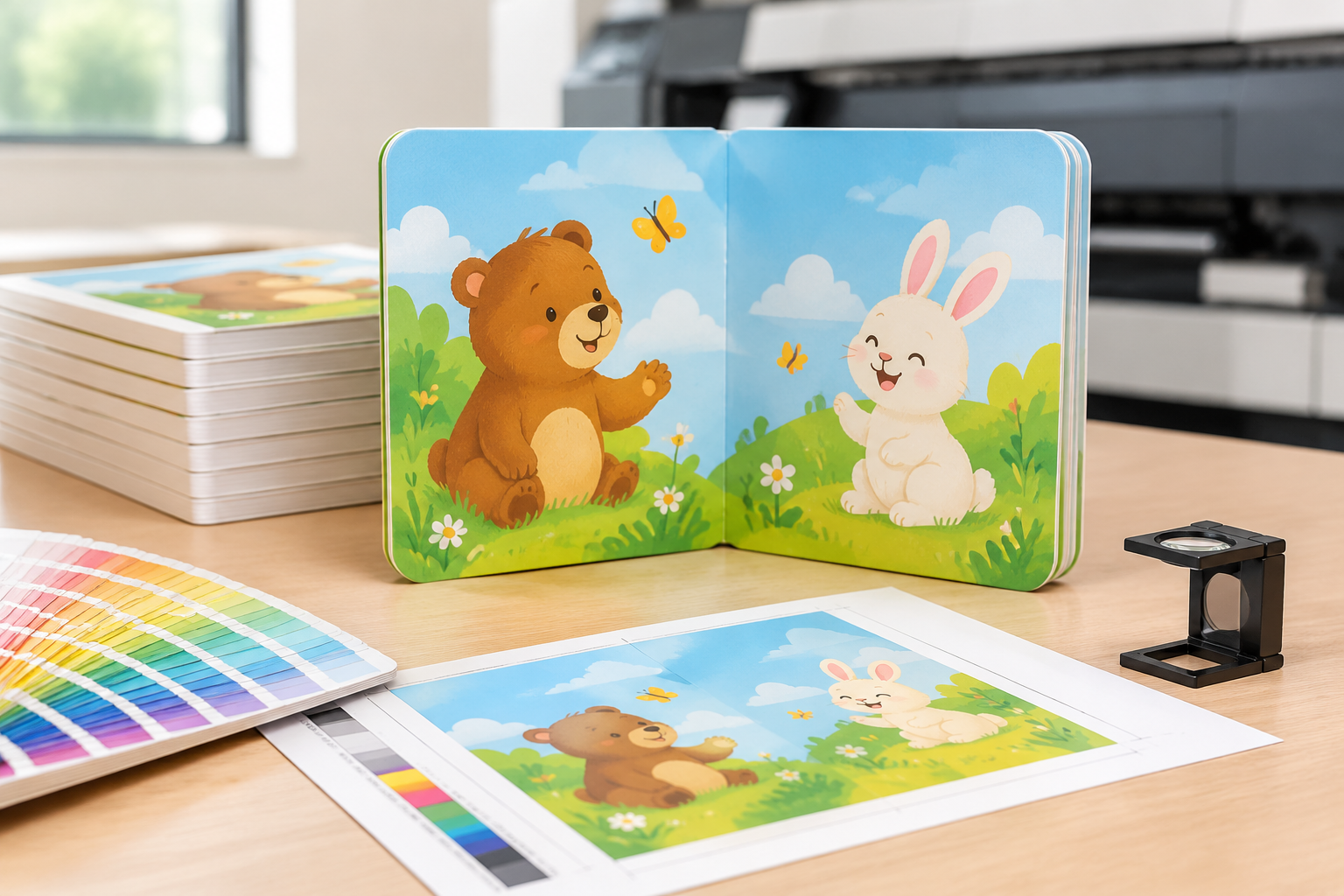
Short answer: Bilingual board book printing should treat each language as its own approved text layer inside one shared page map. Reserve space for the longer approved version, decide language order before artwork is locked, and release the job only after language and production checkpoints are both signed off.
- Choose the layout from the copy. Stacked text, parallel columns, and facing pages solve different reading problems.
- Protect the artwork. Text expansion should not push type into trim, rounded corners, die-cut areas, or important illustration details.
- Verify the type system. Accents, inverted punctuation, special characters, font licensing, and PDF embedding all need review.
- Assign approval clearly. The buyer’s language reviewer approves meaning; the printer checks placement and manufacturability.
- Inspect a physical proof. Board book proofing must cover page pairing, line breaks, contrast, trim, lamination, corners, and binding behavior.
Bilingual Board Book Printing: How Should the Languages Share Space?
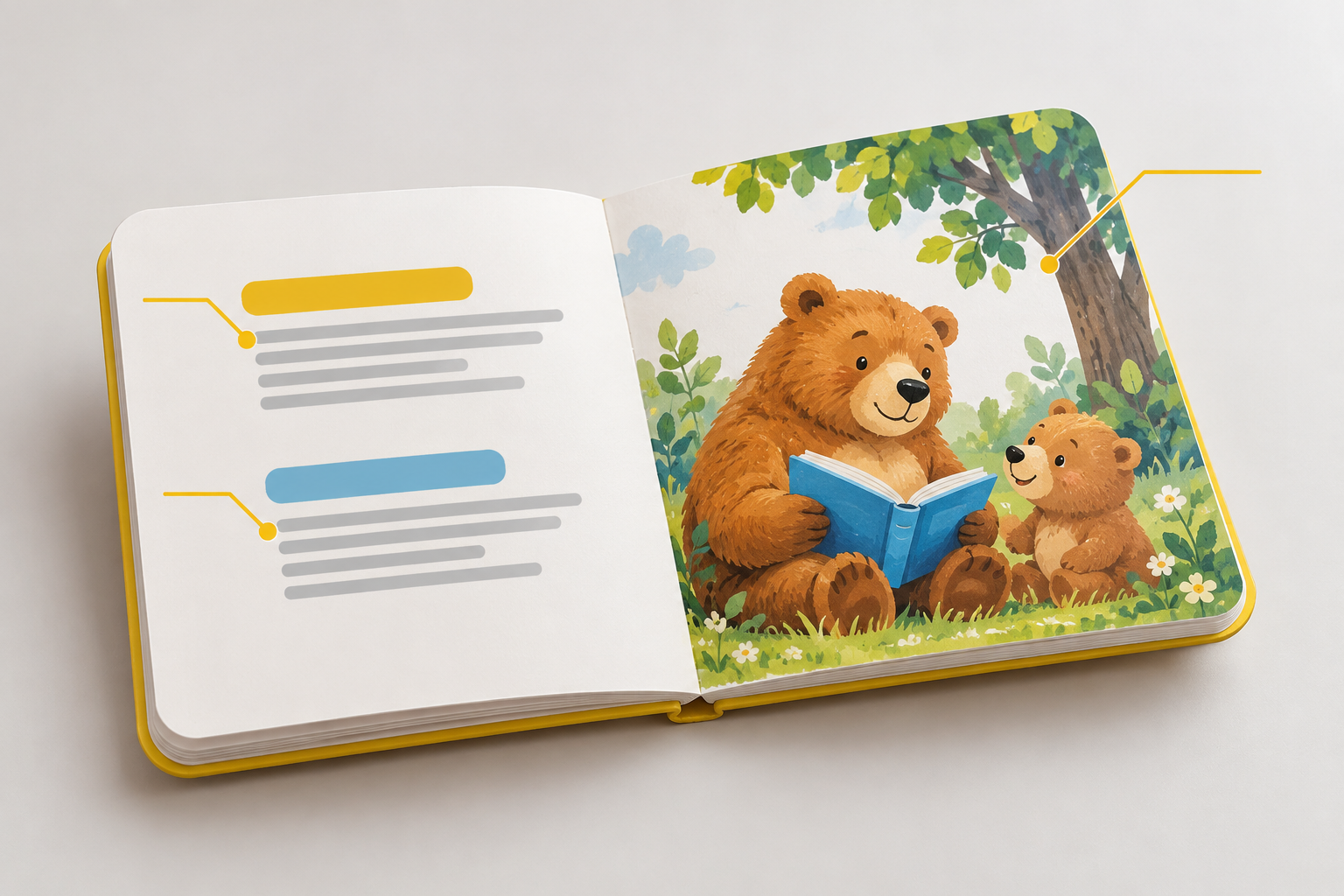
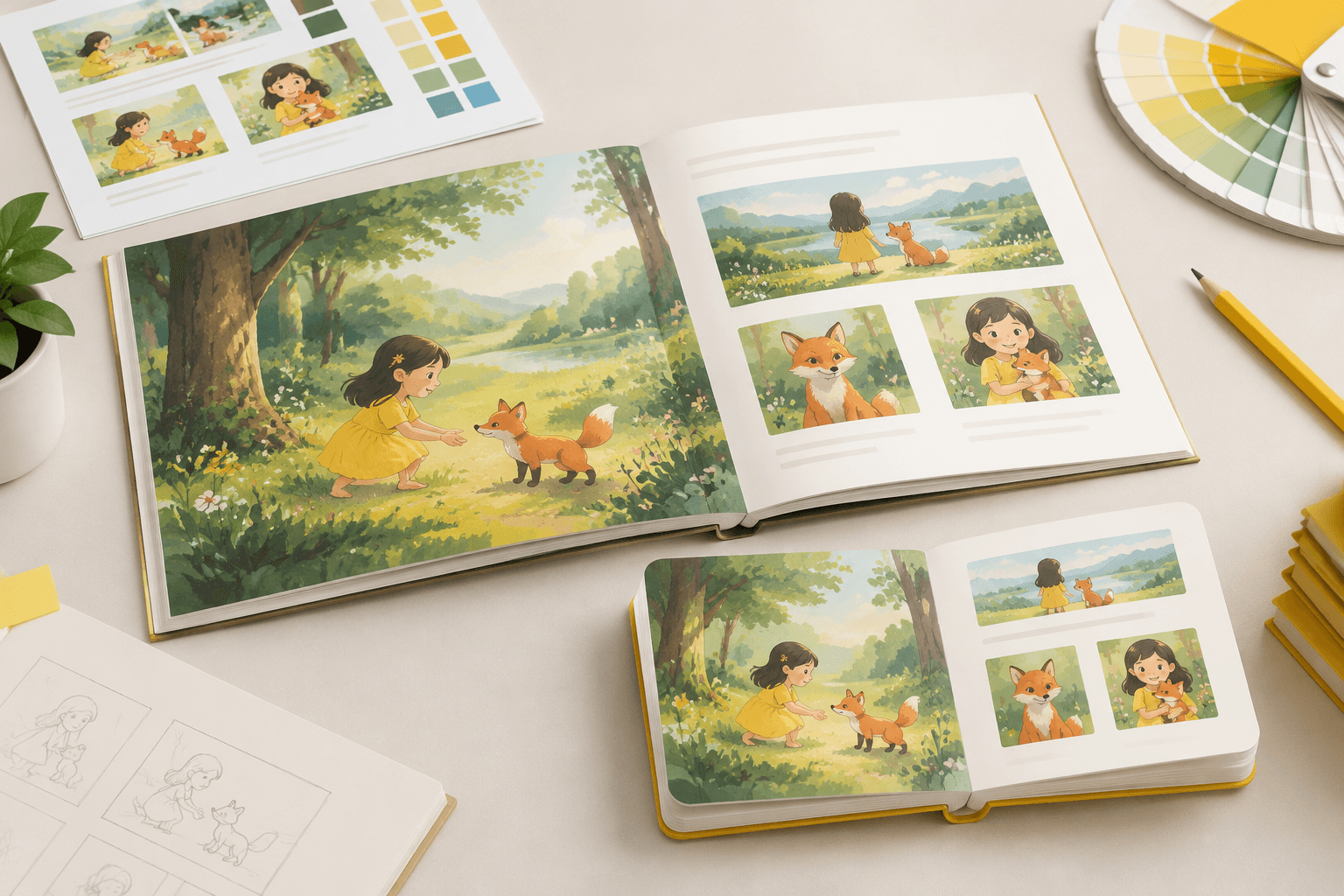
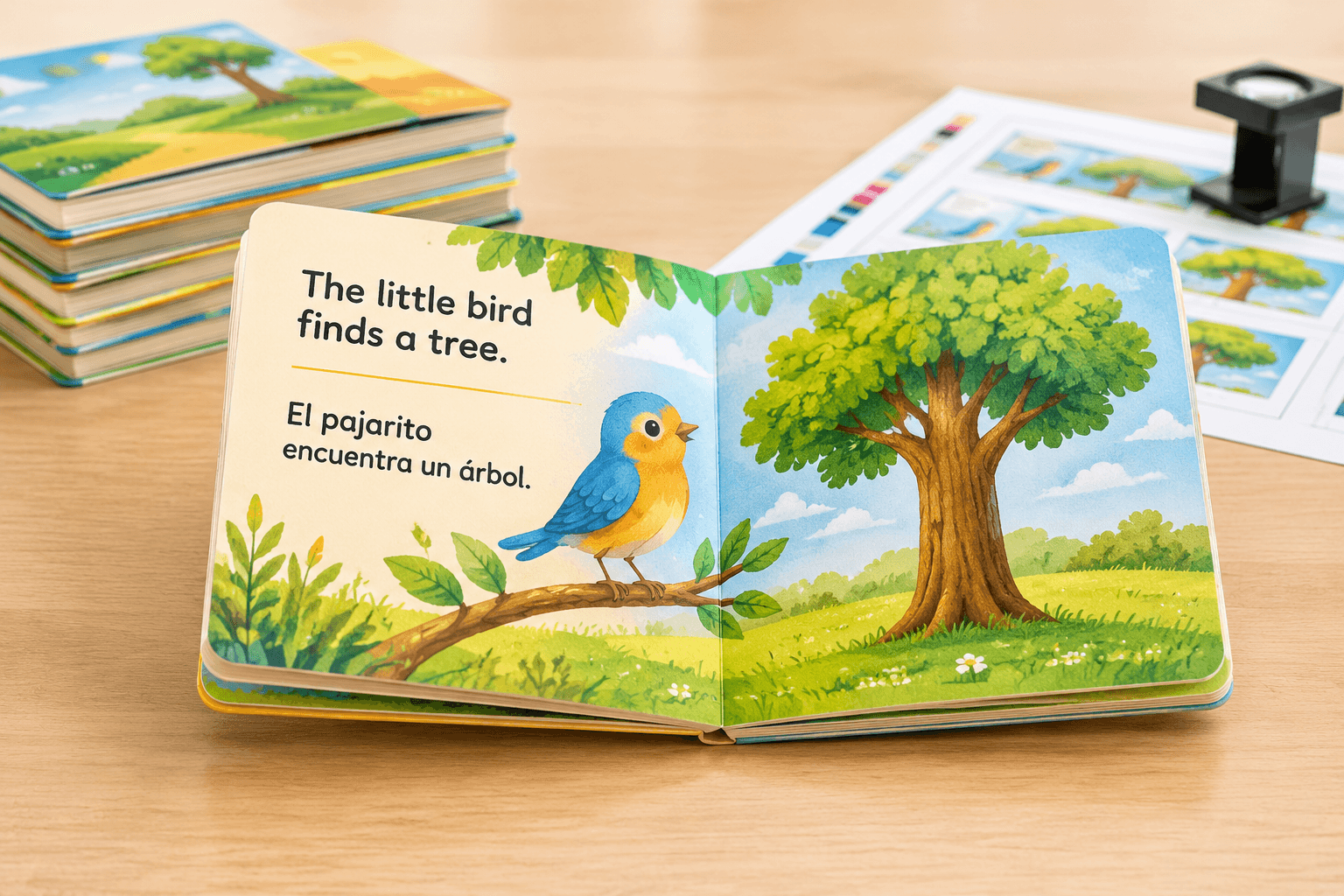
The two languages should share space according to reading behavior, text length, and illustration composition—not a template selected before the copy is approved. Stacked text is often the safest starting point for short shared captions; parallel columns help readers compare lines; facing pages give each language more room but require a more deliberate page map.
For English-Spanish board books, both languages generally read from left to right, yet word length, accents, punctuation, and line breaks still change the spread. Lemon Printing’s custom board book printing workflow can be planned around the physical format, construction, finishing, and proofing needs from the beginning.
Define language pairing, reading direction, and text expansion
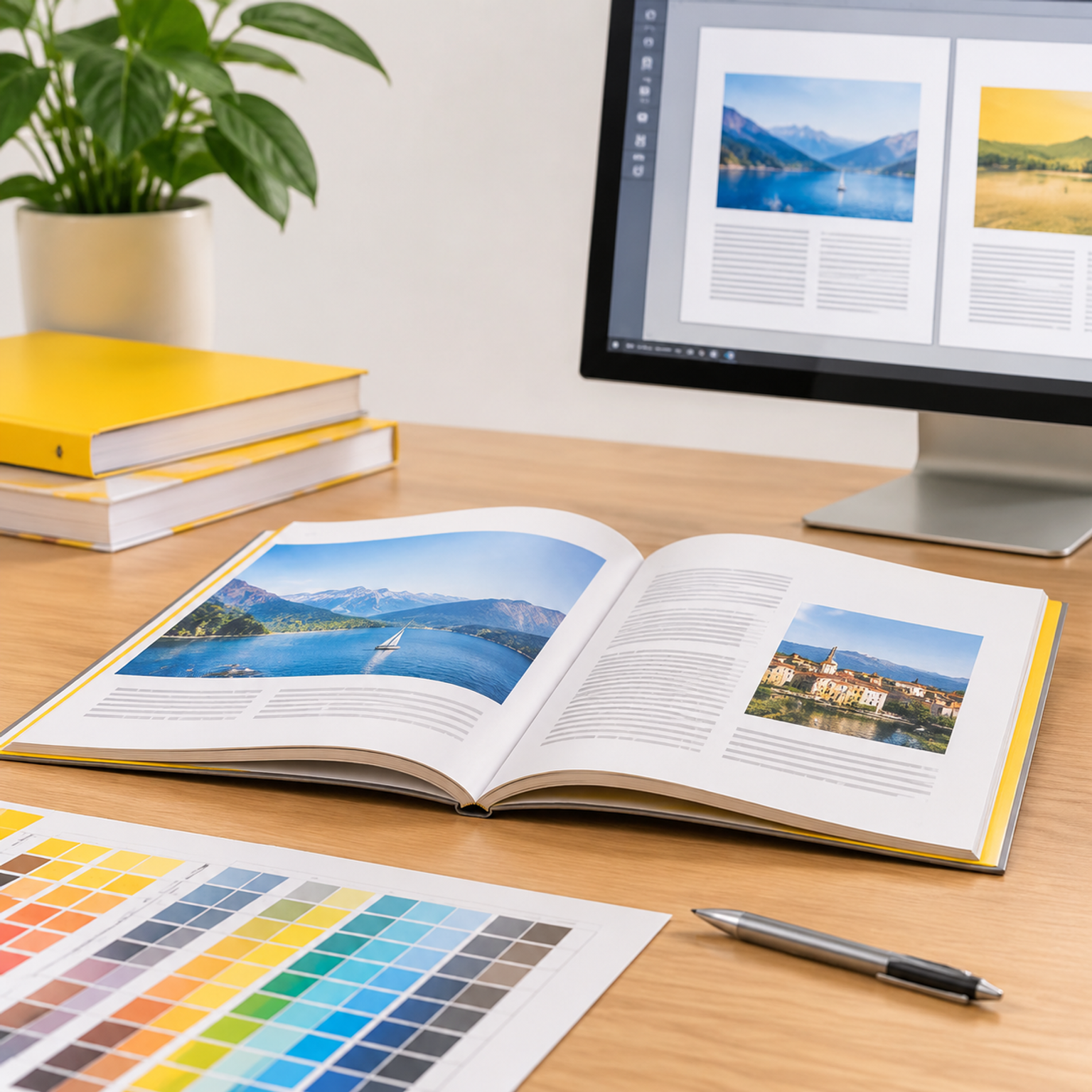
Start with a short language brief before an illustrator or designer builds the final spreads. It should identify:
- the language pair and regional variant;
- the reading direction and interior language order;
- whether the job is one bilingual edition or separate language editions; and
- which passages, labels, songs, or sound effects must appear in both languages.
Text expansion is a layout problem, not merely a translation detail. A longer approved phrase can add lines, increase the height of a text box, or reduce the clear area around an illustration. Test the densest approved spread—not only the shortest caption—and avoid solving late overflow by shrinking the type until it becomes uncomfortable for a young reader.
Set readable type, contrast, and illustration clearance
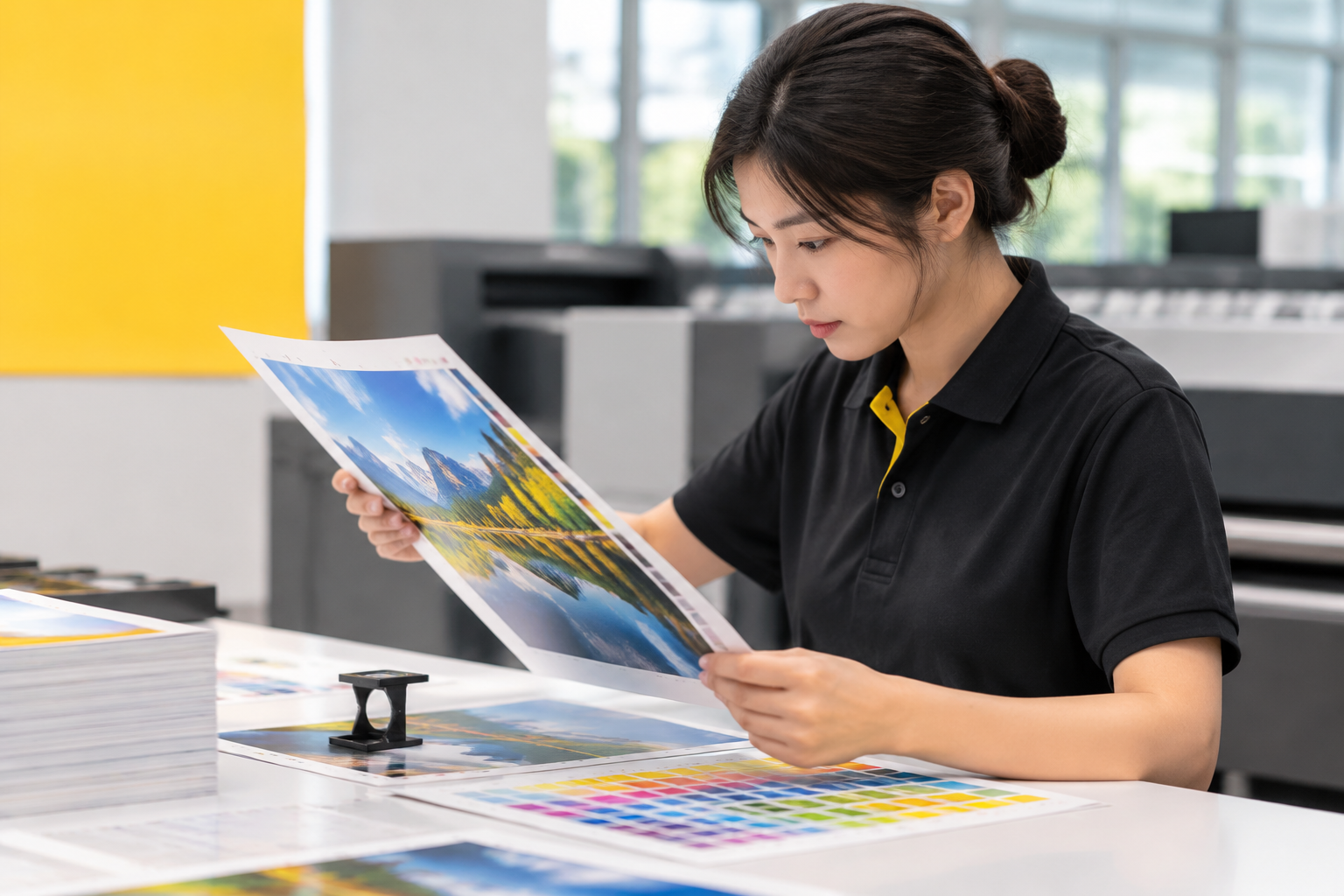
Set type after the approved copy, finished size, and illustration areas are known. A font that looks correct in a design application can still substitute characters in an exported PDF or production system, so verify the actual output.
- Choose a font family that contains every required glyph, including accented letters and language-specific punctuation.
- Use multilingual font embedding in the PDF and keep an editable source file for controlled corrections. Outlining every character can protect appearance, but it makes language edits harder.
- Use clear contrast and avoid placing small type over detailed artwork, dark shadows, or glossy highlights.
- Keep text away from trim, rounded corners, die cuts, folds, glue areas, and binding zones according to the printer’s template.
Review type at the finished reading size, not only at high zoom. Lamination and surface glare can change perceived contrast, which is one reason a physical proof matters.
Comparison Table: Stacked Text, Parallel Columns, or Facing Pages
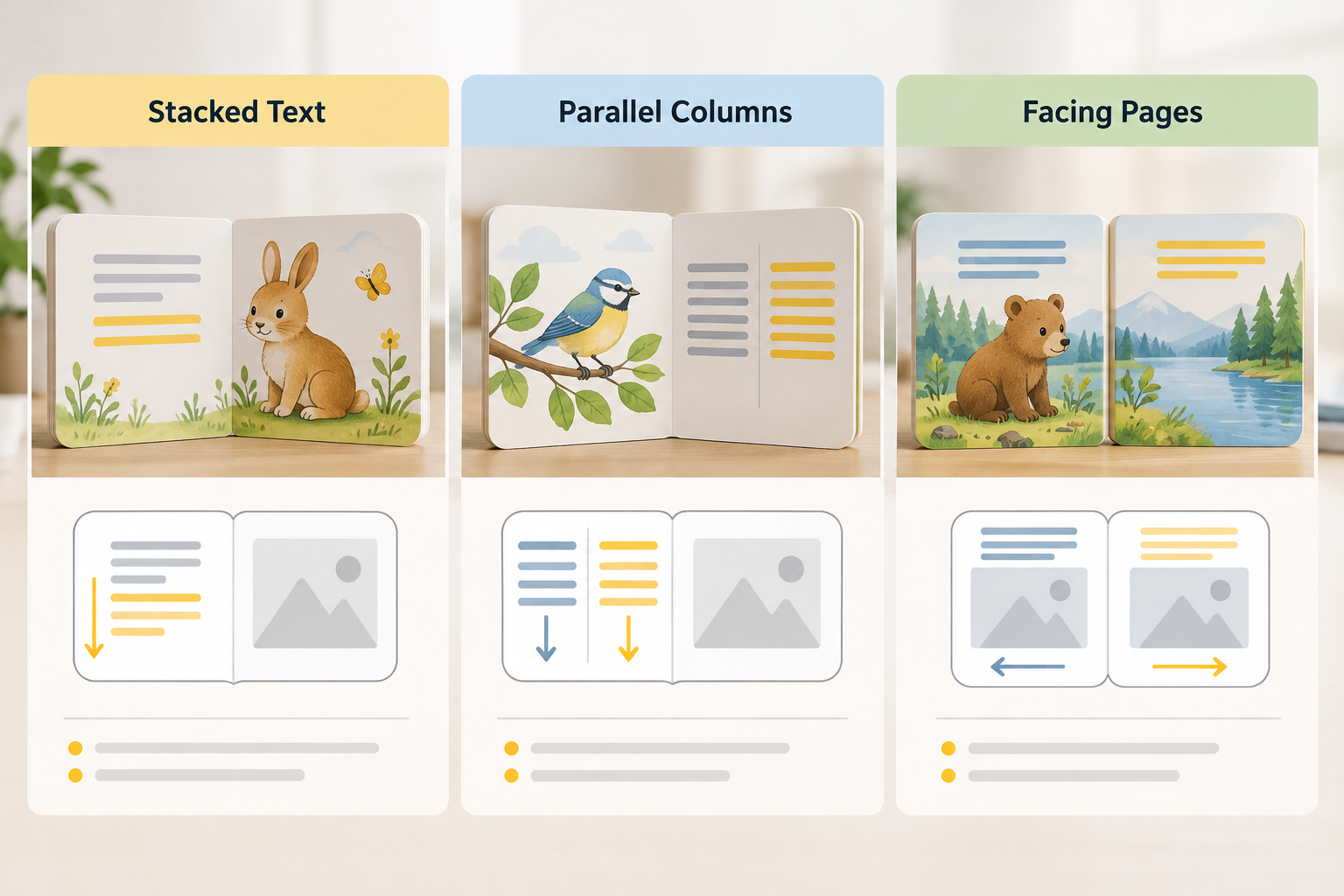
There is no universal best layout. Choose the structure that leaves enough room for the longest approved language while keeping the reading path obvious.
| Layout | Strength | Main risk | Best fit | Proof focus |
|---|---|---|---|---|
| Stacked text | Uses one text area and keeps both languages with the same image. | The longer language can make the block too tall or visually heavy. | Short captions, labels, read-aloud books, and shared scenes. | Language order, line breaks, hierarchy, and clearance below the art. |
| Parallel columns | Makes direct line-by-line comparison easy. | Narrow columns may force small type or reduce illustration space. | Vocabulary, classroom use, and structured educational content. | Column alignment, reading sequence, punctuation, and text width. |
| Facing pages | Gives each language a separate page and more composition freedom. | Uses more page space and can weaken a continuous two-page illustration. | Longer stories or editions intended for separate language reading. | Page pairing, turn sequence, spread continuity, and language order. |
Prepare a Bilingual Board Book in Six Steps
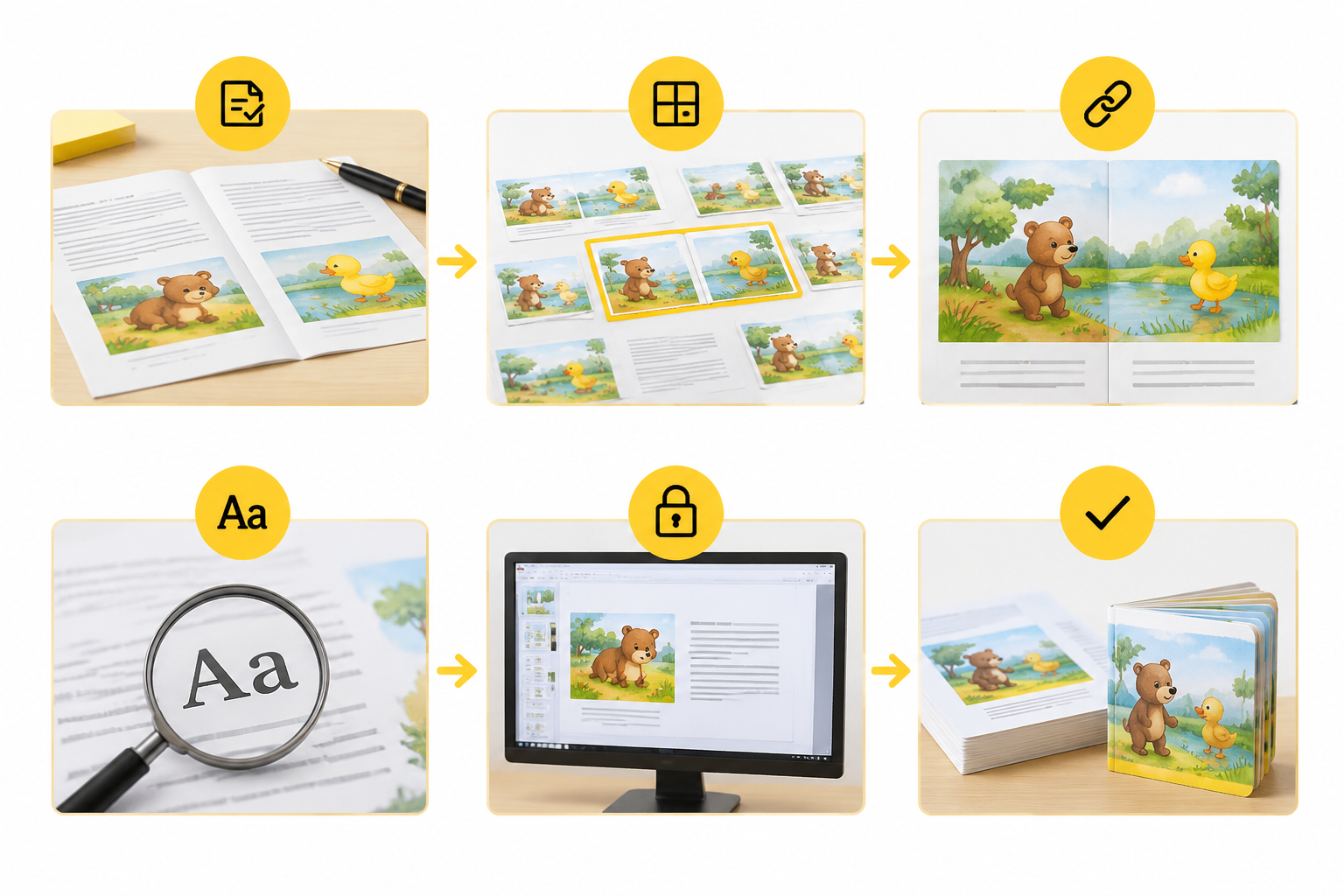
Use six approval gates to prevent a late translation correction from becoming a new artwork file:
- Approve the source text and translation.
- Select a layout using representative and text-heavy spreads.
- Pair every passage with a shared page or scene ID.
- Verify fonts, glyphs, punctuation, and PDF embedding.
- Lock the file version and release manifest.
- Approve both the editorial proof and the physical production proof.
The printer can help identify production risks, but the buyer remains responsible for approving language meaning and regional usage.
Steps 1-2: Approve translations and select a page layout
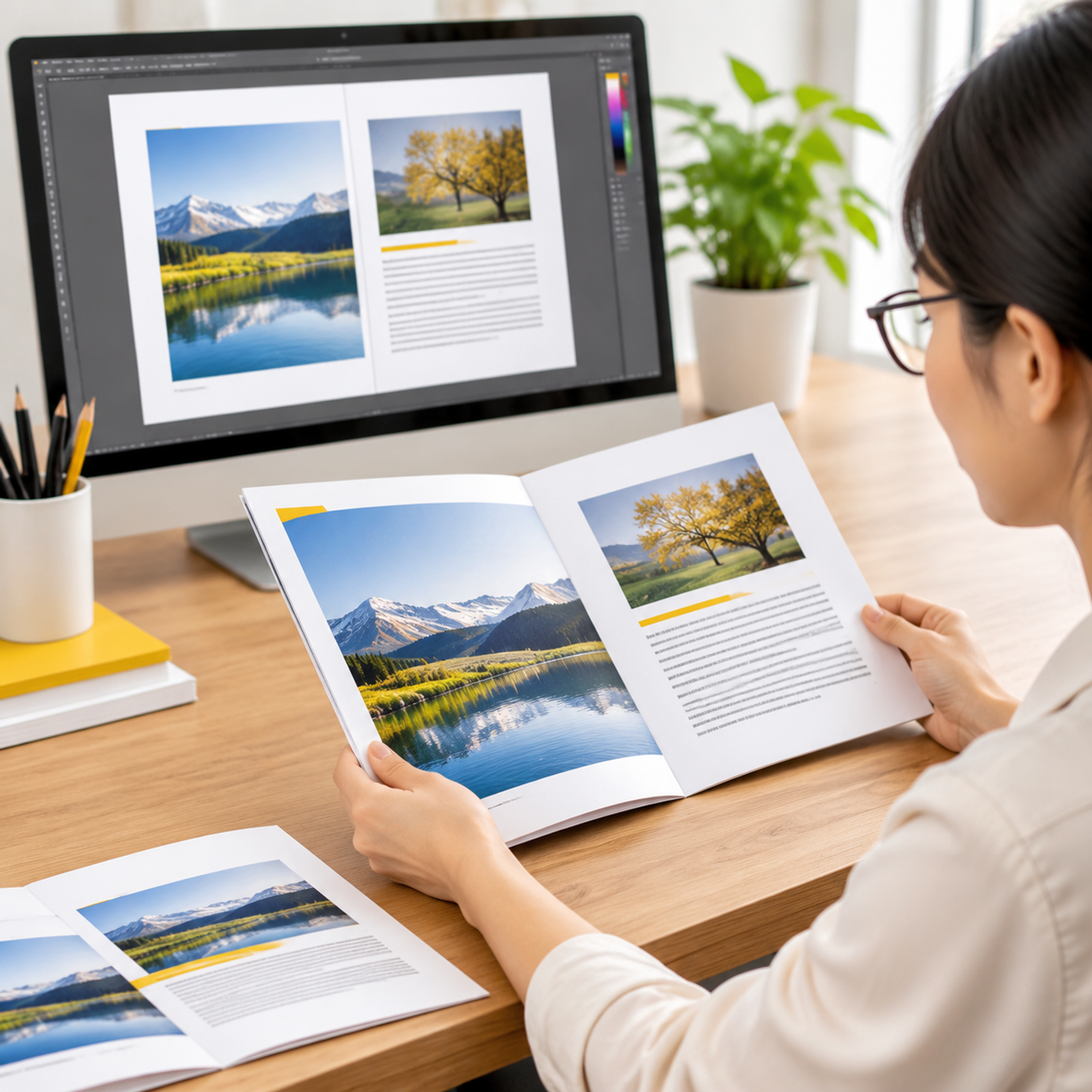
Step 1 — approve translations. The buyer’s editor or designated language reviewer owns wording, punctuation, regional usage, and final meaning. Ask that person to approve a copy deck before layout. The printer should not be expected to decide whether a translation is linguistically or culturally correct.
Step 2 — select the layout. Build a representative spread with the longest sentence, a short caption, a title or label, and the planned illustration. Compare stacked text, columns, or facing pages using approved copy. A layout that works for the shortest page can fail on the densest spread.
Steps 3-4: Pair each text passage and verify fonts and glyphs

Step 3 — pair passages. Give each scene or passage a shared ID, such as SP-03-EN and SP-03-ES. Use those IDs in the copy deck, layout file, proof notes, and page map. This makes a missing translation or mismatched caption easier to spot than a visual scan of a flattened PDF.
Step 4 — verify fonts and glyphs. For Spanish, check characters such as á, é, í, ó, ú, ü, ñ, ¿, and ¡. For other language pairs, list the characters that require special checking. Confirm the font contains them, embed the fonts in the final PDF, and inspect the exported file on a separate prepress system. Lemon Printing’s print-ready book interior file guide covers related PDF, bleed, image, and font checks.
Steps 5-6: Lock file versions and approve editorial and physical proofs

Step 5 — lock versions. Use a clear filename and release manifest, such as a project name, language pair, layout code, version number, and date placeholder. Record the approved translation file, page count, language order, and open corrections. Do not send an isolated corrected sentence after art approval without updating the controlled file.
Step 6 — approve two proofs. An editorial proof checks wording, punctuation, page order, and language pairing. A physical proof checks actual scale, contrast, trim, rounded corners, lamination, binding, and how the spread turns. Lemon Printing’s commercial printing process can be used as a reference for connecting prepress review, proofing, production, and inspection.
Check Accents, Line Breaks, Language Order, and Page Pairing
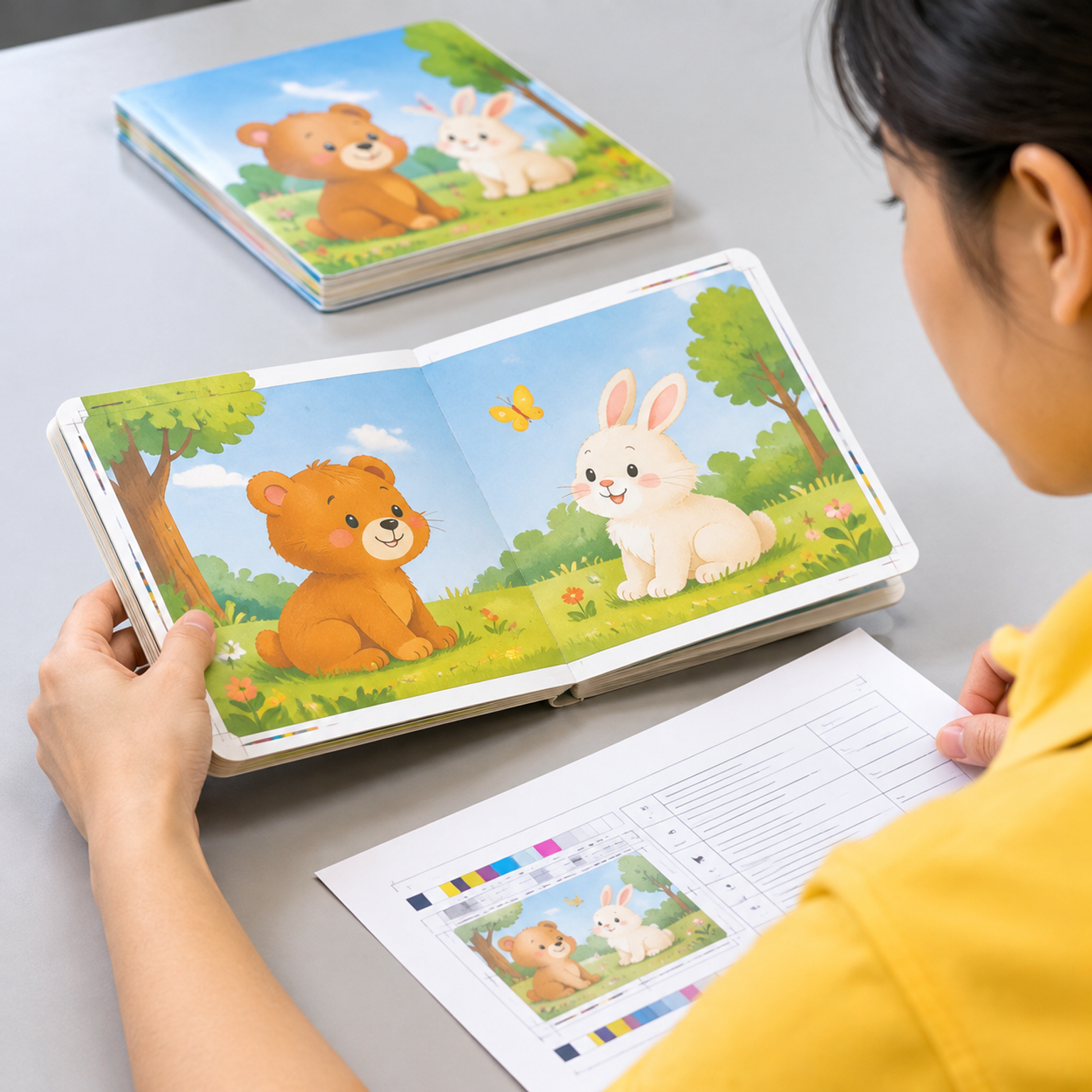
Inspect the proof in the same order a mistake could reach a child reader. Do not rely on a single person to catch every type of error.
- Accents and punctuation: Compare every passage with the buyer-approved copy. Check diacritics, inverted punctuation, apostrophes, quotation marks, and special glyphs.
- Line breaks: Confirm that words, names, punctuation, and short phrases break naturally. A technically correct translation can become awkward or misleading after automatic line wrapping.
- Language order and pairing: Check the cover, title page if used, every spread, and back cover. Confirm that each illustration matches the intended English and translated passage.
- Physical behavior: Inspect trim, rounded corners, contrast, lamination glare, binding, page turns, and text clearance from cut or glue areas.
The language reviewer signs the editorial result. The buyer or production lead signs the manufacturing result. That separation keeps translation decisions from being confused with print corrections.
Quote Checklist for Bilingual Board Book Production
A useful quote request describes the language structure and physical construction together. Sending only a finished artwork PDF leaves too many production decisions open.
- Edition: language pair, regional variant, language order, and whether the job is one bilingual edition or separate editions.
- Page map: finished size, orientation, page count or board-leaf construction, spread sequence, and layout choice.
- Artwork: approved copy status, color requirements, bleed, safe areas, font handling, and any die-cut or shaped pages.
- Construction: board specification, binding method, rounded corners, lamination, coating, and other finishing.
- Quantity: total copies and any different quantities by language or edition.
- Proofing: digital, pre-production, or physical proof requirements and named approvers.
- Logistics: packaging, delivery destination in the United States, target date, and any compliance-testing responsibility.
Final MOQ, production time, pricing, and shipping depend on product specifications, quantity, finishing, and destination. If the project needs broader children’s book guidance, Lemon Printing also provides children’s book printing options with durable construction and proofing considerations.
FAQ: Bilingual Board Book Layout and Printing
Assign these decisions before the artwork reaches final prepress. The FAQ below separates language ownership from manufacturing checks.
Request a Quote With Your Approved Bilingual Files
Send one controlled package rather than several untracked email attachments. Include the approved translation file, page map, language order, representative layout spread, final artwork or working proof, font information, construction requirements, quantity, and delivery details.
Lemon Printing operates a self-owned facility in the Guangzhou–Shenzhen manufacturing corridor, with prepress, printing, binding, finishing, quality inspection, packing, and export preparation handled in-house. That setup supports one workflow for file review, proof notes, production, and repeat-order specifications, but the buyer’s language reviewer still owns translation approval.
Give both languages room early, and the finished board book becomes a controlled manufacturing project instead of a translation rescue operation.
FAQ
How should two languages be arranged in a bilingual board book?
Use stacked text for short shared captions, parallel columns when direct comparison matters, and facing pages when each language needs more independent space. Select the arrangement with approved translations and the densest spread, then keep the language order consistent throughout the book.
How can text expansion affect board book page layout?
A longer translation can add lines, increase the height of a text block, reduce illustration clearance, or force an uncomfortable type reduction. Test the longest approved passage before the artwork is locked and preserve safe areas around trim, rounded corners, and cut features.
What font and character checks are needed before bilingual board book printing?
Confirm that the selected font contains every required glyph, including accents, diacritics, inverted punctuation, and language-specific characters. Check the exported PDF, use multilingual font embedding, verify that no substitution occurred, and retain an editable source file for controlled corrections.
Who should approve translations before production files are released?
The buyer’s editor or designated language reviewer should approve the translation, punctuation, regional usage, and final meaning. The printer reviews layout, file integrity, color, trim, binding, and other production matters; the printer should not be the final authority on language accuracy.
What should buyers inspect in a physical bilingual board book proof?
Check language order, page pairing, line breaks, accents, contrast, image clearance, trim, rounded corners, lamination, binding, and page-turn behavior. Record editorial corrections separately from manufacturing corrections, then issue one controlled approval before the bulk run.
Get a Clear Quote for Your Printing Project
Send Lemon Printing your product type, quantity, finished size, materials, binding or finishing requirements, approved language pair, page map, delivery destination, and target date. Our team will review the specifications and normally respond within one business day with practical production options, pricing, and a project timeline. Final MOQ, production time, pricing, and shipping depend on product specifications, quantity, finishing, and destination.