Table of Contents
- Key Takeaways: Plan the Adaptation Before Preparing Print Files
- Picture Book to Board Book: What Changes in Production?
- Define Pages, Leaves, and Spreads with the Printer
- Connect Story Length, Thick-Page Construction, and Finished Thickness
- Comparison Table: Retain the Story, Condense It, or Split It
- Convert the Picture Book in Six Steps
- Steps 1–2: Confirm Rights and Identify Essential Story Beats
- Steps 3–4: Rebuild Spreads and Make a Reading Dummy
- Steps 5–6: Prepare Production Files and Approve a Prototype
- Check Story Flow, Artwork Placement, and Handling in the Prototype
- Quote Checklist for the Adapted Board Book
- FAQ: Picture Book to Board Book Conversion
- Request a Quote for Your Adapted Board Book
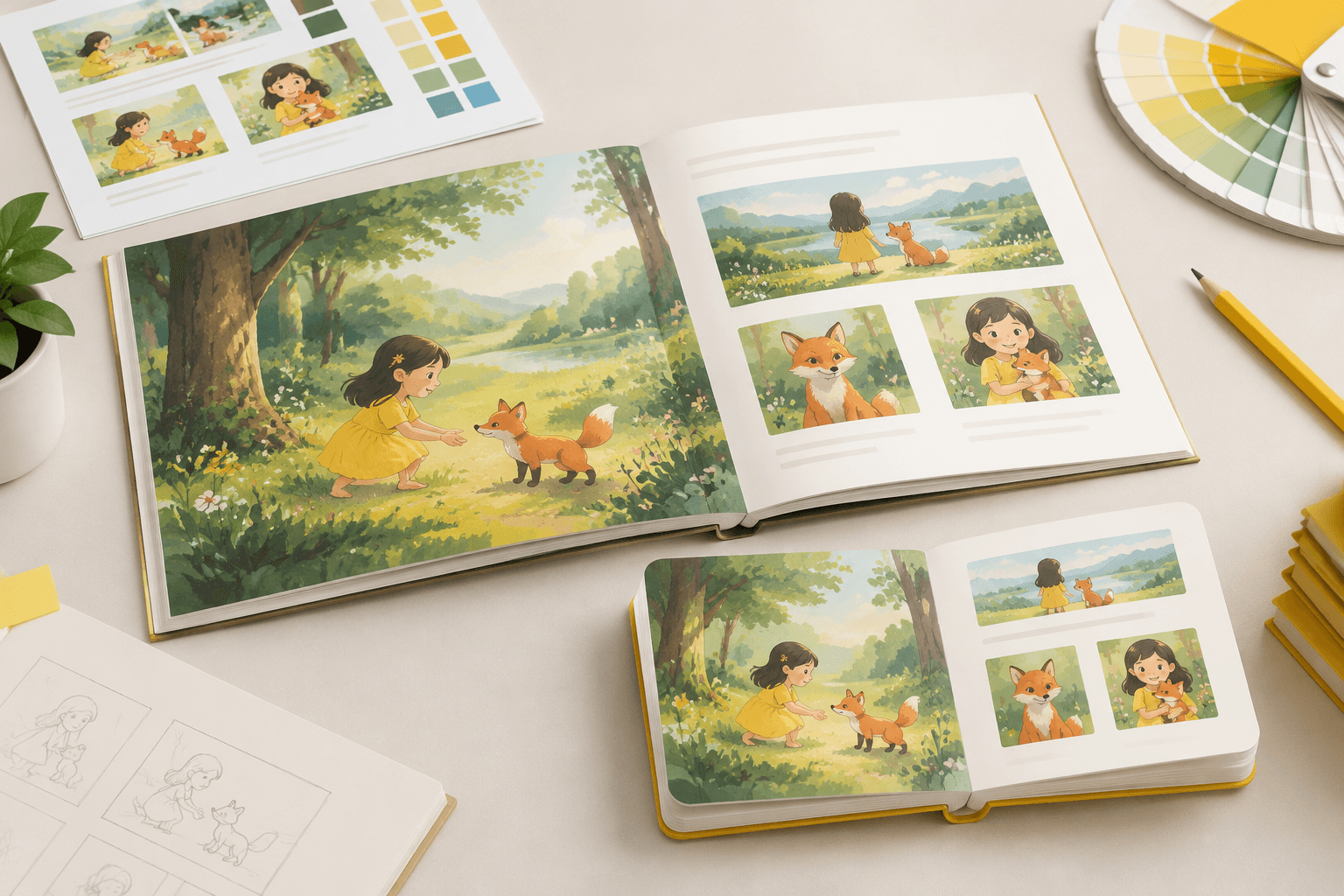
A picture book can be adapted into a board book, but the job is usually editorial as well as technical. A smaller format and thick pages change how the story moves, where artwork sits, and how many spreads the finished book can support. Map the new reading sequence first; prepare print files only after the text and page plan are approved.
Key Takeaways: Plan the Adaptation Before Preparing Print Files
Yes, an existing picture book can become a board book edition. Treat it as a separate adaptation and production approval—not as a cover-size change.
- Map the story first. Decide what must remain, what can be shortened, and whether the content belongs in one edition or more than one.
- Agree on the page map. The board-book page count affects the physical construction and should be confirmed with the printer before artwork is rebuilt.
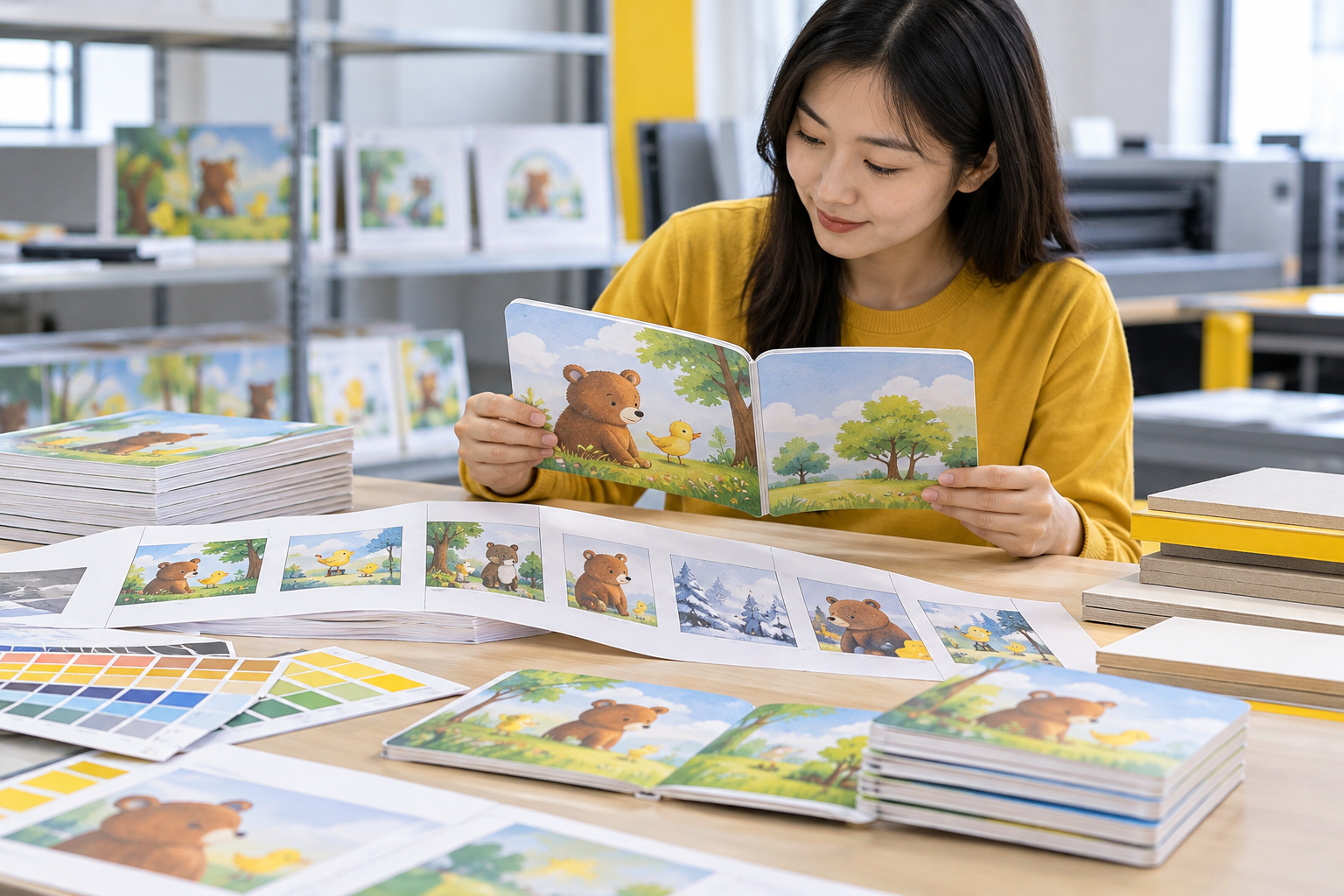
- Use a dummy. A simple printed-and-folded reading model catches pacing and page-turn problems before production files are made.
- Approve the manufactured format. Review artwork position, color, construction, handling, and the production specification before a bulk run.
One practical trap: a story that reads smoothly as a paper-page sequence may feel crowded once each image is assigned to a thick board spread.
Picture Book to Board Book: What Changes in Production?
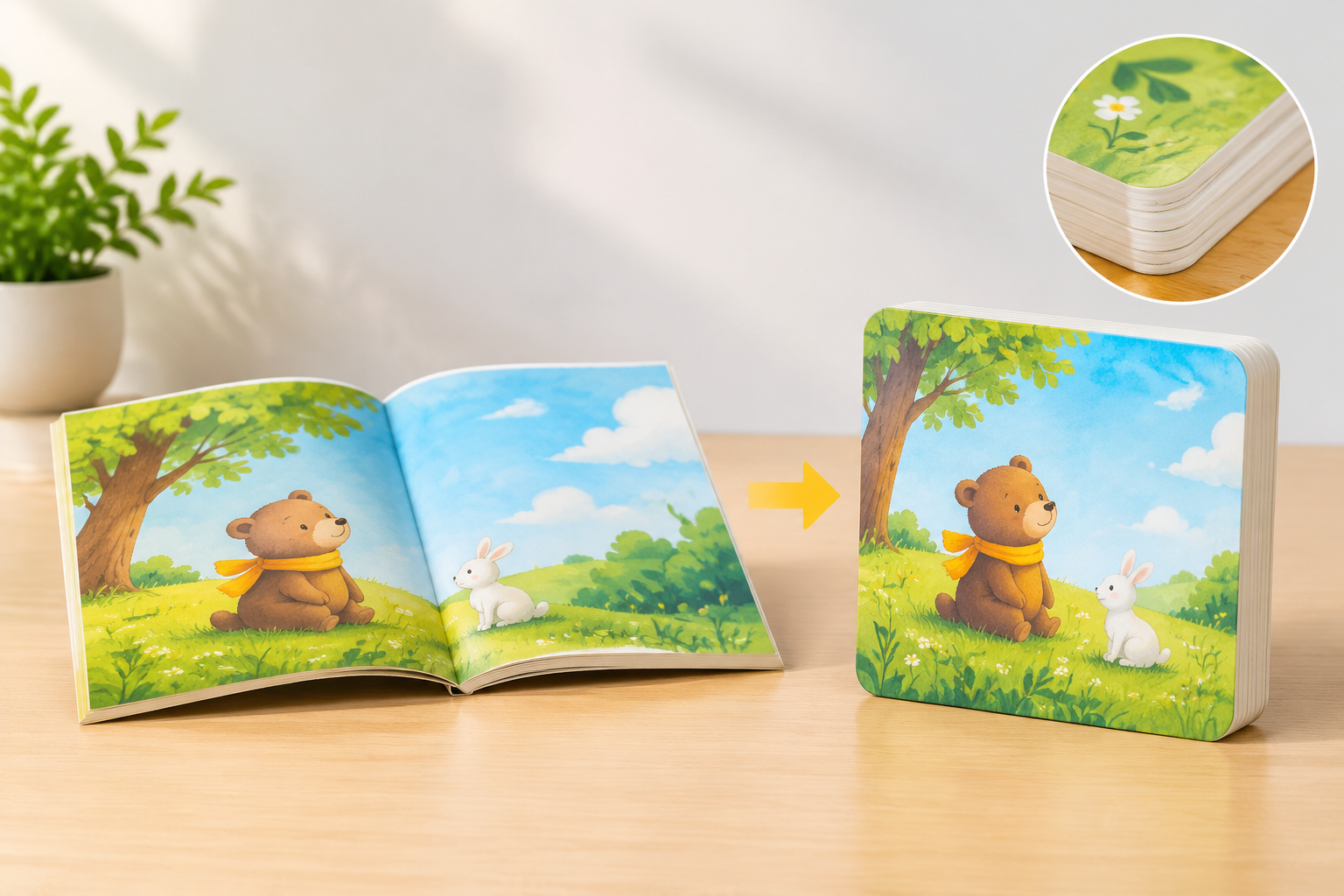
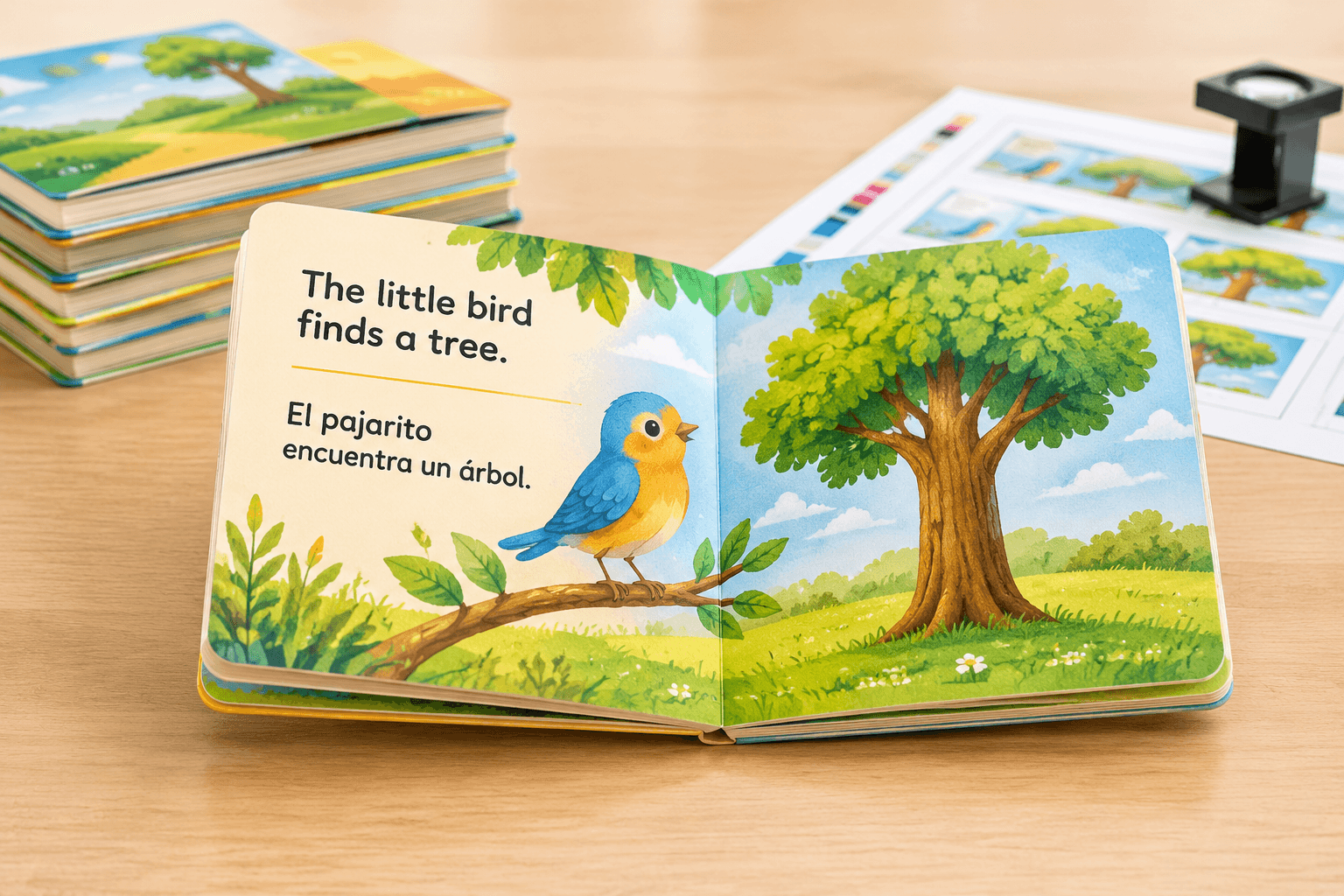
Converting a picture book for board book printing changes the page structure, artwork setup, and physical feel of the finished book. The existing story and illustrations may provide the source material, but the new edition needs its own approved layout and production specification.
Board books use thick, rigid pages rather than separate thin paper leaves. That construction can make a familiar book feel heavier and more compact, and the binding area affects how a spread opens. A scene that relies on detail at the center fold, tiny type, or a wide panorama may need a revised composition. This is not a reason to discard the art; it is a reason to check each image at the intended finished size.
Lemon Printing handles prepress, printing, binding, finishing, and inspection in-house. When the adaptation is editorially settled, its custom board book printing service is the relevant next step for reviewing the manufacturing specification and proofing options.
Define Pages, Leaves, and Spreads with the Printer
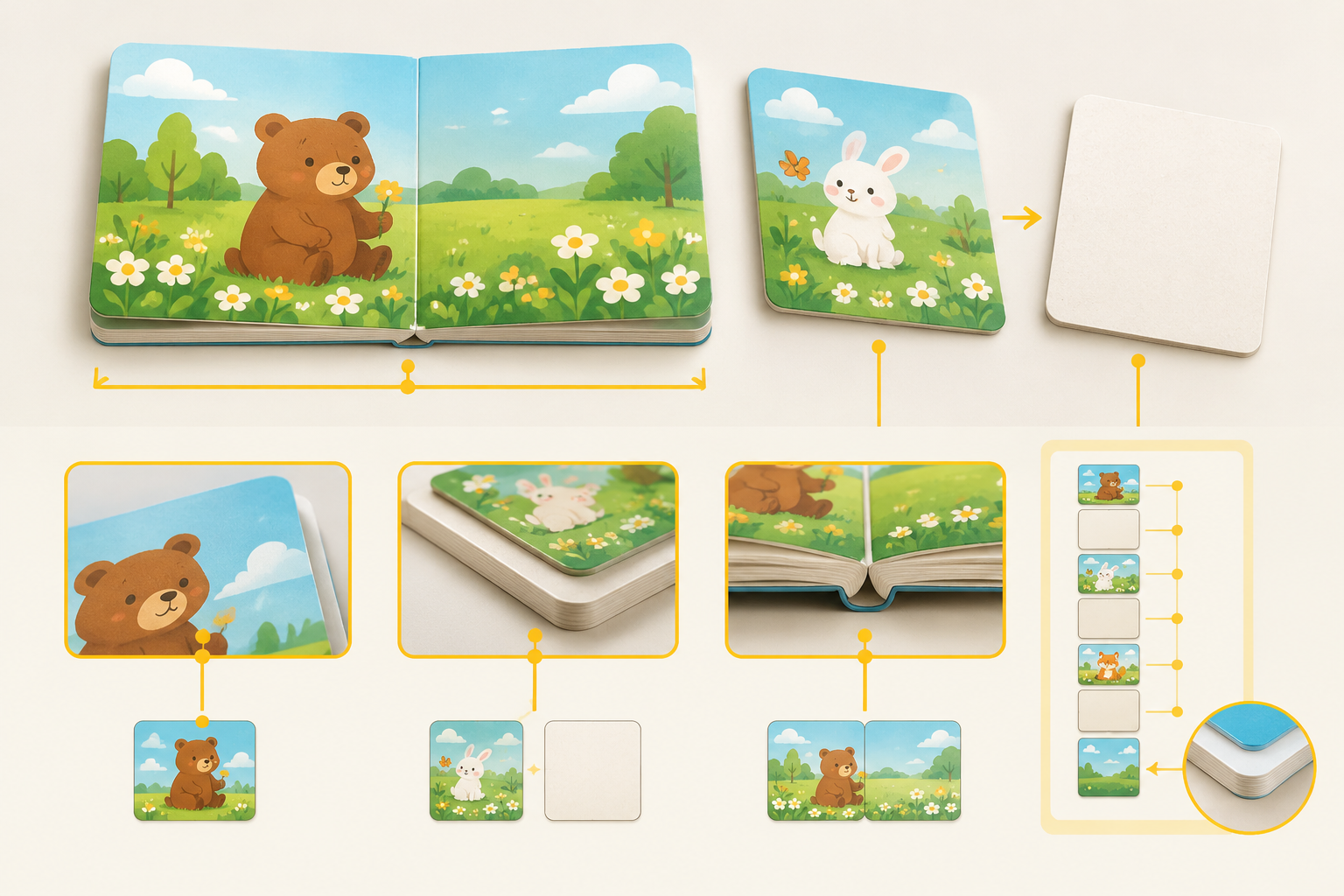
In a board book, a page is one printed side, a leaf is one physical page unit, and a spread is two facing pages viewed together. A leaf commonly has a printed face on each side, but production specifications should make clear how the cover and any unprinted sides are counted.
That vocabulary matters because publishers, designers, and printers sometimes use “page count” differently. One person may mean every numbered side; another may mean the number of physical board leaves. Put the approved sequence in a page map and ask the printer to confirm the count, including cover construction and any blank or introductory sides. This prevents a late mismatch between the editorial plan and the manufacturing plan.
For a deeper production-focused explanation, compare your page map with the guide to board book page count, construction, and packing.
Connect Story Length, Thick-Page Construction, and Finished Thickness
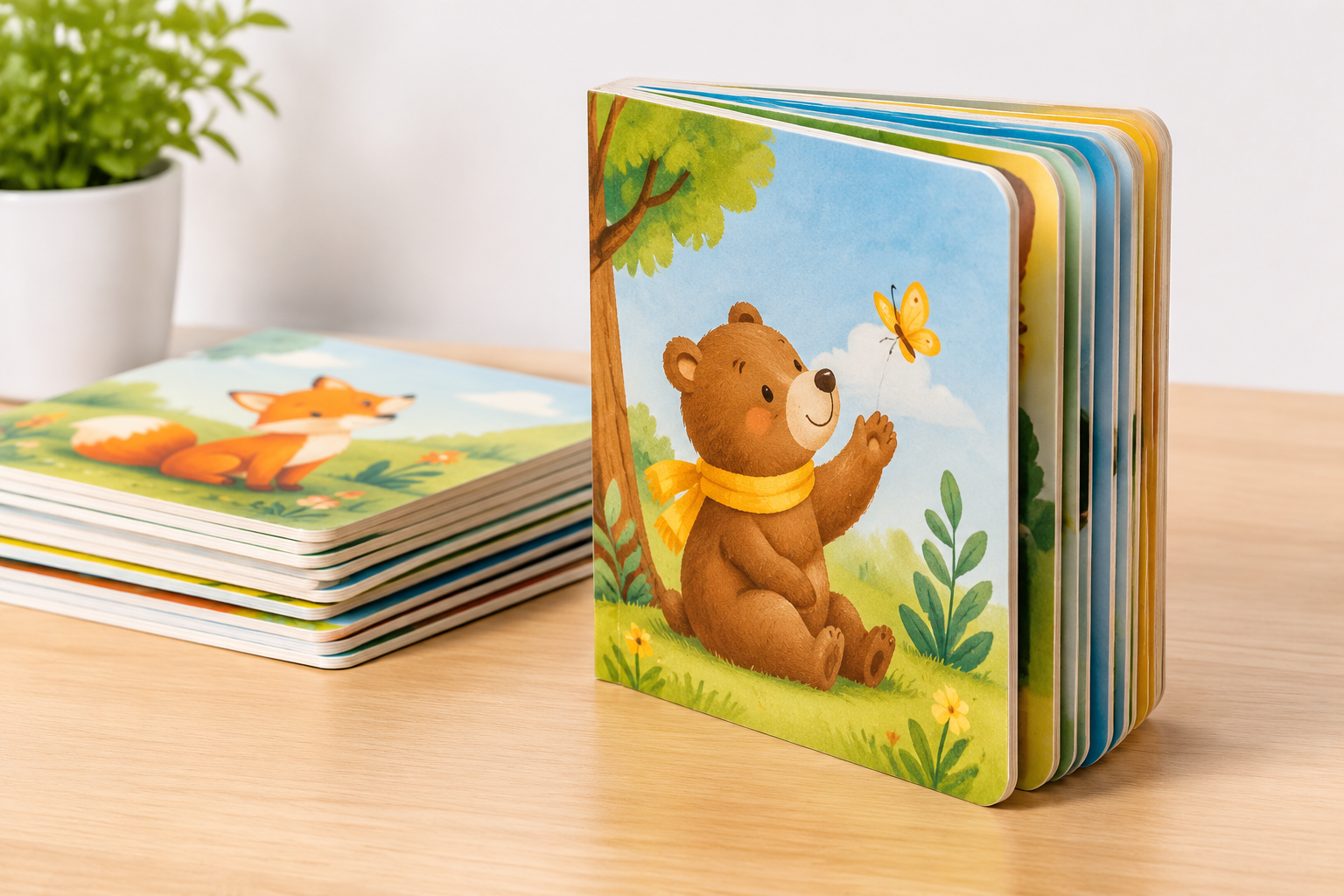
A board book adaptation does not automatically need fewer pages than the original. The practical limit is the combination of story length, page architecture, chosen construction, and the finished thickness that the printer confirms for the project.
Use a hypothetical example: an existing picture book has a long sequence of small scenes and descriptive text. The editor might combine adjacent moments into stronger visual spreads, remove repeated explanation, or preserve a quiet pause that matters to the story. Each choice changes how much content sits on each board leaf and how the book feels in a child’s hands. The right decision is editorial—not a universal page-count formula.
Also confirm how the proposed construction affects the cover, hinge, and total thickness. Don’t finalize a page map around an assumed maximum. Send the printer the desired finished size, story sequence, and handling goals, then ask which board-book construction can support that plan. Final MOQ, production time, pricing, and shipping depend on the product specifications, quantity, finishing, and destination.
Comparison Table: Retain the Story, Condense It, or Split It
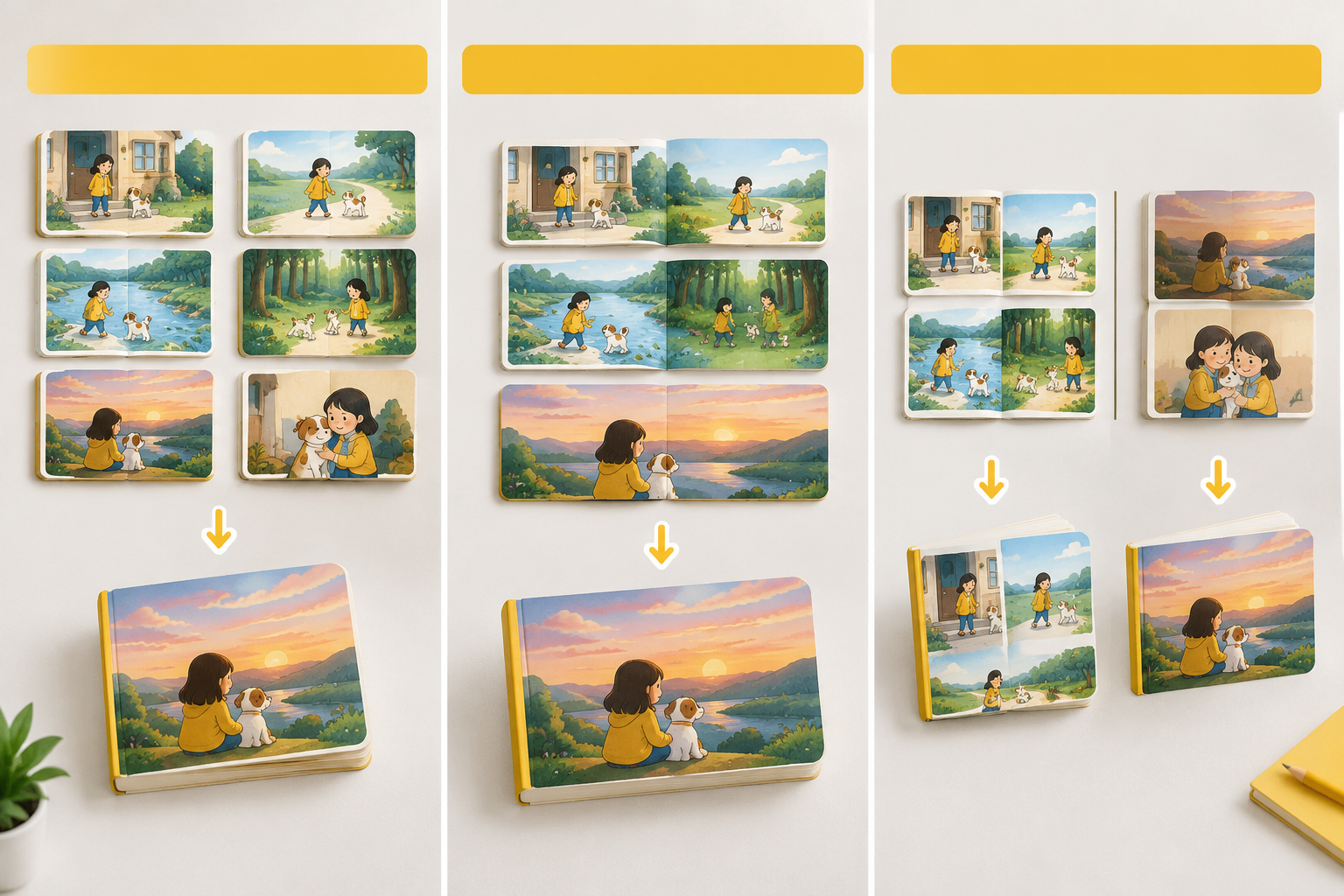
Choose an adaptation approach by asking what the board-book edition must accomplish. Keeping every scene preserves the original structure, but may not suit the new format; condensing improves pace but requires editorial cuts; splitting protects detail at the cost of creating multiple editions.
| Approach | Best fit | Editorial and artwork impact | Watch for |
|---|---|---|---|
| Retain the story | The original already has a clear, concise sequence that fits the proposed board-book page map. | Keep most text and scenes; adapt placement and scale for the new trim and binding area. | Do not assume existing spreads will reproduce unchanged. Check small details, type size, and the center fold. |
| Condense the story | The narrative has repeated explanations, secondary scenes, or text that can be carried by the pictures. | Combine moments, tighten wording, and recompose art where a new spread needs a clearer focal point. | Editorial approval is essential. A cleaner layout can still weaken a character’s motivation or emotional turn. |
| Split into editions | The source material contains distinct story arcs or too much content for one compact edition. | Keep more detail across separate books and give each volume a defined beginning and ending. | Check that each book works independently and that the added production and inventory plan makes sense. |
There is no automatic winner. Mock up the approaches as page sequences and read them aloud before committing to rewritten text or revised illustration work.
Convert the Picture Book in Six Steps
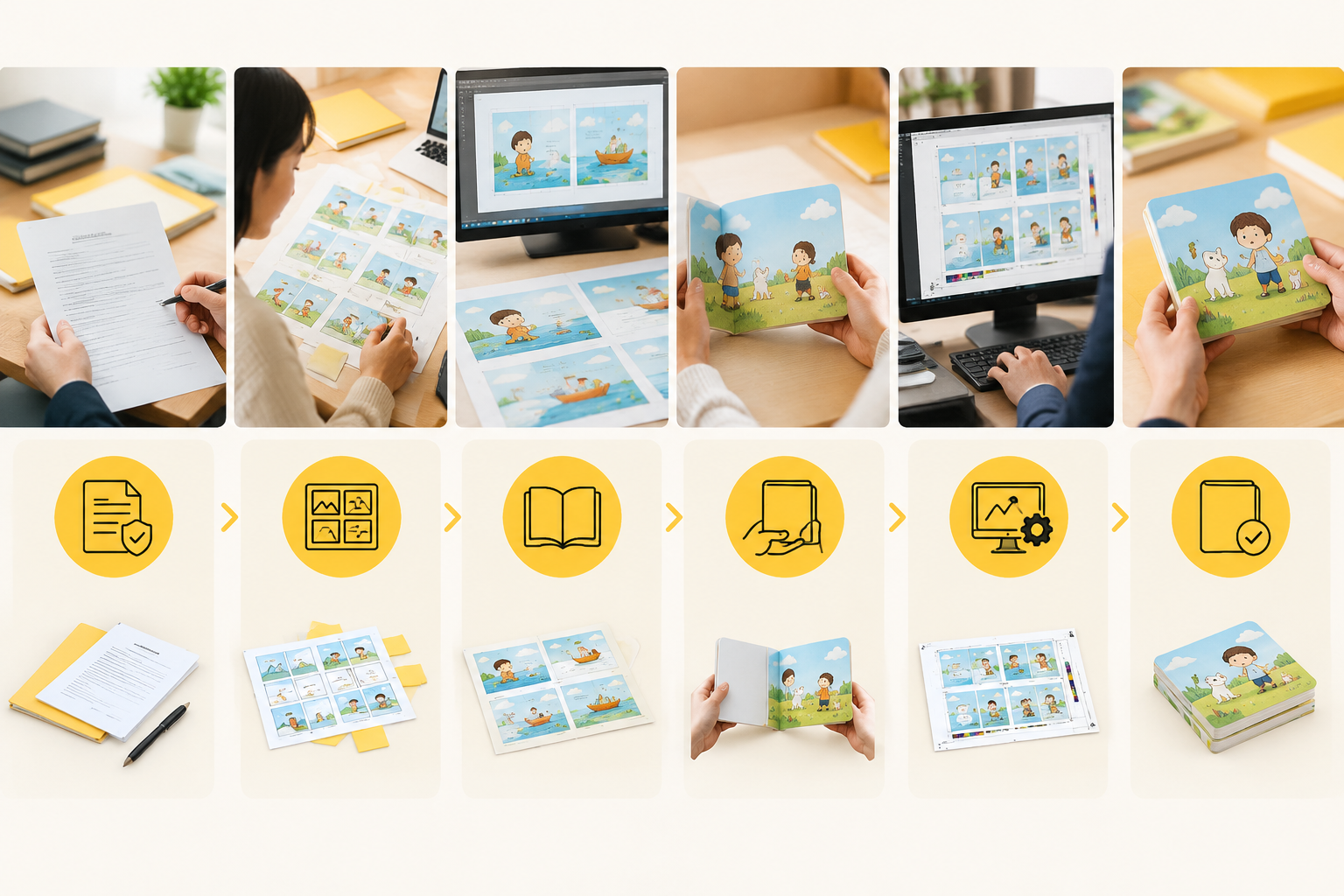
Work from editorial decisions toward manufacturing approval. The sequence below keeps rights, story structure, design, and production files from being mixed together too early.
- Confirm adaptation and reproduction rights.
- Identify essential story beats and what can change.
- Rebuild the narrative as board-book spreads.
- Make and read a physical book dummy.
- Prepare production files to the agreed specification.
- Review and approve the prototype or proof before production.
Each step should leave a record: rights confirmation, approved text, page map, dummy notes, file specification, and signed-off proof. That paper trail is useful when the author, illustrator, publisher, and printer are not working from the same office.
Steps 1–2: Confirm Rights and Identify Essential Story Beats
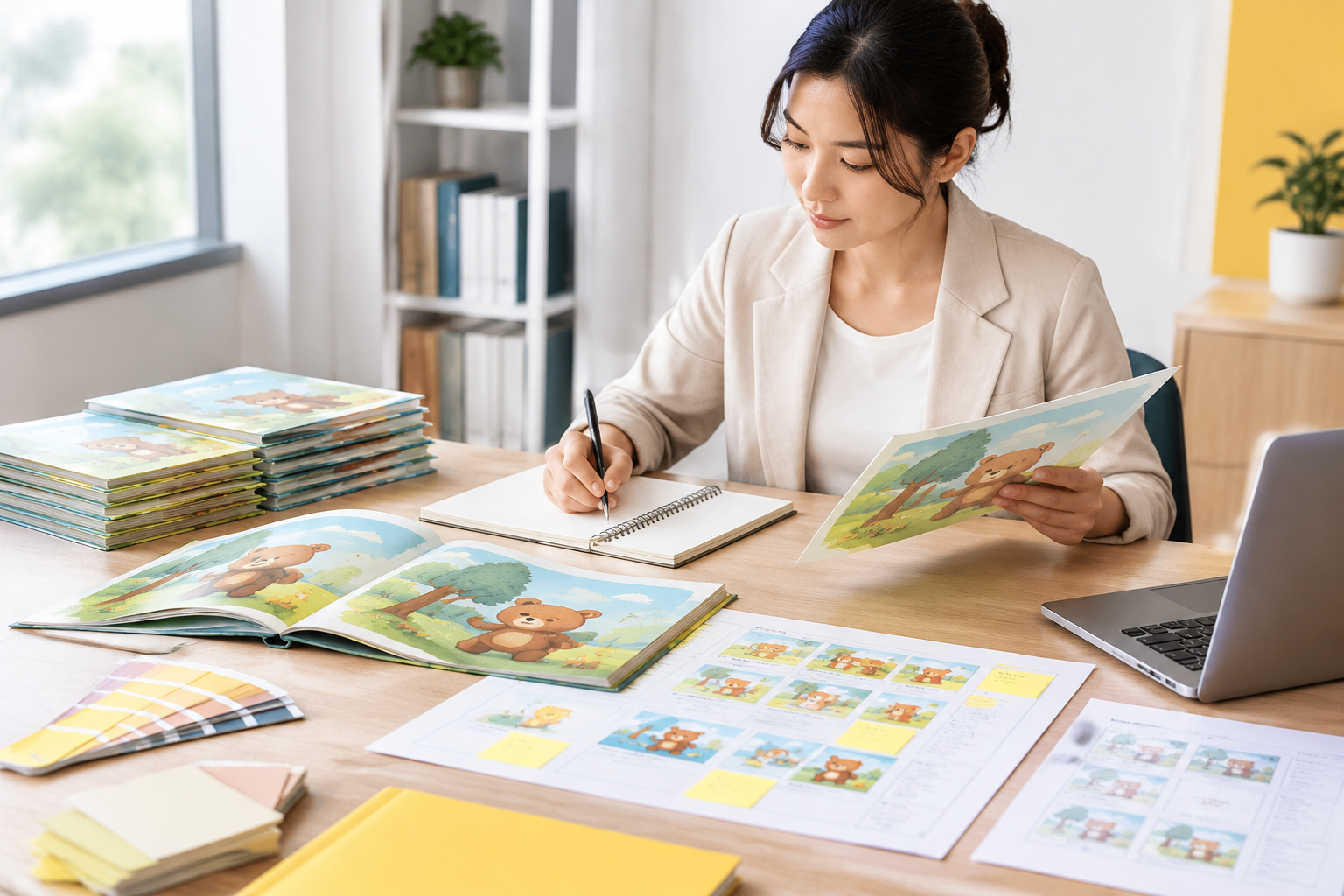
Step 1: Confirm rights before adapting. Check that the publisher or author has permission to create a new board-book edition, revise text, crop or recompose illustrations, and reproduce the work in the intended territories and formats. Illustration contracts can treat adaptation rights differently from ordinary reprinting. Resolve that now—not after the designer has rebuilt every spread.
Step 2: Mark the story’s non-negotiables. Read the book aloud and note the opening, key action, emotional turn, repeated language, and ending. Then mark scenes that can be combined or removed. Ask what a young reader needs to understand from the words and what the picture can carry without explanation.
A useful working document is a scene map with four columns: current page or spread, story purpose, proposed action, and rights or artwork note. It helps the editor make cuts deliberately instead of trimming sentences until the book happens to fit.
Steps 3–4: Rebuild Spreads and Make a Reading Dummy
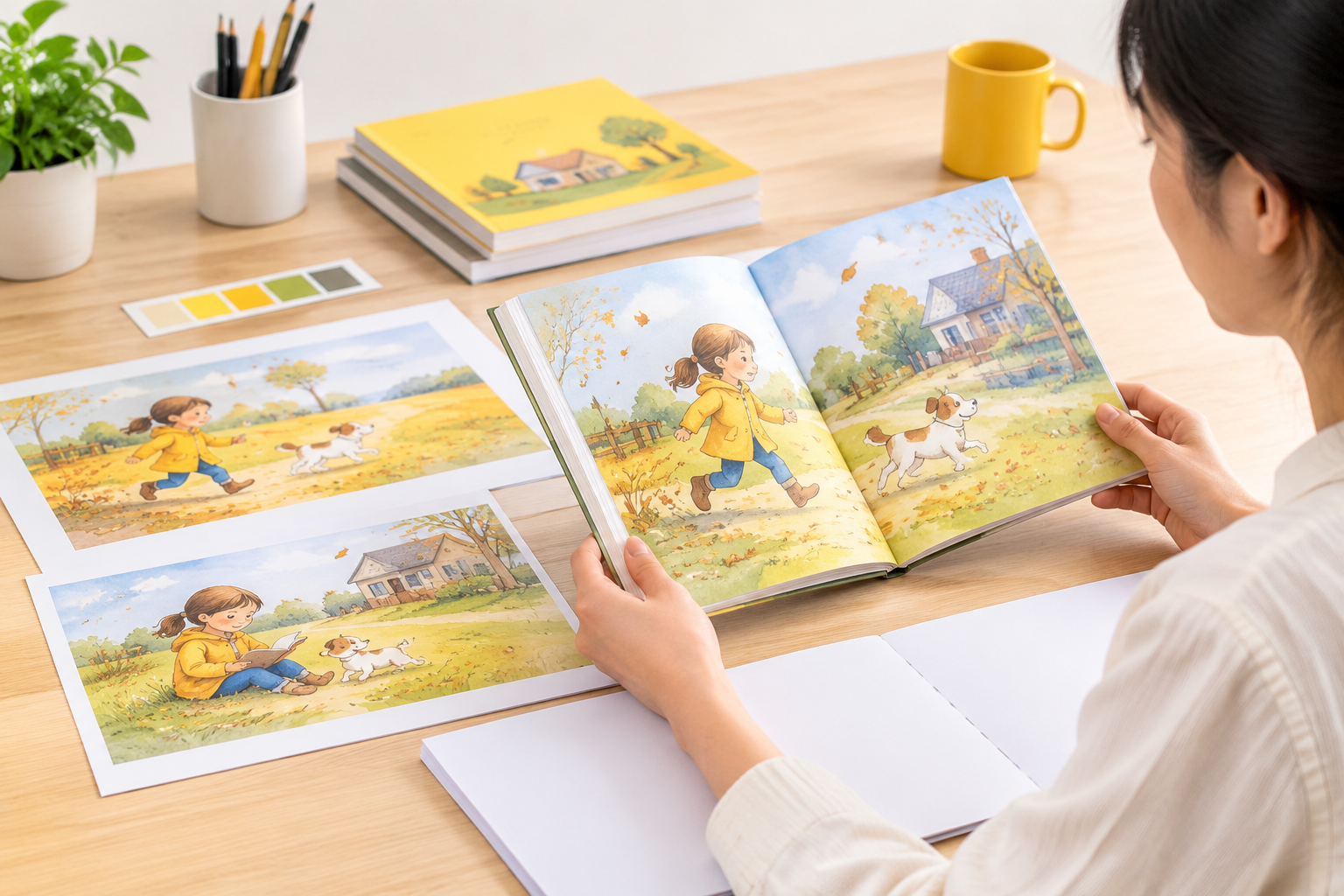
Step 3: Rebuild the spread sequence. A spread is a reading unit, not just two adjacent pages. Give each one a job: introduce a place, show an action, create a pause, or turn the story in a new direction. Rework text and illustration placement together. A paragraph that fitted beside a large original image may become awkward when the board-book trim is smaller.
Check artwork at the proposed finished size. Keep faces, essential objects, and small details away from the binding area and trim. If the original image crosses a spread, test how the center fold or hinge may affect the focal point. Recomposition or a crop may preserve the intent better than scaling the entire image down.
Step 4: Make a physical book dummy. A dummy is a rough, correctly sequenced model of the book used to test reading order, pacing, and page turns. Print the proposed pages, fold or assemble them in sequence, and handle the model at roughly the planned size. It is not a manufacturing sample; its job is to expose editorial problems cheaply.
Read it aloud, then ask someone unfamiliar with the original to follow the story. Mark crowded spreads, abrupt transitions, pages that invite a turn too soon, and moments where the illustration does not support the text. Update the map before final art preparation.
Steps 5–6: Prepare Production Files and Approve a Prototype
Step 5: Prepare production files to the printer’s specification. Confirm the finished dimensions in inches and millimeters, the page sequence, bleed, safe areas, color setup, image requirements, and whether files should be supplied as single pages or spreads. Do not impose the pages yourself unless the printer specifically requests it. The printer’s template—not a guessed template—should govern the final artwork.
Use a clean, final file set with fonts handled as instructed and all linked images checked. Keep a separate approved page map so the printer can compare the PDF against the intended reading order. Lemon Printing offers prepress file checks; the guide to preparing a print-ready book interior also covers common PDF checks such as trim, bleed, color, and image placement.
Step 6: Approve a production proof or prototype. Ask the supplier which proof type is available and what it represents. A digital proof is useful for checking sequence and layout; it cannot show the real feel of the assembled board construction. Where a physical pre-production sample is available, review it against the approved page map and specification before authorizing the run.
Approval should be explicit: record corrections, confirm who signed off, and replace superseded PDFs. Lemon Printing’s commercial printing process includes prepress, production, finishing, and inspection checkpoints; discuss the proof stage and sample scope when you request a quote.
Check Story Flow, Artwork Placement, and Handling in the Prototype
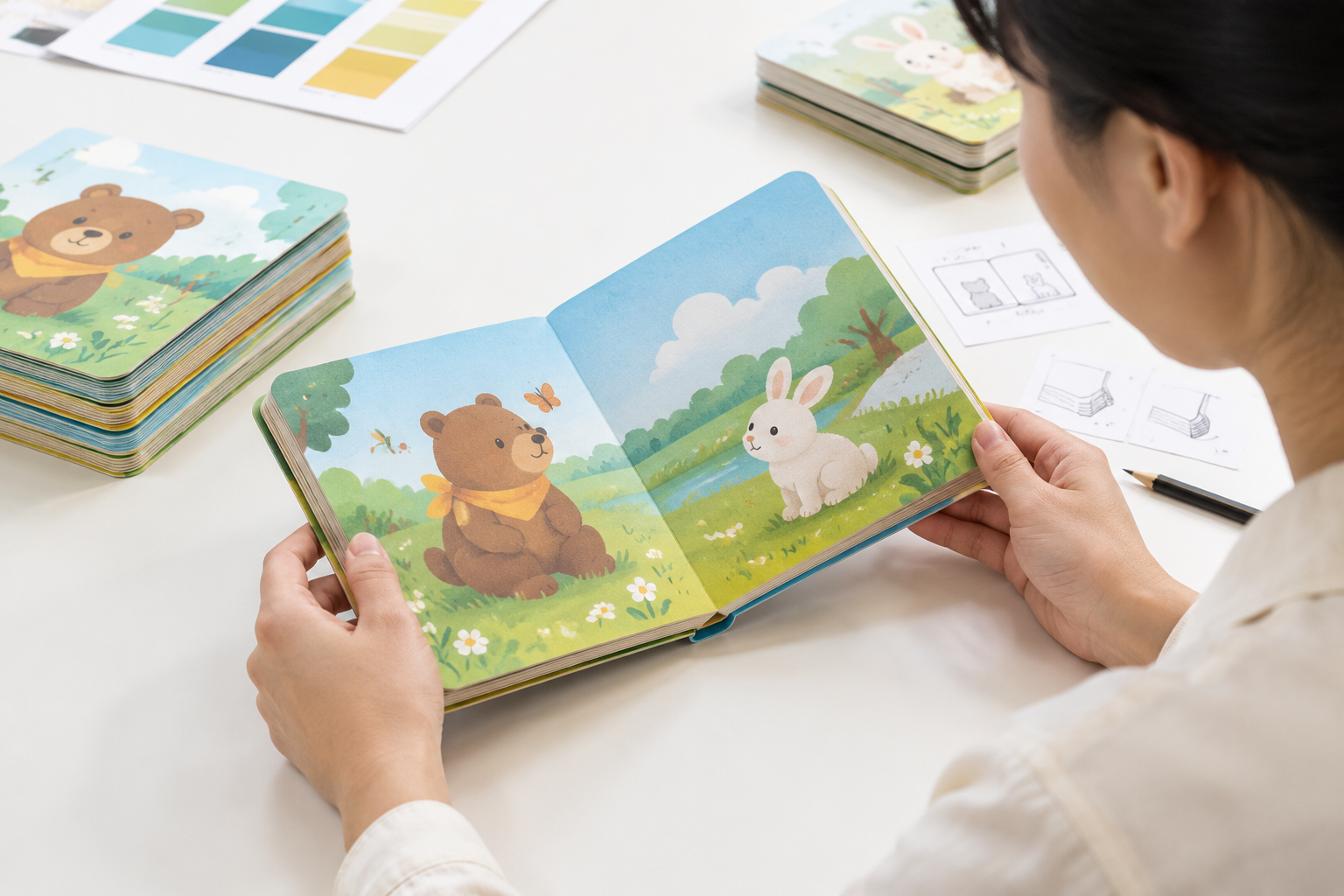
Approve the prototype against both the editorial plan and the manufacturing specification. A book can look correct on screen and still have a weak page turn, a crowded fold, or artwork that loses an important detail at finished size.
- Sequence: Confirm every page is in the approved order, including covers and any blank sides.
- Story flow: Read the book aloud. Check that each turn reveals the intended action or pause and that removed text has not created a logic gap.
- Artwork: Inspect faces, lettering, small objects, color, trim, bleed, and the center binding area at actual size.
- Construction: Review the assembled form, page movement, cover attachment, edge finishing, and any rounded-corner or custom-shape details in the approved specification.
- Handling and intended use: Consider the target age and market. Confirm with the supplier what safety or compliance testing is required for the product and destination; do not assume that a proof alone establishes compliance.
Record issues by page or spread, describe the correction, and request a revised proof when a change could affect layout or construction. Avoid approving from a low-resolution screenshot if the point under review is fine detail, color, or physical assembly.
Quote Checklist for the Adapted Board Book
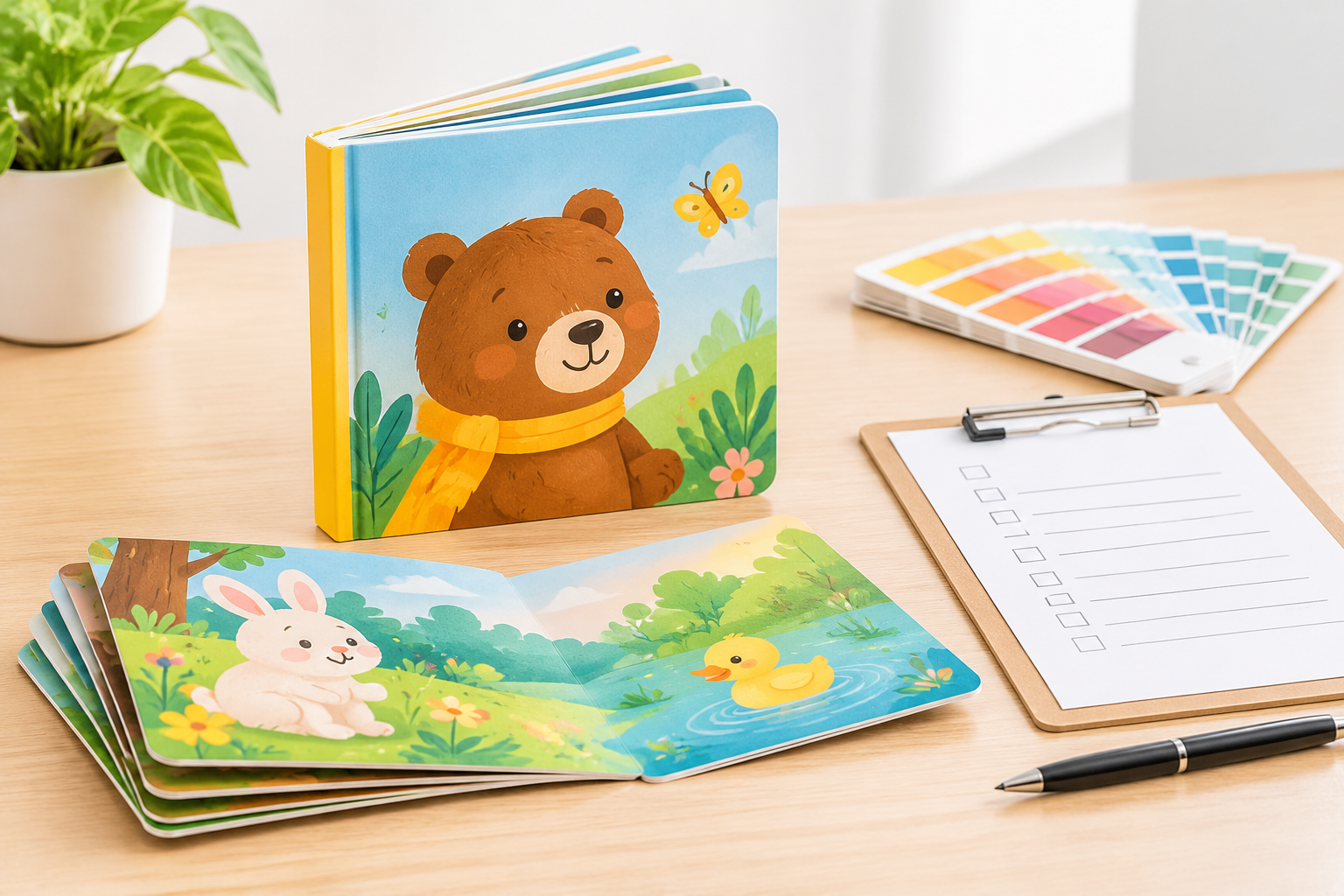
A useful quote starts with an approved adaptation and enough detail for the printer to identify the physical product. Send a specification, not just a reference cover image.
- Product type and intended audience or use.
- Quantity and required delivery destination, including the US ZIP code.
- Finished size in inches and millimeters.
- Final page map, confirming pages, leaves, spreads, and cover treatment.
- Board construction or material requirements, if already specified; otherwise ask the printer to review options.
- Artwork and finishing details, such as lamination, rounded corners, or a custom shape.
- Proofing request: digital proof, physical sample, or other supplier-confirmed option.
- Packing requirements, target date, and any destination-specific testing or compliance needs.
Attach the approved reading sequence and a representative sample of the original artwork. Lemon Printing can review the files and production details; final MOQ, production time, pricing, and shipping depend on specifications, quantity, finishing, and destination.
FAQ: Picture Book to Board Book Conversion
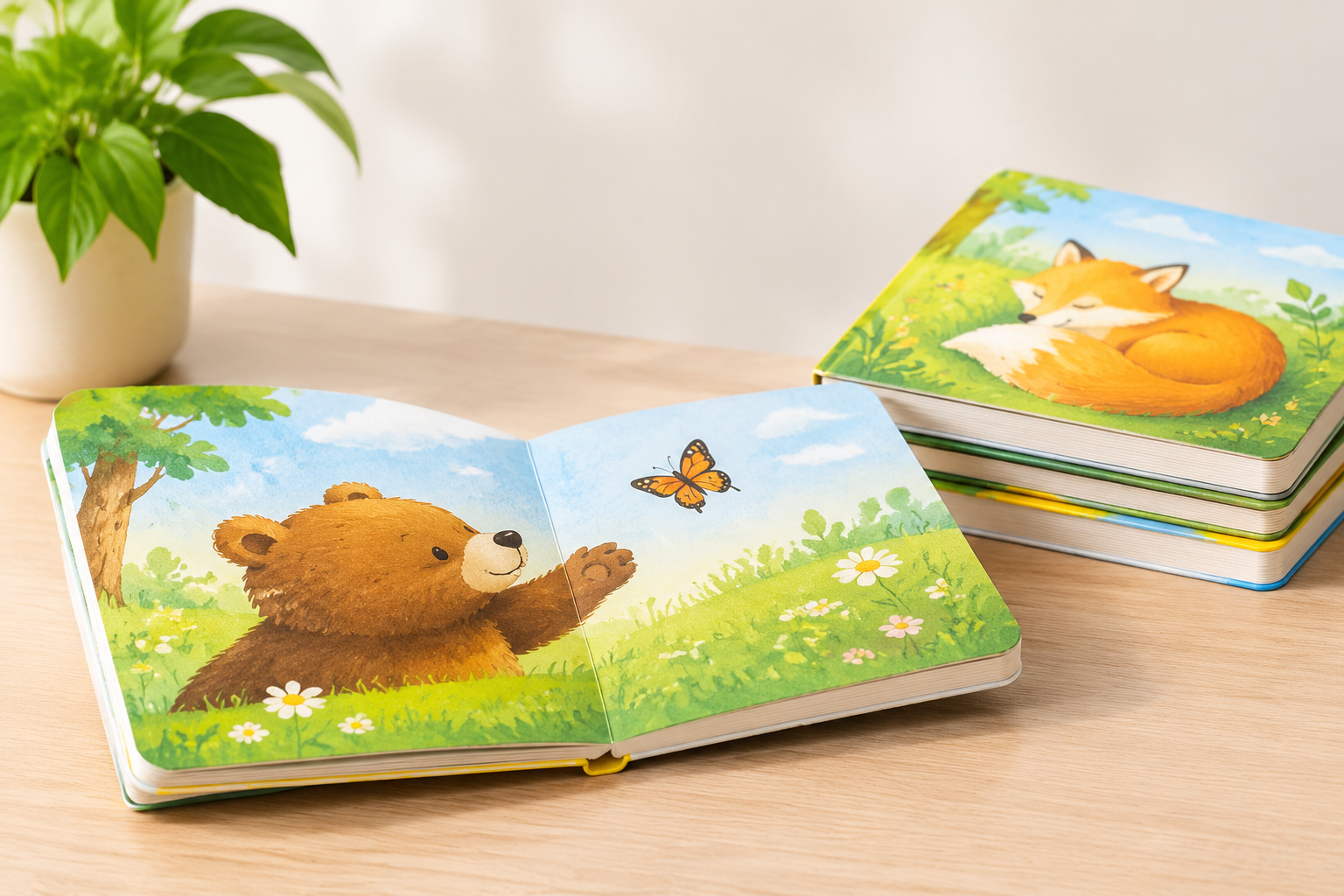
These questions cover the decisions publishers should settle before sending adapted artwork for board book production.
Request a Quote for Your Adapted Board Book
Once the rights, story map, page sequence, and artwork direction are approved, ask the printer to review the production specification and available proofing options. A short, complete brief is more useful than a file transfer with unresolved editorial choices.
Send the quantity, finished size, confirmed page count, construction or material requirements, finishing, proof needs, US delivery ZIP code, and target date. Include the approved page map and note any questions about the proposed build. Lemon Printing can review the files and discuss practical production options; the final quotation depends on the confirmed specification and destination.
FAQ
Can an existing picture book be converted into a board book?
Yes. Confirm the rights to adapt the text and illustrations, then rebuild the story for the new page sequence and physical construction. Existing artwork may need cropping, recomposition, or revised placement.
Does a board book adaptation need fewer pages than the original picture book?
Not necessarily. The right page count depends on the story, proposed spread sequence, and construction confirmed with the printer. Condense only when it improves the reading experience or fits a considered production plan—not to meet an assumed universal limit.
How are pages, leaves, and spreads counted in a board book?
A page is one printed side, a leaf is one physical board-page unit, and a spread is two facing pages. Ask the printer to confirm how the page count includes covers, blank sides, and any special construction.
Can the original illustrations be reused without changing their layout?
Sometimes, but do not assume they will fit unchanged. Check every image at the new finished size, especially details near trim and the center binding area. Cropping, scaling, or recomposition may be needed.
What should a publisher approve before printing the adapted edition?
Approve the rights, final text, page map, artwork placement, production files, construction specification, and proof or prototype. Confirm the required safety or compliance testing for the intended market separately with the supplier.
Get a Clear Quote for Your Printing Project
Send Lemon Printing your quantity, finished size, approved page count and map, materials or construction, finishing, proofing requirements, US delivery ZIP code, and target date. The team can review the files and normally responds to complete quote requests within one business day with practical production options, pricing, and a project timeline. Final MOQ, production time, pricing, and shipping depend on the specifications, quantity, finishing, and destination.