Table of Contents
- Why Board Book Quotes Vary
- The Board Book Specifications to Send a Printer
- Quantity, Proofing, Packaging, and Shipping Details
- Board Book Quote Comparison Table
- Questions to Ask Before Approving a Supplier
- What a Factory Should Confirm Before Production
- MOQ, Production Time, Pricing, and Shipping Caveats
- Frequently Asked Questions
- Request a Custom Board Book Quote
- Use This Board Book Quote Checklist
A useful board book quote depends on more than page count and quantity. This checklist explains the construction, artwork, finishing, proofing, packing, and shipping details publishers and self-publishers should give a printer.
Why Board Book Quotes Vary
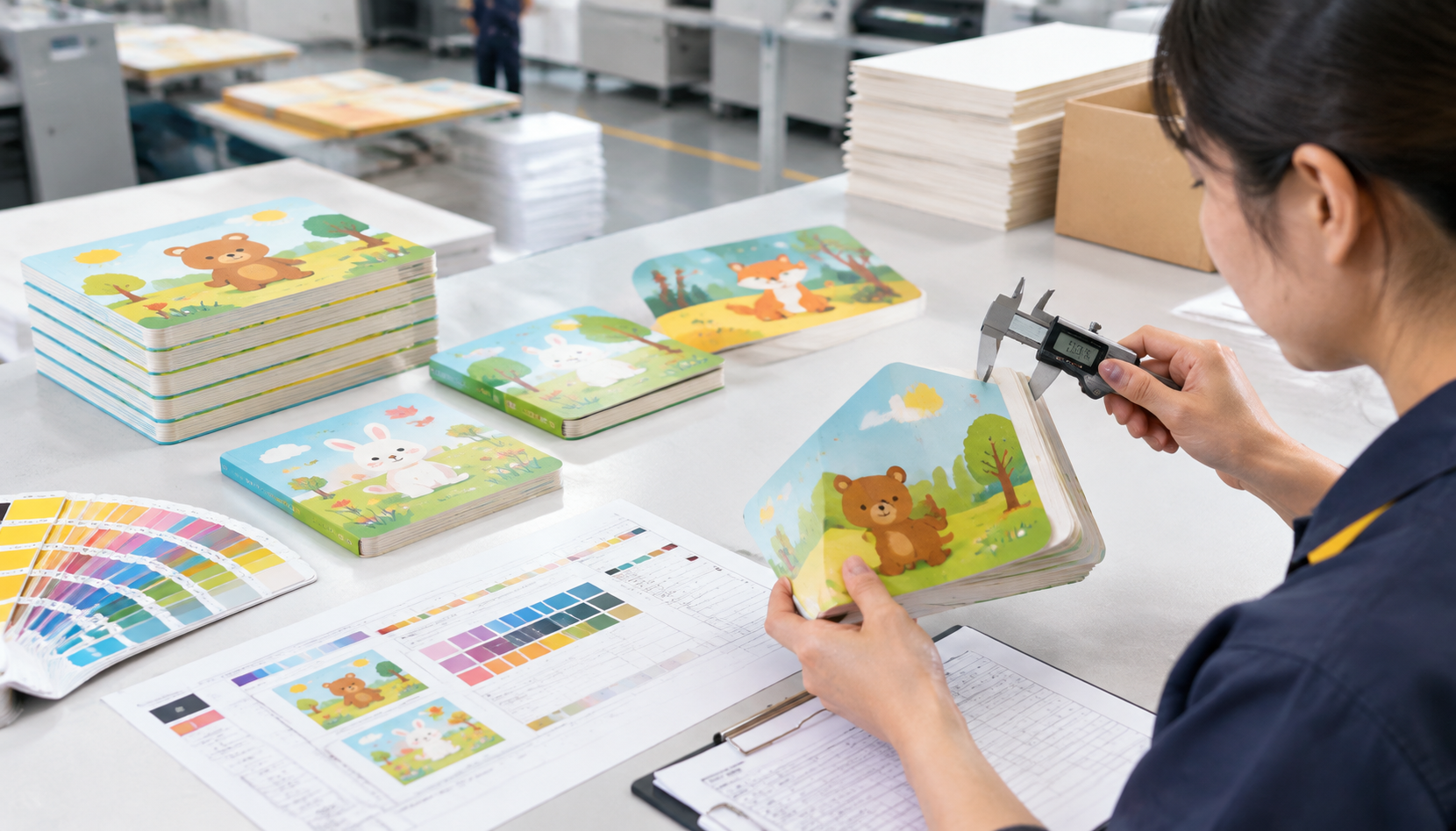
A board book printing quote varies because the printer is pricing a complete construction, not only ink on paper. Finished size, page count, board thickness, binding, surface protection, corner shape, proofing, packing, and freight can all change material use and production steps.
Board books are commonly made by printing sheets, applying a protective surface treatment, mounting or folding the printed material into thick leaves, and binding the leaves into a durable book block. Small changes can affect sheet layout, waste, tooling, handwork, carton weight, or shipping volume. For example, changing from square corners to rounded corners introduces a corner-cutting operation, while adding a die-cut window requires tooling and tighter registration control.
To compare suppliers fairly, send the same written specification to each one. Lemon Printing’s printing cost breakdown explains how setup, materials, quantity, finishing, packing, and freight interact in a commercial printing estimate.
The Board Book Specifications to Send a Printer
A usable custom board book quote request should define the physical book, printed appearance, order quantity, proofing method, packing, and delivery requirement. Reference photos can clarify an idea, but they do not replace measurable specifications.
Provide a print-ready file if available. If the design is still being developed, send a page plan or low-resolution PDF so the printer can identify spreads, covers, folds, die cuts, and areas where artwork crosses a gutter. The child board book printing specification guide provides additional detail on construction and file preparation.
Size, Orientation, Pages, Board, and Binding
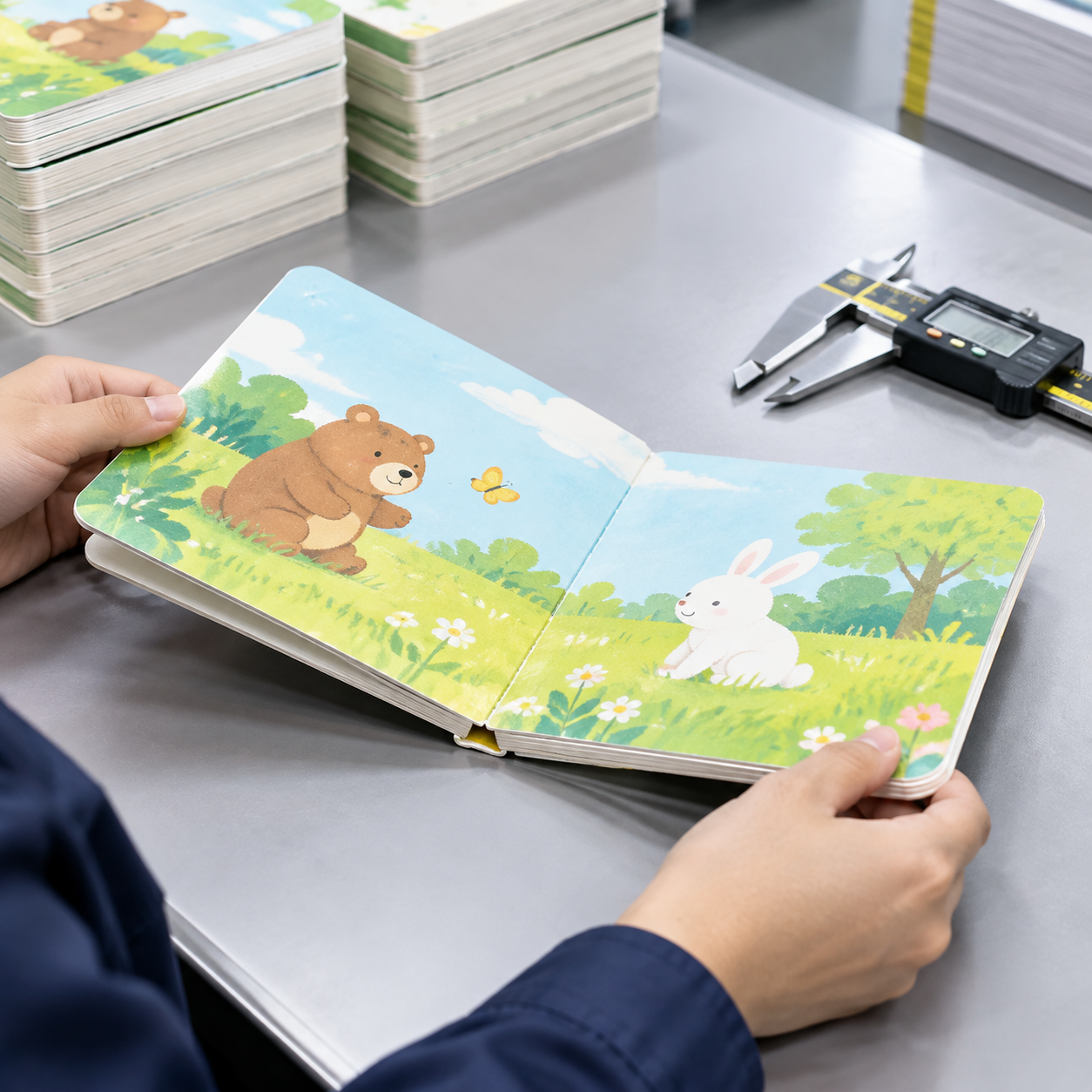
State the closed finished size as width x height, followed by the unit of measurement and orientation. A request for a 6 x 6 in square book is clearer than asking for a small children’s book.
- Page count: State whether the count includes the front and back covers. Board book counting conventions differ, so also provide a page-by-page PDF or pagination diagram.
- Board: Specify the requested finished leaf thickness or ask the factory to propose a construction based on a physical sample. Nominal material thickness and finished mounted thickness may not be identical.
- Binding: Confirm board book construction rather than using general terms such as hardcover or perfect bound.
- Opening behavior: Tell the printer if spreads must open relatively flat or if artwork crosses the center joint.
- Shape: Identify square, portrait, landscape, shaped, or die-cut formats and provide dimensions or a dieline.
For adjacent construction choices, review Lemon Printing’s custom book printing capabilities.
Color, Coating, Lamination, Corners, and Special Finishes
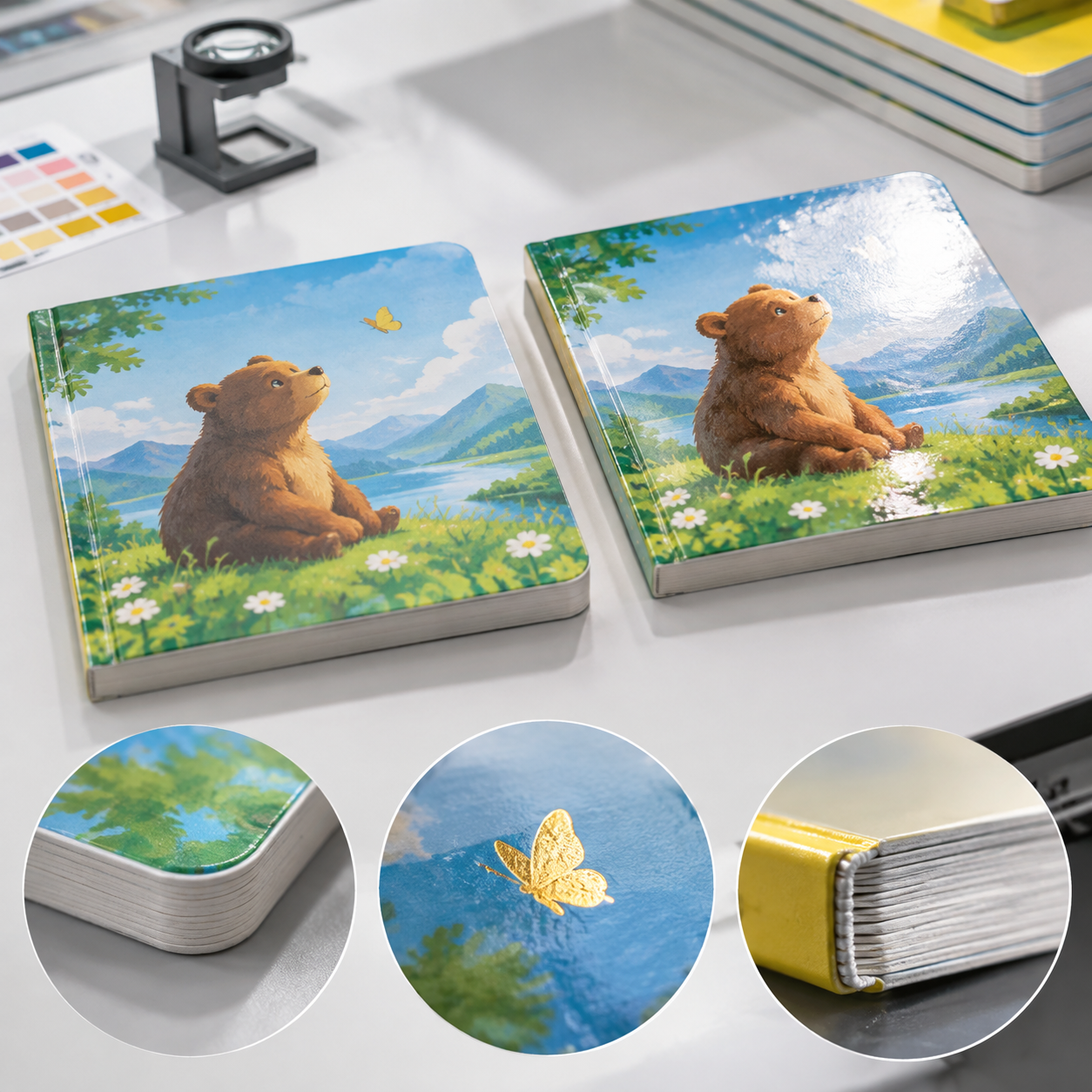
Finishing specifications should identify both the visual result and the surfaces receiving the treatment. Write 4-color process printing, usually described as CMYK, if artwork is reproduced with cyan, magenta, yellow, and black inks. Supply a spot-color reference when a brand color requires separate matching and ask how it will be produced.
Choose a surface treatment appropriate to handling and artwork. Gloss lamination generally increases shine and color contrast; matte lamination reduces glare but can show rubbing on dark, solid areas. A coating and a film lamination are not interchangeable, so ask the supplier to name the proposed material.
Also specify the corner radius, whether all leaves and covers are rounded, and any foil, embossing, debossing, spot gloss, textures, windows, tabs, movable pieces, or custom die cuts. Special features need dimensions, positions, dielines, and reference images. Ask whether tooling charges are included and whether tools can be reused for an unchanged repeat order.
Quantity, Proofing, Packaging, and Shipping Details
Quantity alone is not enough for a board book production estimate. Ask for clearly separated prices at realistic order quantities, then define the proof, packing method, delivery destination, and freight scope for each option.
- Quote quantity and acceptable overrun or underrun policy
- Digital proof, printed proof, blank construction sample, or production-equivalent sample
- Individual wrapping, bundles, retail labels, barcode placement, or master cartons
- Maximum carton weight or carton marking requirements
- Delivery city, postal code, country, and commercial or residential address type
- Requested Incoterm, freight mode, and target arrival date
Before approving color or construction, use a documented printing proof approval checklist to record accepted files and corrections.
How Destination and Packing Requirements Affect the Request

The destination affects freight method, export packing, carton labels, pallet decisions, taxes, import handling, and the meaning of the quoted delivery term. A factory cannot provide a comparable landed estimate from a country name alone.
Provide the full delivery location and state whether the shipment goes to a port, warehouse, fulfillment center, school, retailer, or residence. Warehouses may impose appointment, pallet, carton-label, or routing requirements. Individual shrink wrapping or bagging adds material and labor but can protect books during fulfillment; bulk packing uses less individual packaging but may not suit direct retail distribution.
Ask suppliers to show product price and freight separately and to name the applicable Incoterm. The bulk printed product shipping guide explains the information needed for export planning.
Board Book Quote Comparison Table
Compare quotes line by line using identical specifications. A lower unit price is not directly comparable if it excludes proofing, tooling, packing, export charges, or the requested material construction.
| Quote item | What the supplier should state | Common comparison risk |
|---|---|---|
| Finished book | Closed size, orientation, page-count convention, construction, and corner shape | Cover counted differently or size listed before trimming |
| Materials | Printed stock, board or mounted leaf thickness, and surface treatment | Nominal board substituted without finished-thickness confirmation |
| Printing | Color process, spot colors, and color-reference method | CMYK output compared with a separately matched brand color |
| Finishing | Lamination or coating, die cutting, foil, embossing, and tooling | One-time tooling omitted or charged separately |
| Proofing | Proof type, quantity, shipping, and limitations | Digital proof assumed to represent final materials exactly |
| Packing | Unit packing, carton quantity, labels, estimated carton size, and weight | Retail preparation excluded |
| Commercial terms | Quantity, unit price, setup charges, payment terms, and quote validity | Different quantities or currencies compared |
| Shipping | Incoterm, destination, freight mode, and included charges | Port delivery compared with delivered service |
Common construction options
| Option | Practical effect | Quote information needed |
|---|---|---|
| Standard rectangular format | Simpler trimming and packing | Finished width, height, orientation, and corner radius |
| Custom die-cut shape | Adds tooling and registration checkpoints | Dieline, dimensions, cut positions, and sample image |
| Matte lamination | Lower glare; dark areas may show handling marks | Surfaces laminated and desired visual reference |
| Gloss lamination | Higher reflectivity and stronger apparent contrast | Surfaces laminated and any writable areas to exclude |
Questions to Ask Before Approving a Supplier
Before approving a supplier, confirm what will be manufactured, how it will be checked, and which assumptions remain open. Written answers reduce the risk of approving two different interpretations of the same book.
- Does the stated page count include the front and back covers?
- What is the proposed board construction and expected finished leaf thickness?
- Which proof best represents color, materials, thickness, binding, and die cutting?
- Are dies, plates, setup, proof shipping, packing, and export preparation included?
- What production tolerances apply to trim, registration, corner cutting, and finishing position?
- How will rubbing, delamination, exposed board edges, glue marks, and page sequence be inspected?
- Which files, dielines, fonts, color references, and approvals are required?
- What quantity variance policy applies to the final shipment?
- Which product-testing documents or third-party tests are required for the destination market, and who is responsible for arranging them?
- What happens if approved specifications and production samples do not match?
What a Factory Should Confirm Before Production
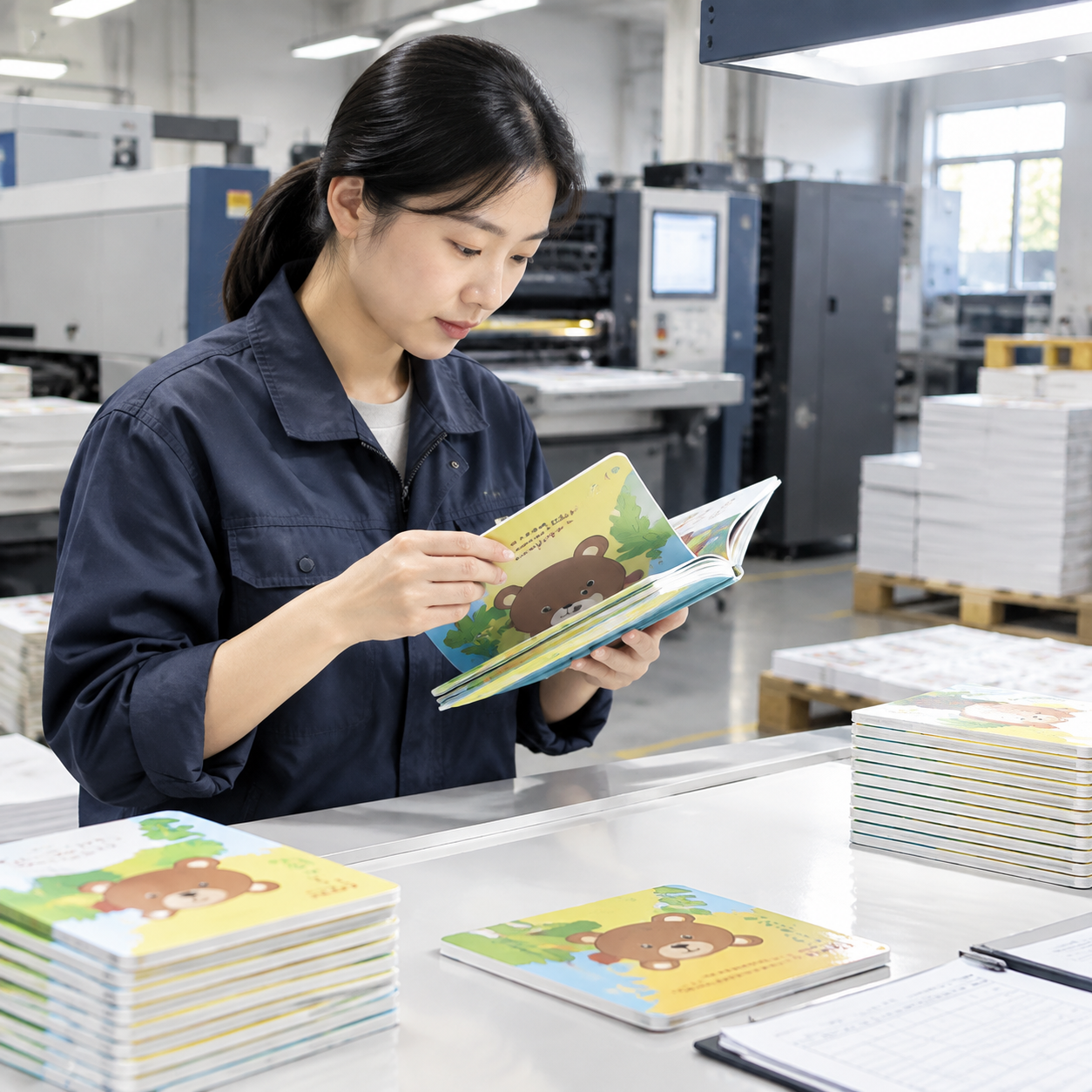
A factory should issue a final specification or production order that connects the approved artwork, materials, finishes, proof, quantity, packing, and shipping marks. Production should not depend on scattered email comments that can be interpreted differently.
At minimum, the confirmation should identify file versions, finished dimensions, page sequence, board construction, print colors, lamination or coating, corner radius, dielines, special-finish positions, proof status, packing instructions, and carton marks. Critical dimensions and acceptable tolerances should be agreed where they affect function or appearance.
According to Lemon Printing, its prepress, printing, binding, finishing, quality inspection, packing, and export preparation are handled in-house at its self-owned facility. Buyers can review the company’s printing quality control approach when discussing inspection points for a board book order.
MOQ, Production Time, Pricing, and Shipping Caveats
There is no single board book printing MOQ, production time, or unit price that applies to every project. Final MOQ, production time, pricing, and shipping depend on product specifications, quantity, finishing, and destination.
MOQ means minimum order quantity, the smallest quantity a supplier will accept for a particular production method and specification. It can be influenced by press setup, material purchasing, binding setup, die-cutting, and finishing efficiency. Request prices at two or three quantities instead of assuming the lowest quantity offers the lowest overall purchasing cost.
Production timing should be stated from a defined starting point, such as final proof approval and receipt of required payment, rather than from the first inquiry. Freight estimates should identify their validity period because space, fuel charges, routing, and seasonal demand can change. Confirm current figures before placing an order.
Frequently Asked Questions
These answers address the details most often needed to turn an initial inquiry into a comparable children’s book printing quote. Project-specific requirements should still be confirmed in writing with the selected factory.
Request a Custom Board Book Quote
Send one consolidated request containing the product type, quantity, finished size, page count and counting method, board construction, print colors, surface treatment, corner shape, special finishes, proof requirement, packing, delivery destination, and target date. Attach the artwork, page plan, dielines, and reference photographs available at the quoting stage.
If a specification is undecided, mark it clearly and ask the factory to price named alternatives. This makes the effect of changing thickness, lamination, proofing, or packing easier to evaluate.
Use This Board Book Quote Checklist
A complete board book printing quote request should answer the following questions before prices are compared:
- What is the exact closed finished size and orientation?
- Does the stated page count include covers?
- What leaf thickness or reference sample should be matched?
- What printing colors and color references are required?
- Which lamination, coating, corner treatment, and special finishes apply?
- Are dielines and artwork available for every custom feature?
- What quantities should be quoted?
- Which proof is required before production?
- How should individual books and export cartons be packed and labeled?
- What is the complete delivery destination and requested freight scope?
- What target date should the supplier assess?
- Which charges, tolerances, assumptions, and exclusions must appear in the quote?
Keep the completed checklist with the approved proof and final purchase order. It provides a practical reference for prepress review, production, inspection, and shipment.
FAQ
What information is needed for a board book printing quote?
Provide the quantity, closed finished size, orientation, page count and counting convention, board or finished leaf thickness, binding construction, print colors, lamination or coating, corner shape, special finishes, proof type, packing, delivery destination, freight scope, and target date. Include artwork, page plans, dielines, and reference samples when available.
What are the main board book printing cost factors?
The main cost factors are format, page count, board construction, quantity, printing process, lamination or coating, die cutting, special finishes, proofing, packing, and freight. Tooling and setup can have a larger effect on a short run, while material use, packing volume, and freight become increasingly important as quantity rises.
How should pages be counted in a board book quote?
State the total number of visible printed pages and explicitly say whether the front and back covers are included. Because suppliers and publishers may use different conventions, attach a page-by-page PDF or pagination diagram. The printer should repeat the agreed count in its quotation and final production specification.
What is a typical board book printing MOQ?
There is no universal board book printing MOQ. The practical minimum depends on the printing method, material purchasing, size, page count, binding setup, die cutting, and finishing. Ask the supplier to quote its current minimum and at least one higher quantity using the same specifications.
Do I need a physical proof before board book production?
A physical proof is useful when thickness, binding, corner shape, die cutting, or finish appearance is important. However, a digitally produced proof may not reproduce the exact color or materials of offset mass production. Ask the printer to state what the proof does and does not represent, and consider a blank construction sample when mechanics matter more than print.
Should freight be included in the board book quote?
Request both the product price and the shipping cost as separate lines. The freight line should identify the destination, transport mode, Incoterm, included services, estimate validity, and known exclusions. This makes quotes easier to compare and shows whether customs clearance, duties, taxes, appointments, or final delivery are outside the supplier’s scope.
Can a printer quote before the artwork is finished?
Yes, a printer can usually prepare a preliminary estimate from a detailed specification, page plan, and reference images. The estimate may need revision after final artwork and dielines are reviewed. Features such as heavy ink coverage, crossovers, custom cuts, foil areas, or movable components can reveal requirements that were not visible in the initial description.
Send Your Board Book Specifications for Review
Request a board book printing quote from Lemon Printing by sharing your product type, quantity, finished size, page count, board or leaf thickness, printing colors, lamination or coating, corner treatment, special finishes, proof requirement, packing instructions, delivery destination, and target date. Final MOQ, production time, pricing, and shipping will depend on the confirmed specifications, quantity, finishing, and destination.