Table of Contents
- Understand what makes a board book different from a paper-page book
- Define pages, leaves, board construction, and intended handling
- Separate printing specifications from child-product compliance requirements
- Create a board book production specification table
- Choose board thickness, surface treatment, format, and corner style
- Plan color coverage, page sequence, binding, and edge finishing
- Prepare artwork and approve a board book proof
- Inspect board books for alignment, adhesion, corners, surfaces, and packing
- Match the project to Lemon Printing's custom board book capability
- Quote-ready board book checklist
- FAQ: Board book printing
Successful board book printing starts with a production specification, not just finished size and artwork. This guide explains how to define leaves and pages, choose board construction and rounded corners, prepare files, approve a physical proof, inspect finished books, and request a comparable quote.
Understand what makes a board book different from a paper-page book
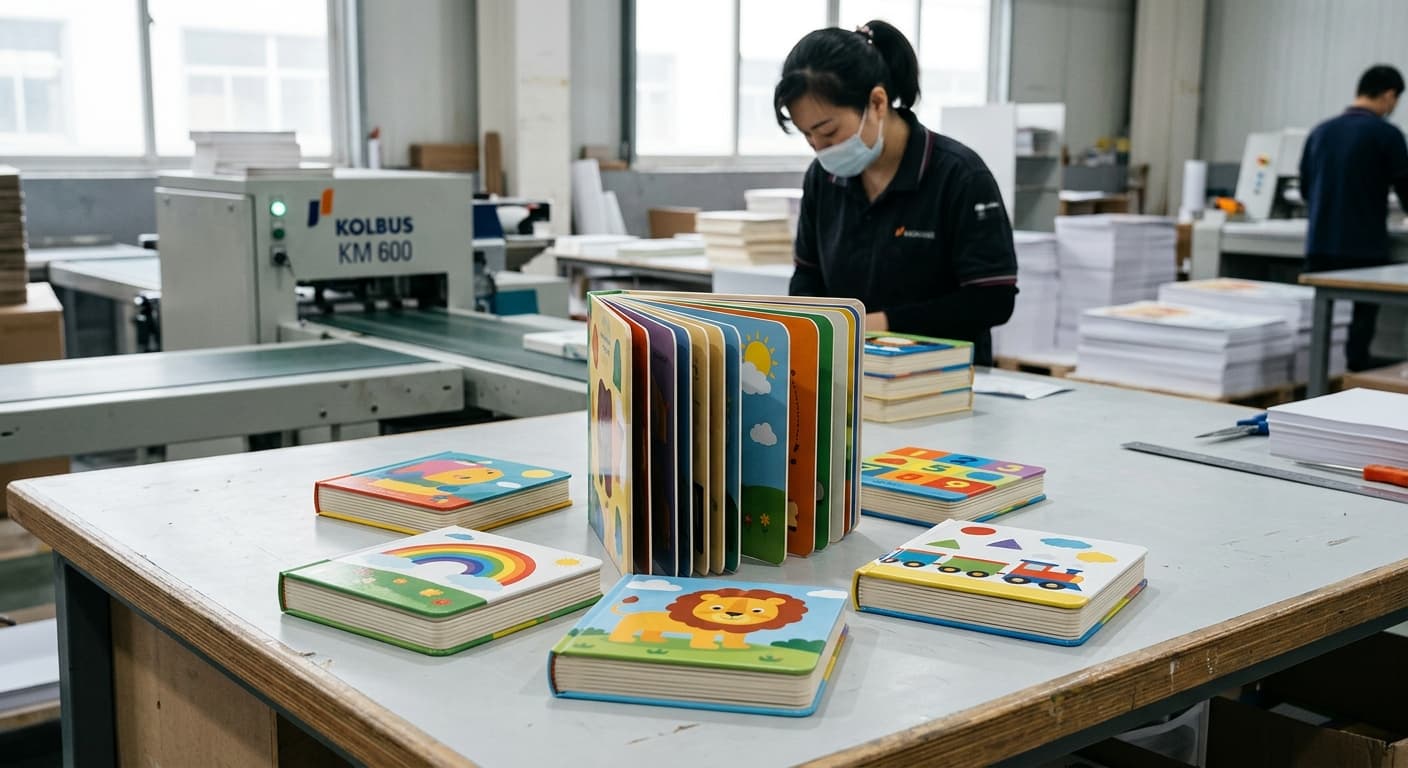
Board book printing uses thick, rigid board leaves instead of flexible paper pages. A successful order must define the physical construction, not only the finished size and artwork, because board thickness, mounting, corners, edge treatment, and packing all affect production.
This construction changes the quotation and quality checkpoints compared with a paper-page book:
- Rigid leaves increase thickness and finished weight.
- Rounded corners require a specified radius and controlled cutting or finishing.
- Printed panels must remain correctly aligned after mounting and trimming.
- Surface treatments can change glare, touch, scuff resistance, and color appearance.
- Carton dimensions and shipping weight may be affected by the board specification.
These points matter for picture books, early-learning titles, flashcard-style books, and educational board books. Treat the project as a manufactured product with a print component, rather than as a paper book with heavier pages.
Define pages, leaves, board construction, and intended handling
Start the inquiry by separating reading sides from physical board units. A page is one printed side, while a leaf is one physical board unit that normally has a front and back side; covers and end panels may be counted differently by different suppliers.
For a clear request, state the following separately:
- Interior reading sides or board book pages.
- Number of physical leaves.
- Front cover, back cover, and any separate cover boards.
- Whether end matter, flaps, pockets, or inserts are included.
- How the leaves should connect and how the book should open.
For example, write 16 interior reading sides across 8 board leaves, plus front and back covers, if that is what the project requires. Do not rely on a label such as 16 pages if the cover-count convention has not been agreed.
Also describe the expected handling. A toddler title, a classroom manipulative, and a retail gift book may need different decisions about board rigidity, surface treatment, rounded corners, and packing. The intended market and use help the printer review whether the proposed construction is practical.
Separate printing specifications from child-product compliance requirements
Printing approval and child-product compliance are separate decisions. A printer can produce an agreed board construction, but the buyer or brand owner must identify the destination-market requirements that apply to the finished children’s product.
Before requesting a final quote, tell the supplier:
- Target country or countries and intended age range.
- Whether the book is sold as a toy, children’s publication, educational product, or another category.
- Any required review of board, inks, coatings, films, adhesives, or other materials.
- Whether testing, declarations, traceability records, or specific packaging information are required.
- Whether the product includes small parts, loose inserts, magnets, pockets, or special attachments.
A digital artwork proof confirms layout and content; it does not by itself confirm material or regulatory suitability. Ask the printer which production information and samples can be supplied, and have the responsible importer or compliance specialist confirm the requirements for the selling market.
Create a board book production specification table
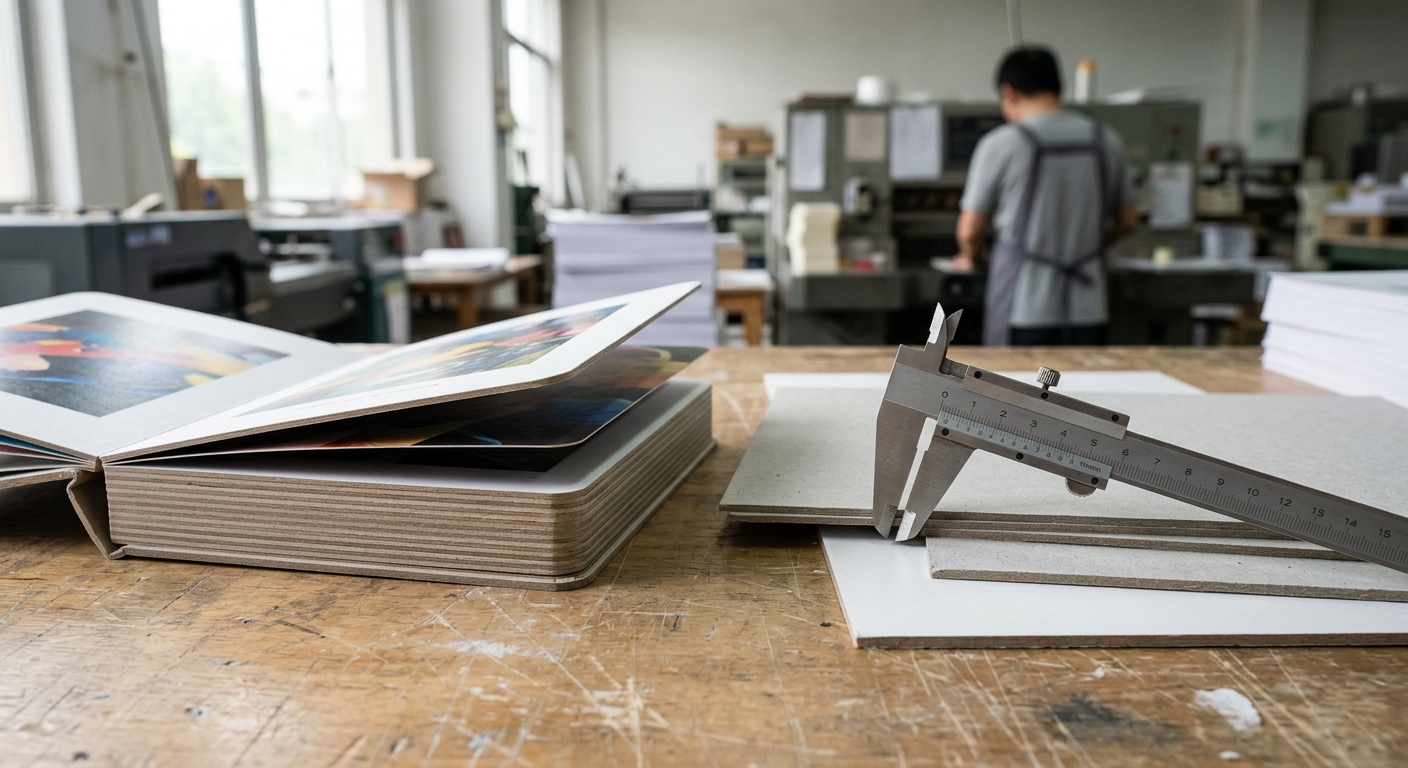
Put the project into one specification table before comparing suppliers. This prevents a low quote from appearing comparable when it uses a different board thickness, page count, corner radius, packing method, or proof standard.
| Item | What to specify | Why it matters |
|---|---|---|
| Quantity | Total units, editions, and any language versions | Sets the production route and material requirement. |
| Finished format | Closed size in millimeters or inches; portrait, square, or landscape | Influences sheet layout, rigidity, trim, and carton size. |
| Pages and leaves | Interior reading sides, physical leaves, covers, and inserts | Prevents page-count and construction misunderstandings. |
| Board | Thickness in millimeters, board grade, core color, and sample requirement | Controls stiffness, weight, edge appearance, and handling. |
| Surface | Uncoated, coated, film-laminated, or another agreed treatment | Changes touch, reflection, color, and surface durability. |
| Corners | Rounded or square; radius in millimeters; all corners or selected corners | Defines tooling and the visible finished profile. |
| Color | Full color or spot color on each side; color references if critical | Clarifies coverage and color-control expectations. |
| Construction | How printed panels, board leaves, covers, and any spine are assembled | Allows the factory to review feasibility and proof method. |
| Packing | Individual protection, inner packs, master cartons, labels, and carton marks | Reduces packing assumptions and supports freight planning. |
| Destination and date | Delivery country, city or port, target date, and shipping preference | Freight and schedule depend on destination and final specifications. |
Send this table with the artwork status and any reference sample. For additional context on setup, quantity, finishing, packing, freight, and proofing inputs, review Lemon Printing’s printing cost breakdown.
Choose board thickness, surface treatment, format, and corner style
Specify board thickness in millimeters rather than using terms such as heavy board or extra rigid. Thicker board can increase stiffness, finished weight, and freight volume, while a large format may require a construction review to maintain a practical page-turning feel.
Ask for the board thickness or caliper, board grade, and whether the core should be white or another color. Request a physical sample when touch, opacity, edge appearance, or rigidity is important. A paper sample alone may not represent the behavior of a mounted board leaf.
Surface treatment should also be explicit. A coating is a finish applied to the printed surface; lamination is a film bonded over it. Either can change glare, color appearance, hand feel, and resistance to ordinary scuffing. The surface must also be checked at the trimmed edge and at any fold or mounted seam. Lemon Printing’s guide to coated and uncoated paper can help with surface terminology, but board construction still needs a project-specific sample.
For rounded corner board books, state the radius in millimeters and identify whether it applies to the cover, interior leaves, or all components. Rounded corners are a manufacturing specification, not an automatic child-safety claim. Keep artwork, text, barcodes, and important facial details away from the trim and corner zones shown on the approved dieline.
Plan color coverage, page sequence, binding, and edge finishing
Build a page map before sending final files. It should show every reading side in order, the front and back covers, any end panels, and the direction in which the finished book opens.
State whether each side is full color or spot color. In commercial print language, 4/4 usually means full-color printing on both sides, but the final quotation should use the supplier’s written specification. If the project has a small quantity, variable content, or a color-critical run, ask whether offset or digital printing is more suitable for the complete production route. Lemon Printing’s offset versus digital printing comparison explains the main decision factors without separating printing from finishing and quantity.
Binding for a board book may not resemble a conventional paperback spine. Describe how leaves are joined, how the covers are formed, and whether printed panels are mounted, wrapped, or assembled by another approved method. Confirm the edge finish as well: exposed board, wrapped edges, colored edges, or another treatment will affect appearance and inspection.
Finally, define board book packaging early. State whether units need individual sleeves or protection, how many books go in an inner pack, the preferred master-carton quantity, carton marks, and whether mixed titles are permitted. Packaging affects handling, warehouse counting, and the freight quote.
Prepare artwork and approve a board book proof
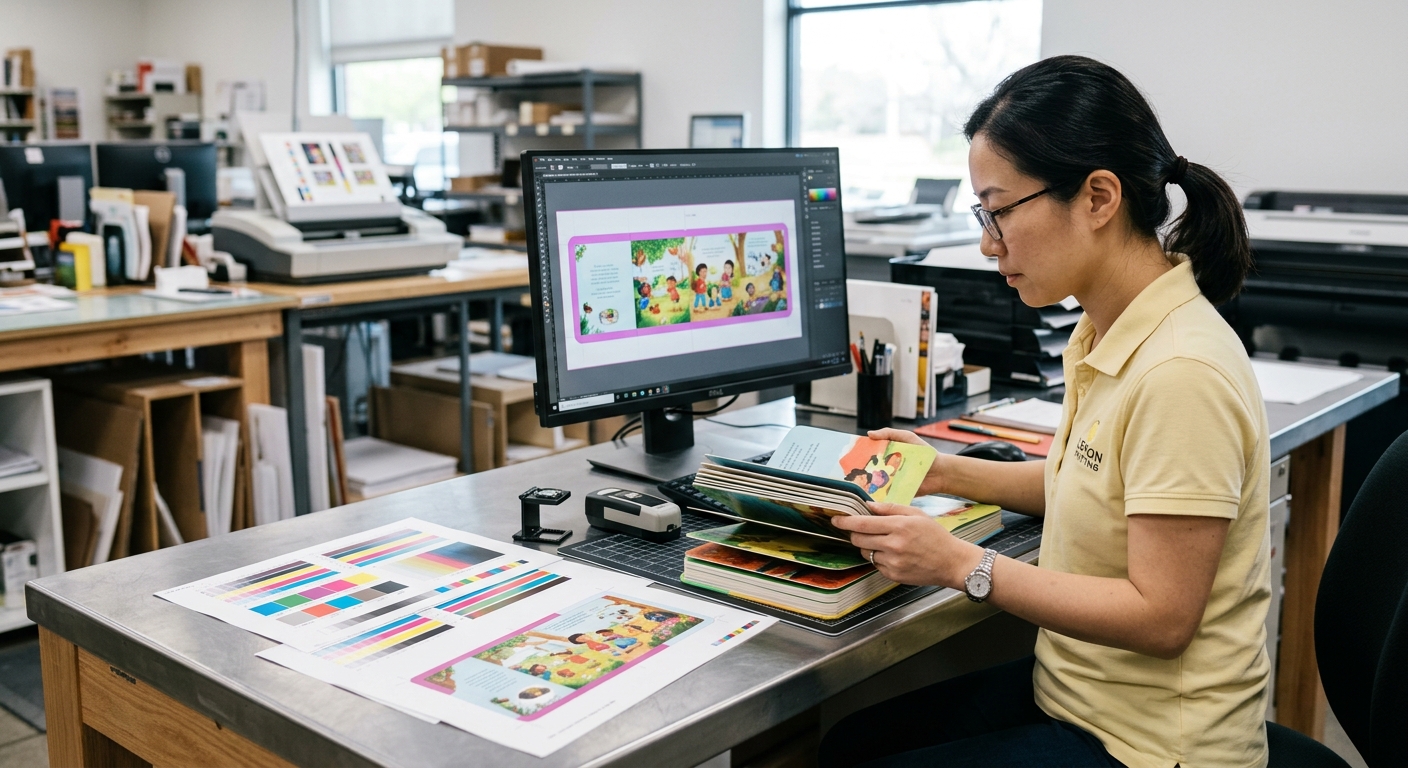
Artwork for board book printing should be prepared from the approved construction dieline, not from a generic book template. The dieline should show finished size, trim, rounded corners, panel boundaries, bleed, safe areas, and any mounting or wrap zones.
- Confirm the file plan. Decide whether the printer wants one PDF, separate cover and interior files, or a panel-by-panel layout.
- Build the page sequence. Label files clearly and check that front-to-back order matches the physical construction.
- Protect the trim area. Extend backgrounds through bleed and keep text, faces, barcodes, and fine details inside the safe area, especially near rounded corners.
- Check production assets. Embed or outline fonts as requested, review image quality, confirm color mode, and remove hidden notes or unused layers.
- Approve the proof in two stages. Use a digital proof to check content and placement, then use a physical dummy or production proof to review board thickness, corners, page turning, surface, and assembly.
A screen proof cannot fully show the final board stiffness, edge treatment, glare, or mounted alignment. Record the approved file name, revision, date, and physical sample reference so the bulk run has a clear baseline. Lemon Printing’s guide to preparing artwork for commercial printing covers PDF, bleed, safe-area, font, and preflight checks.
Inspect board books for alignment, adhesion, corners, surfaces, and packing
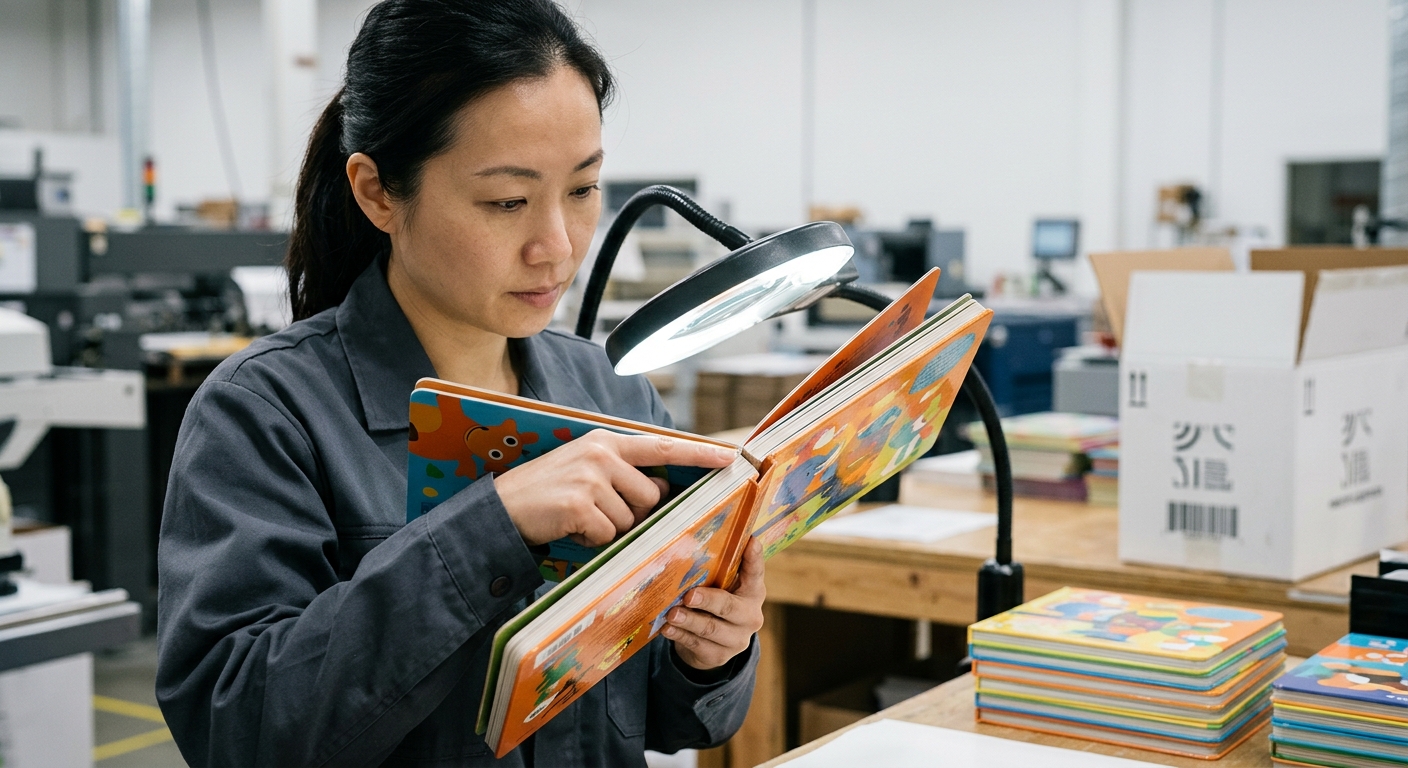
Inspect a board book against the approved sample and written specification, not against an informal expectation. The most useful inspection checks cover appearance, construction, function, and packing.
- Alignment and trim: Check image registration, panel placement, trim position, bleed coverage, and whether artwork sits consistently near the rounded corners.
- Adhesion and assembly: Look for lifted panels, bubbles, wrinkles, open edges, excessive adhesive, uneven mounting, or visible gaps.
- Corners and edges: Compare the corner radius across sampled units and check for crushed, sharp, chipped, or poorly cut edges. Confirm that the edge treatment matches the approved sample.
- Surface: Review color consistency, scratches, fingerprints, scuffing, lamination bubbles, coating marks, and unwanted glare under normal viewing light.
- Sequence and function: Turn every leaf in order, confirm the opening direction, and check that the book closes as intended without pages catching.
- Packing: Count units per inner pack and carton, verify carton labels and marks, and inspect for crushed corners or movement inside the carton.
Keep a signed or dated approval sample and photos of any agreed tolerances. If an exact tolerance is important, put it in the purchase specification before production. Lemon Printing’s bulk book printing guidance provides related checkpoints for proofing, quality review, packing, and shipment planning.
Match the project to Lemon Printing's custom board book capability
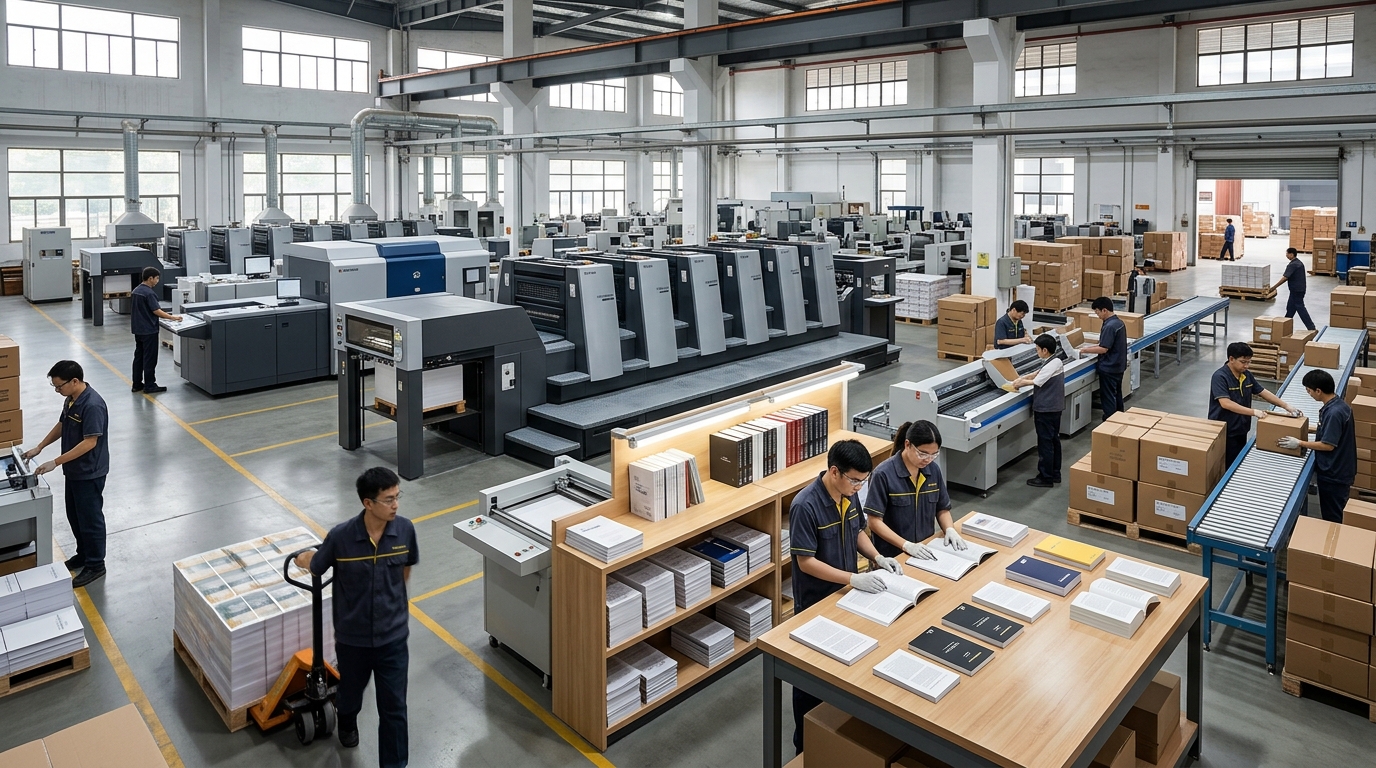
Lemon Printing is a factory-backed supplier for buyers who need coordinated prepress, printing, binding, finishing, inspection, packing, and export preparation. A custom board book inquiry should still begin with a construction review so the board, mounting method, corner tooling, surface treatment, and packing plan are confirmed before quotation.
Lemon Printing was established in 2015 in China’s Guangzhou–Shenzhen manufacturing corridor. The company operates a self-owned facility with more than 130 skilled workers and 8+ offset and digital presses. Its in-house workflow covers prepress, printing, binding, finishing, quality inspection, packing, and export preparation for publishers, brands, educators, event organizers, NGOs, retailers, and other organizations in more than 30 countries.
When you contact the team, include the specification table, a representative artwork file or reference sample, the intended market, and any child-product review requirements. Ask for confirmation of the proposed board construction, physical proof method, inspection checkpoints, packing format, and quote assumptions. You can also review Lemon Printing’s in-house printing capabilities when deciding which production questions to include.
Quote-ready board book checklist
A quote becomes easier to compare when the printer receives the complete product definition at the start. Use this checklist before sending an inquiry:
- Product type and intended use, such as a picture book, toddler title, or educational board book.
- Quantity, number of editions, language versions, and whether the order will be repeated.
- Finished size, orientation, interior reading sides, physical leaves, covers, and any inserts.
- Board thickness, grade, core color, surface treatment, and edge finish.
- Corner style and radius, plus any special die-cut or folding requirements.
- Color coverage, artwork status, reference colors, and whether a physical proof is required.
- Leaf assembly, cover construction, spine treatment if applicable, and page-opening direction.
- Individual protection, inner-pack quantity, master-carton requirements, labels, and carton marks.
- Delivery destination, target date, preferred shipping method, and any import or compliance documentation needs.
Ask the supplier to identify assumptions and separate proofing, tooling, production, packing, freight, and other applicable line items. Final MOQ, production time, pricing, and shipping depend on product specifications, quantity, finishing, and destination.
FAQ: Board book printing
The questions below address the specification issues that most often create confusion during custom board book ordering.
FAQ
What is the difference between a board book page and a leaf?
A page is one printed side. A leaf is one physical board unit, usually with a front and back side. Because suppliers may count covers differently, specify reading sides, physical leaves, and covers separately in the quote request.
What board thickness should I choose?
There is no single thickness for every project. The appropriate specification depends on finished format, intended handling, desired rigidity, page-turning behavior, product weight, and packing. Request board samples or a construction recommendation instead of choosing from a thickness label alone.
Are rounded corners automatically safer for children's books?
No. A rounded corner is a defined cutting or finishing radius, but it is not by itself proof of child-product compliance. State the radius and affected components, then confirm applicable market requirements and any required testing or documentation.
Do I need a physical board book proof?
A physical proof or approved dummy is strongly useful when thickness, surface, corners, mounting, page sequence, or opening behavior matters. A digital proof is still useful for content and layout, but it cannot fully represent the finished board construction.
What should board book packaging include in the quote?
Specify individual protection if needed, inner-pack quantity, master-carton quantity, carton marks, labels, mixed-title rules, and the delivery destination. Confirm how the finished books will be protected against movement and corner damage during handling and shipment.
What information does a printer need to quote custom board books?
Provide product type, quantity, finished size, reading sides, leaves, covers, board thickness, surface treatment, corner radius, color coverage, construction, proof requirement, packaging, destination, and target date. The final MOQ, production time, pricing, and shipping depend on these specifications and the destination.
Request a board book printing review
Send Lemon Printing your product type, quantity, finished size, reading-side or page count, physical leaf count, board specification, binding or assembly details, corner and surface finishing, packaging requirements, delivery destination, and target date. Include artwork or a reference sample if available so the construction and proofing route can be reviewed clearly.