Table of Contents
- Invoice book printing by branch: reserve one number per set
- Should branches share one number sequence or use separate prefixes?
- Build a two-branch allocation table in three steps
- What should match on the physical proof and in the packed order?
- Where should a reorder start when one branch runs out first?
- Quote checklist: form size, copy order, branch ranges, carton labels, and US delivery details
- Frequently asked questions about invoice book numbering
- Request a printing quote with your branch allocation table
For invoice book printing, 20 books of 50 three-part sets need 1,000 invoice numbers, not 3,000. Reserve a block for each branch before the printer starts. When one branch runs out, the number after its last invoice may already be sitting in another branch’s unopened carton.
Invoice book printing by branch: reserve one number per set
An invoice set is the original and all copies for one transaction. In carbonless invoice books, pressure from writing on the original makes a mark on the copies beneath it. The invoice number should already be printed on each part. A repeated number within a set is correct; the same number on two separately issuable sets is a duplicate.
Why 50 three-part sets need 150 form sheets but only 50 numbers
Fifty three-part invoice sets contain 50 originals, 50 middle copies and 50 bottom copies. That’s 150 finished form sheets, excluding the cover and backing board, but the branch can issue only 50 invoices.
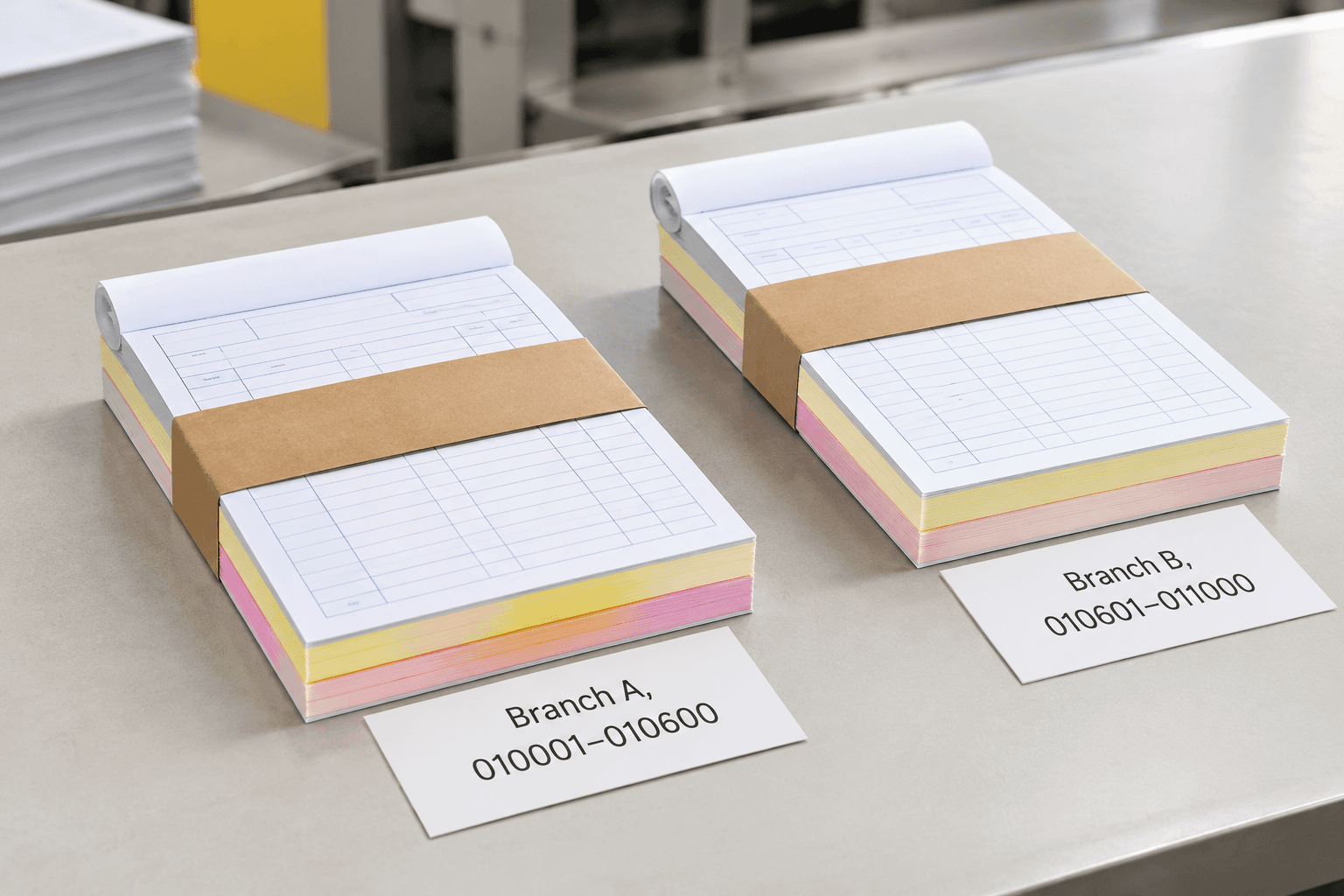
Describe where each sheet goes: for example, white original to the customer, yellow middle copy to accounting, pink bottom copy stays bound at the branch. Lemon Printing’s carbonless invoice book formats and copy options are a reference for specifying that arrangement. “Triplicate” alone doesn’t tell the printer which sheets should tear out.
Should branches share one number sequence or use separate prefixes?
Choose a shared sequence if accounting wants one numeric register and purchasing can reserve blocks for all locations. Use invoice number prefixes if branches need independent counters and accounting can distinguish their full IDs.
One caution with a shared sequence: invoice numbers won’t necessarily follow sale dates. B can issue 010601 before A has used 010050. If finance expects the lowest number to identify the earliest sale, settle that point before ordering.
Sample invoice IDs, accounting software checks, and restart rules
Test the exact printed IDs from entry through export. A spreadsheet can display six digits while passing a five-digit value to accounting.
| System | Sample printed IDs | What accounting must preserve | Start or restart rule |
|---|---|---|---|
| Shared series | 010001 at A; 010601 at B | All six digits, including the leading zero. Check for duplicates across branches. | Continue after the highest reserved number. No restart at a new book or branch. |
| Branch prefix | A-000001 and B-000001 | The prefix, hyphen and padded digits together as the unique ID, including on reports and exports. | Each new prefix may start at 000001. After A-000600, continue at A-000601; don’t restart an existing prefix. |
In a test account, import both prefixed examples, look up each by its printed ID, then export and reopen the records. Try entering A-000001 again by hand. The system should accept the two branches’ IDs as distinct and flag the exact repeat. If it treats both as invoice 1, don’t order prefixed forms.
Build a two-branch allocation table in three steps
Keep one master worksheet for purchasing, the printer and receiving. This example assumes 010001 is available. Before reserving it, check earlier print orders, unused stock and any electronically issued invoices in the same series. An empty space in the sales ledger isn’t proof that a number is free.
1. Multiply books by sets per book for each location
Multiply the books a branch will receive by the sets per invoice book. A needs 12 × 50 = 600 numbers; B needs 8 × 50 = 400. Cross-check the purchase order: 20 books, 1,000 complete sets, 3,000 form sheets. Specify “50 three-part sets per book,” not “150 pages.”
2. Calculate the last number in each block: first number + set count − 1
Both endpoints count. A’s block ends at 10,001 + 600 − 1 = 10,600, printed as 010600. Start B at 010601. Its 400th set is 011000, not 011001.
In the worksheet below, column B holds the first ID and column C holds the set count. The spreadsheet formula =TEXT(VALUE(B2)+C2-1,"000000") calculates the last ID as six characters. Import the serial fields as text when moving the file; a CSV doesn’t tell the receiving software which columns need their leading zeros.
3. Record each book’s first and last numbers and check for overlaps
Give each book a stock reference distinct from its invoice IDs. A01 means Branch A, book 1; the A does not print as part of its invoice numbers. This example groups four books per carton so receiving can work directly from the purchase order.
| Book ref. | First ID | Sets | Last ID | Planned carton |
|---|---|---|---|---|
| A01 | 010001 | 50 | 010050 | A1 |
| A02 | 010051 | 50 | 010100 | A1 |
| A03 | 010101 | 50 | 010150 | A1 |
| A04 | 010151 | 50 | 010200 | A1 |
| A05 | 010201 | 50 | 010250 | A2 |
| A06 | 010251 | 50 | 010300 | A2 |
| A07 | 010301 | 50 | 010350 | A2 |
| A08 | 010351 | 50 | 010400 | A2 |
| A09 | 010401 | 50 | 010450 | A3 |
| A10 | 010451 | 50 | 010500 | A3 |
| A11 | 010501 | 50 | 010550 | A3 |
| A12 | 010551 | 50 | 010600 | A3 |
| B01 | 010601 | 50 | 010650 | B1 |
| B02 | 010651 | 50 | 010700 | B1 |
| B03 | 010701 | 50 | 010750 | B1 |
| B04 | 010751 | 50 | 010800 | B1 |
| B05 | 010801 | 50 | 010850 | B2 |
| B06 | 010851 | 50 | 010900 | B2 |
| B07 | 010901 | 50 | 010950 | B2 |
| B08 | 010951 | 50 | 011000 | B2 |
Sort by numeric start across the entire series, not by branch. A start at or below the highest preceding end is an overlap. For this continuous order, a jump of more than one also needs explaining. Keep the approved ranges fixed; add columns for the order revision, actual carton, quantity received and exceptions rather than overwriting the plan.
What should match on the physical proof and in the packed order?
Use the proof to approve a working set and the packing records to account for the run. A layout PDF shows where the number sits; it can’t tell you whether handwriting reaches the bottom sheet.
Use Lemon Printing’s Printing Proof Approval Checklist to record the artwork revision, allocation-sheet revision and corrections. When defining the scope of the physical sample, specify the intended stock, copy order and binding—not three loose printouts.
Match the preprinted number on all parts, then test handwriting transfer to the retained copy
Use two consecutive sample sets. Mark every proof part as a sample and keep it out of issuable stock, especially if the printer uses the actual starting number to show placement.
- Before writing, look for 010001 on all three parts of the first set and 010002 on all three parts of the next. Check the leading zero, too.
- Put a writing shield (a stiff divider) under the whole first set. With the branch’s usual pen and normal pressure, write a quantity of 17 and an amount of 48.60.
- Tear out the customer and accounting sheets. Ask a colleague to read the ID, quantity and amount from the bound copy alone. Check the detached sheets for digits lost to the tear-off stub and the next blank set for stray handwriting.
Check packed counts and documented exceptions, not just the first and last numbers on a carton
Matching endpoints don’t prove that the sets between them are complete. Carton A1 should hold A01–A04: four books, 200 sets, 010001–010200. A duplicate 010126 in place of 010127 would leave both the count and the carton label looking right.
Agree before printing whether the printer will check a sample or verify every set, and what record will accompany the packing list. Lemon Printing includes packing verification in its print quality control process; specify any requirement for a complete serial check separately.
At receiving, count the books, match their ranges to the worksheet and reconcile usable sets with the inspection record. If 010127 was spoiled and not replaced, A1 is one set short. A void record explains the gap; it doesn’t deliver the missing invoice. Hold affected stock aside and document the disposition of any duplicate or replacement before release.
Where should a reorder start when one branch runs out first?
Branch A’s reorder starts at 011001, not 010601. Its own books stop at 010600, but purchasing reserved 010601–011000 for B. B doesn’t have to issue an invoice for that reservation to count.
Say A orders four more books. Assuming no higher reservation, 4 × 50 = 200 sets take 011001–011200. Add books A13–A16 under the new purchase order; 011201 is now the next unassigned number. Don’t extend A’s original block to 011200—that would make A appear to own B’s stock, too.
For bulk invoice book reorders, give one buyer responsibility for checking open orders and dating the new reservation. Otherwise two branches can both request the same “next” number before either order ships.
Quote checklist: form size, copy order, branch ranges, carton labels, and US delivery details
Give suppliers the same form specification and shipping instructions. A branch name on a carton is a packing instruction, not a delivery address.
- Dimensions and artwork: Give width × height, with units, for the bound book and the usable form after tear-out. Mark the binding edge, perforation line and number position on the artwork.
- Copy construction: Specify carbonless paper, sheet colors and recipients in top-to-bottom order, removable sheets, retained copy, binding method, cover and any writing shield.
- Quantities and numbers: List books per branch, sets per book and parts per set. Attach the dated range table, with digit width, any prefix and one ID exactly as it should print.
- Packing: Specify carton ID, branch, book references, inclusive invoice range and counts on the labels. State whether mixed-branch cartons are acceptable and what exception records you require.
- US delivery: Distinguish branch-labeled cartons going to one warehouse from separate branch deliveries. Give city, state, ZIP code, quantity, receiving restrictions and required arrival date for each address. Ask for factory-ready and delivery dates separately.
Final minimum order quantity (MOQ), production time, pricing and shipping depend on product specifications, quantity, finishing and destination.
Frequently asked questions about invoice book numbering
How many invoice numbers do I need for 20 books of 50 three-part sets?
Reserve 1,000 numbers: 20 books × 50 sets. Each ID prints on three sheets, so the order contains 3,000 form sheets but only 1,000 invoices.
What should we test before using branch prefixes or leading zeros?
Test entry, import, lookup, duplicate detection and export. An exported 010001 must not come back as 10001. A-000001 and B-000001 must remain distinct, while a second A-000001 should be flagged.
How can a physical proof show whether the retained copy is usable?
Write on the assembled set at normal pressure, then remove the tear-out sheets. Read the preprinted ID, quantity and amount on the retained copy without consulting the original. Include a decimal amount so a faint point is easy to catch.
Do matching first and last numbers on a carton prove no sets are missing?
No. A missing set and a duplicate inside the block can cancel each other out on a count. Compare book ranges and usable-set counts with the serial inspection record, and resolve exceptions before issuing the affected books.
Which number starts a reorder while another branch still has unused books?
In a shared series, start one above the highest number already reserved anywhere in that series. If B holds 010601–011000 and nothing higher is assigned, A starts at 011001. A branch with its own prefix continues after its own last reservation.
Request a printing quote with your branch allocation table
Keep the dated worksheet with the approved form proof. The proof tells the printer what belongs on each sheet; the worksheet tells receiving who owns each book. When A asks for more, B’s last entry gives purchasing the right starting number.
Get a Clear Quote for Your Printing Project
Send Lemon Printing your invoice book artwork, finished form dimensions, paper and copy order, binding edge and tear-out requirements. Include parts per set, sets per book, quantities by branch, your range table and carton-label instructions. Specify one warehouse or separate branch deliveries, with each delivery ZIP code and required arrival date.