Book Printing · Formats & construction
Magnetic Book Printing
Create scenes that readers can change. Combine printed book panels with removable magnetic picture pieces, then plan the complete set around the activity, piece count and storage.
- Removable magnetic picture pieces and printed play scenes
- Matched piece backing, receptive panel and surface finish
- Complete-set inventory, sample and storage checks
Start with the intended use, finished size and quantity. The material and construction can follow.
The product in use
Printed scenes that become a hands-on activity
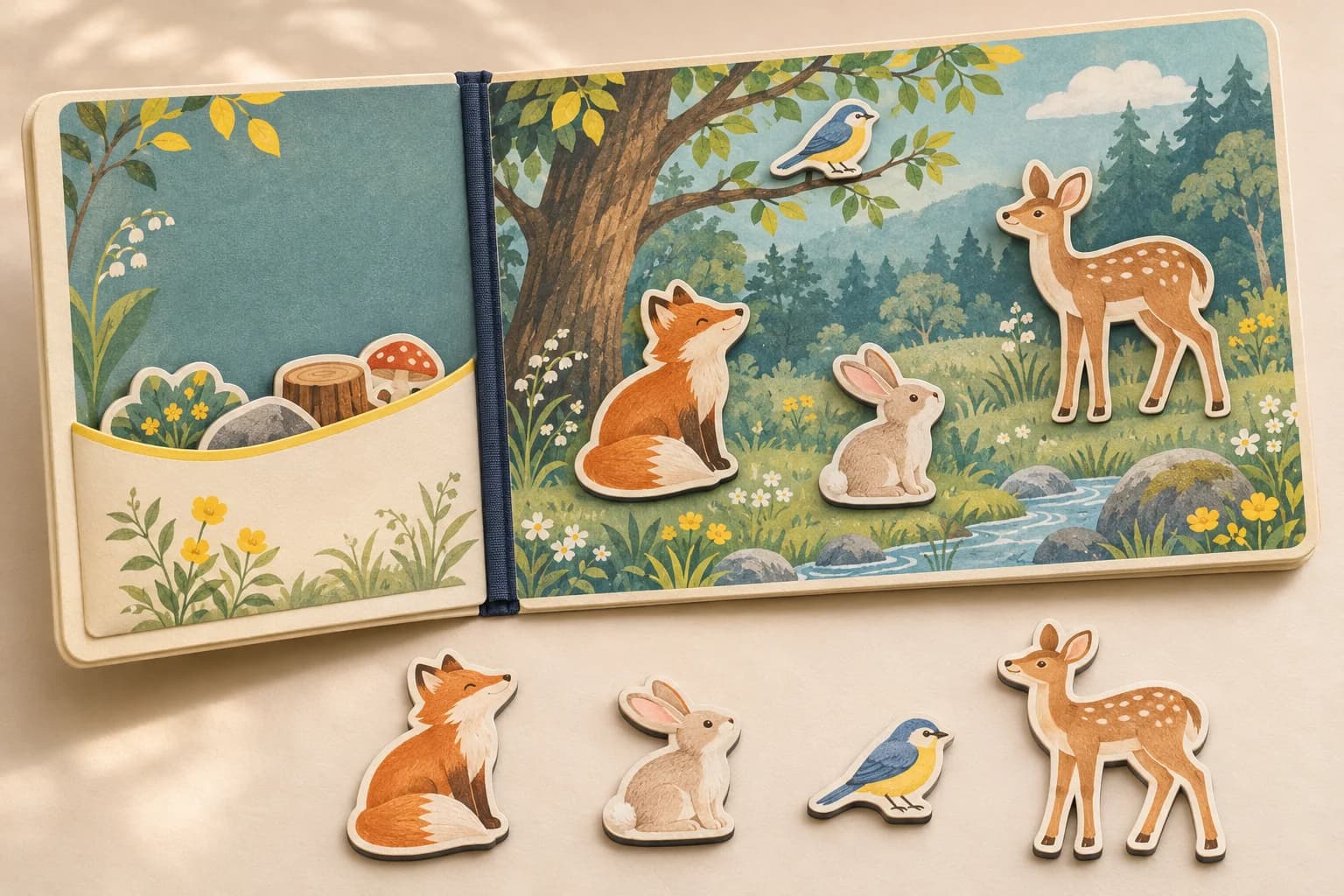
A magnetic activity book pairs a printed play surface with movable picture pieces. The pieces attach to a receptive layer within the book panel, so a reader can rearrange characters, match an example or build a new scene without sticking an adhesive label to the page. The printed background supplies the setting; the loose pieces supply the action. A useful design gives each piece a purpose, enough room to handle it and a defined place to go when play finishes. This is a picture-building book, distinct from a book-shaped packaging box that simply closes with a magnet.
What makes up the finished product?
- The receptive book panel
- Carries the printed scene and provides a flat target for movable magnetic pieces. Its usable area should stay clear of hinges and storage features.
- The removable picture pieces
- Combine the printed image with magnetic backing. The outline, finished thickness and grip influence handling as well as the appearance of the scene.
- The complete-set storage
- A pocket, carrier or tray provides a defined place for loose parts. Capacity must be checked using the full inventory and any accompanying cards.
Specifications and materials
Magnetic Book Printing specifications
Use these reference options to build the project brief. Dimensions are design examples; material availability, tooling and production timing depend on the confirmed specification.
| Parameter | Reference or option | Why it matters |
|---|---|---|
| Book and play dimensions | Closed width × height; open play area; packed depth, all in mm | Example: 210 × 210 mm closed trim. A fold-out panel, pocket or tray changes both usable space and packed thickness. |
| Set inventory | Book or fold-out board + magnetic pieces + any prompt cards and storage | For example, 1 book + 12 pieces + 6 cards is one illustrative set. Give every component an ID; a set count is not a loose-piece count. |
| Play-panel structure | Printed coated-paper or white-card facing over a rigid board support and receptive layer | Specify each layer and the finished panel thickness separately. The facing must bond flat; excess cover material between the piece and receptive layer can affect performance. |
| Magnetic sheet references | Supplier examples: 0.020 in (about 0.51 mm) and 0.030 in (about 0.76 mm) | Industrial material references, not approved toy specifications or Lemon stock limits. Select the actual backing, facing and piece geometry through a complete sample. |
| Magnet versus receptive layer | Magnetic backing on removable pieces; a compatible ferrous/receptive layer in the play panel | The receptive layer is the target for the magnet, not simply another name for magnetic sheet. Match the two materials and the full surface stack. |
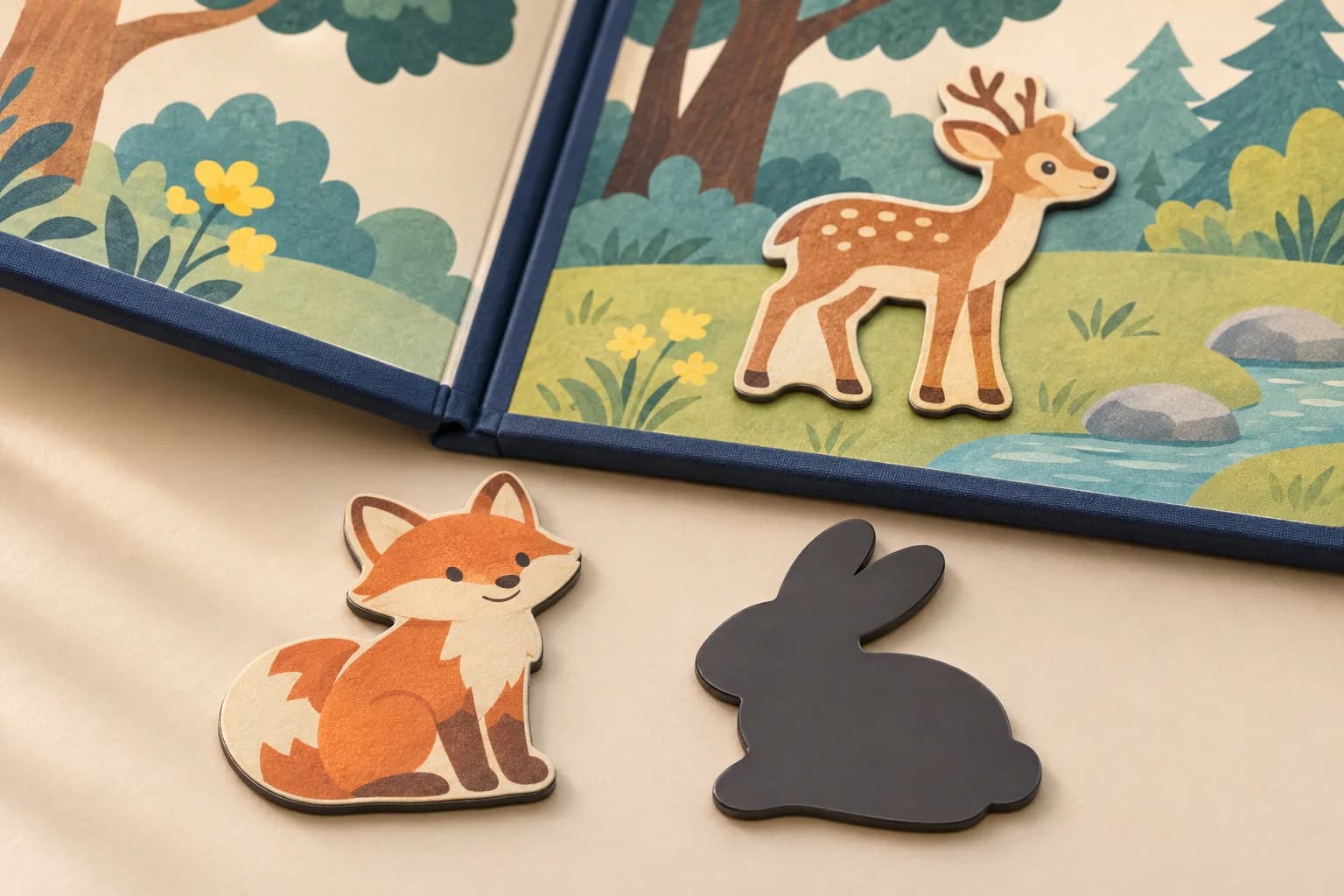
| Piece construction | Printed facing laminated to flexible magnetic sheet; die-cut outlines and specified reverse | Record finished thickness, smallest features and edge quality. Avoid fragile narrow necks and assess the actual parts for the intended age and market. |
| Surface and print | Full-color scenes and pieces; protective finish suited to handling | Match facing colors, inspect rubbing and edge lift, and verify easy repositioning. Dry-erase performance requires its own selected coating and marker test. |
| Artwork and quotation files | Print-ready PDF; 300 ppi images at final size; separate vector cut lines and assembly map | Use the approved drawing for bleed and safety zones. Supply the play background, piece fronts, any reverse printing and a per-set packing list. |
Compare the material and its effect.
Choose the surface and construction for the way the finished product will be used. The options below are selection references, not a guaranteed inventory list.
Flexible magnetic backing
Cuttable magnetic sheet laminated to a printed face
Turns the printed picture into a reusable movable piece without a peel-and-stick adhesive on the play surface.
Sample check: Review magnetization, finished thickness, edge bonding and removal on the actual receptive panel; an industrial datasheet is not finished-toy approval.
Receptive panel layer
Compatible ferrous sheet or receptive material within the board assembly
Provides the target beneath the scene artwork so pieces can be moved around the play area.
Sample check: Check coverage and flatness, then evaluate the complete facing and finish. Do not substitute an unrelated sheet simply because it contains metal.
Selected sample focus — Flexible magnetic backing: Review magnetization, finished thickness, edge bonding and removal on the actual receptive panel; an industrial datasheet is not finished-toy approval.
Format & usable space
Plan the scene, piece count and packed size
210 × 210 mm closed book — illustrative design reference
This square planning example provides a broad scene when opened. It is not a standard size or a production limit. Specify the closed width × height, open scene dimensions and packed depth separately, including any pocket or tray.
This is a design reference, not a required size or a manufacturing limit.
A page-based activity or an expanding scene?
Bound scene panels keep activities in a reading sequence; a fold-out board gives one larger play area.
Compare open dimensions, support on a table, access around the hinge and packed thickness. More panels or pieces also create more surfaces and components to inspect.
Bound scene panels
Activities arranged in a book sequence
Useful for separate scenes or matching tasks; check panel opening and component access.
Fold-out play scene
One larger surface that folds for storage
Useful for storytelling layouts; check hinge clearances, support and closing with the pieces stored.
View the original format reference
Details that change the finished product
Build the picture, magnetic backing and play panel together
Use different materials for the piece and its target
A flexible magnetic backing makes the removable picture attach; the book panel contains the compatible receptive material. The printed facing sits between those functional surfaces. Develop the complete stack before choosing the final feel or thickness, and compare holding across the usable scene rather than on an exposed raw sample alone.
Cut shapes that can be handled and counted
An intricate outline can look attractive on screen yet leave thin tails, narrow bridges or awkward pick-up points. Simplify weak features, keep critical artwork inside the cut boundary and check the cut edge after lamination. Inspect a complete inventory for missing, duplicated and incorrectly printed pieces, not just a handful of samples.
Protect the print without assuming every surface is writable
Repeated repositioning rubs the piece face and the play scene. Compare the selected finish for scuffing, surface transfer and lifting at the edges. A wipe-clean surface is not automatically a dry-erase surface: specify the marker system and check staining, wiping and print wear on the actual finished panel.
Piece geometry · retention · finished-set assessment
Reduce swallowing risk and keep magnetic layers secure
Assess the complete picture piece and any component it could release. Design the outline, magnetic backing and bonded face together, then verify the finished set for its intended age group and sales market.
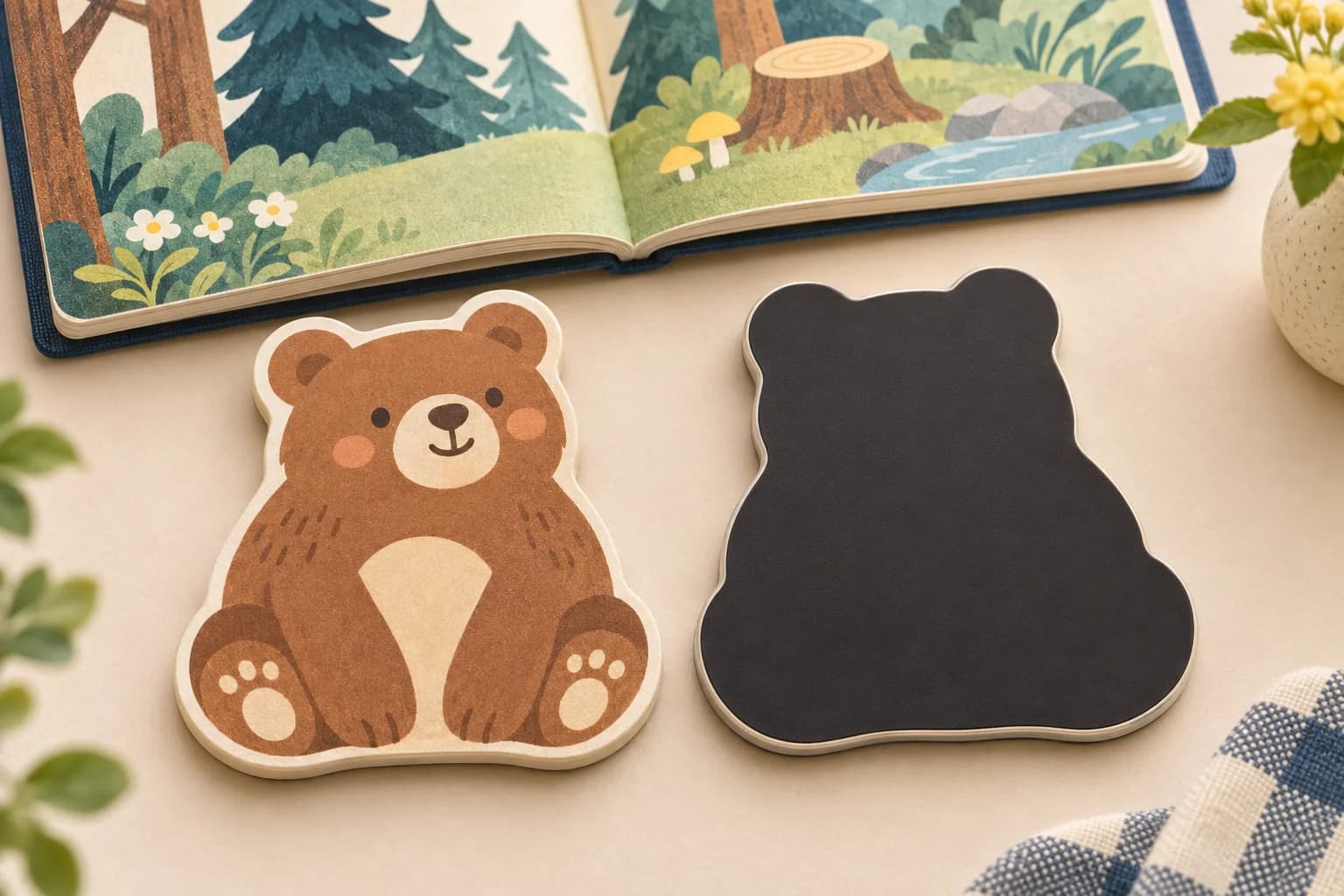
Start with the whole outline
Prefer broad, uncomplicated shapes over narrow necks, thin limbs and fragile projections. Review actual-size pieces and parts that could detach. One width, a rounded corner or a larger drawing cannot establish that a piece will stay outside an applicable small-parts gauge.
Treat bonding as a safety feature
Specify the face, backing and edge bond as one construction. Where flexible magnetic sheet is selected, it still requires assessment; it is not automatically safe because it contains no separate disc. Check peeling, tearing and separation that could expose or release magnetic material.
Check after foreseeable handling
Assessment must consider the product as supplied and what can become accessible after applicable use-and-abuse tests. Have a qualified test laboratory define the relevant small-parts, magnet and material checks for the actual age group, construction and destination.
| Review item | Information to define | What to verify |
|---|---|---|
| Whole pieces and released parts | Actual outlines, thicknesses, inventory and possible breakaway features. | Evaluate the finished parts in the applicable assessment, including parts liberated during testing; do not use one nominal dimension as a universal pass rule. |
| Magnetic components | Magnet type, grade, geometry, accessibility and layer arrangement. | Assess small-part size and magnetic properties together where required. Holding feel on the book is not a measurement of the applicable magnet-safety criteria. |
| Face and backing retention | Substrates, adhesive, edge treatment and intended handling conditions. | Check the actual laminated pieces after the specified conditioning and mechanical tests; a raw-sheet sample does not represent the finished bond. |
| Age, market and release records | Product classification, intended audience, destination and final bill of materials. | Link the applicable assessment, reports and required labeling to the approved specification. Material or component substitutions need review before release. |
A magnetic activity set should not be assumed exempt simply because it is sold as a book. Confirm its classification and applicable requirements. Supplier datasheets, rounded outlines, warning labels and a photograph do not by themselves establish finished-product compliance.
Choose the activity before multiplying the pieces
Scene-building stories
Use a printed setting with movable characters and props. Give the scene enough open space for different arrangements, and make the loose-piece inventory understandable without turning every background detail into a separate part.
Matching and sequence activities
Pair picture pieces with prompt cards, categories or a planned sequence. Check the scale of the targets and the space needed to pick up the pieces; printing smaller is not always a useful way to add more content.
Portable activity sets
Design storage at the same time as the play surface. A pocket, retained sheet or tray changes packed thickness and how easily the set can be checked and put away. Test the loaded configuration rather than an empty cover.
Solve the risk before production
Prevent sliding, lifting edges and incomplete sets
The critical finished-product check
Check magnetic holding and easy removal together. A piece that slips on an upright scene is difficult to use, but stronger attraction alone is not a complete solution. The selected backing, receptive layer, printed facing, piece shape and surface contact all affect the result. Evaluate the finished set in its intended play position rather than specifying a magnet grade in isolation.
Pieces slide during play
Why it happens: The chosen backing and target are poorly matched, or the finished surface stack and contact area differ from the raw material sample.
Fix and check: Test the actual printed assembly in its intended position, compare the smallest and largest pieces, and adjust the matched materials rather than quoting thickness alone.
The printed face lifts at an edge
Why it happens: A narrow cut feature or poorly bonded edge is repeatedly gripped during removal.
Fix and check: Review the outline, lamination and cutting condition. Check each sample shape after repeated handling, especially narrow parts and high-use grip edges.
A finished set has missing or mixed pieces
Why it happens: Several similar designs or language versions are collated without a clear component list and set boundary.
Fix and check: Use stable piece IDs, a per-set inventory and version-specific packing labels. Verify the loaded set before sealing; carton quantity alone cannot confirm its contents.
When to choose another format
Magnetic play, stickers or attached flaps?
| Alternative | Use and trade-off |
|---|---|
| Sticker Book Printing | Choose an adhesive sticker book when the activity is based on sticking pictures to pages. Specify repositionability separately; magnetic pieces use a matched target rather than relying on the page adhesive. |
| Lift-the-Flap Book Printing | Choose lift flaps when the interaction should stay attached to the book and reveal a hidden picture. Magnetic play offers rearrangement but introduces a loose-piece inventory and storage. |
| Board Book Printing | Choose a plain board book when the story works through page turns alone. It removes magnetic matching and loose-piece collation, but does not offer movable scene building. |
Sample and approval
Test the finished set, not a bare magnet
Free samples are available, with preparation completed within 15 days. Confirm the sample scope; courier arrangements and transit time are separate.
Structural sample
Checks dimensions, fit and assembly using unprinted or representative materials. It does not establish final color.
Printed proof
Checks text, image reproduction and artwork on the agreed proof medium. It may not reproduce final assembly or every finish.
Complete finished sample
Review an actual-size structural sample, then a printed and assembled complete set. Check holding and removal across the scene, surface wear, cut edges, bonding, folding and loaded storage. Record the agreed test conditions and compare every packed set component with the approved inventory.
From brief to delivery
Specify one complete magnetic activity set
Develop and approve the complete activity set
Define the activity
Provide the intended audience and market, scene plan, closed and open sizes, piece inventory and quantities per design and language.
Develop the matched materials
Select the board, receptive surface, magnetic-backed pieces and print finish as one construction. Resolve storage with the full inventory present.
Approve the complete reference
Check the printed sample, component count, play behavior, assembly and packing. Record the approved artwork revision, materials and required assessment.
Release and deliver
Agree the finished-set specification, inspection records, packing labels, destination and schedule. Keep development, sample approval, manufacture and freight as separate milestones.
Count, contain and protect every set
Count each set against its component list and contain the loose pieces so they cannot migrate into another set. Protect printed surfaces and panel edges, label design and language versions, and agree carton counts, weights and moisture protection for the shipment.
- Give each movable piece a stable ID and provide its vector cut outline, print face and reverse requirement. Keep backgrounds extended to the agreed bleed boundary and important details within the approved safe area.
- Supply separate play-scene artwork and any prompt cards. Map which pieces belong to each activity and identify duplicates intentionally included in the set; do not rely on a composite mockup to define the inventory.
- Include the panel fold or hinge positions, receptive coverage and pocket or tray drawing in the assembly specification. Keep required information and small matching targets clear of folds and storage obstructions.
Project questions
Planning Magnetic Book Printing
Is this a magnetic-closure book or a magnetic activity book?
This page describes an activity book with removable magnetic picture pieces and a receptive play surface. A magnetic closure only keeps a cover or box shut; it does not make the pages suitable for magnetic play. Specify the play format and any closure separately.
Can I select the pieces by magnetic-sheet thickness alone?
No. Thickness is one material input. Piece size, magnetization, the receptive layer, surface flatness and the printed facing also affect holding and removal. Evaluate an assembled sample in the intended play position, using both the smallest and largest pieces in the inventory.
How should quantities be stated for pricing?
Quote complete sets per design and language, then list the contents of one set. Separate the book or board, every unique and repeated magnetic piece, prompt cards and storage. Extra pieces or versions change cutting, collation and packing work even when the book size stays the same.
Can a material datasheet establish age suitability for the finished book?
No. Age suitability and the required assessment depend on the finished parts, how they are retained, foreseeable use and the sales market. Identify those conditions during development and arrange applicable testing for the complete construction. A flexible backing, rounded outline or supplier datasheet does not by itself establish compliance.
What should be checked on a development sample?
Review the actual-size scene, every piece, holding and easy removal, print rubbing, laminate bonding, hinge movement and the packed set. Count against the component list, close and reopen the book with everything stored, and record the agreed acceptance checks before releasing production.
Specify the finished product.
Send finished-set quantity per design and language, intended reader age and sales markets, closed book size, open play area, panel or page count and a complete piece inventory. Include piece outlines, example cards, storage preference, destination and required arrival date. Identify any dry-erase requirement separately.